-
-
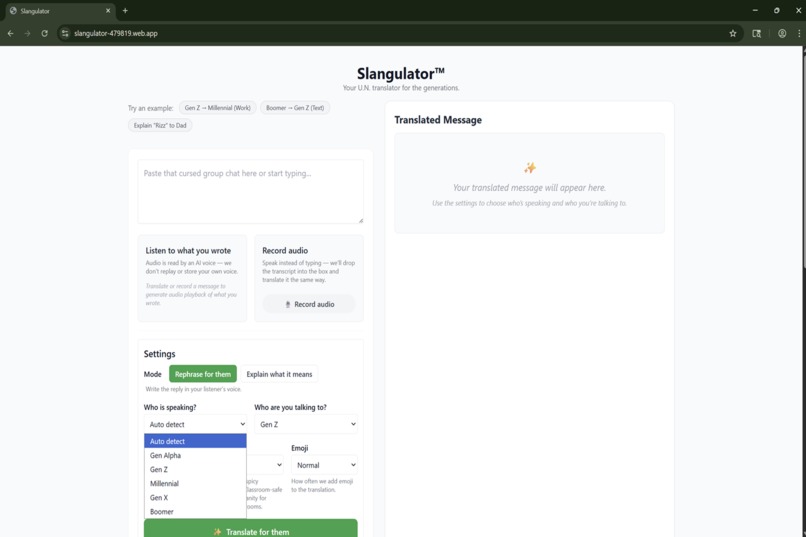
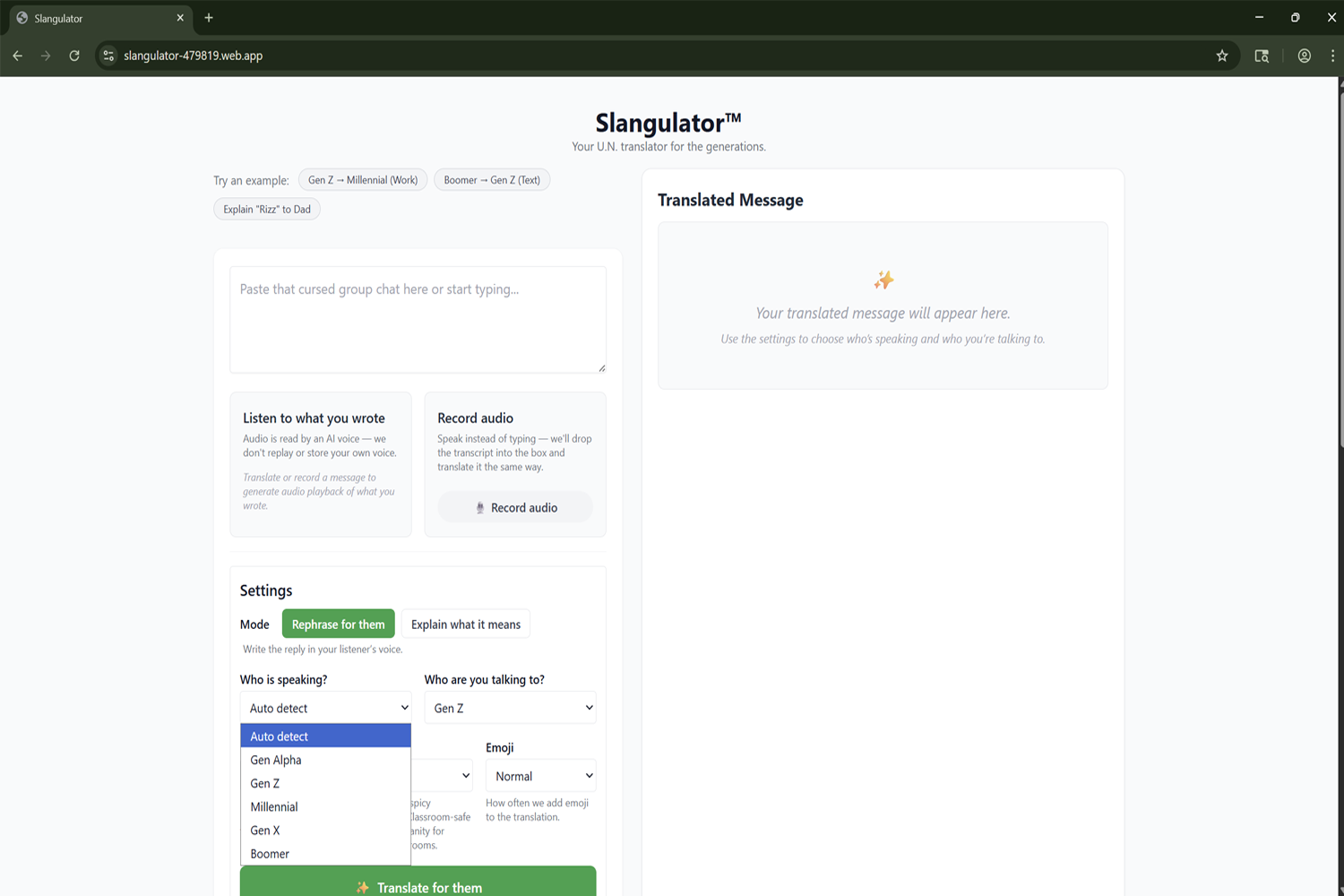
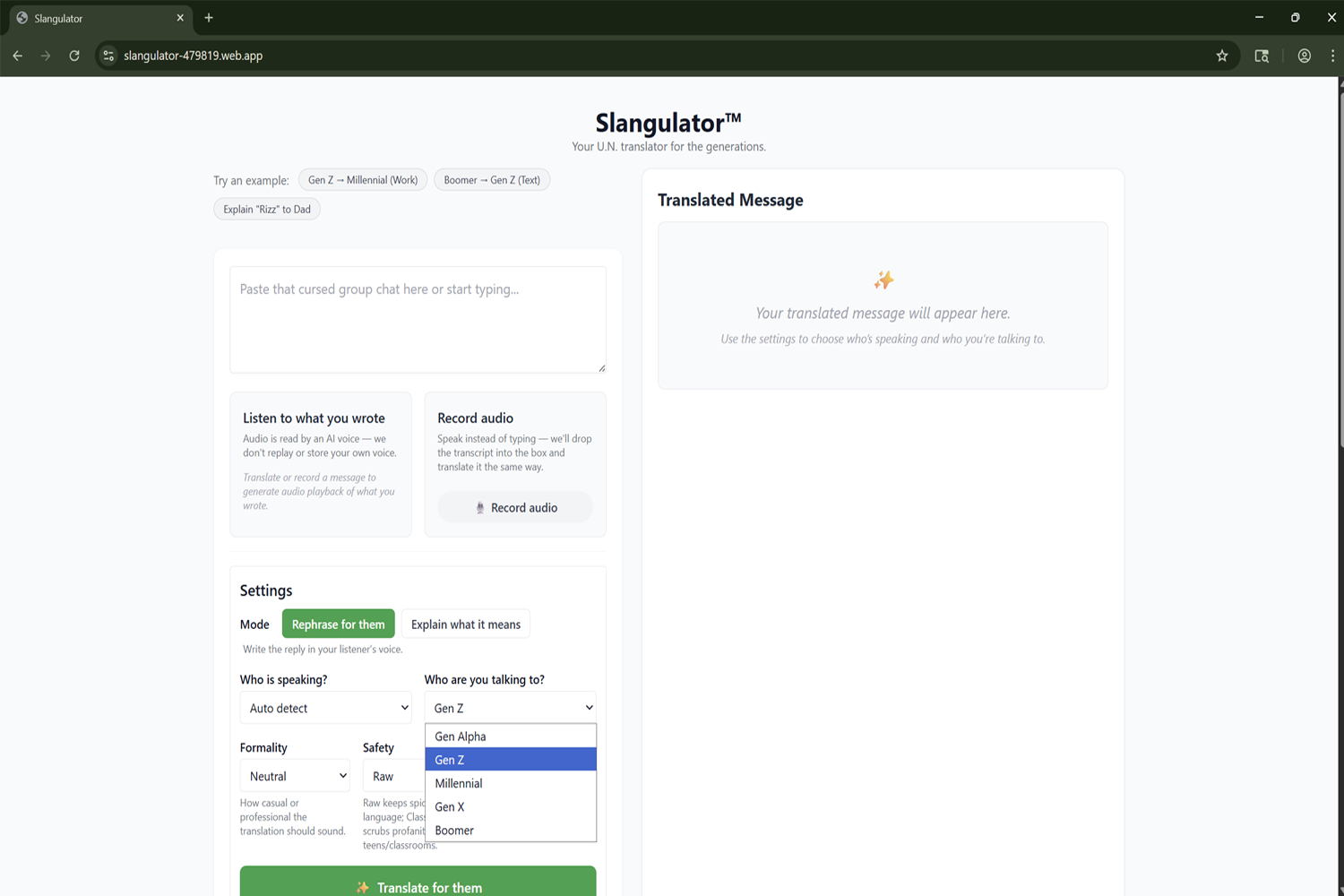
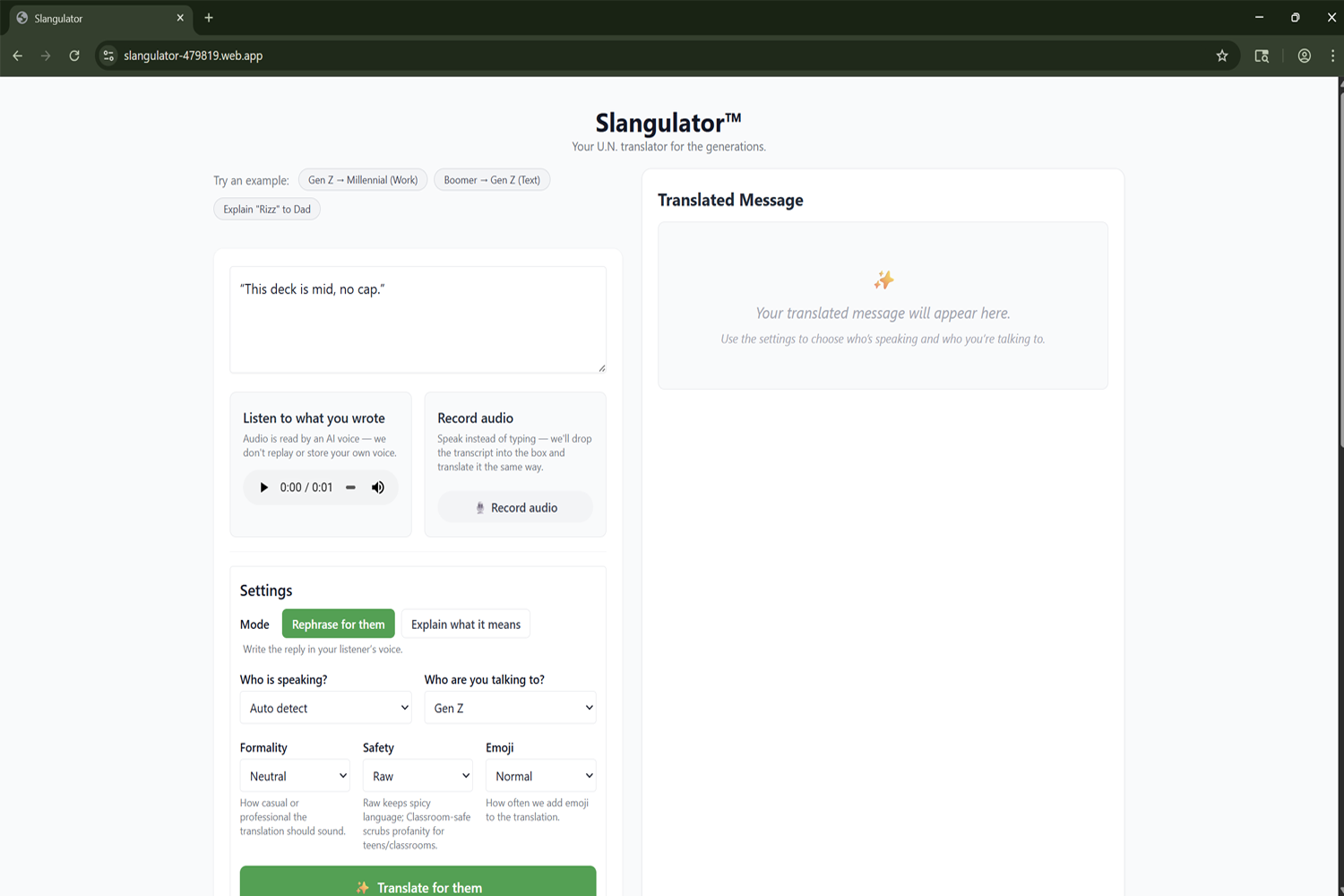
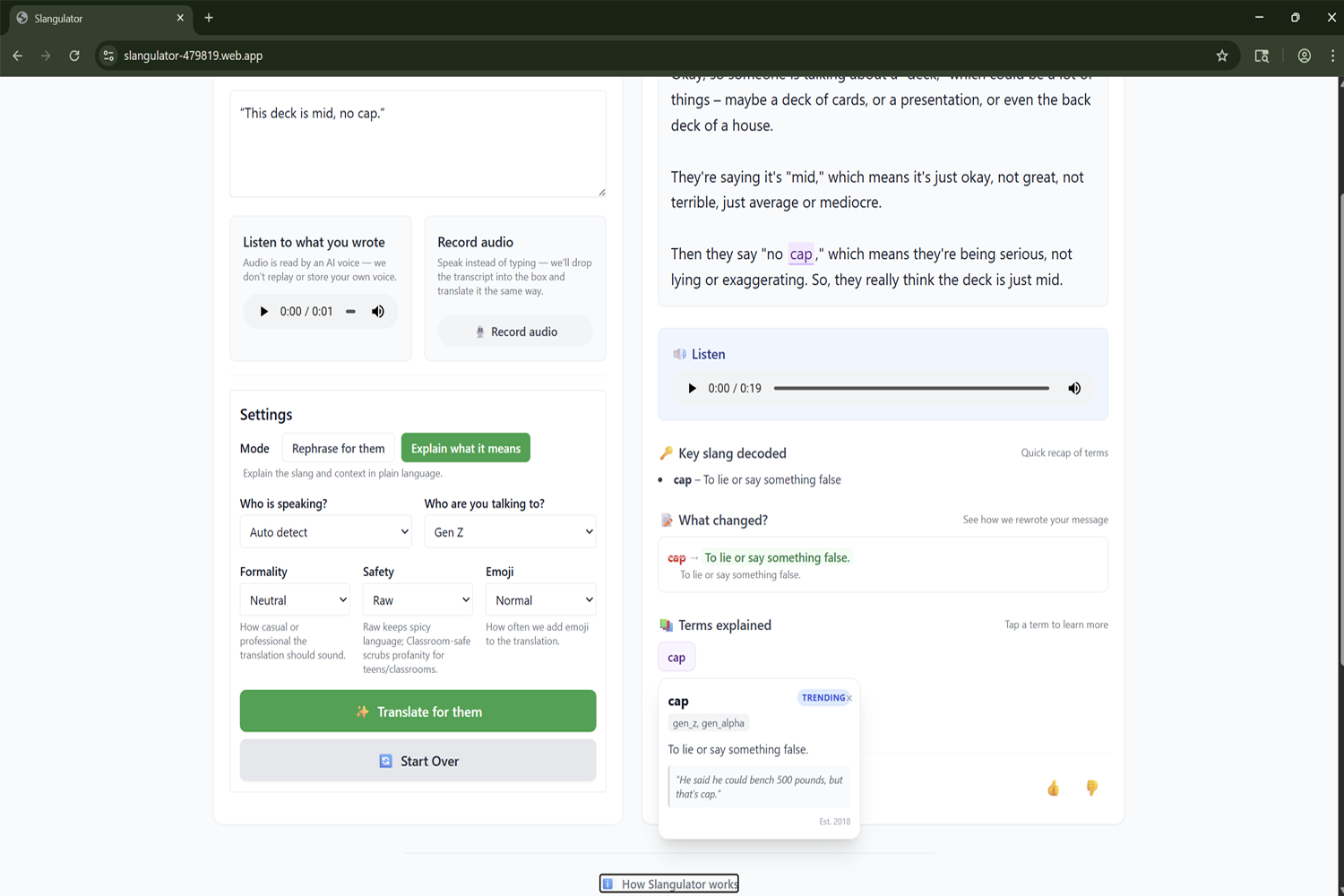
Choose "Who is speaking" from the dropdown menu or leave as Auto Detect by default.
-
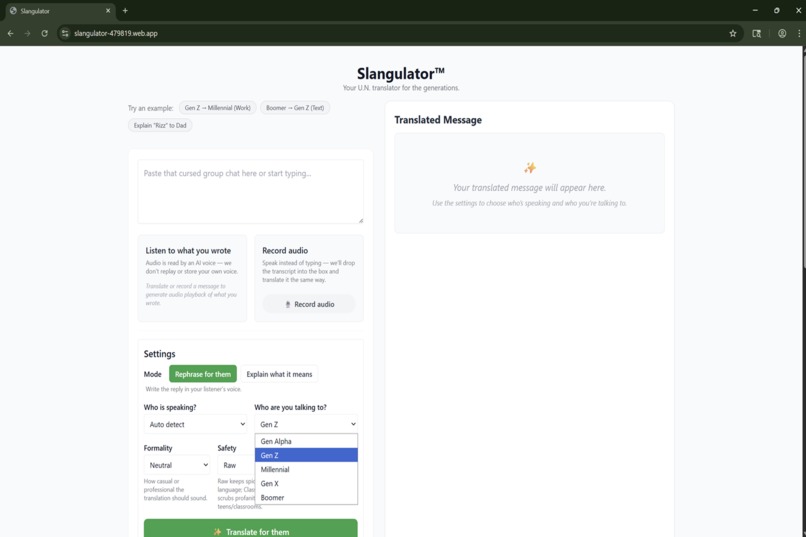
Choose "Who you are talking to" from the dropdown menu.
-
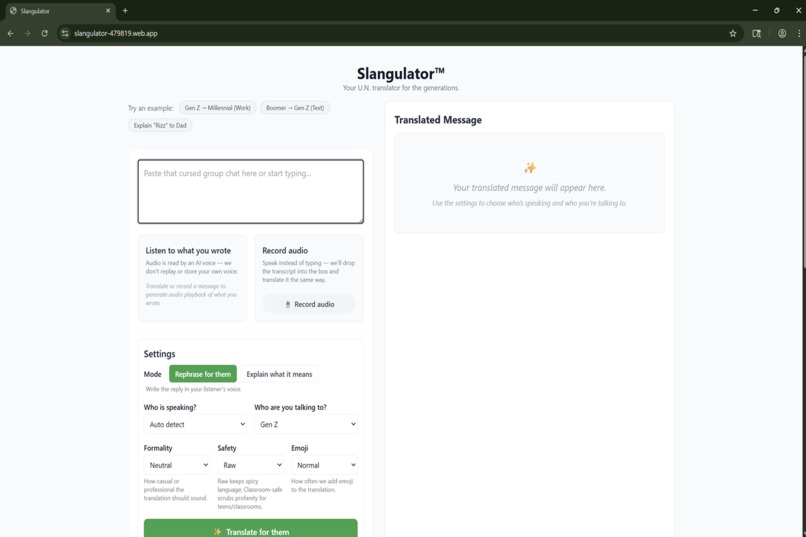
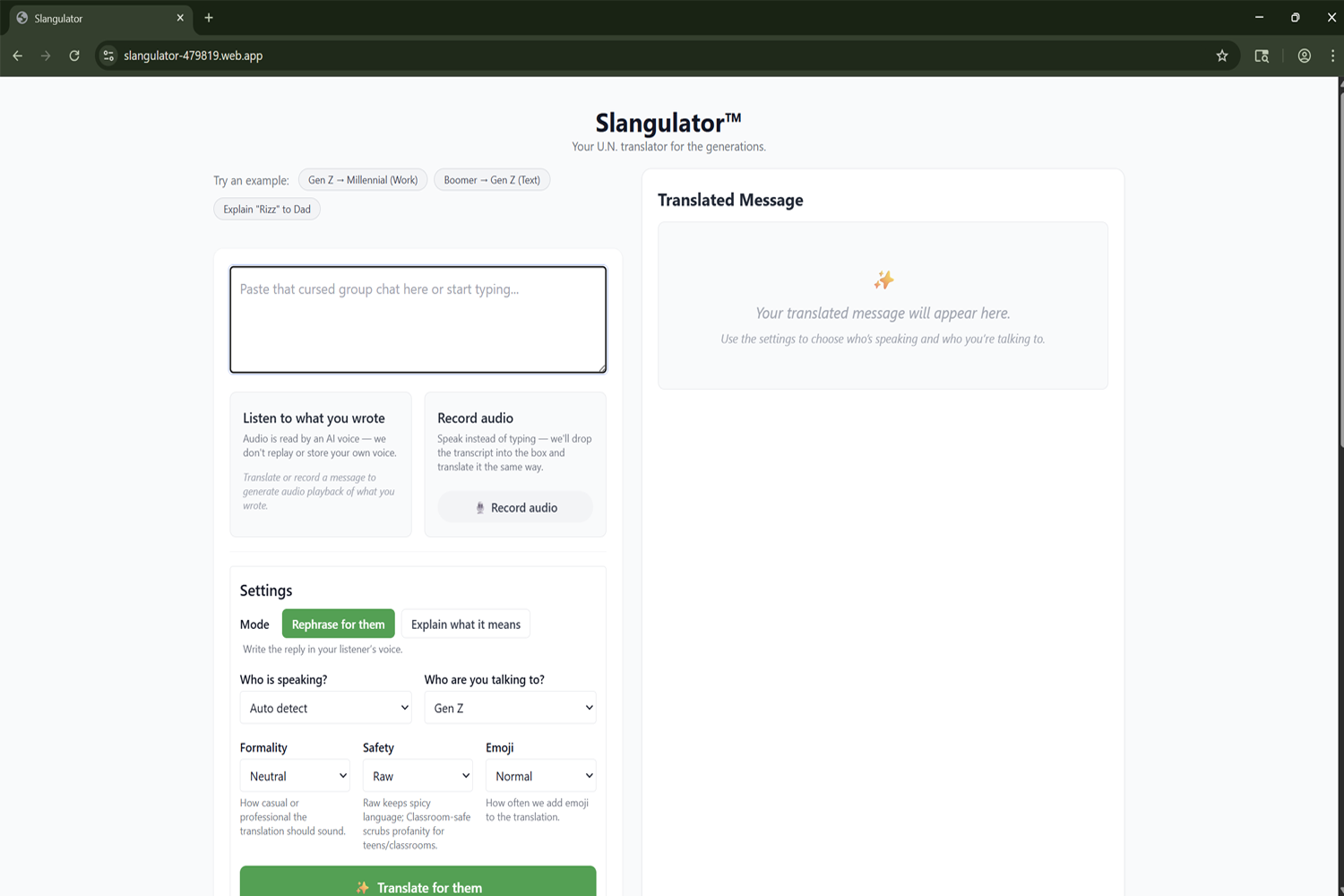
Enter text or record the input message. Slangulator does not store your voice.
-
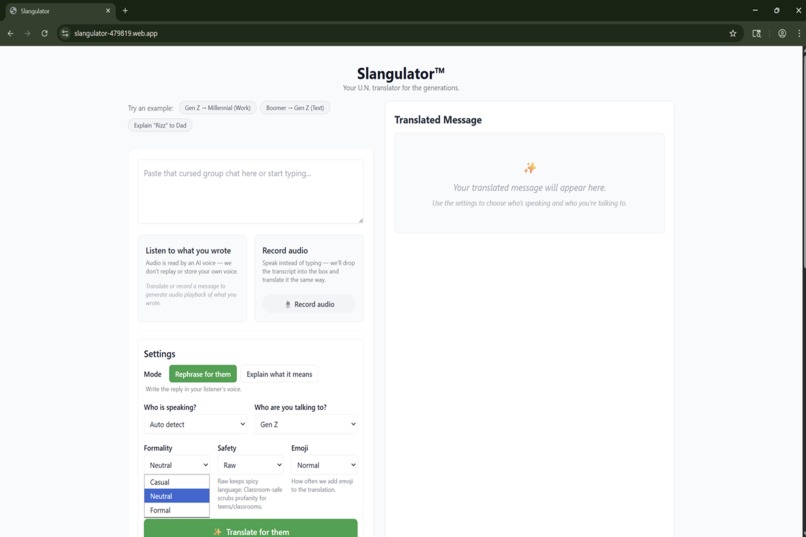
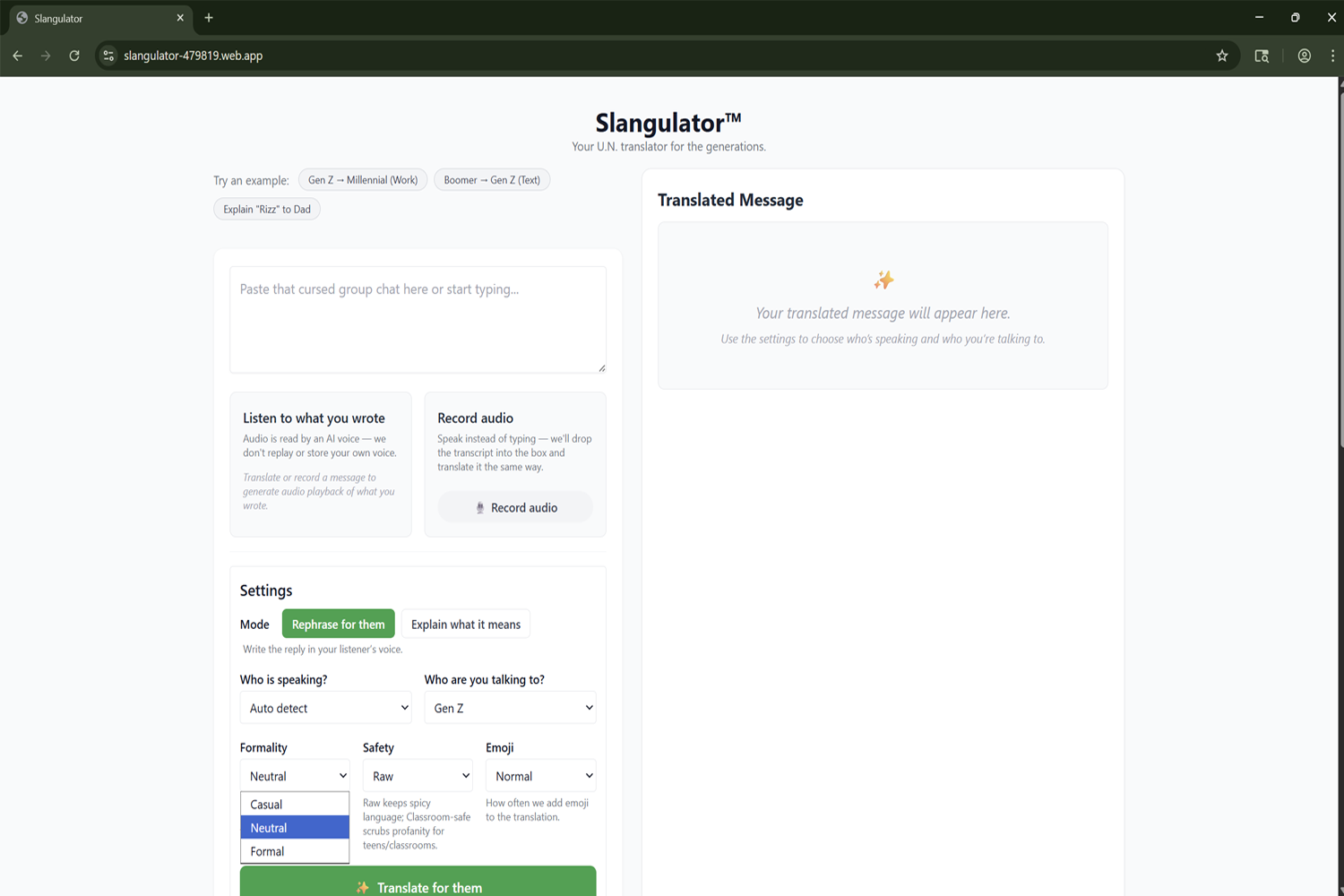
Choose Formality from the dropdown menu.
-
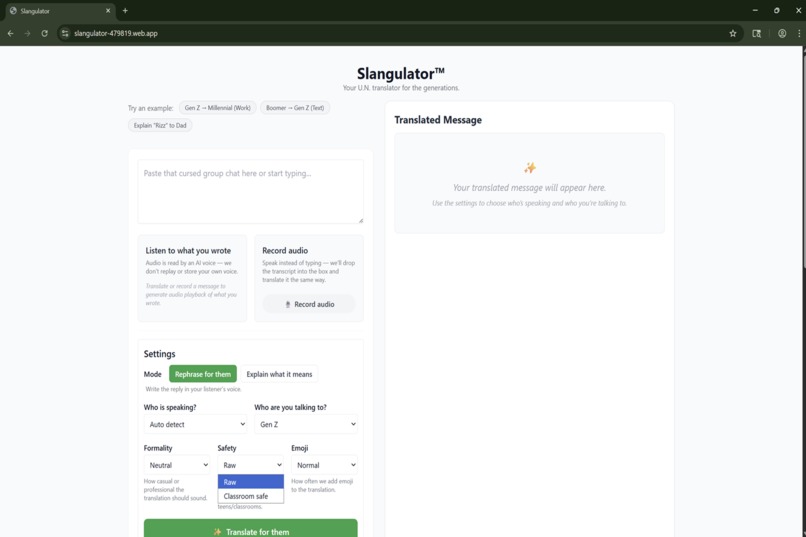
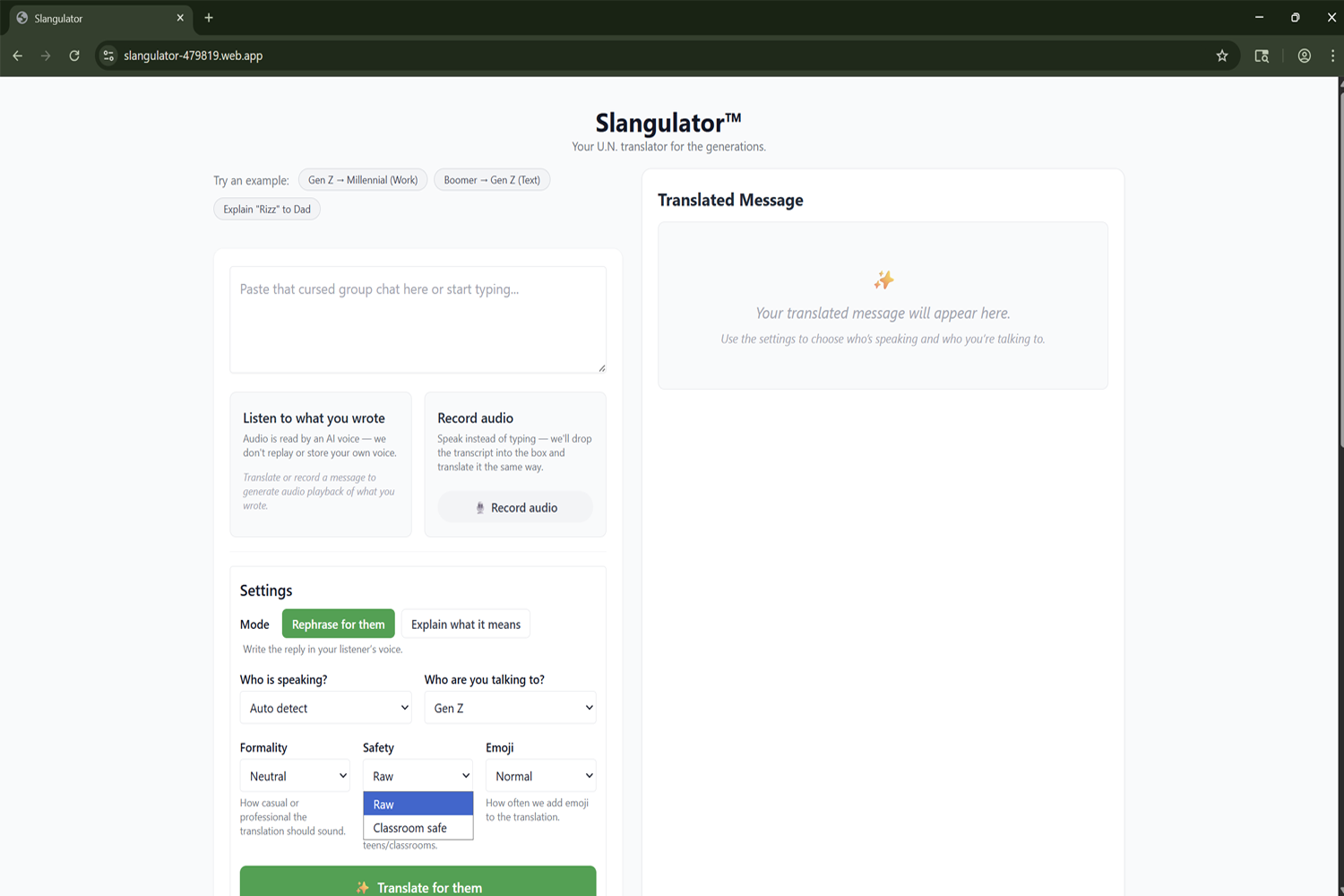
Choose Safety Level from the dropdown menu.
-
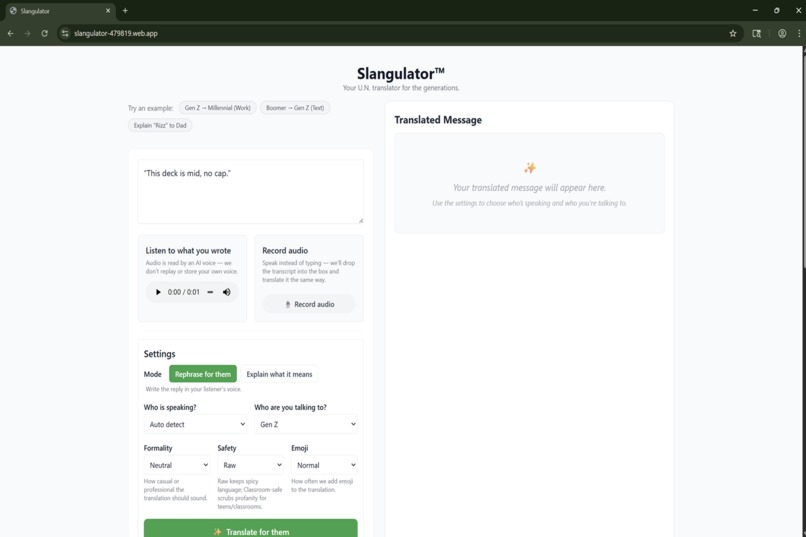
Listen to what you wrote. If you recorded the input, Slangulator uses an AI voice for playback.
-
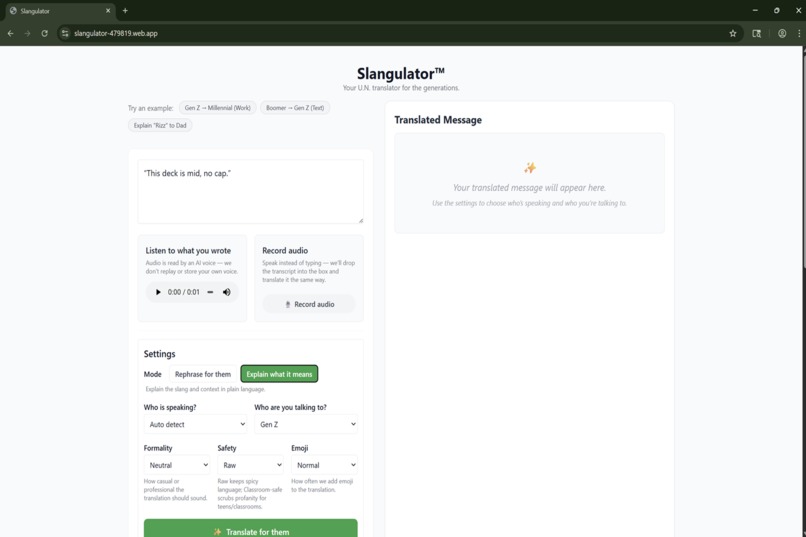
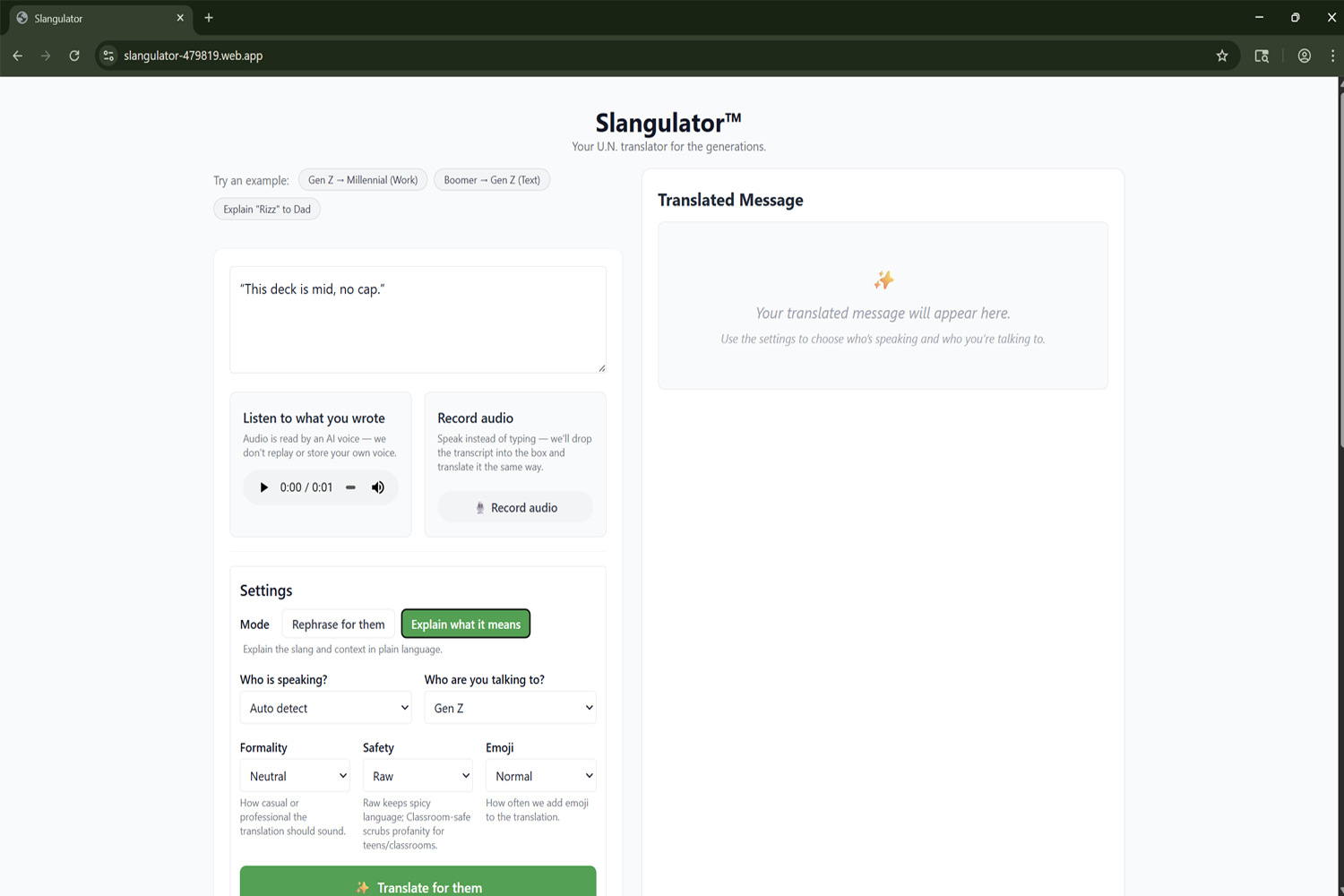
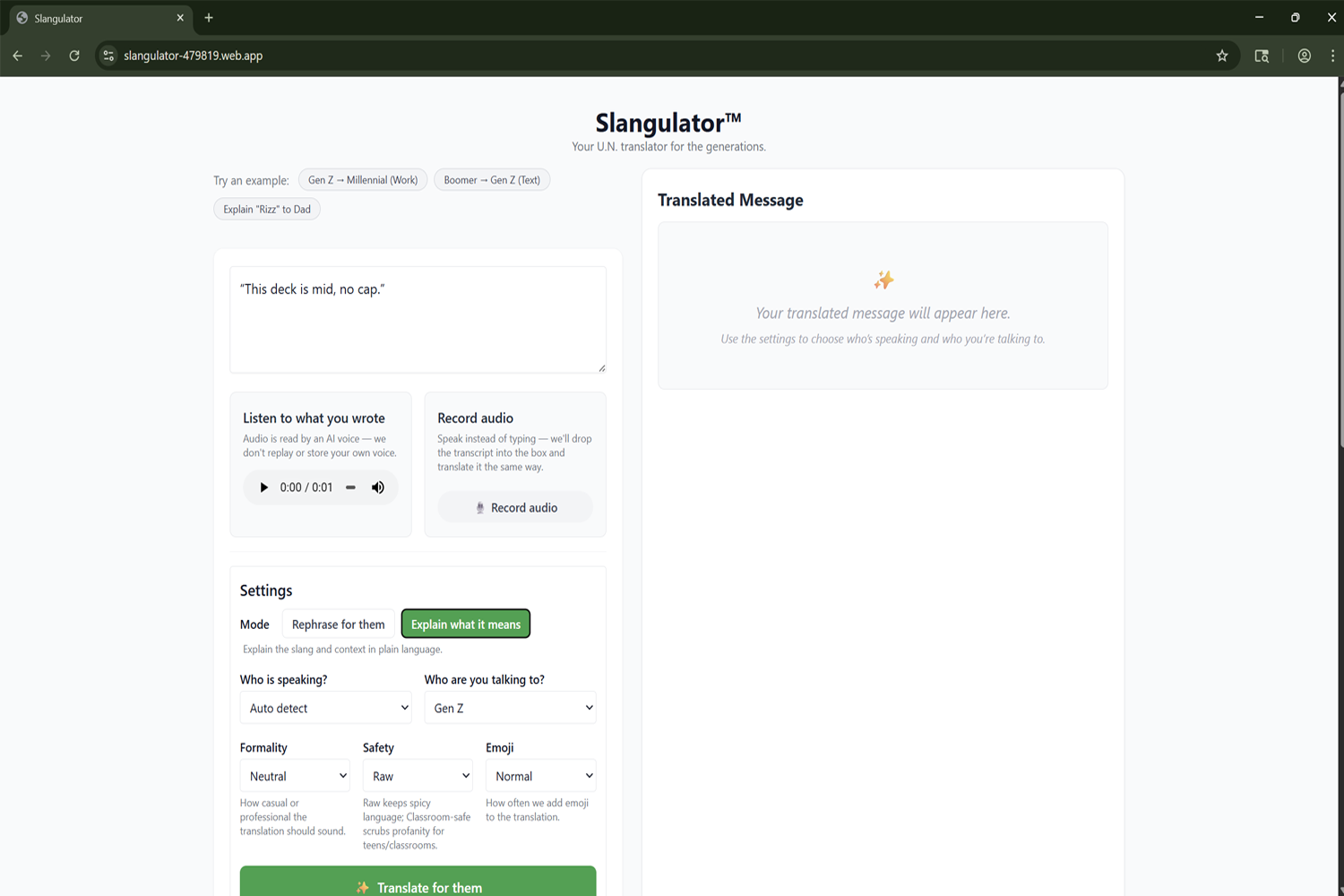
Choose your Slangulator mode: 'Rephrase for them' or 'Explain what it means'.
-
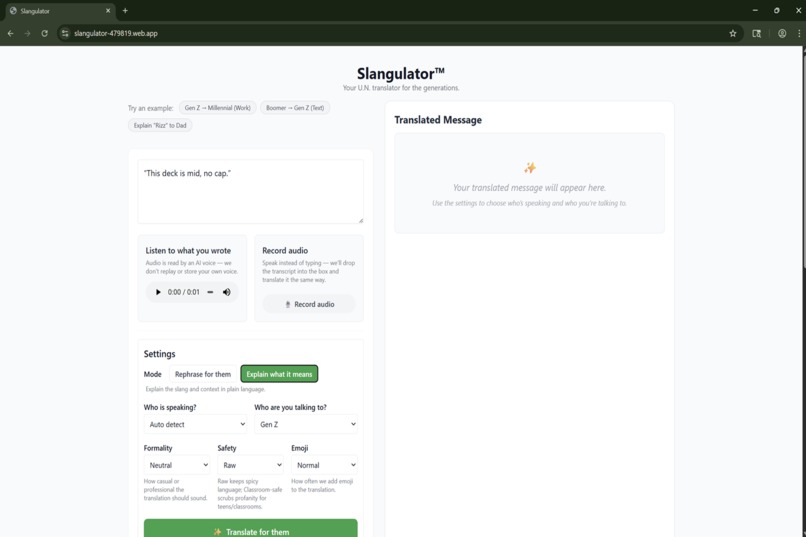
Click the 'Translate for them' button.
-
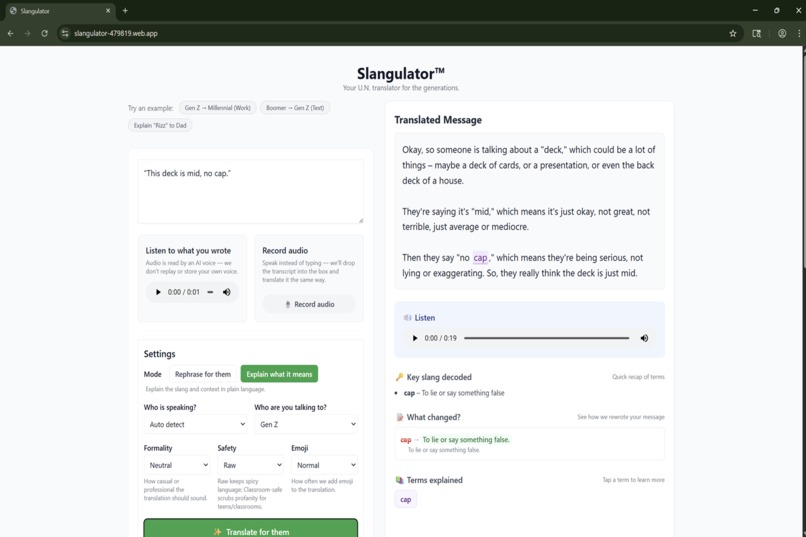
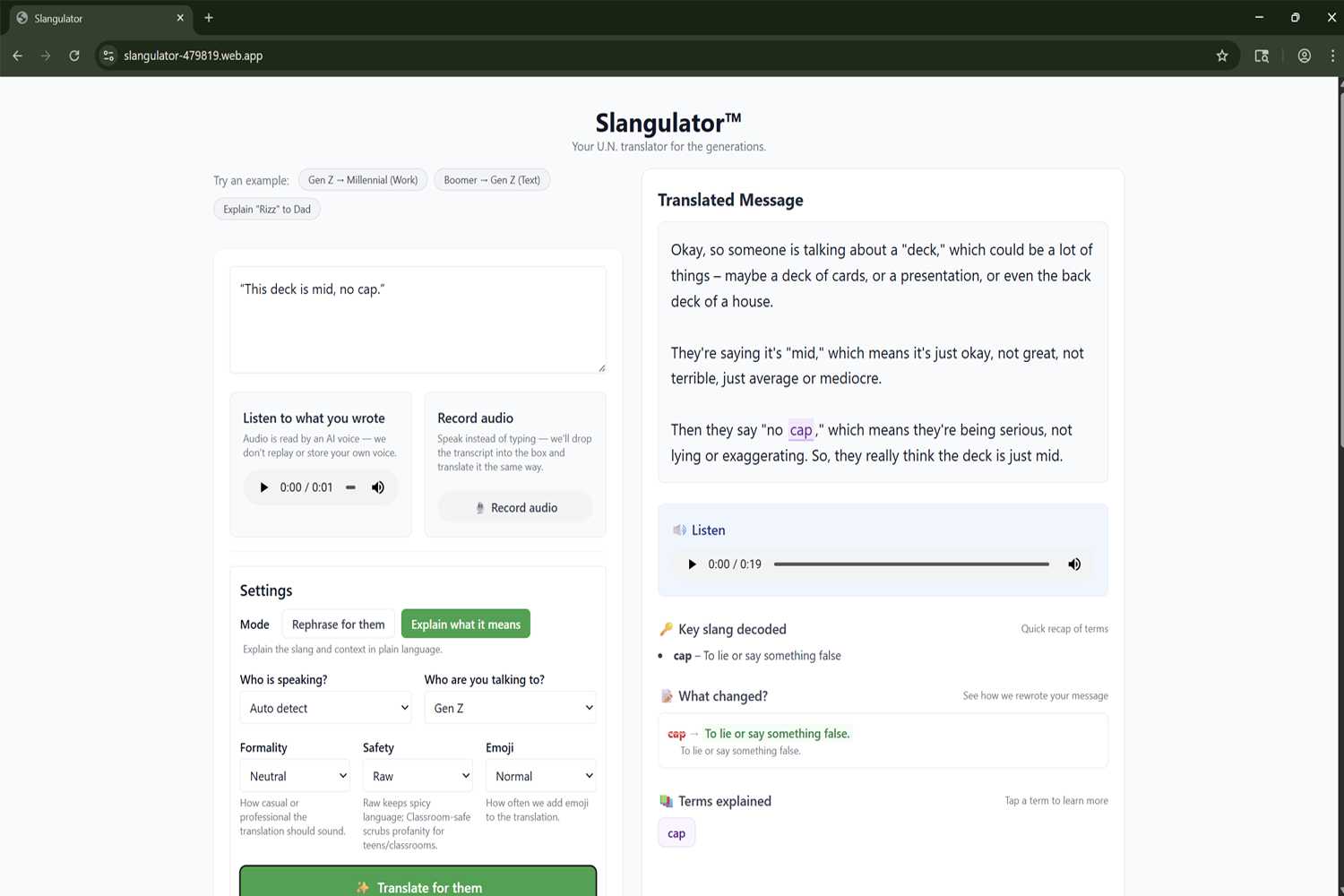
Read or play the translated message.
-
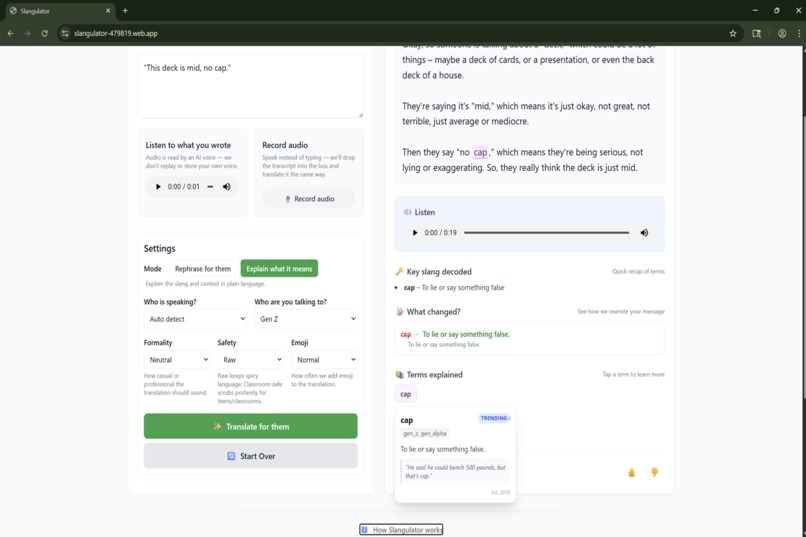
Click 'terms explained' button for definition for each term.
-
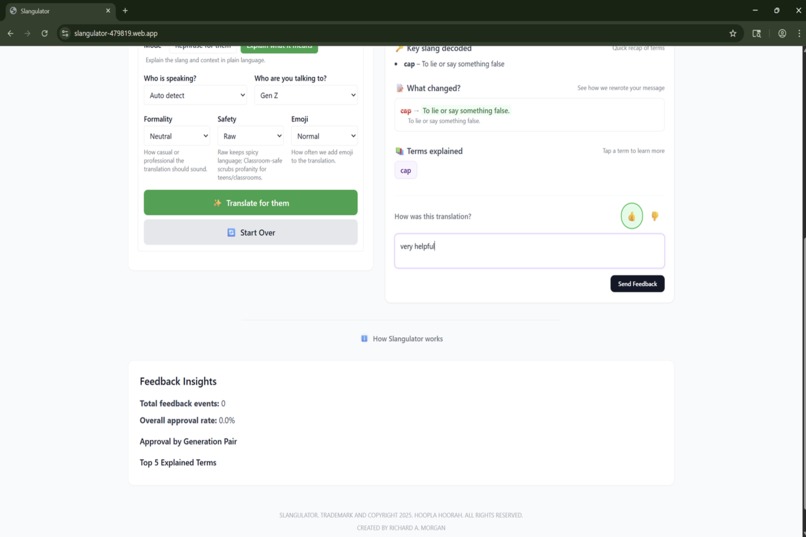
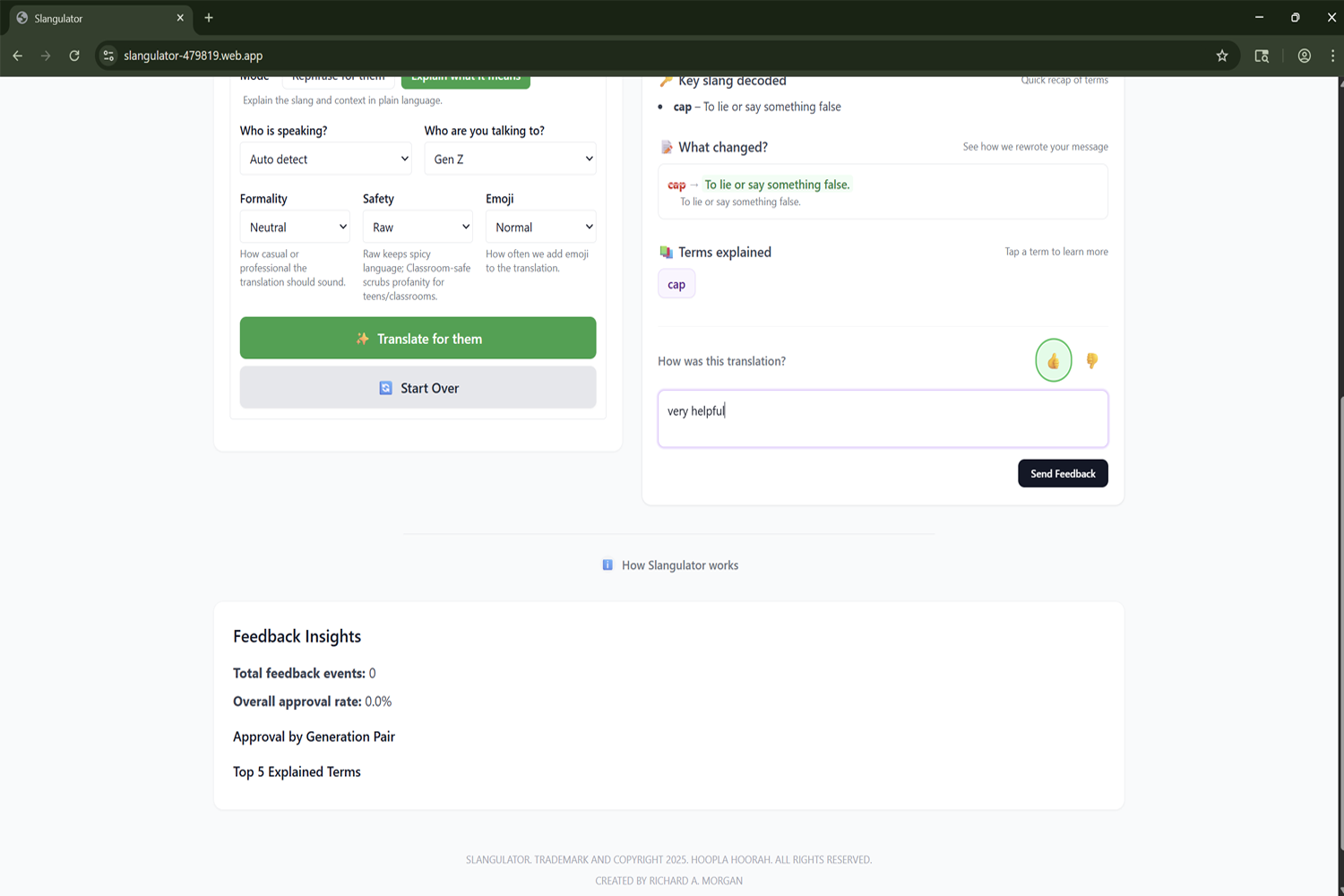
Give anonymous and aggregated feedback to improve Slangulator and update the Feedback Insight dashboard.
Inspiration
Modern slang evolves rapidly across generations, regions and cultures. This creates gaps in understanding between family members, teachers and students, brands and communities. We wanted to build a tool that bridges those gaps and helps people "talk across time" without shaming or appropriation.
What it does
Slangulator is an AI‑powered translator for slang and vernacular. Paste a message or speak into the app and it:
- Detects slang terms and highlights them.
- Provides plain‑language definitions with context notes (trend charts, whether a term is current or cringe).
- Rephrases the entire message for a target demographic, adjusting for age, region, formality and safety. You can "dial in" the target audience via sliders.
- Disambiguates terms with multiple senses and shows alternatives.
- Reads the translated message aloud using an appropriate voice.
How we built it
The web app consists of a React/Vite frontend and a Node.js/Express API written in TypeScript. A curated slang lexicon is stored in a vector database and indexed by age, region and sentiment. When a user submits text, the backend:
- Runs a slang detector and demographic/tone classifiers.
- Retrieves candidate senses from the lexicon via a retrieval‑augmented generation (RAG) pipeline.
- Uses Google Cloud Vertex AI to select the best meaning and rewrite the message for the target audience.
- Generates audio output through ElevenLabs text‑to‑speech.
Translations and feedback are stored in Firebase Firestore for analytics. We added Datadog monitoring and BigQuery export for deeper insights. The app deploys on Cloud Run and serves the static frontend via Firebase Hosting.
Challenges we ran into
- Designing a UI that feels playful yet powerful while supporting both text and voice input.
- Ensuring that audio recordings reset correctly between sessions and that stale translations do not leak.
- Building the slang lexicon with appropriate metadata and ensuring respectful handling of sociolects like AAVE.
- Balancing tone preservation with safety filters and multiple sense disambiguation.
Accomplishments
We delivered a working proof‑of‑concept that translates slang across generations in real time. The cross‑demo rephrase slider feels intuitive, and the glossary definitions help parents, teachers and brands understand modern vernacular without judgment. Integrating Vertex AI and ElevenLabs gave us high‑quality language and voice output.
What we learned
We learned how to engineer AI prompts for demographic translation, how to build retrieval‑augmented pipelines around small custom lexicons, and how to design UI/UX for both text and voice. We also learned the importance of ethical guidelines when handling community‑linked slang.
What's next
- Expand the slang knowledge base and add more demographic/region options.
- Train classifiers on a larger, licensed dataset and incorporate user voting to keep terms fresh.
- Release browser extensions and messaging plugins for iMessage, Discord and WhatsApp.
- Build an educator kit with printable glossaries and quiz modes.
- Allow API access so moderation tools or CMS can annotate user‑generated content.
Built With
- bigquery
- datadog
- elevenlabs
- express.js
- firebase-firestore
- google-cloud-vertex-ai
- node.js
- react
- typescript
- vite

Log in or sign up for Devpost to join the conversation.