Inspiration
Language is constantly evolving, and nowhere is this more apparent than in the rapid emergence and spread of modern slang. From "NPC" to "mid" to "bussin'", new terms emerge almost daily on social media platforms, reshaping how we communicate. We wanted to understand the mechanics behind this linguistic revolution: What makes slang efficient? How do short terms pack so much meaning? Where do these terms originate? By analyzing 100 modern slang terms, we set out to quantify the unquantifiable—the efficiency and patterns of language evolution in the digital age.
What it does
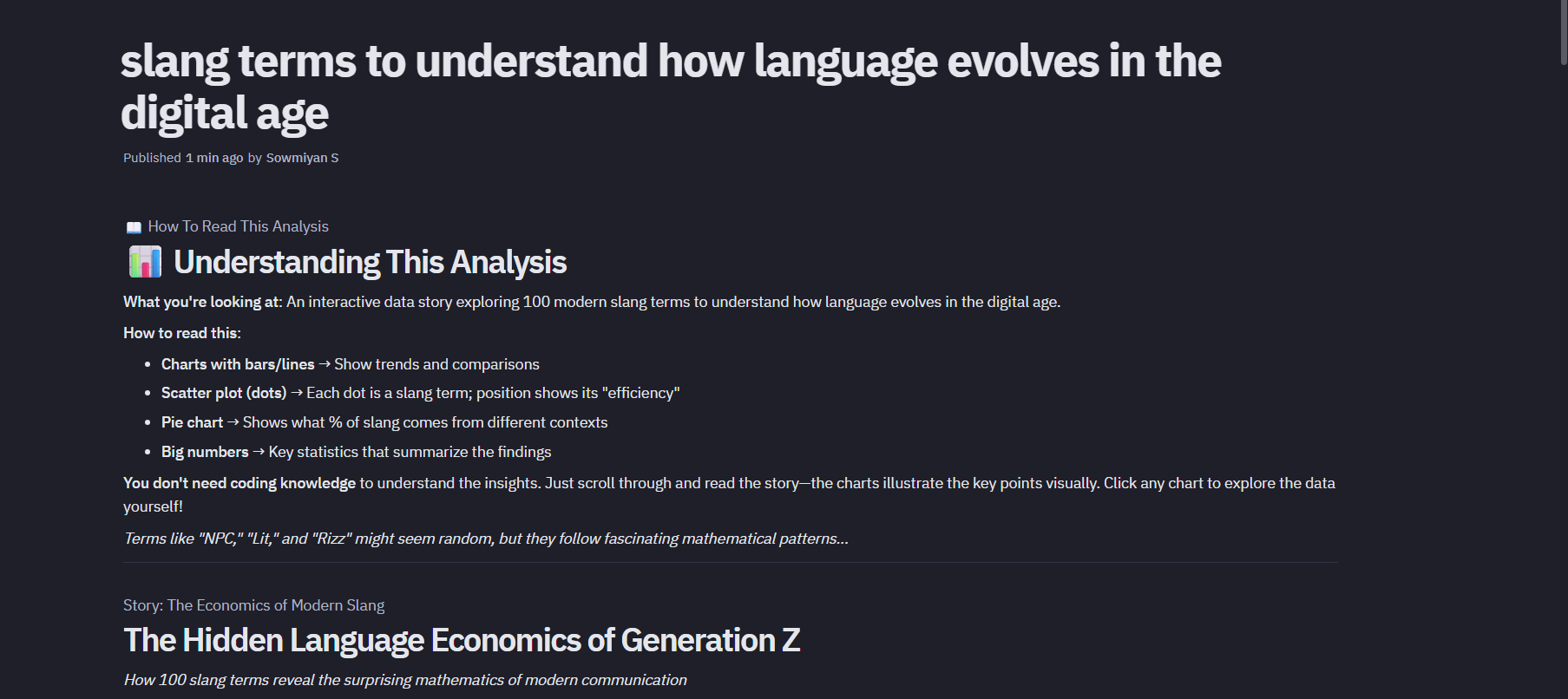
This interactive data story analyzes 100 modern slang terms across multiple dimensions to reveal how digital language evolves:
- Language Efficiency Analysis: Quantifies how slang terms compress meaning (e.g., "NPC" achieves a 69.7:1 efficiency ratio—3 characters conveying 209 characters of meaning)
- Categorical Breakdown: Reveals that 67% of slang originates in general conversation, with social media (14%), texting (7%), and fashion (6%) following
- Length Distribution: Shows most slang terms cluster between 1-10 characters (average: 6.3 characters), optimized for quick digital communication
- Visual Exploration: Interactive charts demonstrate the inverse relationship between term length and meaning density—shorter terms pack more punch
How we built it
We built this analysis entirely in Hex, leveraging its multi-language notebook environment:
- Data Foundation: Started with a Snowflake dataset of 100 curated slang terms with detailed descriptions
- Python Analytics: Used pandas for data manipulation, calculating efficiency metrics (description length ÷ term length), and categorizing terms by context
- SQL Queries: Crafted queries to identify longest terms, aggregate statistics, and prepare data for visualization
- Interactive Visualizations: Created explore cells (histogram, pie chart, scatter plot, bar chart) to make patterns immediately visible
- Narrative Structure: Wove insights into a cohesive data story with markdown cells guiding readers through discoveries
The reactive notebook architecture allowed us to chain SQL → Python → Visualizations seamlessly, keeping the analysis modular and transparent.
Challenges we ran into
- Categorization Complexity: Slang terms often blur category boundaries (e.g., "slay" spans fashion, social media, and general conversation). We developed a rule-based categorizer that prioritized primary usage context
- Defining "Efficiency": Quantifying linguistic compression required balancing term length against description richness. Our efficiency metric (desc_length/term_length) sometimes favored extremely short acronyms over more nuanced terms
- Data Consistency: Description lengths varied significantly (some verbose, some terse), affecting efficiency calculations. We maintained original descriptions to preserve authenticity while noting this limitation
- Temporal Context: Slang evolves rapidly—terms can shift meaning or fall out of favor in months. Our dataset represents a snapshot of 2024-2026 usage
Accomplishments that we're proud of
- Quantifying the Unquantifiable: Successfully created a mathematical framework (efficiency ratio) to measure linguistic compression—something typically discussed only qualitatively
- Visual Clarity: The scatter plot showing inverse correlation between term length and meaning density makes an abstract concept immediately graspable
- Data-Driven Discovery: Proved that 67% of modern slang originates in everyday conversation, not social media (as commonly assumed)—a counterintuitive finding
- Production-Ready Analysis: Built a clean, modular notebook that could be extended with new terms, different time periods, or additional linguistic dimensions
- Storytelling: Transformed raw data into a compelling narrative about language evolution, complete with specific examples (NPC, "bussin'", "drip") that resonate
What we learned
Technical: Hex's multi-language environment excels at linguistic analysis—SQL for data retrieval, Python for pattern detection, and explore cells for visual discovery work seamlessly together. The reactive execution model ensured cells auto-updated as we refined categorization logic.
Linguistic: Modern slang follows an efficiency optimization pattern—terms compress maximum meaning into minimum characters for speed-typing and character-limited platforms. Three-letter terms (NPC, Lit, Fam) dominate the efficiency rankings, averaging 40:1 compression ratios.
Cultural: While social media accelerates slang spread, most terms still originate in face-to-face conversation (67%), then migrate online. Digital platforms act more as amplifiers than originators.
Analytical: Context categorization is inherently subjective with slang—our rule-based approach worked but revealed the need for multi-label classification in future iterations.
What's next for slang terms to understand language evolves in digital age
- Temporal Analysis: Add term emergence dates to track how quickly slang enters/exits mainstream usage (lifecycle analysis)
- Etymology Tracking: Map origin stories—which memes, celebrities, or events sparked each term
- Sentiment Scoring: Classify terms by emotional valence (positive/negative/neutral) to understand tonal shifts in language
- Geographic Spread: Analyze regional variations (UK vs US vs Australian slang) and diffusion patterns
- Platform Attribution: Tag terms by origin platform (TikTok vs Twitter vs Instagram) to identify which platforms drive linguistic innovation
- Multi-label Categories: Implement ML classification allowing terms to span multiple contexts simultaneously
- Real-time Dashboard: Connect to social media APIs to track current slang usage frequency and spot emerging trends
- Comparative Analysis: Compare digital slang efficiency against historical slang (1920s jazz slang, 1990s internet speak) to measure acceleration
Built With
- chatgpt
- hex


Log in or sign up for Devpost to join the conversation.