-
-
-
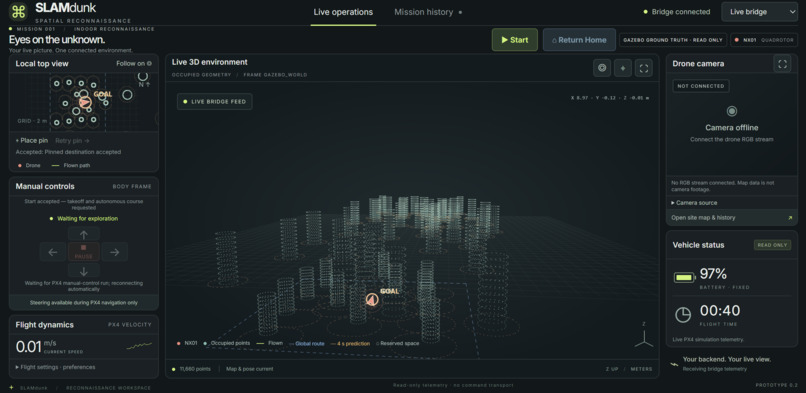
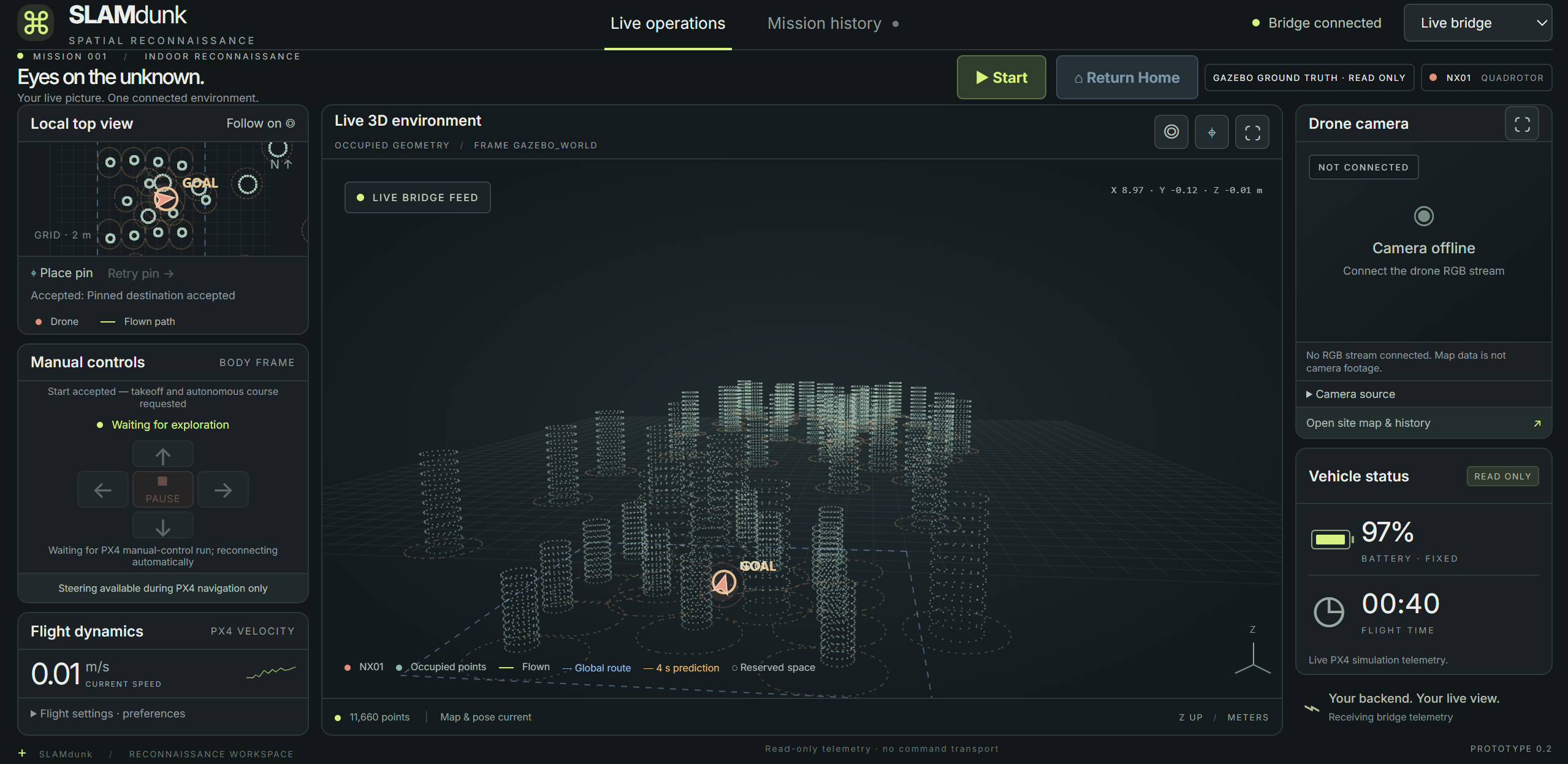
Visualization and Mapping UI
-
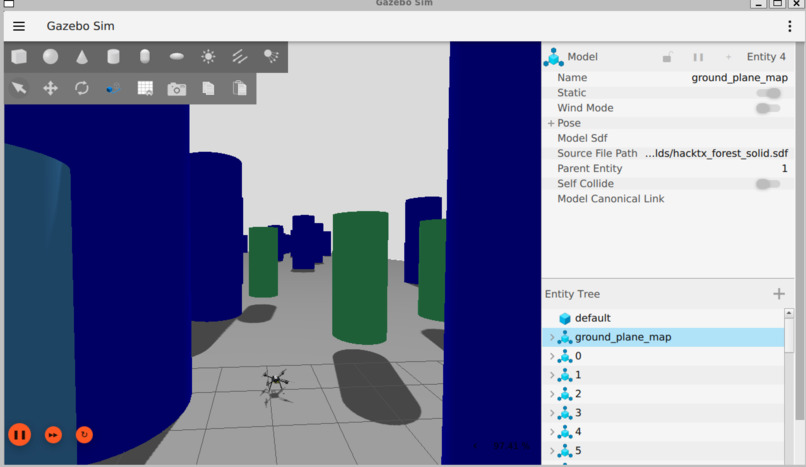
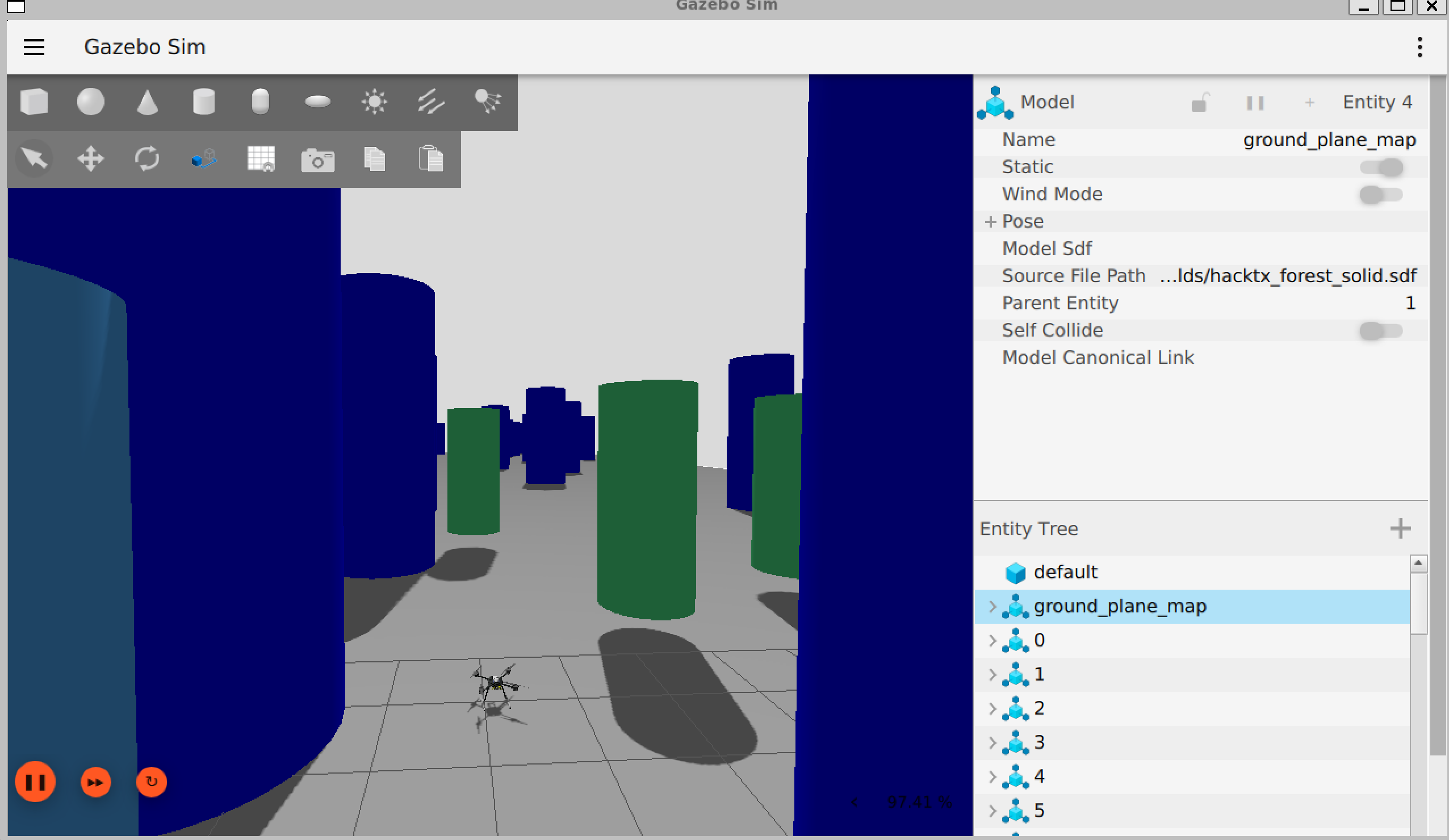
Gazebo Simulation
Inspiration
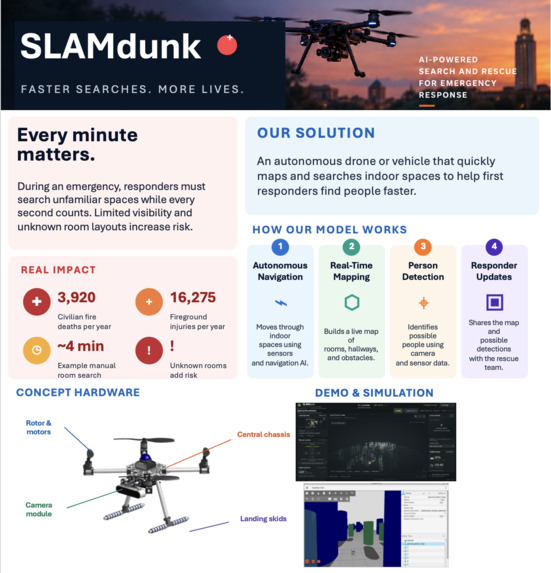
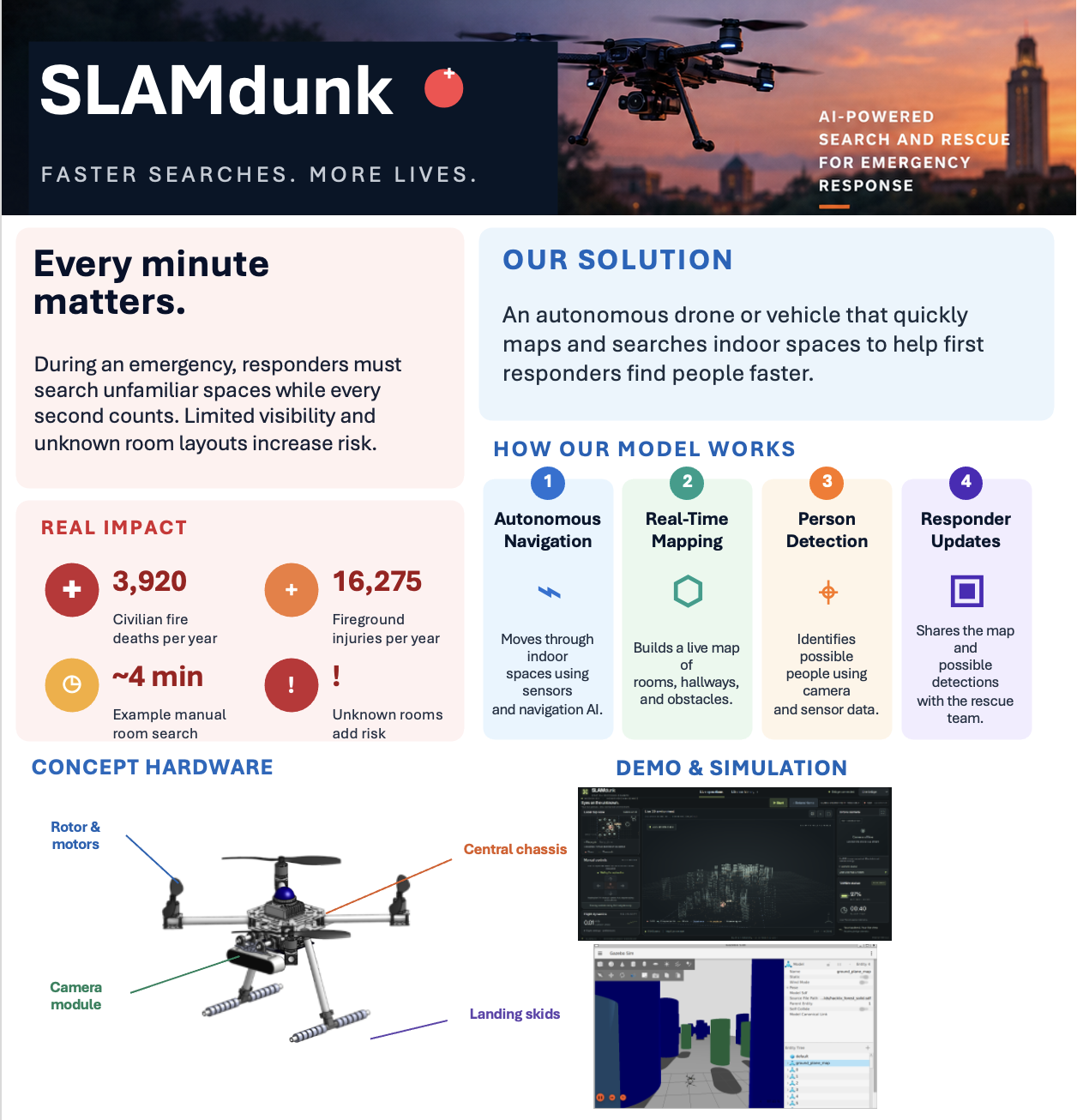
Our goal was to help solve something that impacts many lives. In disaster response, every second matters, and sending first responders into unknown environments can put their lives at risk. Whether it's a collapsed building, a fire-damaged structure, or an unstable industrial facility, responders often have limited information about the hazards ahead. SLAMdunk was inspired by the idea that drones should be able to explore dangerous environments before humans enter them.
What it does
Our algorithm uses LiDAR to create a map of its unknown surroundings and localize itself. Furthermore, it creates a risk analysis of all static and dynamic objects and their potential paths, creating an optimized global trajectory. Rather than requiring an operator to manually pilot a drone through every obstacle, our system employs a human-in-the-loop approach in which autonomous systems handle navigation while humans retain mission-level oversight.
How we built it
We first researched into MIT's SANDO paper, existing drones we could buy, SLAM and gaussian mapping capabilities, and simulation environments. Then in parallel, we set up Linux and Gazebo, fully understood the paper and its implementations, defined our improvements on the frontier research, and created high level goals which also informed our UI design. Then we recreated SANDO, implemented ROS2 nodes, built an informative UI, and also created a representative CAD model of our potential drone. Finally, we integrated the UI frontend and the Gazebo backend together via the ROS2 nodes, ran tests which allowed us to improve features and UX, fixed bugs, and created video documentation.
Challenges we ran into
Linux is hard. Gazebo simulation is very difficult to use. It was difficult to get our dependencies to line up, and we struggled with integrating MIT's SANDO paper due to its mathematical complexity.
Accomplishments that we're proud of
We are proud of our UI which we believe serves as a very informative dashboard. Additionally, we are proud of our persistence in integrating the paper's challenging architecture into Gazebo and our use of ROS2 nodes to create maps of the drone's historical paths and also to allow manual overrides to explore mission-critical areas.
What we learned
Breaking tasks up for the team is essential to working under time pressure. We also learned how to use GitHub to collaborate better and control experimental versions.
What's next for SLAMdunk
Next, we would test our system in more challenging environments (multi-story buildings/rubble), integrate colors when possible, and then physically build out our proposed drone and test it. We see this as a potential layer across first response cases. Long term, we envision extending the platform beyond drones to other robotic systems capable of navigating hazardous spaces such as submersed caves among other hostiles situations.


Log in or sign up for Devpost to join the conversation.