Slacktory
Track: New Slack Agent
Slacktory is a Slack-native workflow discovery agent. It finds repeated manual work hidden in Slack conversations, explains the evidence, and turns the next request into a reviewed, accountable workflow.
Inspiration
The most expensive workflows in an engineering organization are often the ones nobody has named. A staging-access request, production support escalation, or onboarding task starts as a simple Slack message, then becomes a scattered chain of clarification, approvals, handoffs, and “any update?” follow-ups.
We wanted to reverse the usual automation model. Rather than making an admin guess a process and manually build a form, Slacktory starts from the work that is already happening in Slack and proposes the workflow the team is actually following.
What it does
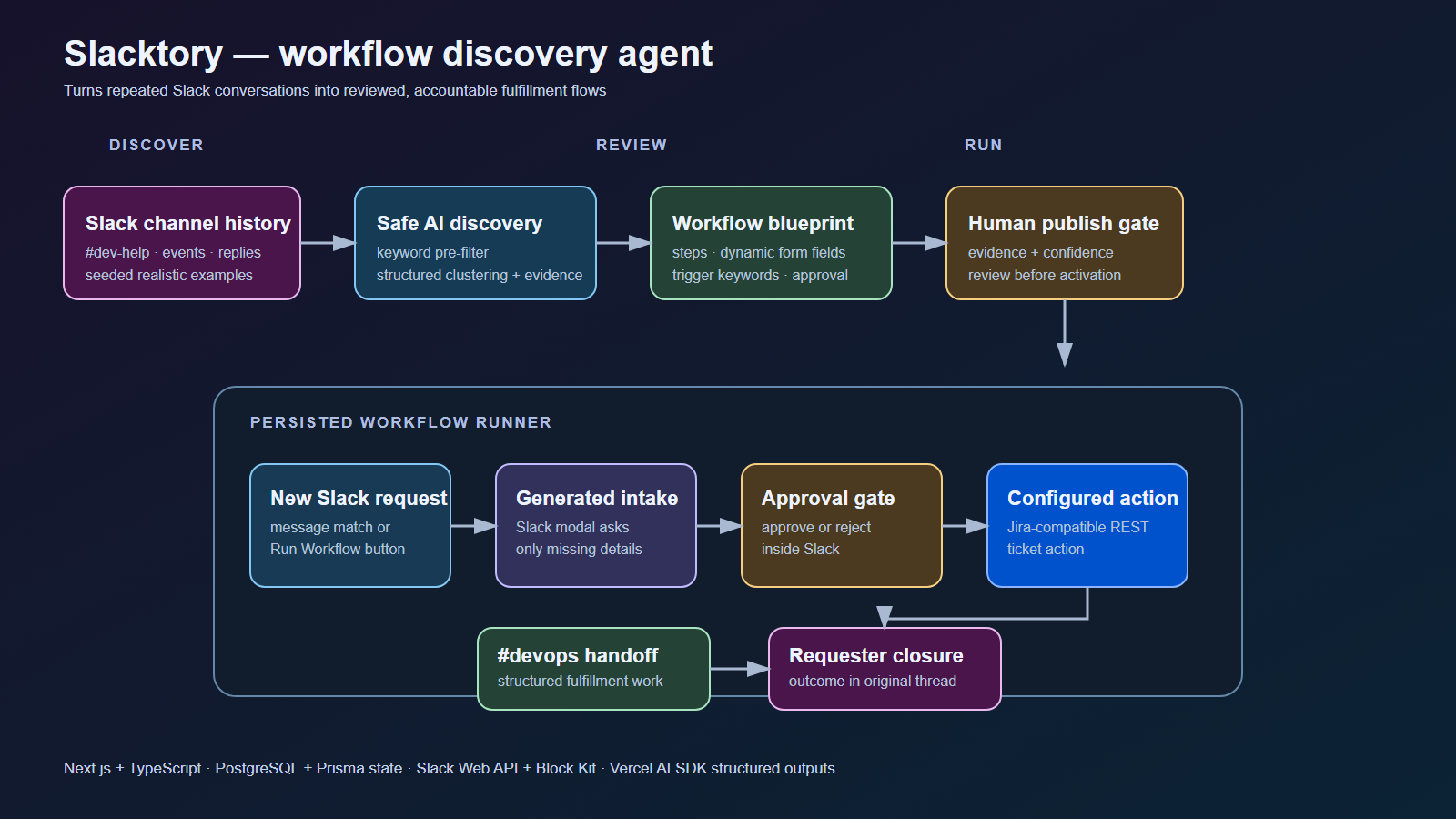
Slacktory scans an approved Slack channel, identifies repeatable work patterns, and presents the supporting message evidence, confidence, and an AI-generated workflow blueprint for human review.
In our sandbox demo, Slacktory finds a repeated Staging Environment Access
Request pattern from 23 matching messages in #dev-help. Once a reviewer
publishes it, a new natural-language request is recognized in the channel.
Slacktory then:
- opens a generated intake modal for the missing request details;
- sends the request to a human approval checkpoint;
- creates a configured ticket through a Jira-compatible REST action;
- posts a structured handoff to
#devops; and - closes the original Slack thread when fulfillment is confirmed.
This is not a generic chat bot and not a static form builder. The product’s core capability is discovering and operationalizing a team’s existing Slack workflow with visible evidence and human control.
How we built it
- Slack platform: Slack Web API for channel ingestion, Block Kit for cards, buttons and modals, Events API for message-driven workflow offers, and native Slack Agent thread status, titles, and suggested prompts.
- AI pipeline: Vercel AI SDK
generateObjectwith Zod schemas clusters messages into structured workflow candidates and generates workflow blueprints, form fields, approval requirements, and trigger keywords. - Safety and reliability: A deterministic keyword pre-filter runs before any LLM call; published workflows are reviewed by a person; the runner uses an explicit persisted state machine rather than unbounded model tool calls.
- Application: Next.js and TypeScript API routes, PostgreSQL with Prisma for workflow, evidence, scan, and run state, plus a Jira-compatible REST adapter. For the public demo, that adapter targets a clearly labelled controlled service; it can be configured for a real Jira endpoint.
Challenges we ran into
The hard part was not rendering a Slack form—it was making discovery credible and safe. Similar messages are not automatically a workflow, so we had to separate recurring requests from channel noise, attach message evidence to the candidate, and keep a human publish gate.
We also designed around Slack’s fast acknowledgement requirements. Slacktory acknowledges Slack events immediately, then runs heavier ingestion and AI work asynchronously. Finally, we made the demo honest: the Slack sandbox and Slack API calls are real; the ticket endpoint is explicitly labelled as a controlled demo unless configured to point at Jira.
Accomplishments that we're proud of
- A real Slack developer sandbox demo that completes discovery through closure.
- Evidence-backed workflow discovery: the demonstrated published workflow has 23 supporting messages and 95.5% clustering confidence.
- AI-generated workflow blueprint and dynamic intake fields instead of a hand-built form for the showcased process.
- A visible human-in-the-loop approval before the ticket action and operations handoff.
- A complete feedback loop: requester thread, ticket record, DevOps handoff, fulfillment, and persisted run history.
What we learned
AI agents earn trust when they show their evidence and their boundaries. Discovery is more useful when a manager can inspect why a workflow was proposed; automation is more useful when approval, ownership, and completion are explicit. We also learned that structured model output plus deterministic workflow transitions is a much stronger Slack experience than letting a model silently improvise side effects.
What's next for Slacktory
Next, we will add more configured action connectors, richer reviewer controls, workflow versioning, and organization-level workflow analytics. The discovery and blueprint layer is designed to generalize across repeated Slack processes; new execution connectors will be added only with explicit schemas, permission boundaries, and review gates.
Architecture diagram
Uploaded ARCHITECTURE_DIAGRAM.png as the required
architecture-diagram image in Devpost.
Built With
- nvidia-nim
- slack
- slack-agent
- slack-block-kit
- slack-web-api


Log in or sign up for Devpost to join the conversation.