-
-
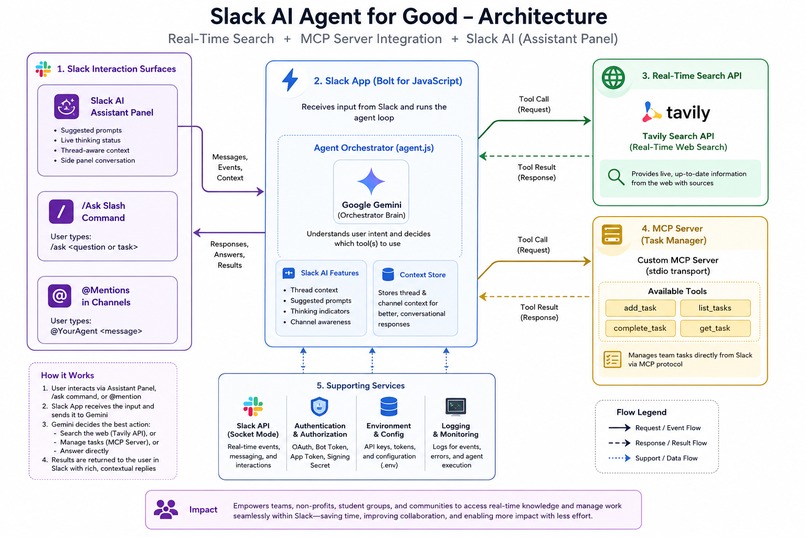
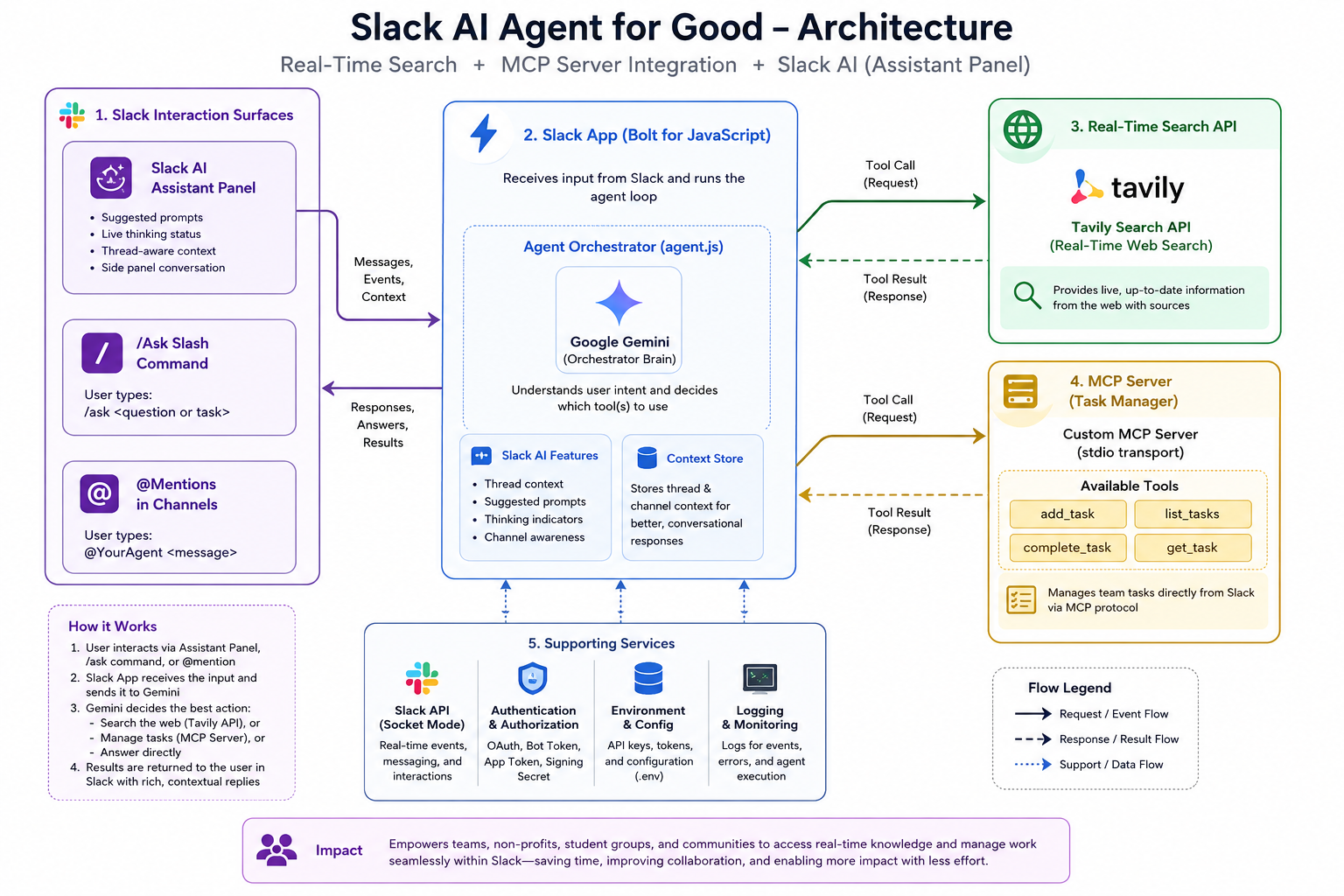
Architecture of SlackSenseAi
About the Project
Inspiration
Modern teams rely heavily on Slack for communication, yet they still leave the platform to search for information, manage tasks, or access external tools. This constant context switching interrupts workflows, reduces productivity, and makes collaboration less efficient.
We wanted to build an AI assistant that could act as an intelligent teammate inside Slack—one that understands user requests, retrieves real-time information, manages tasks, and provides contextual assistance without requiring users to leave their workspace. Our goal was to demonstrate how AI agents can become practical collaborators that simplify everyday work while creating a positive impact for student organizations, volunteer groups, non-profits, and small teams.
What it does
Our project, Slack AI Agent for Good, is an intelligent Slack-native assistant that combines three key technologies from the hackathon:
- Slack AI Capabilities through the native Assistant Panel
- Real-Time Search API (Tavily) for live and reliable web information
- Model Context Protocol (MCP) for intelligent task management
Powered by Google Gemini, the agent analyzes each user request and automatically determines the appropriate action. If the user needs current information, the agent performs a live web search using Tavily. If the request involves workflow management, it communicates with a custom MCP server to create, list, or complete tasks. All interactions happen naturally inside Slack through the Assistant Panel, slash commands, or channel mentions.
How we built it
The project was built using a modular architecture that separates user interaction, AI reasoning, and external tool execution.
Core Components
- Slack Bolt for JavaScript powers the Slack application and handles Assistant Panel interactions, slash commands, and mentions.
- Google Gemini acts as the reasoning engine and orchestrates tool selection.
- Tavily Real-Time Search API provides live information from the web.
- Custom MCP Server exposes task management tools through the Model Context Protocol.
- Node.js serves as the runtime for both the Slack application and the MCP server.
Workflow
- A user sends a request through Slack.
- Slack forwards the request to our Bolt application.
- Google Gemini analyzes the user's intent.
- Gemini decides whether the request requires:
- a real-time web search,
- an MCP tool,
- or a direct AI response.
- The selected service executes the request.
- Results are returned directly inside Slack.
This architecture allows the AI to function as an intelligent orchestrator rather than relying on hardcoded workflows.
Challenges we faced
One of our biggest challenges was integrating multiple technologies into a seamless conversational experience.
Some of the challenges included:
- Designing reliable communication between the Slack application and the MCP server.
- Allowing Gemini to dynamically choose the correct tool without explicit user instructions.
- Integrating Slack's Assistant Panel while maintaining consistent behavior across slash commands and mentions.
- Managing asynchronous communication between Slack, Gemini, Tavily, and the MCP server while keeping response times low.
- Creating a modular architecture that could easily support additional MCP tools in the future.
Debugging interactions across several APIs while ensuring a smooth user experience required significant testing and refinement.
What we learned
Throughout this project, we gained practical experience with:
- Building AI-powered Slack applications
- Using Slack AI capabilities and Assistant Panel features
- Integrating the Model Context Protocol (MCP) into real-world workflows
- Orchestrating multiple AI tools using Google Gemini
- Implementing real-time information retrieval through external APIs
- Designing scalable agent architectures using Node.js
More importantly, we learned that AI agents become significantly more useful when they are capable of selecting and invoking external tools autonomously instead of acting solely as conversational chatbots.
Impact
Our project is designed to help communities and organizations collaborate more effectively.
Instead of switching between multiple applications for searching information and managing work, users receive intelligent assistance directly inside Slack. This reduces context switching, improves productivity, and enables teams to focus on meaningful work.
The solution is particularly valuable for:
- Student organizations
- Volunteer communities
- Non-profit organizations
- Small teams
- Startup teams
By combining real-time knowledge retrieval, intelligent task management, and AI-driven decision making, our project demonstrates how conversational AI can become an active collaborator that helps teams work smarter and create greater impact.
Future Improvements
We envision expanding the project with additional MCP integrations, including:
- GitHub issue management
- Google Calendar scheduling
- Jira task synchronization
- Notion knowledge base integration
- Multi-user task management
- Team analytics and reporting
- Persistent cloud database support
Our long-term vision is to transform the Slack AI Agent into a unified intelligent workspace capable of orchestrating multiple productivity tools through a single conversational interface.
Built With
- application-logic
- backend-runtime
- google-gemini
- javascript
- mcp
- node.js
- slack-app-framework
- slack-bolt


Log in or sign up for Devpost to join the conversation.