-
-
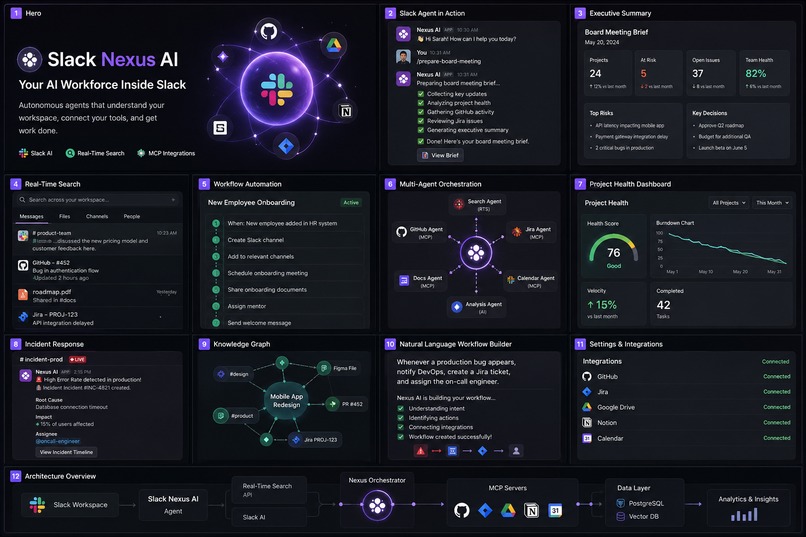
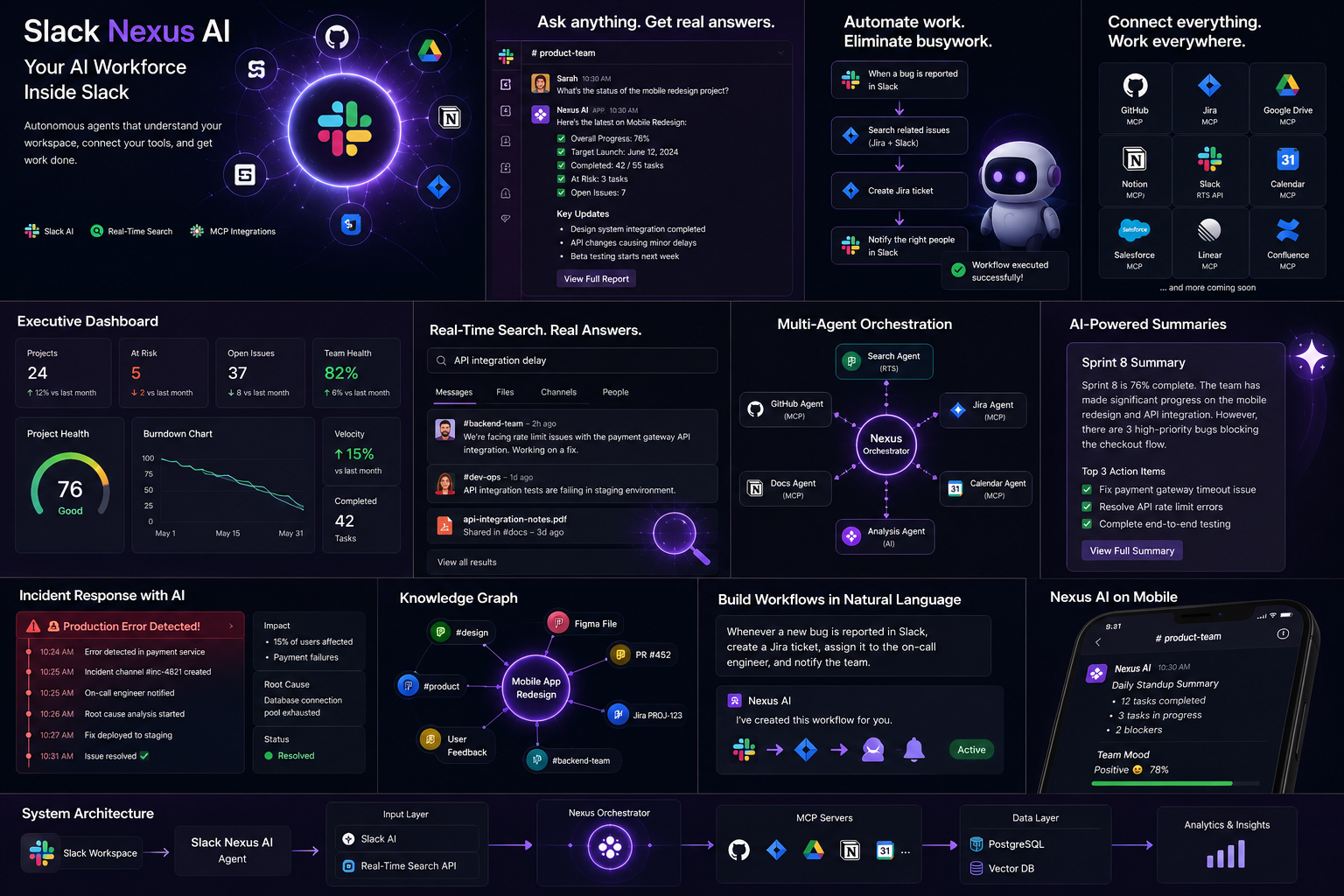
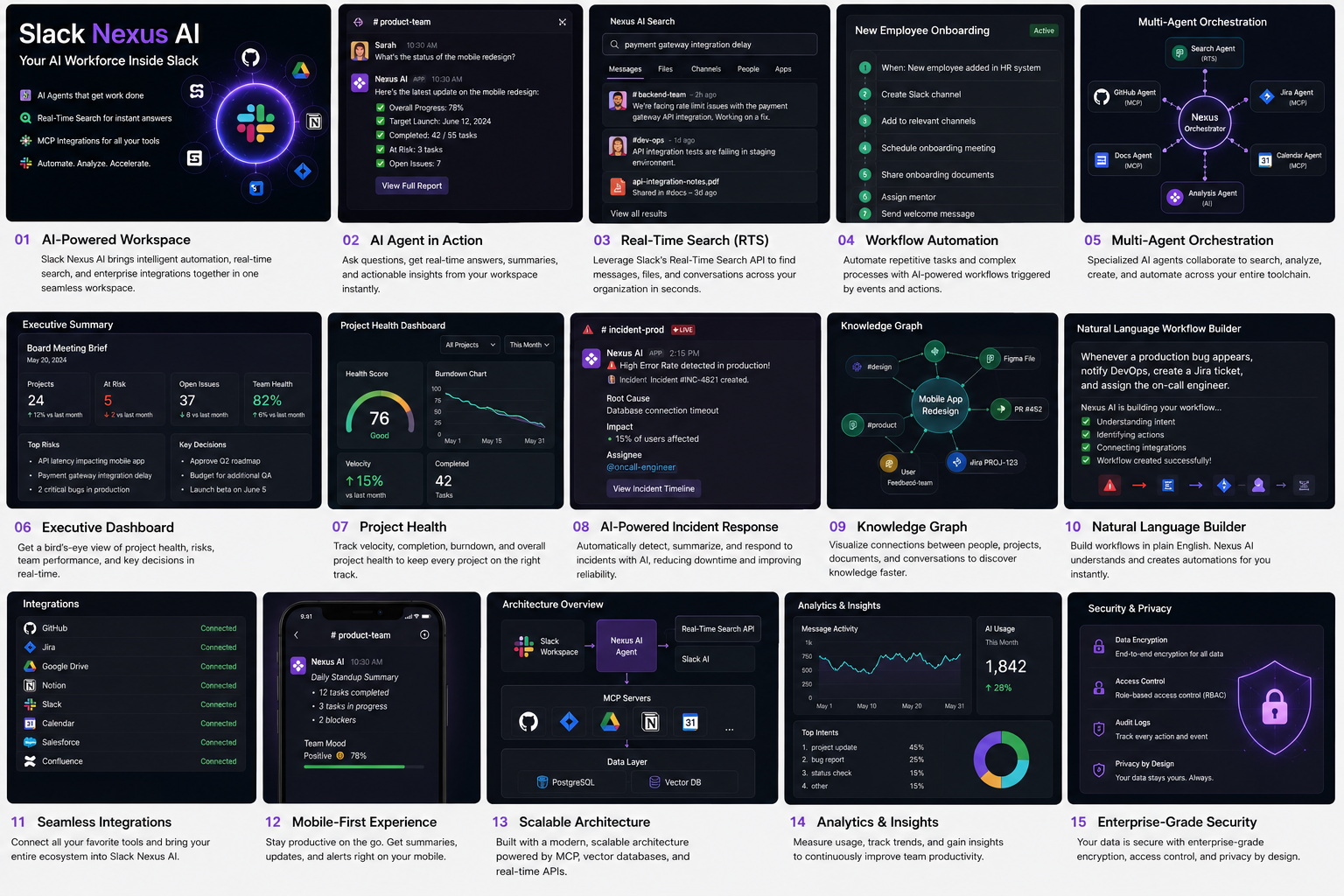
A next-generation AI workspace that combines Slack AI, Real-Time Search (RTS), and MCP integrations
-
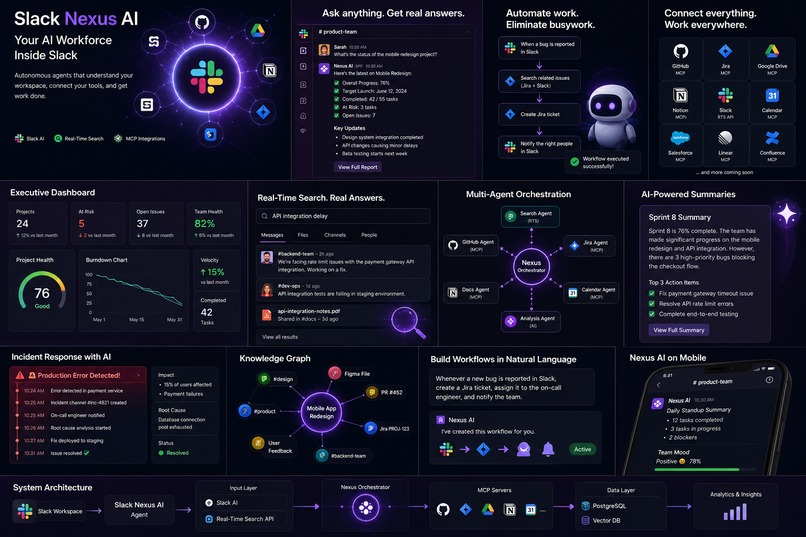
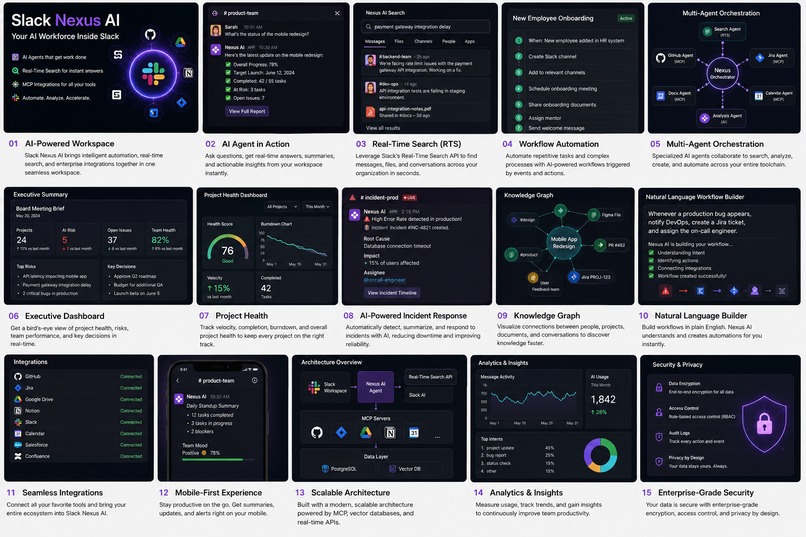
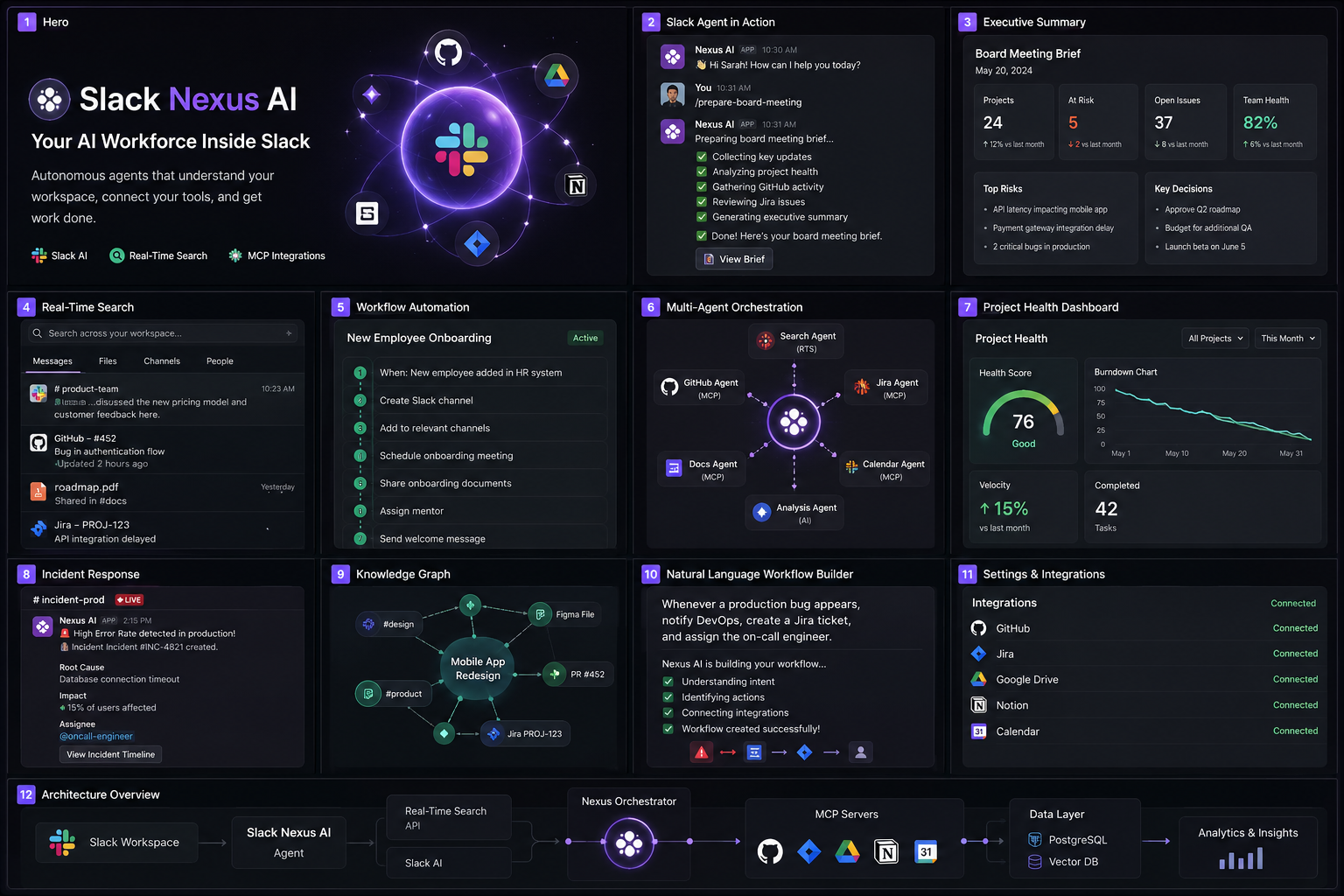
A next-generation enterprise dashboard showcasing AI-powered workflow automation, multi-agent collaboration, executive analytics
-
Inspiration
💡 Inspiration of the Project
The inspiration behind Slack Nexus AI came from a simple observation: although Slack is the central communication platform for millions of teams, much of an organisation's most valuable knowledge gets buried in conversations. Important decisions, technical discussions, meeting outcomes, project updates, and shared resources are scattered across multiple channels and threads. Employees often spend a significant amount of time searching for old messages, asking questions that have already been answered, or switching between different tools to find the information they need. This leads to lost productivity, duplicated work, and delayed decision-making.
As students working on AI-powered solutions, we wanted to explore how Artificial Intelligence could transform Slack from a communication tool into an intelligent workplace assistant. Rather than building another chatbot that simply answers questions, we envisioned an AI agent capable of understanding conversations, remembering organisational knowledge, summarising discussions, extracting action items, and providing context-aware assistance directly within Slack. We wanted the AI to function like an experienced team member who remembers every conversation, knows where information is stored, and can instantly provide accurate answers when needed.
Another major source of inspiration was the rapid advancement of Large Language Models (LLMs), Retrieval-Augmented Generation (RAG), and AI agents. These technologies have demonstrated remarkable capabilities in understanding natural language and reasoning over large amounts of information. We realised that by combining these advancements with Slack's collaborative ecosystem, we could build a practical solution that addresses real workplace challenges rather than creating a purely experimental AI application.
We were also inspired by the increasing adoption of remote and hybrid work environments. Modern teams collaborate across different time zones, making it difficult for everyone to stay updated on ongoing discussions. Team members who miss meetings or join projects midway often struggle to catch up because information is spread across numerous channels and documents. Slack Nexus AI aims to bridge this gap by acting as a centralised knowledge assistant that provides instant summaries, retrieves relevant information, and helps every team member stay informed regardless of when or where they work.
Ultimately, our motivation was to create a solution that reduces information overload, saves valuable time, improves collaboration, and enables teams to focus on innovation instead of searching for information. Slack Nexus AI represents our vision of a smarter digital workplace where AI doesn't replace human collaboration but enhances it by making organisational knowledge instantly accessible, actionable, and easy to understand.
What it does
⚙️ What Slack Nexus AI Does
Slack Nexus AI is an AI-powered workplace assistant that transforms Slack into an intelligent knowledge and productivity hub. Instead of manually searching through countless channels, threads, and documents, users can interact with the AI using natural language to instantly find information, summarise discussions, automate repetitive tasks, and receive context-aware assistance—all without leaving Slack.
The application continuously processes conversations, shared files, and workspace activities to build an intelligent organisational knowledge base. When a user asks a question, Slack Nexus AI understands the request, retrieves the most relevant information using semantic search, and generates accurate responses based on the organisation's own data rather than relying solely on general AI knowledge. This enables employees to quickly locate project updates, technical documentation, meeting notes, and important decisions, even if they do not remember the exact keywords or channel where the information was originally shared.
Beyond answering questions, Slack Nexus AI automatically summarises lengthy discussions and meetings into concise overviews, highlighting key decisions, action items, assigned responsibilities, deadlines, and next steps. This helps team members quickly catch up on conversations they may have missed and reduces the need to read hundreds of messages.
The platform also features specialised AI agents tailored for different organisational roles. For example, a Project Manager Agent tracks project progress and identifies blockers, an Engineering Agent retrieves technical documentation and summarises development discussions, an HR Agent answers onboarding and policy-related questions, and a Support Agent helps teams access customer-related information. These role-specific agents provide more relevant and context-aware assistance while sharing a common organisational knowledge base.
Slack Nexus AI further improves productivity by identifying tasks directly from conversations. Whenever team members mention assignments, deadlines, follow-ups, or action items, the AI extracts them automatically and organises them into structured tasks. This minimises manual tracking and ensures that important responsibilities are not overlooked.
To support better collaboration, the assistant provides semantic search capabilities that understand the meaning behind user queries rather than relying on exact keyword matches. Users can ask questions naturally, such as "What was decided about the payment gateway integration?" or "Summarise yesterday's engineering discussion," and receive accurate, context-rich responses within seconds.
Overall, Slack Nexus AI serves as an intelligent teammate that helps organisations preserve institutional knowledge, improve collaboration, reduce information overload, automate repetitive workflows, and enable employees to focus on meaningful work instead of spending time searching for information.
How we built it
🛠️ How We Built Slack Nexus AI
We built Slack Nexus AI by combining Slack's developer platform with modern Artificial Intelligence technologies to create an intelligent workplace assistant that understands conversations, retrieves organisational knowledge, and automates team workflows. Our development approach focused on creating a modular, scalable, and secure architecture so that new AI capabilities and integrations can be added easily in the future.
- Slack App Development
The first step was creating a custom Slack application using the Slack Developer Platform. We configured the necessary OAuth scopes and permissions to securely access workspace data such as messages, channels, threads, users, and shared files. Using the Slack Events API and Slack Bolt SDK, the application listens for events like new messages, mentions, thread replies, and file uploads. This allows Slack Nexus AI to stay updated with ongoing conversations in real time.
- Data Collection and Knowledge Processing
Once workspace data is received, it is processed through a knowledge pipeline. Messages are cleaned, grouped into conversations, and enriched with metadata such as timestamps, channels, authors, and thread relationships. Shared documents and important discussions are indexed so that the AI can understand the complete context rather than isolated messages. This transforms unstructured Slack conversations into a structured organisational knowledge base.
- Semantic Search with Vector Embeddings
Instead of relying on traditional keyword matching, we implemented semantic search. Conversations and documents are converted into vector embeddings, numerical representations that capture the meaning of the text. These embeddings are stored in a vector database such as FAISS, ChromaDB, or Pinecone. When a user asks a question, the system searches for semantically similar information, allowing it to retrieve relevant content even if the exact keywords are not used.
- Retrieval-Augmented Generation (RAG)
To improve response accuracy and reduce AI hallucinations, we implemented a Retrieval-Augmented Generation (RAG) pipeline. When a query is received, Slack Nexus AI first retrieves the most relevant conversations and documents from the knowledge base. These retrieved results are then provided as context to the Large Language Model (LLM), enabling it to generate responses that are grounded in the organisation's actual data rather than relying solely on pretrained knowledge.
- Intelligent AI Agents
Rather than creating a single chatbot, we designed multiple specialised AI agents for different workplace functions. Each agent has a dedicated responsibility while sharing access to the same organisational knowledge.
Project Manager Agent monitors project discussions, tracks deadlines, identifies blockers, and generates sprint summaries.
Engineering Agent answers technical questions, retrieves API documentation, summarises development discussions, and explains implementation details.
HR Agent assists with onboarding, company policies, and employee-related queries.
Support Agent organises customer discussions, summarises reported issues, and retrieves previous solutions.
This modular agent-based architecture makes the platform easier to extend and customise for different industries.
- Meeting and Conversation Intelligence
Slack Nexus AI continuously analyses long discussions and meeting threads to automatically generate concise summaries. It identifies key decisions, action items, pending tasks, assigned owners, and important deadlines. This allows team members who were unavailable during meetings to quickly understand what happened without reading hundreds of messages.
- Automated Task Extraction
Natural Language Processing techniques are used to detect assignments, deadlines, follow-up actions, and commitments mentioned during conversations. These are converted into structured tasks that can be tracked more effectively, helping teams reduce manual effort and avoid missing important responsibilities.
- Backend Architecture
The backend was developed using Python and FastAPI, providing a lightweight, scalable, and high-performance API service. The backend coordinates Slack event handling, AI inference, semantic retrieval, task extraction, and communication with external AI services. The modular architecture ensures that additional integrations, such as GitHub, Jira, Notion, or Google Drive, can be added with minimal changes.
- User Experience
Our primary design goal was to make the AI feel like a natural part of Slack. Users do not need to learn new commands or interfaces. They simply mention the assistant or ask questions in plain English, such as:
"Summarise today's engineering discussions."
"What decisions were made about the payment gateway?"
"Show my pending action items."
"Find the latest API documentation."
The assistant responds directly within Slack, providing concise, contextual, and actionable information without requiring users to switch between multiple applications.
- Future Scalability
We intentionally designed Slack Nexus AI with scalability in mind. The modular architecture allows future integration with enterprise tools such as GitHub, Jira, Notion, Google Drive, Confluence, and cloud storage platforms. Additional AI agents can also be introduced for finance, marketing, legal, sales, and customer success teams, making Slack Nexus AI a comprehensive AI-powered workplace operating system.
By combining Slack's collaborative ecosystem with semantic search, Retrieval-Augmented Generation (RAG), vector databases, Large Language Models, and specialised AI agents, we built a solution that enables organisations to find information faster, automate repetitive tasks, preserve institutional knowledge, and improve collaboration across teams.
Challenges we ran into
🚧 Challenges We Ran Into
Building Slack Nexus AI was an exciting experience, but it also presented several technical and design challenges. Since our goal was to create an AI assistant that could understand workplace conversations and provide reliable, context-aware responses, we had to solve problems beyond simply integrating a language model with Slack.
- Understanding Conversation Context
One of the biggest challenges was preserving the context of Slack conversations. Discussions are often spread across multiple channels, threads, and direct messages, making it difficult for the AI to understand the complete picture. We needed a way to reconstruct conversations so that the assistant could distinguish between unrelated discussions and accurately answer user queries.
- Information Retrieval
Traditional keyword-based search was not sufficient because users rarely remember the exact words used in previous conversations. We had to implement semantic search using vector embeddings so the AI could understand the meaning behind both the stored information and the user's query. Finding the right balance between retrieval accuracy and response speed required several iterations.
- Reducing AI Hallucinations
Enterprise users expect accurate and trustworthy answers. A major challenge was ensuring that the AI-generated responses were based on actual Slack conversations rather than making assumptions. To address this, we adopted a Retrieval-Augmented Generation (RAG) approach, where relevant organisational knowledge is retrieved first and then used as context for the language model.
- Handling Large Volumes of Data
Active Slack workspaces generate thousands of messages every day. Processing, indexing, and searching through large amounts of conversational data while maintaining fast response times was a significant technical challenge. Efficient data preprocessing and optimised retrieval mechanisms were essential for delivering a smooth user experience.
- Privacy and Access Control
Not every employee has access to every channel or document within an organisation. We needed to ensure that Slack Nexus AI respected Slack's permission model and only retrieved information that the requesting user was authorised to access. Designing the system with security and privacy in mind was a key consideration throughout development.
- Task Identification
People express action items in many different ways. Statements such as "I'll handle it tomorrow," "Can someone review this?" or "Let's finish this by Friday" all imply tasks, but they are phrased differently. Developing logic that could consistently identify and extract meaningful action items without generating false positives was another important challenge.
- Building Specialised AI Agents
Instead of creating a single general-purpose chatbot, we designed multiple role-specific AI agents such as Project Manager, Engineering, HR, and Support agents. Ensuring that each agent responded with relevant expertise while sharing a common organisational knowledge base required careful architectural planning and prompt design.
- Time Constraints of a Hackathon
Like many hackathon projects, we had limited time to design, develop, test, and refine the application. We prioritised building a strong core architecture with essential features first, while designing the system in a modular way so that additional capabilities and integrations could be added after the competition.
🌱 What These Challenges Taught Us
Every challenge helped us improve both the product and our understanding of AI application development. We learned that building a successful AI assistant is not only about integrating a powerful language model—it also requires effective knowledge retrieval, thoughtful system architecture, strong security practices, and an intuitive user experience.
These experiences reinforced the importance of designing AI systems that are accurate, scalable, secure, and genuinely useful for real-world workplace collaboration. They also laid a strong foundation for future enhancements, including deeper integrations with enterprise tools, more specialised AI agents, and advanced workflow automation.
Accomplishments that we're proud of
🏆 Accomplishments That We're Proud Of
One of our biggest accomplishments was successfully transforming the idea of an AI-powered workplace assistant into a practical solution that integrates naturally with Slack. Instead of building another standalone chatbot, we designed Slack Nexus AI as an intelligent teammate that understands workplace conversations, retrieves organisational knowledge, and assists employees without disrupting their existing workflow.
We are particularly proud of implementing a Retrieval-Augmented Generation (RAG) architecture, which enables the AI to generate responses based on real organisational data rather than relying solely on a language model's general knowledge. This significantly improves response accuracy and makes the assistant more reliable for enterprise use.
Another achievement was developing a semantic search system that understands the meaning behind user queries instead of depending on exact keyword matches. Users can ask questions in natural language and quickly receive relevant information from conversations, meeting discussions, and shared documents, making knowledge retrieval far more intuitive.
We are also proud of designing a modular multi-agent architecture. Instead of one general-purpose assistant, Slack Nexus AI includes specialised AI agents for different workplace functions, such as Project Management, Engineering, Human Resources, and Customer Support. This architecture makes the platform easier to extend and allows organisations to customise AI assistance for different teams.
Building an automated meeting intelligence system was another significant milestone. The assistant can summarise lengthy discussions, identify key decisions, extract action items, assign responsibilities, and highlight deadlines, helping team members stay informed even if they miss important conversations.
A major accomplishment was ensuring that the platform was designed with scalability and extensibility in mind. The modular backend allows future integration with tools such as GitHub, Jira, Notion, Google Drive, and other enterprise platforms, enabling Slack Nexus AI to evolve into a comprehensive workplace operating system.
Beyond the technical achievements, we are proud of what we learned throughout the project. Working on Slack Nexus AI strengthened our understanding of AI agents, semantic search, vector databases, Retrieval-Augmented Generation, prompt engineering, API integration, backend architecture, and enterprise application design. More importantly, it demonstrated how AI can solve real productivity challenges by making organisational knowledge instantly accessible and actionable.
Finally, our greatest accomplishment is creating a solution with genuine real-world potential. Slack Nexus AI addresses a common problem faced by organisations of all sizes—information overload—and demonstrates how AI can enhance collaboration, improve productivity, and help teams work smarter without changing the tools they already use.
What we learned
📚 What We Learned
Building Slack Nexus AI was a valuable learning experience that extended beyond software development. Throughout the project, we gained practical knowledge about designing AI-powered enterprise applications, integrating intelligent agents into collaborative platforms, and building solutions that solve real workplace problems.
One of the most important lessons we learned was that a powerful AI model alone is not enough. The quality of an AI assistant depends heavily on the quality of the information it can access. By implementing Retrieval-Augmented Generation (RAG), we learned how grounding AI responses in organisational data greatly improves accuracy, reduces hallucinations, and makes the assistant far more reliable for real-world use.
We also gained hands-on experience with semantic search and vector embeddings. Unlike traditional keyword search, semantic retrieval allows the AI to understand the meaning behind user questions and retrieve relevant conversations even when different words are used. This helped us appreciate how modern AI systems can make knowledge discovery faster and more intuitive.
Another key learning was the importance of context management. Workplace conversations are often spread across multiple channels, threads, and documents. We learned how preserving conversation history, metadata, and user context enables the AI to generate responses that are more accurate, relevant, and helpful.
Developing specialised AI agents taught us the value of modular system design. Instead of relying on a single general-purpose assistant, we explored how role-specific agents—such as Project Manager, Engineering, HR, and Support agents—can provide more focused assistance while sharing a common organisational knowledge base. This approach makes the platform easier to scale and customise for different business needs.
We also learned the importance of security and privacy in enterprise AI applications. Since organisational data is sensitive, it is essential to respect user permissions and ensure that AI only retrieves information users are authorised to access. This reinforced the need to consider security as a core design principle rather than an afterthought.
From a technical perspective, we strengthened our skills in Slack API integration, Python backend development, FastAPI, prompt engineering, vector databases, AI workflow design, and system architecture. We also learned how to connect multiple technologies into a cohesive application that delivers a seamless user experience.
Beyond the technical aspects, this project improved our teamwork, problem-solving, and project planning skills. Working within the time constraints of a hackathon taught us how to prioritise core features, iterate quickly, and focus on building a functional solution with a strong foundation for future development.
Overall, Slack Nexus AI showed us that the most impactful AI solutions are not those that simply generate text, but those that understand context, retrieve the right information, automate meaningful tasks, and integrate naturally into the tools people already use. This project has deepened our understanding of enterprise AI and inspired us to continue building intelligent systems that make workplaces more productive and collaborative.
What's next for Slack Nexus AI
🚀 What's Next for Slack Nexus AI
While Slack Nexus AI demonstrates how AI can transform workplace collaboration, we see this project as the foundation of a much larger intelligent workplace platform. Our next goal is to evolve it from a hackathon prototype into a production-ready solution that organisations of all sizes can adopt.
The priority is to expand Slack Nexus AI into a multi-platform AI workspace assistant. In addition to Slack, we plan to integrate popular productivity tools such as GitHub, Jira, Notion, Google Drive, Google Calendar, Confluence, Microsoft Teams, and Zoom. By connecting these platforms, users will be able to retrieve information, manage tasks, and receive AI-powered assistance from a single interface instead of switching between multiple applications.
We also plan to introduce more specialised AI agents tailored to different business functions. Beyond the current Project Management, Engineering, HR, and Support agents, future versions will include Sales, Marketing, Finance, Legal, Operations, and DevOps agents. Each agent will have domain-specific knowledge and workflows while collaborating through a shared organisational knowledge base.
Another major enhancement is the development of a proactive AI assistant. Instead of waiting for users to ask questions, Slack Nexus AI will actively monitor workspace activities and provide intelligent recommendations. For example, it could remind team members about approaching deadlines, detect unresolved discussions, suggest relevant documents during conversations, summarise important updates at the end of each day, and identify potential project risks before they become major issues.
We also envision adding voice-based interactions using speech recognition and text-to-speech technologies. Users will be able to ask questions, receive summaries, and interact with AI agents using natural voice commands, making the platform even more accessible during meetings and remote collaboration.
To improve decision-making, we plan to build an AI-powered analytics dashboard that provides managers with insights into team collaboration, project progress, workload distribution, meeting effectiveness, and organisational knowledge trends. These analytics will help organisations identify communication bottlenecks and optimise team productivity.
Security and enterprise readiness will remain a top priority. Future releases will include advanced authentication, role-based access control, audit logs, encrypted knowledge storage, and compliance with enterprise security standards to ensure organisations can confidently deploy Slack Nexus AI in production environments.
We also aim to improve the intelligence of the platform by incorporating long-term organisational memory, allowing the AI to learn from historical conversations while respecting privacy and access permissions. This will enable the assistant to provide richer context, recognise recurring issues, and deliver more personalised recommendations over time.
Looking further ahead, we envision Slack Nexus AI becoming an AI-powered Workplace Operating System—a unified platform where communication, knowledge management, task automation, project tracking, and intelligent decision support work together seamlessly. Rather than simply answering questions, the AI will become an active digital teammate that helps teams collaborate more effectively, reduces repetitive work, preserves organisational knowledge, and empowers employees to focus on innovation and problem-solving.
Our long-term vision is to redefine how organisations interact with workplace information by making AI a trusted, secure, and intelligent collaborator that transforms conversations into actionable knowledge and drives smarter, faster decision-making across the entire organisation
Built With
- block
- docker
- fastapi
- github-actions
- github-api
- google-calendar-api
- google-drive-api
- javascript
- jira-api
- langchain
- langgraph
- mcp
- model-context-protocol-(mcp)
- next.js
- notion-api
- openai
- postgresql
- python
- qdrant
- railway
- react
- redis
- slack-agent-builder
- slack-ai
- slack-bolt-sdk
- slack-cli
- slack-real-time-search-(rts)-api
- slack-real-time-search-api
- tailwind-css
- typescript
- vercel

Log in or sign up for Devpost to join the conversation.