-
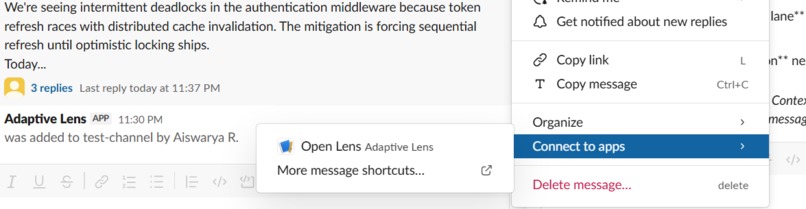
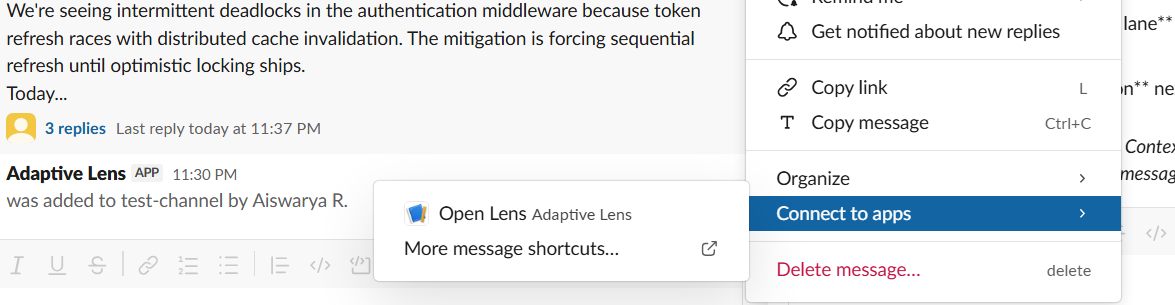
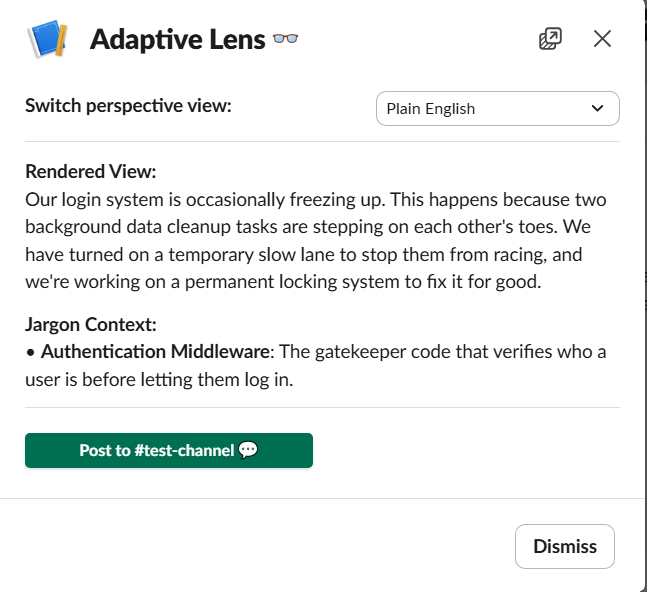
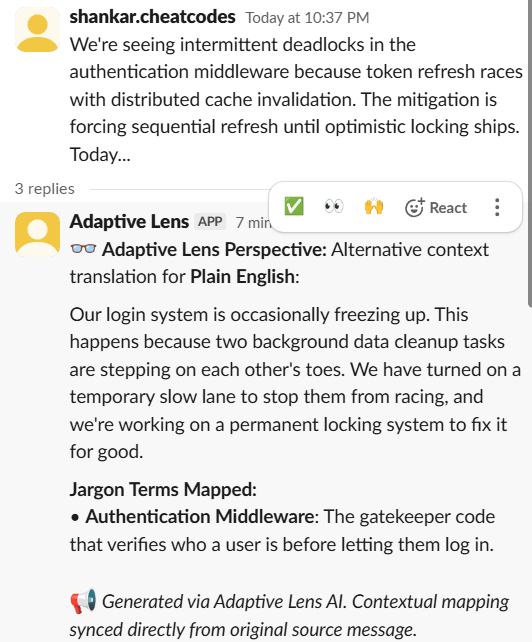
Adaptive Lens integrates directly into Slack message actions, making personalized communication available with a single click.
-
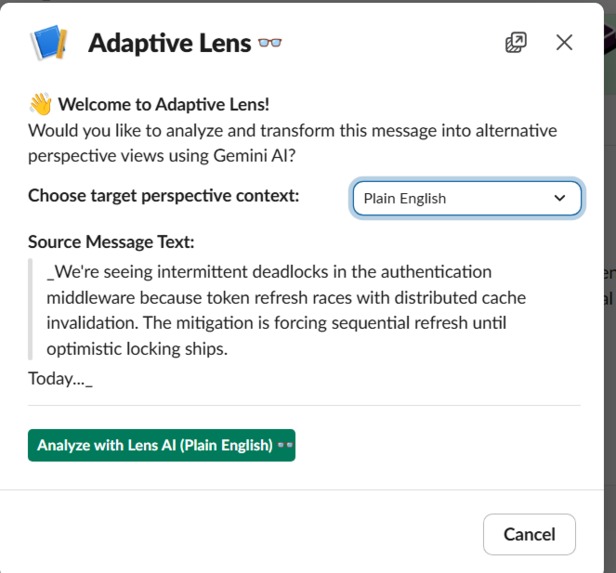
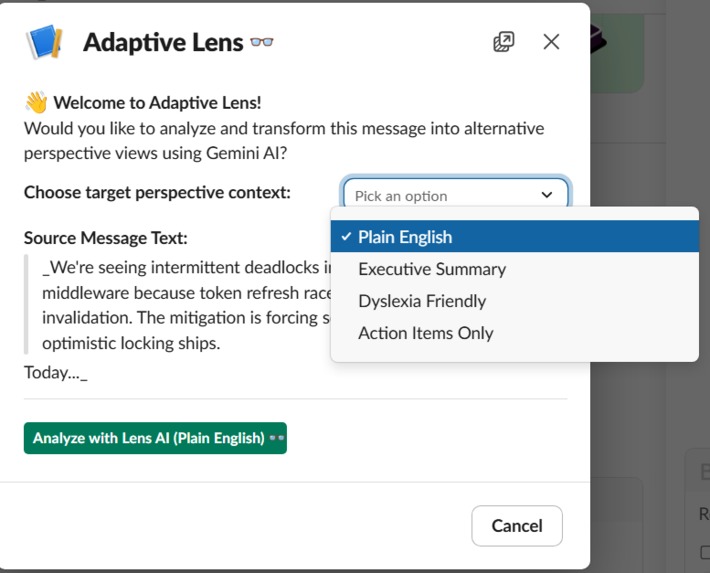
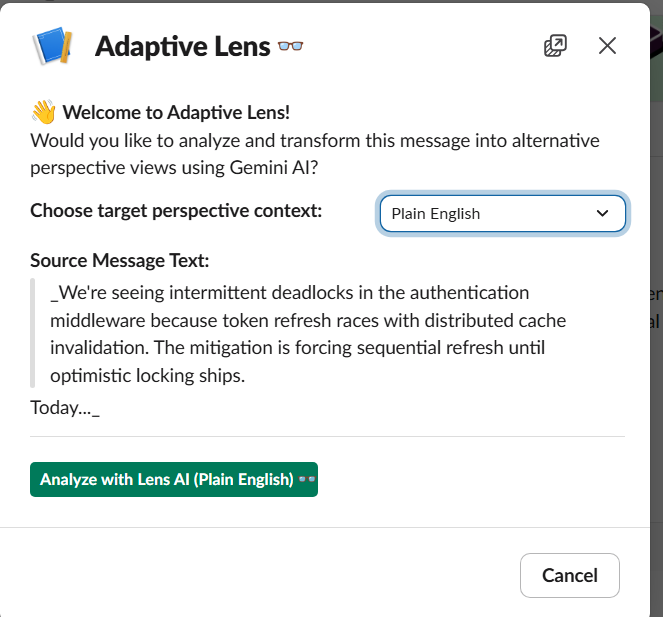
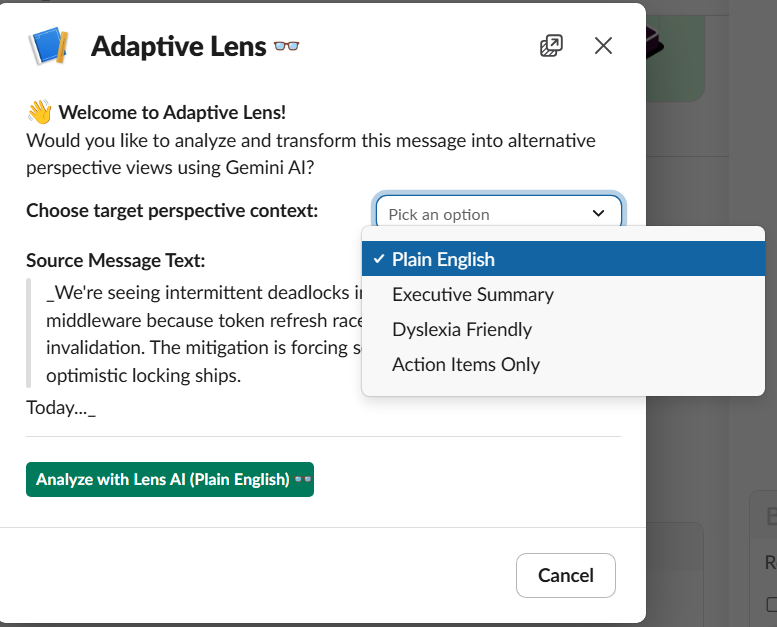
Rather than rewriting messages, users choose the perspective that best matches their role, expertise, or accessibility needs.
-
The original Slack message is always preserved. Adaptive Lens changes only how each individual experiences the communication.
-
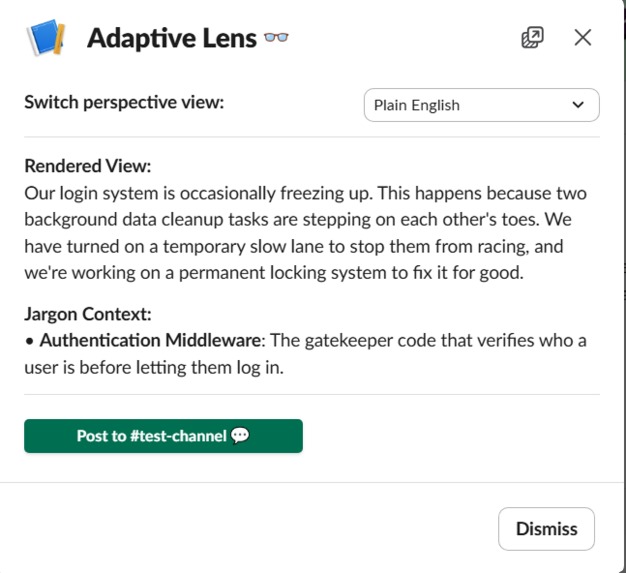
Gemini AI generates personalized perspectives while maintaining accuracy and explaining technical terminology through context mapping.
-
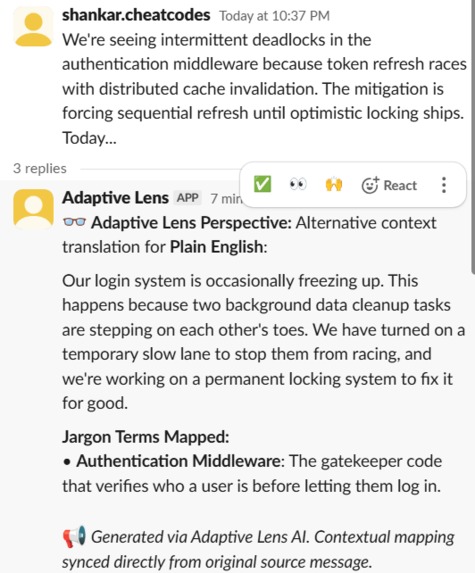
Generated perspectives can be shared as threaded replies, enabling inclusive communication without altering the original conversation.
Inspiration
Modern workplace communication is one-size-fits-all. The same Slack message is expected to work equally well for executives, engineers, new hires, global teams, and employees with accessibility needs. We asked a simple question: What if communication adapted to the reader instead of forcing the reader to adapt to the communication? That idea became Adaptive Lens—a personalized AI reading layer for Slack that preserves the original message while transforming how each individual experiences it.
What it does
Adaptive Lens fits into the track "Slack Agent for good" allowing users to view and understand any Slack message through different AI-powered perspectives without modifying the original message. Adaptive Lens leverages Slack's Real-Time Search API to enable contextual conversions. Users can instantly switch between Plain Language, Executive Summary, Dyslexia-Friendly, Focus Mode, Translation, and future Cognitive Lenses tailored to different thinking styles. The original message always remains intact, ensuring trust, compliance, and transparency while making communication more accessible and personalized.
How we built it
We built Adaptive Lens as a Slack application using Slack's message actions and interactive modals. When a user selects Adaptive Lens from a message, the app retrieves the original message and sends it to Google's Gemini AI along with lens-specific prompting. The generated perspective is displayed in an interactive Slack modal and can optionally be shared back into the conversation. The architecture is designed to support MCP integration for retrieving organization-specific terminology, policies, and contextual knowledge, enabling more accurate enterprise-aware transformations.
Challenges we ran into
One of our biggest challenges was balancing AI transformation with user trust. We wanted to improve readability without changing the meaning of the original message. Designing prompts that simplify language while preserving facts, deadlines, names, and intent required careful prompt engineering. Another challenge was creating a user experience that felt native to Slack instead of appearing like a separate chatbot.
Accomplishments that we're proud of
Built a fully functional Slack application integrated directly into message actions. Created multiple AI-powered perspectives that address different communication needs. Designed the product around immutable source messages to preserve trust and compliance. Developed a scalable architecture that can evolve into a personalized communication platform. Demonstrated how AI can enhance communication without replacing the original content.
What we learned
This project reinforced that accessibility is only one aspect of personalization. Different people understand information differently based on their role, language, expertise, and cognitive preferences. We also learned that AI is most trustworthy when it augments communication rather than rewriting it. Preserving the original message while generating personalized perspectives creates a balance between usability and transparency. Uses Slack Real-Time Search to connect related messages and workspace context, enabling AI to generate more accurate and context-aware perspectives.
What's next for Slack Adaptive Lens
Our vision is to make Adaptive Lens the Reader Mode for workplace communication.
Next, we plan to:
Add Cognitive Lenses that adapt messages to different thinking styles, such as checklist, analytical, timeline, or visual learners. Introduce role-aware perspectives for engineers, executives, legal teams, customer support, and new hires. Integrate MCP servers to provide organization-specific terminology, documentation, and knowledge retrieval. Support multilingual collaboration with enterprise-aware translations. Learn user preferences over time and automatically apply the most suitable perspective. Expand beyond Slack to platforms such as Microsoft Teams, Email, Confluence, and other workplace communication tools.

Log in or sign up for Devpost to join the conversation.