Inspiration
Aircraft structures experience repeated loading from turbulence, maneuvers, takeoffs, and landings. We were interested in whether changes in the way a structure responds to those loads could be detected before a problem becomes visually obvious. With this hackathon's "Into the Skies" theme, we decided to build SkySafe, a prototype aircraft structural health monitoring system that makes those changes visible in real time.
What it does
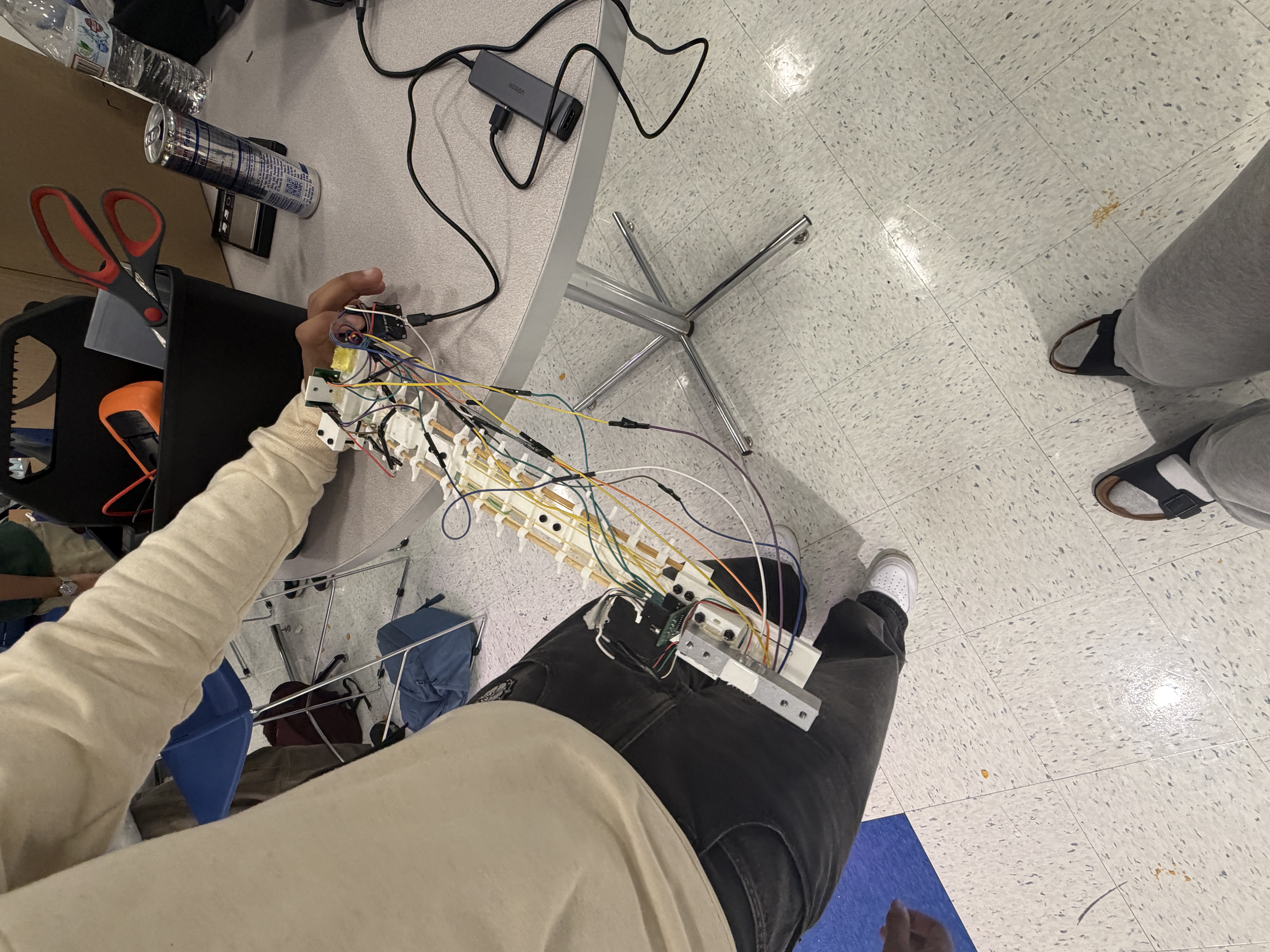
SkySafe monitors a 3D-printed aircraft wing using multiple sensors. Instead of relying on a single measurement, the system looks at the wing's response to an applied load and compares it with a healthy baseline.
Our system measures:
- Force applied to the wing using a load cell
- Strain near the wing root using a strain gauge
- Vibration using an accelerometer
- Wing-tip deflection to evaluate changes in stiffness
The measurements are collected by an ESP32 and displayed on a live dashboard. After establishing a healthy baseline, SkySafe can identify when the wing responds abnormally to a similar load and display a warning.
How we built it
We designed and 3D printed a cantilever-style aircraft wing that could be repeatedly loaded during testing. The wing contains designated locations for our sensors and electronics.
A load cell connected through an HX711 measures the applied force, while a foil strain gauge measures deformation near the wing root. An accelerometer measures changes in the wing's vibration behavior, and tip deflection provides another measurement of structural stiffness.
The ESP32 collects the sensor readings and sends them over USB serial to our laptop. We built a real-time dashboard that displays the sensor data, establishes a healthy baseline, and compares later tests against that baseline.
One useful relationship we can examine is the experimental stiffness of the structure:
$$ k \approx \frac{F}{\delta} $$
where $F$ is the applied force and $\delta$ is the measured wing-tip deflection. If approximately the same force produces significantly more deflection or a different strain response than the healthy baseline, SkySafe can flag the behavior as a potential structural anomaly.
Challenges we faced
One of our biggest challenges was getting several different sensors to work together reliably. Small changes in mounting, calibration, electrical noise, and sensor placement can significantly affect measurements such as strain.
We also had to balance complexity with reliability. There were many additional features we could have added, but we focused on making the core measurement and detection system repeatable and understandable.
Another challenge was determining how to identify an anomaly without simply choosing an arbitrary threshold. We approached this by first measuring the behavior of the healthy structure and then looking for deviations from that baseline under comparable loading conditions.
What we learned
This project taught us that structural monitoring is not just about detecting whether something is physically broken. The way a structure responds to a known load contains useful information about its condition.
We also learned a lot about strain measurement, load cells, sensor calibration, signal noise, ESP32 communication, 3D-printed structural design, and integrating physical hardware with real-time software.
Most importantly, SkySafe showed us how combining several relatively simple measurements can provide a much clearer picture of structural behavior than relying on any single sensor.
What's next
With more time, we would test SkySafe across more loading conditions and structural configurations to build a larger dataset of healthy and abnormal responses. We would also explore additional sensing locations across the wing and improve the system's ability to distinguish between different types and locations of structural changes.
Ultimately, SkySafe demonstrates how continuous structural data could help engineers identify unusual aircraft behavior and direct further inspection before small structural changes develop into more serious problems.
Built With
- 3d
- accelerometer
- arduino
- c++
- cell
- css
- flask
- gauge
- html
- hx711
- javascript
- load
- mpu6050
- plotly
- printing
- pyserial
- python
- sensor
- strain
- ultrasonic

Log in or sign up for Devpost to join the conversation.