-
-
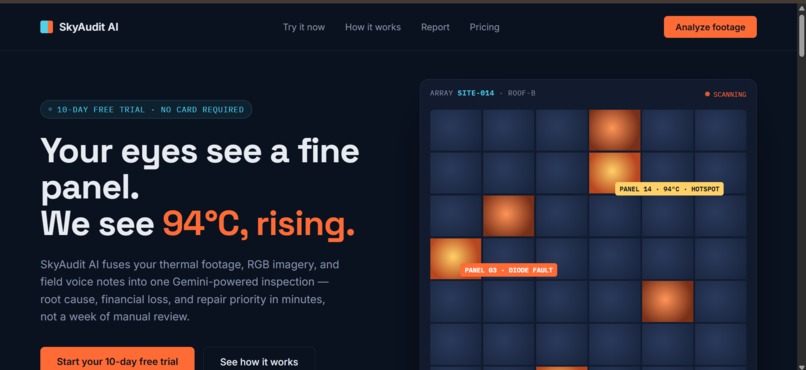
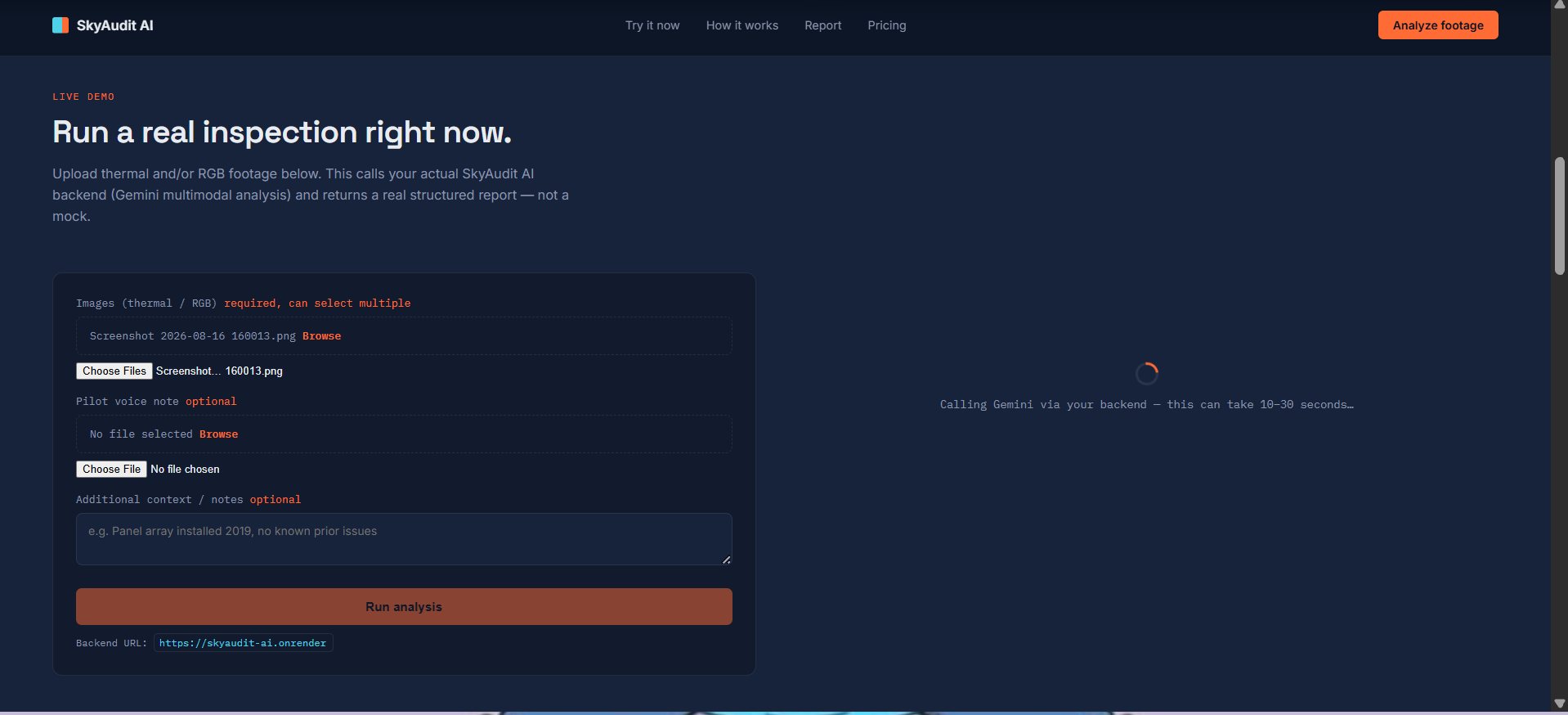
home page
-
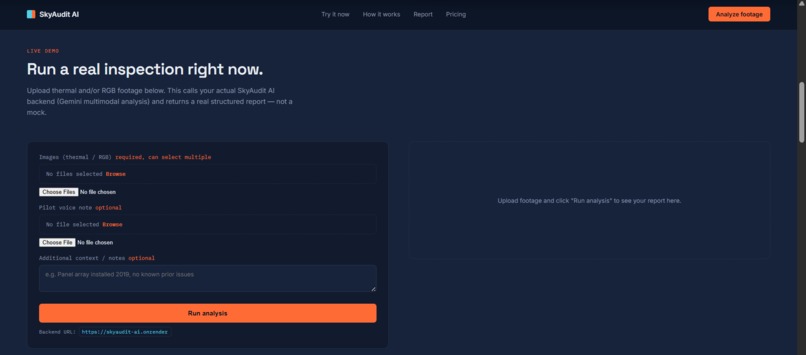
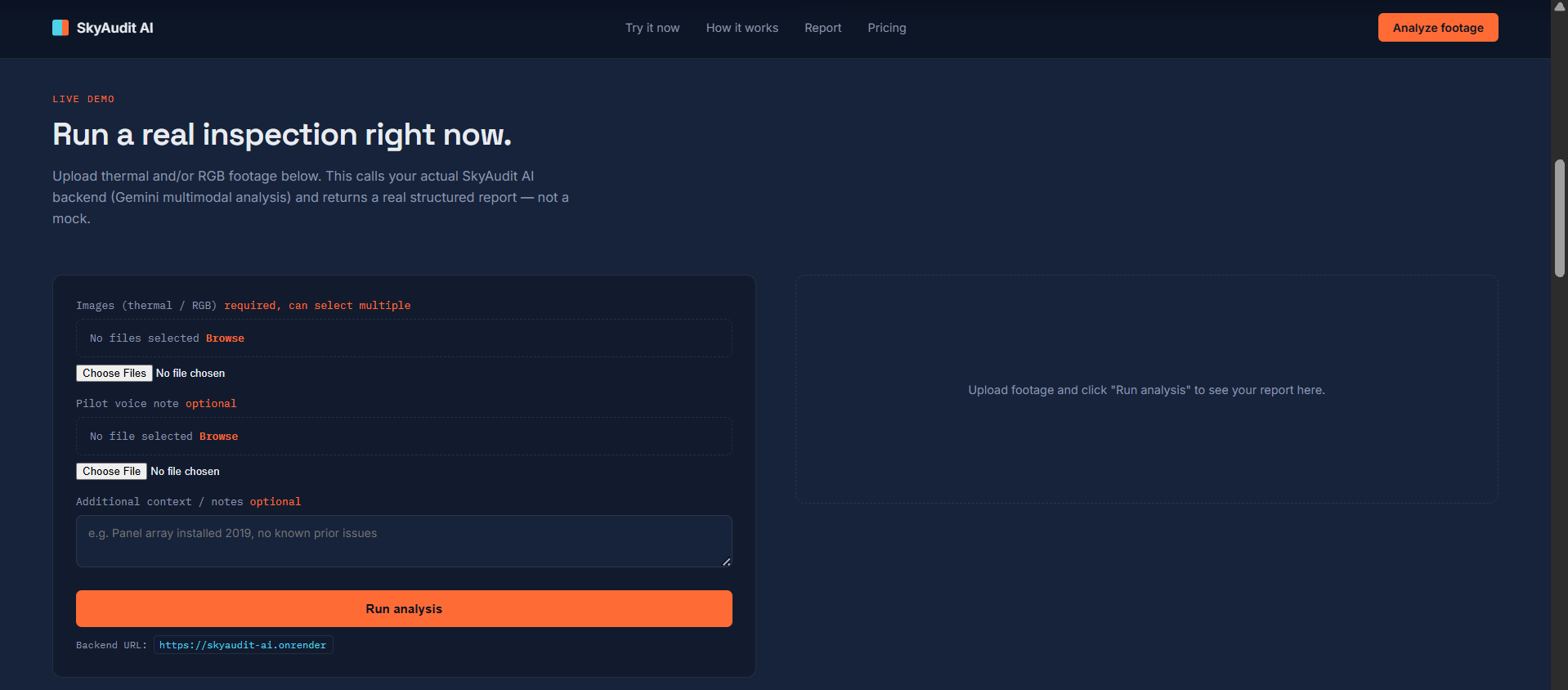
uploading
-
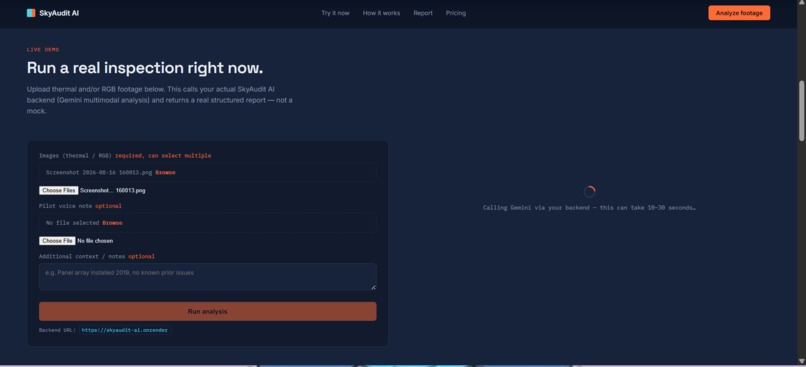
processing
-
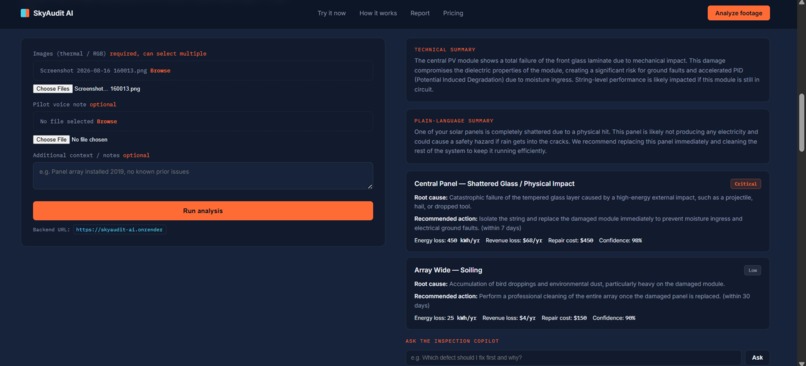
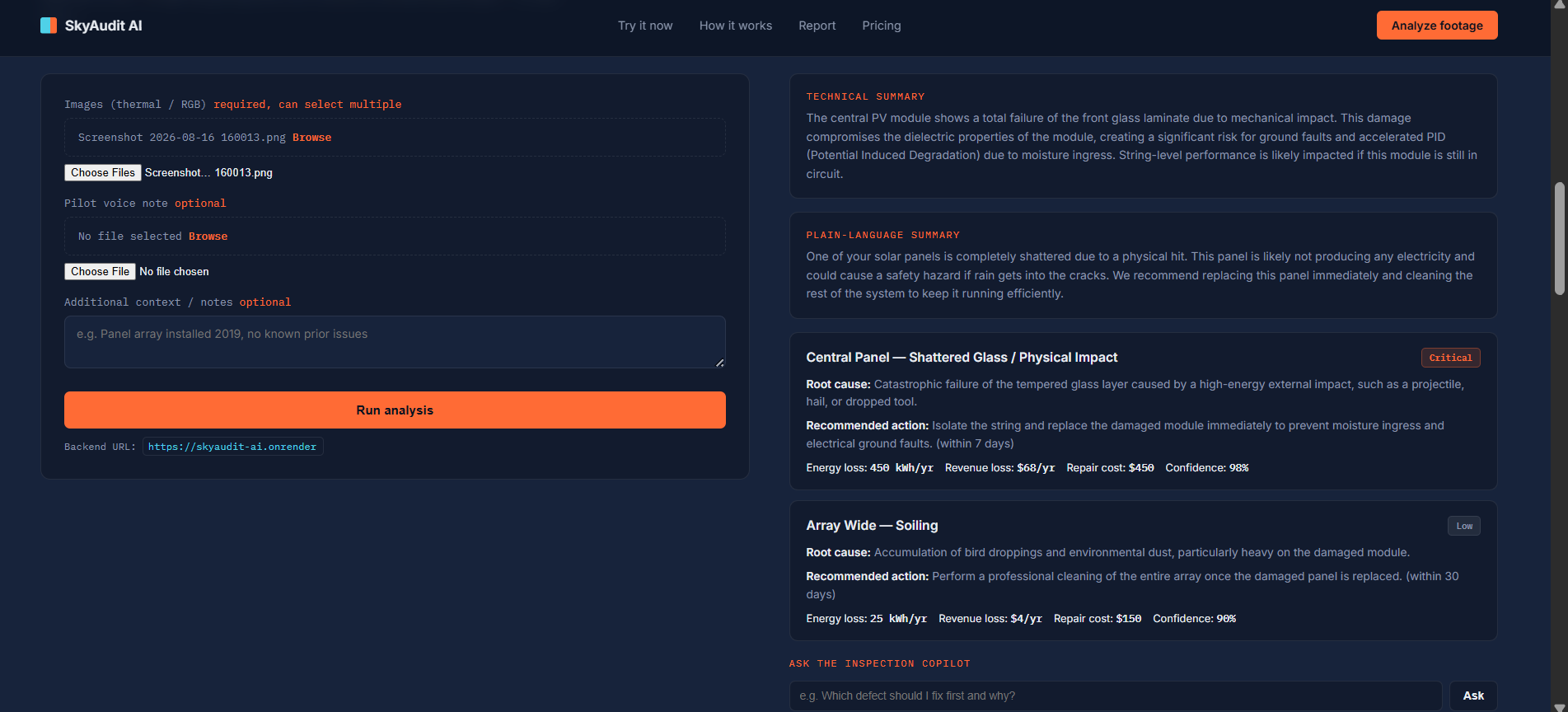
execution
-
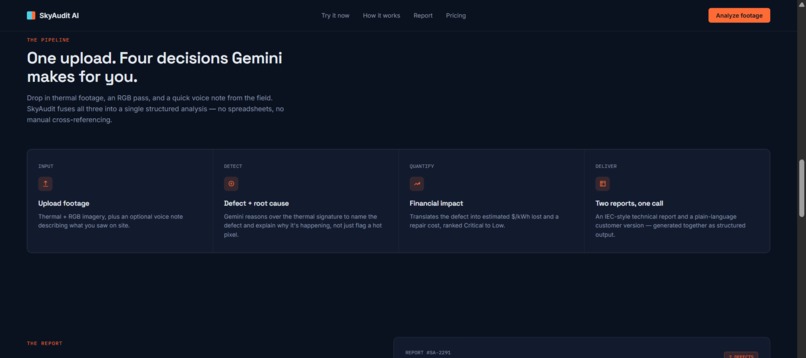
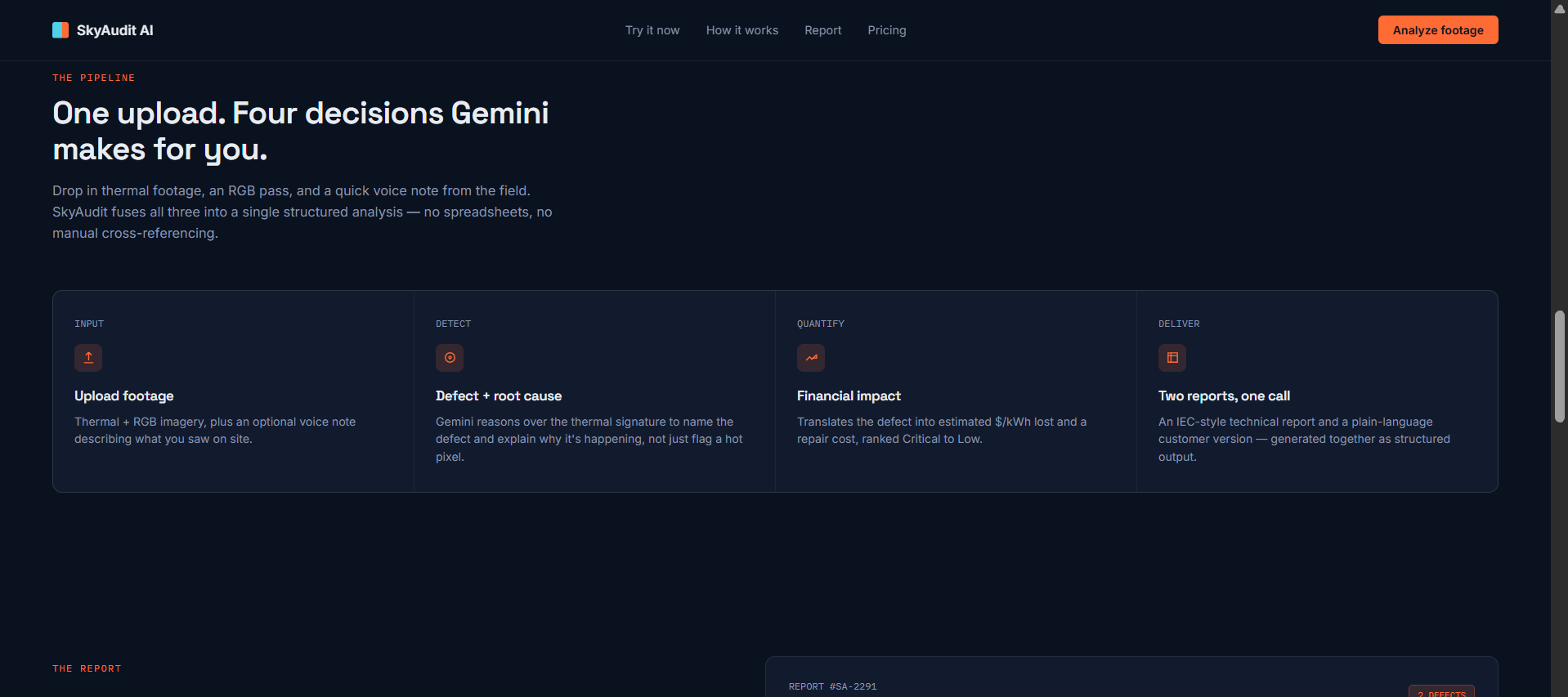
how it works
-
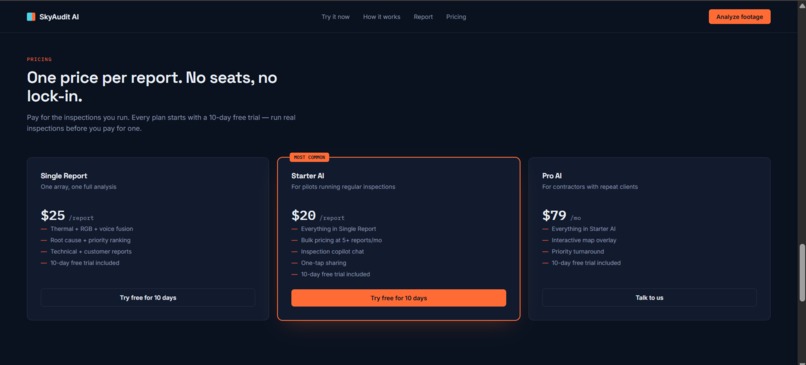
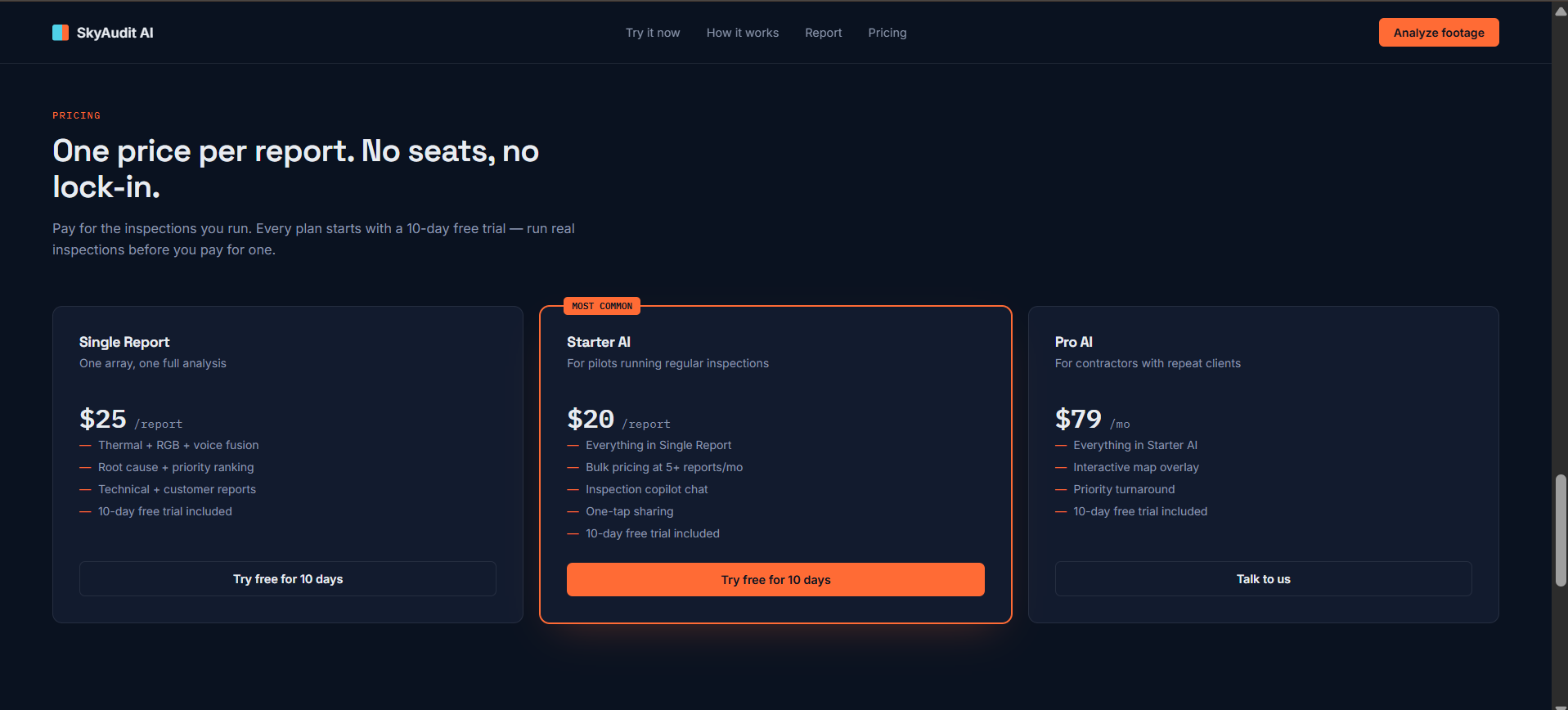
price page
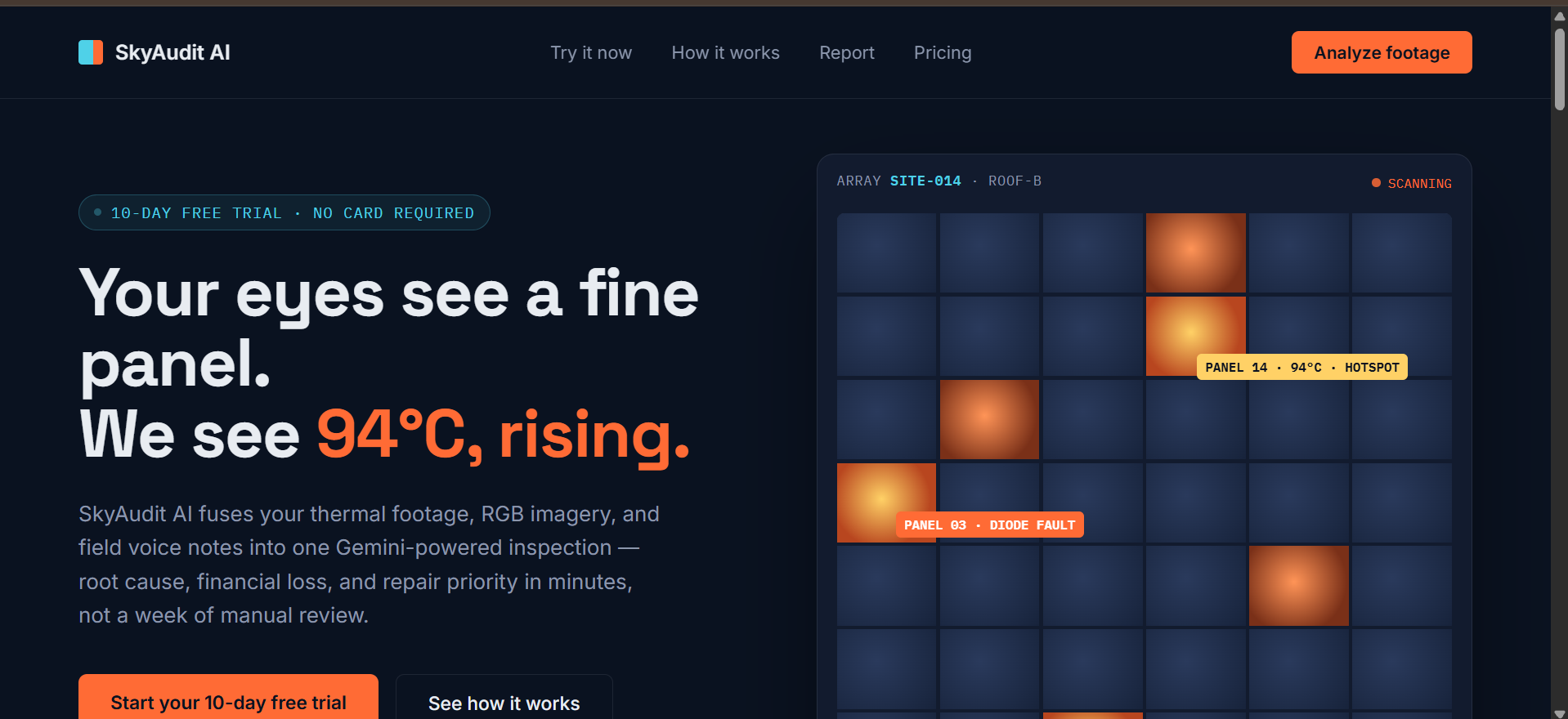
Inspiration
Independent drone pilots and small solar contractors are locked out of enterprise thermography tools that cost $5,000–$20,000 per year. Without them, they spend hours manually cross-referencing thermal footage, RGB photos, and equipment manuals just to identify a single failing panel.
SkyAudit AI was born to solve this. We wanted to give small businesses the same AI-powered decision support as the big guys—turning a 3-hour manual review into a 5-minute automated report for just $25.
What it does
SkyAudit AI is a pay-per-report inspection platform. A drone pilot uploads their thermal footage, RGB imagery, and a quick voice note from the field. Behind the scenes, Google’s Gemini Multimodal API fuses all three inputs into a single analysis.
In under 5 minutes, the pilot receives a structured report containing:
- The exact defect type and root cause (e.g., failed diode, micro-crack).
- The estimated annual financial loss in $/kWh.
- A repair priority ranking (Critical, High, Medium, Low) with an estimated repair cost.
The system automatically generates two versions of the report: a technical IEC-style report for contractors, and a plain-language customer version for homeowners—ready to share in one tap.
How we built it
We built the frontend using clean HTML, CSS, and vanilla JavaScript. The backend is a lightweight Python FastAPI application deployed on Google Cloud Run, with image files hosted in Google Cloud Storage.
The core intelligence relies entirely on the Gemini 1.5 Pro API. Through iterative prompt engineering, we taught Gemini to accept multimodal inputs (images + audio) and output a strictly structured JSON schema. This JSON drives the automated financial calculations and defect severity rankings without human intervention.
Challenges we ran into
The biggest challenge was prompt tuning. We needed Gemini to reliably differentiate between a true hardware failure (like a diode fault) and a benign environmental anomaly (like a bird dropping or dust).
Early results were inconsistent, sometimes hallucinating non-existent defects. We overcame this by building a few-shot prompting pipeline that feeds Gemini a controlled example of a valid defect report before processing the user's upload. This significantly increased the accuracy of the root-cause reasoning.
Another massive challenge was time management. As a solo builder, I had to balance building the product with doing real customer discovery. I learned that building a "concierge MVP"—where I manually processed the first few reports behind the scenes to prove the business model—was the only way to survive the tight deadline.
Accomplishments that we're proud of
- Fully functional multimodal pipeline: We successfully fused thermal + RGB images with audio voice notes into a single Gemini reasoning call.
- Ultra-lean economics: We proved that our cost per report is ~$0.05 (Gemini API usage), allowing a massive 99% gross margin at a $25 price point.
- Two-in-one reporting: We successfully engineered a single JSON output to dynamically generate both a technical inspector report and a plain-language homeowner report, saving hours of manual rewriting.
- Validated market need: Even before the final automated deployment, our direct outreach to local drone pilot communities resulted in genuine interest and signed-up pilot contacts ready to buy once the roll-out is complete.
What we learned
- Sell before you build: The biggest lesson was not to wait for a perfect product. By offering a "concierge" version of the service to pilots early on, I validated that people actually wanted this tool before I spent days polishing the code.
- Structured JSON is king: Getting Gemini to reliably output a strict JSON schema is significantly harder than getting it to output human-readable text. We learned that explicit, highly defined instructions and strict formatting constraints in the system prompt are non-negotiable for production.
- Cloud deployment is the last step: Spending hours on DevOps early on is a trap for solo developers. Prototyping the AI locally and only moving to Google Cloud Run in the final 48 hours saved major development time.
What's next for SkyAudit AI
We are actively building the Gemini Inspection Copilot—an AI chat interface that allows users to ask follow-up questions over their completed report (e.g., "Why is Panel 14 overheating?").
In the next quarter, we plan to:
- Launch a Pro subscription tier for high-volume contractors.
- Add an interactive Leaflet map overlay for visualizing defect pin locations.
- Expand from solar farm inspections into general roofing and industrial drone thermography.
- Enable one-click WhatsApp/email sharing for the plain-language customer reports.


Log in or sign up for Devpost to join the conversation.