Sky Launchpad
Global AI Hackathon Series with Qwen Cloud — Track 4: Autopilot Agent
Inspiration
It takes more than a decade to become a solutions architect, and most architects only ever master one cloud. You have to know hundreds of services, estimate costs, plan for scale, and defend the system against security mistakes. Big companies hire whole DevOps teams for this. A startup or a 50-person shop can't — so they guess, overpay, or get stuck.
But the thing that really bothered me was watching AI infrastructure tools make the same mistake twice. I'd ask an assistant to generate Terraform, it would pick an instance type that isn't offered in the target zone, terraform apply would fail, it would patch it, and we'd move on. Next week, different project, same class of mistake. The model never got worse — but it never got better either. Every deploy started from zero.
That's not how engineers work. When an SRE hits a wall at 2am, they write it down. The runbook grows. The team gets faster. I wanted infrastructure automation that compounds — not a bigger model, but an agent with memory — and I wanted it to live where teams already make these decisions: in Slack.
What it does
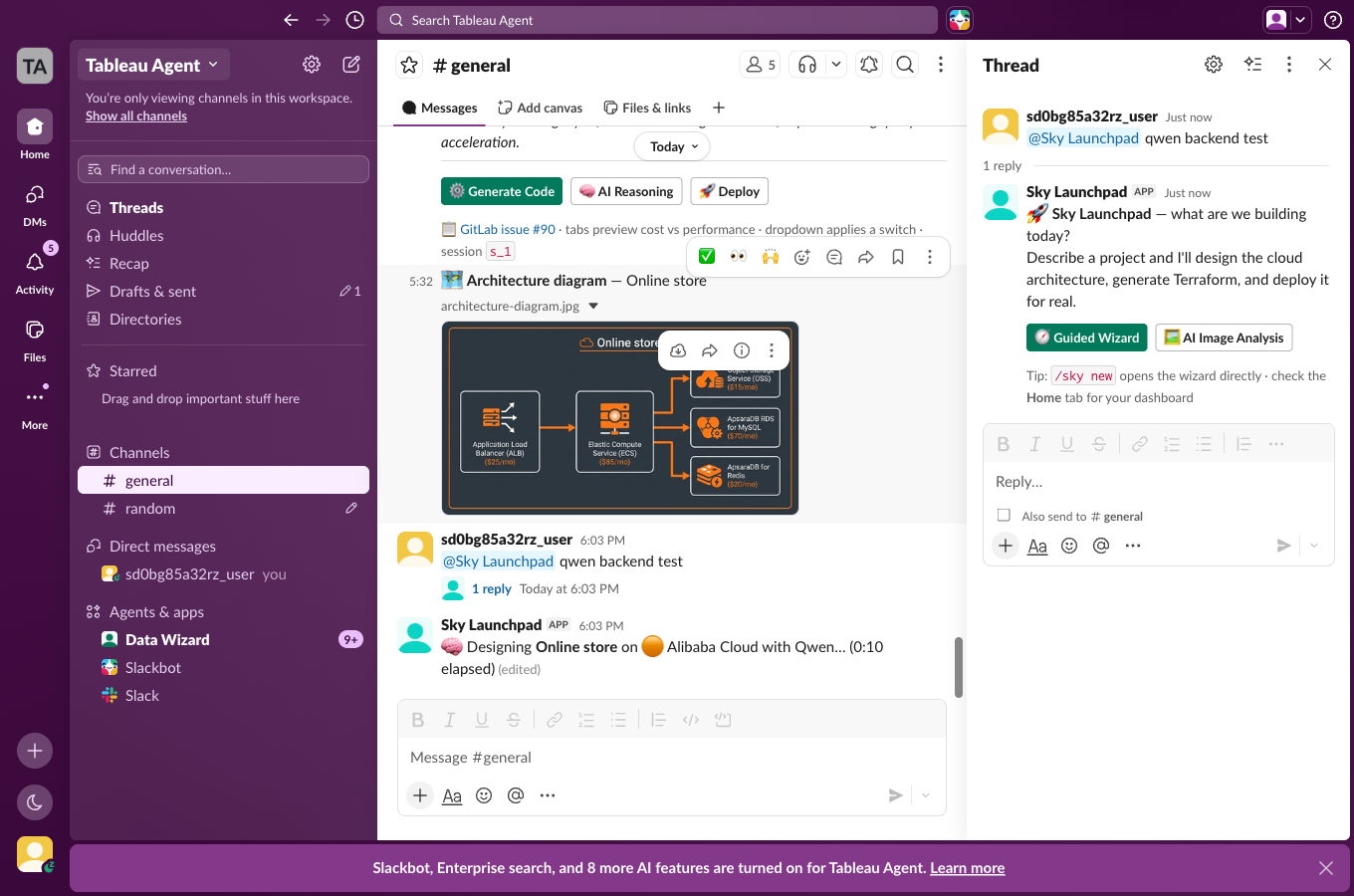
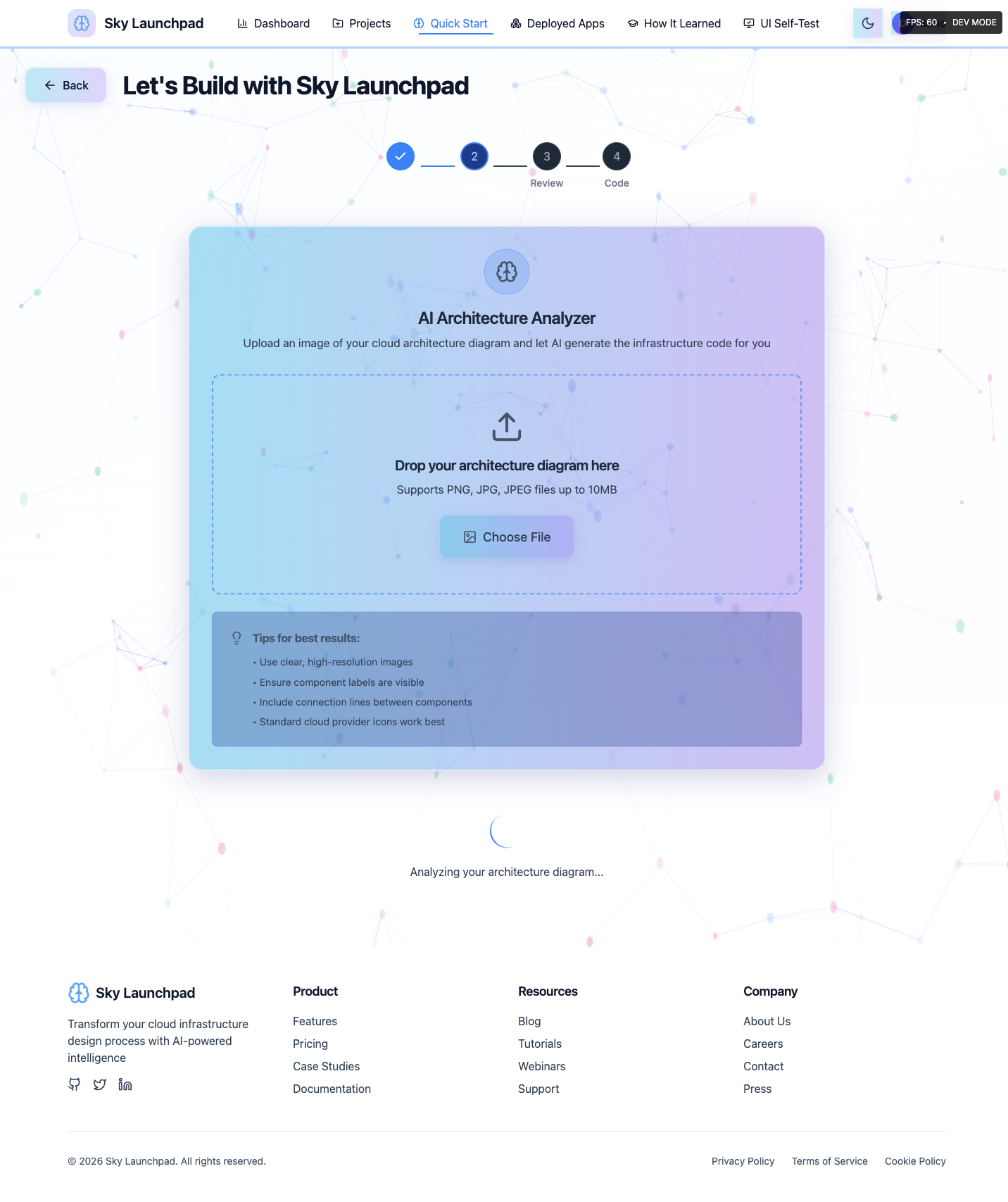
Sky Launchpad turns plain English (or an uploaded architecture diagram) into deployed cloud infrastructure, and learns from its own failures along the way.
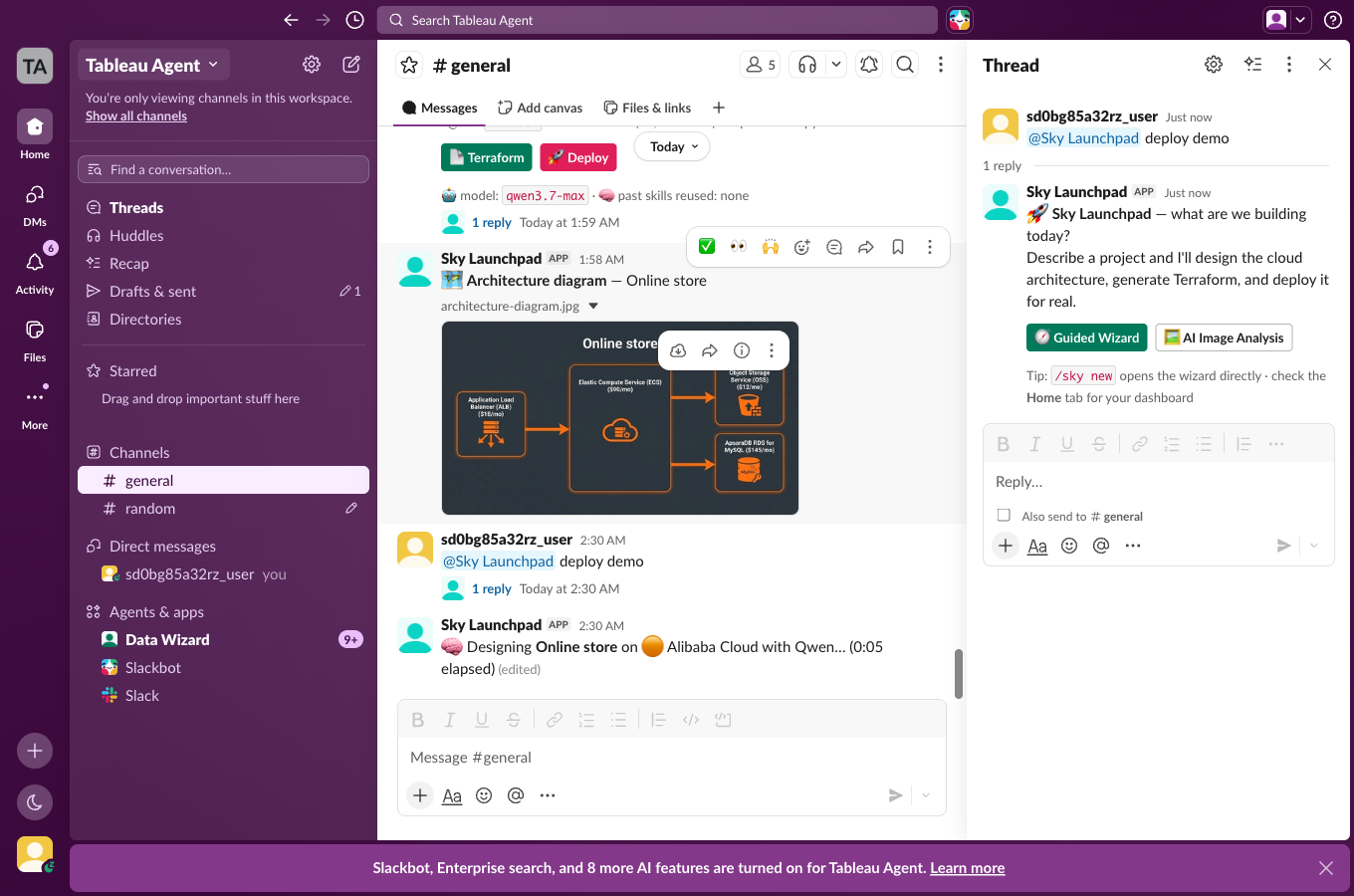
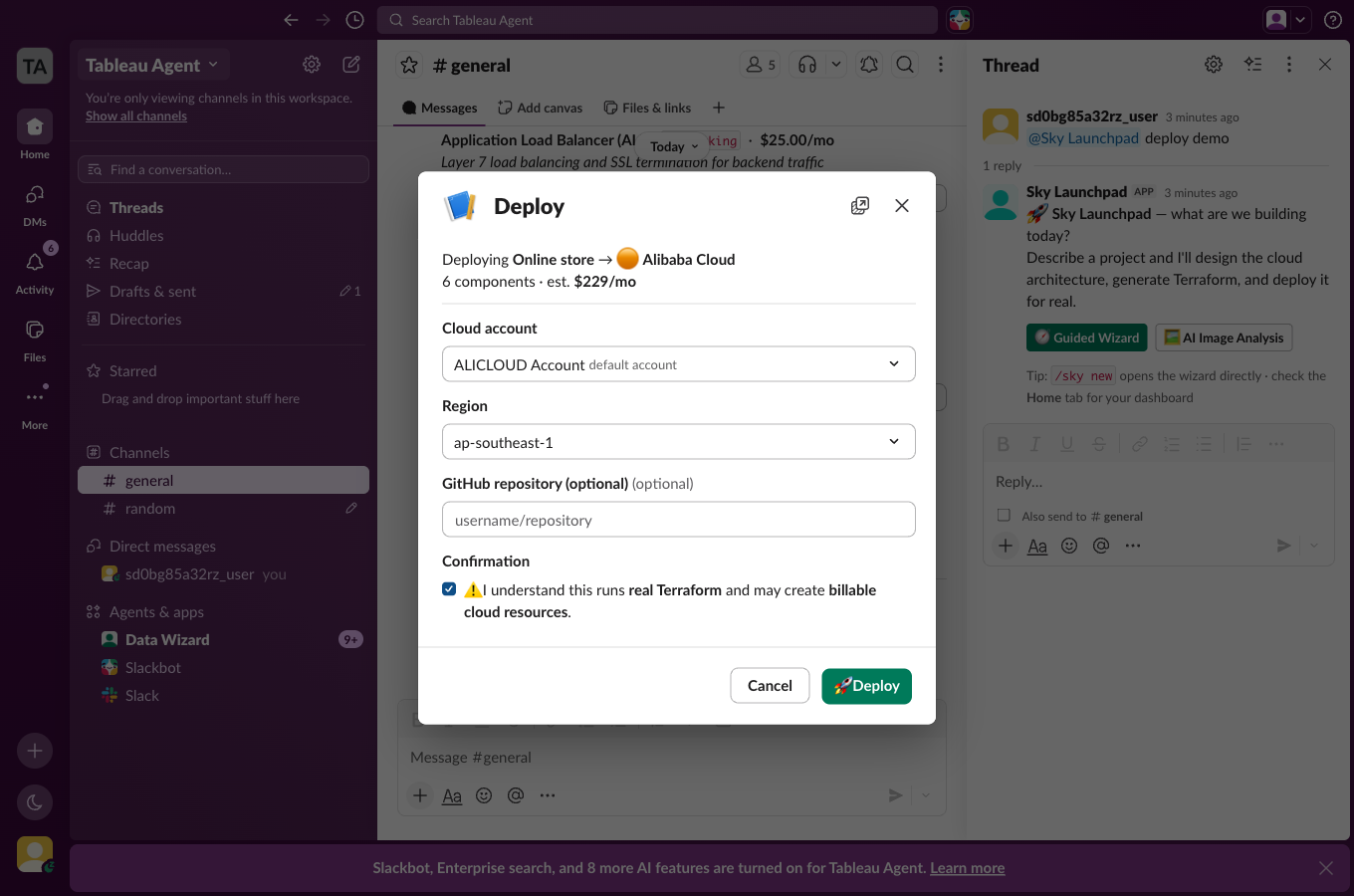
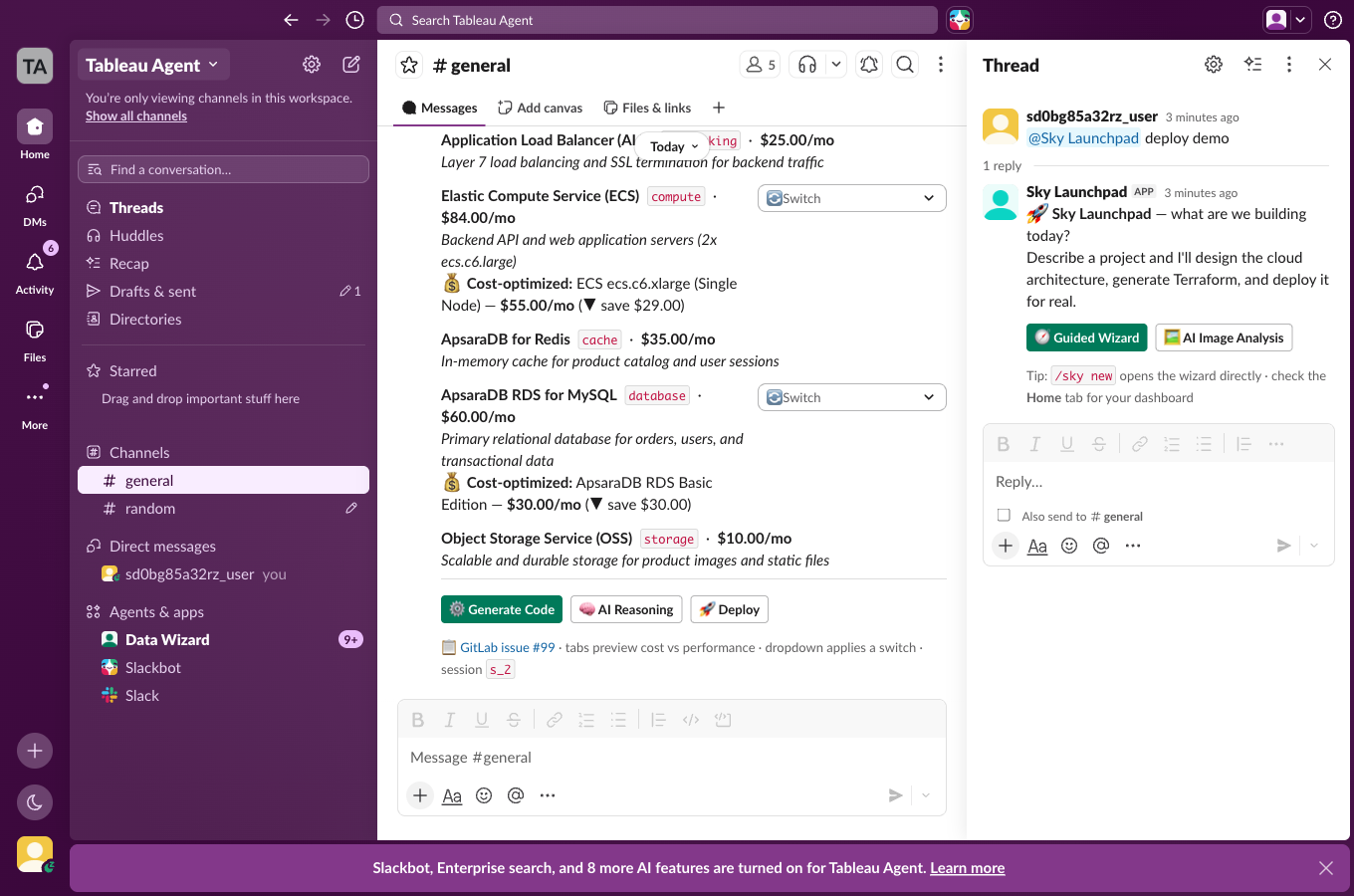
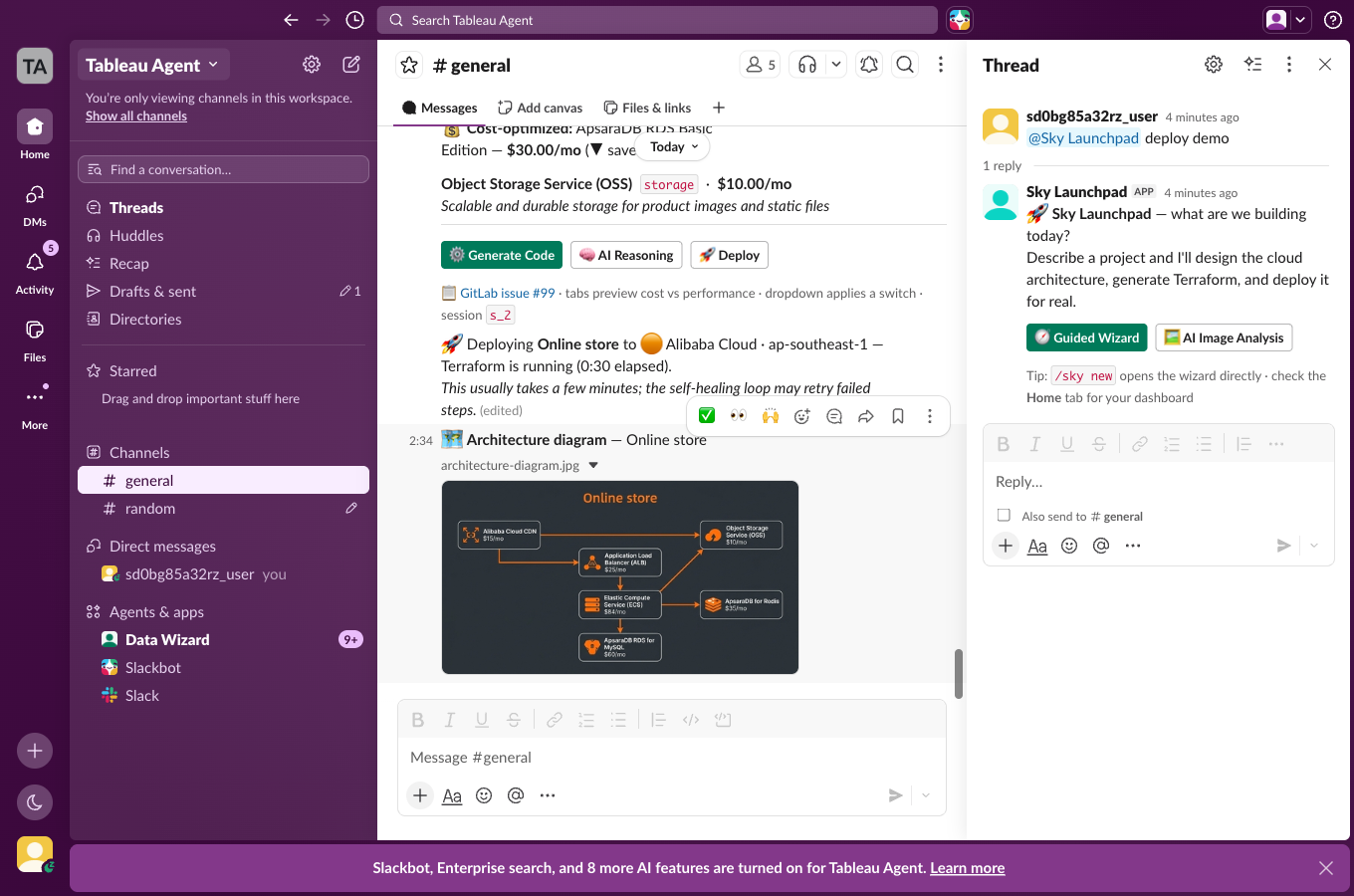
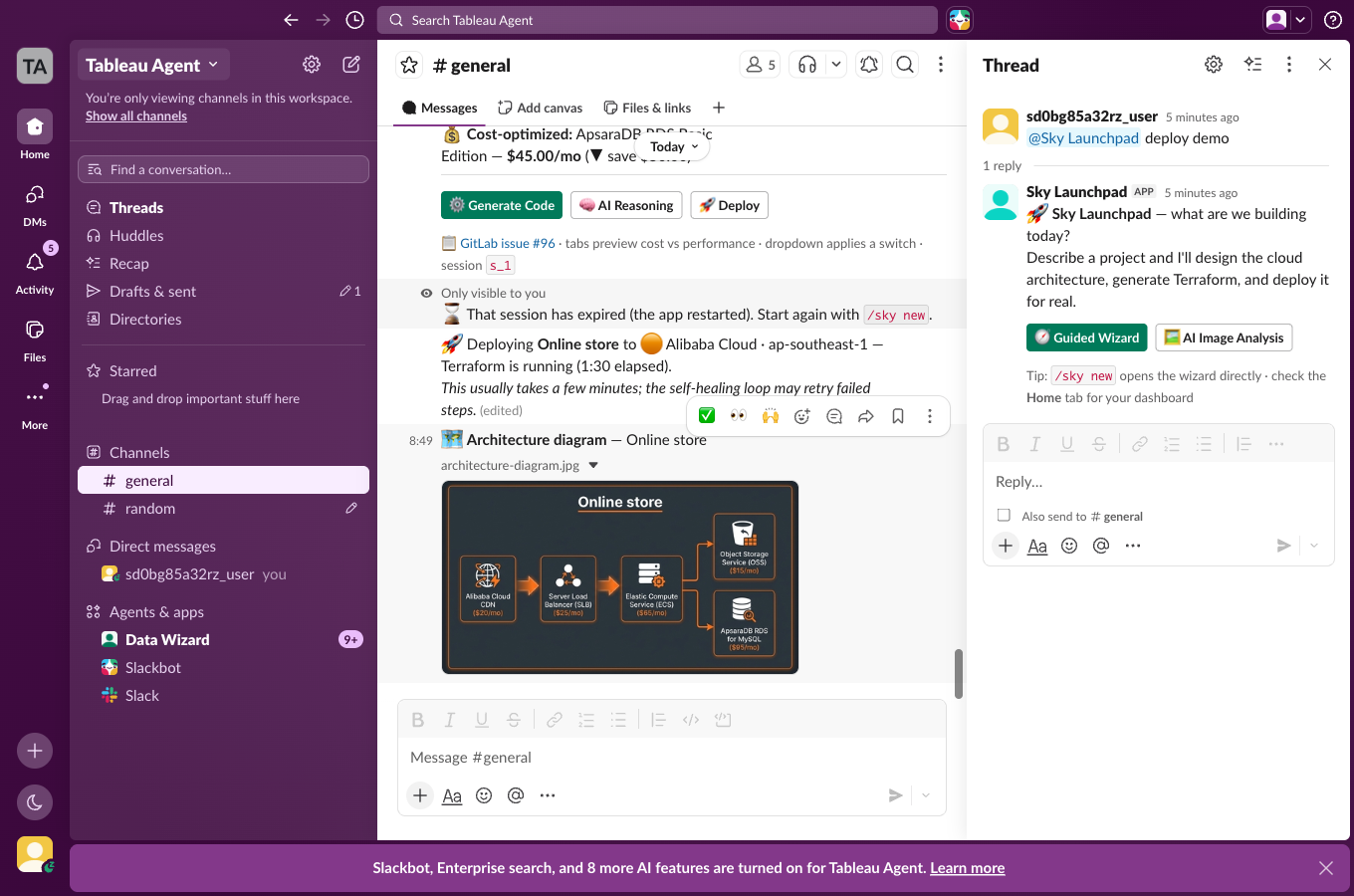
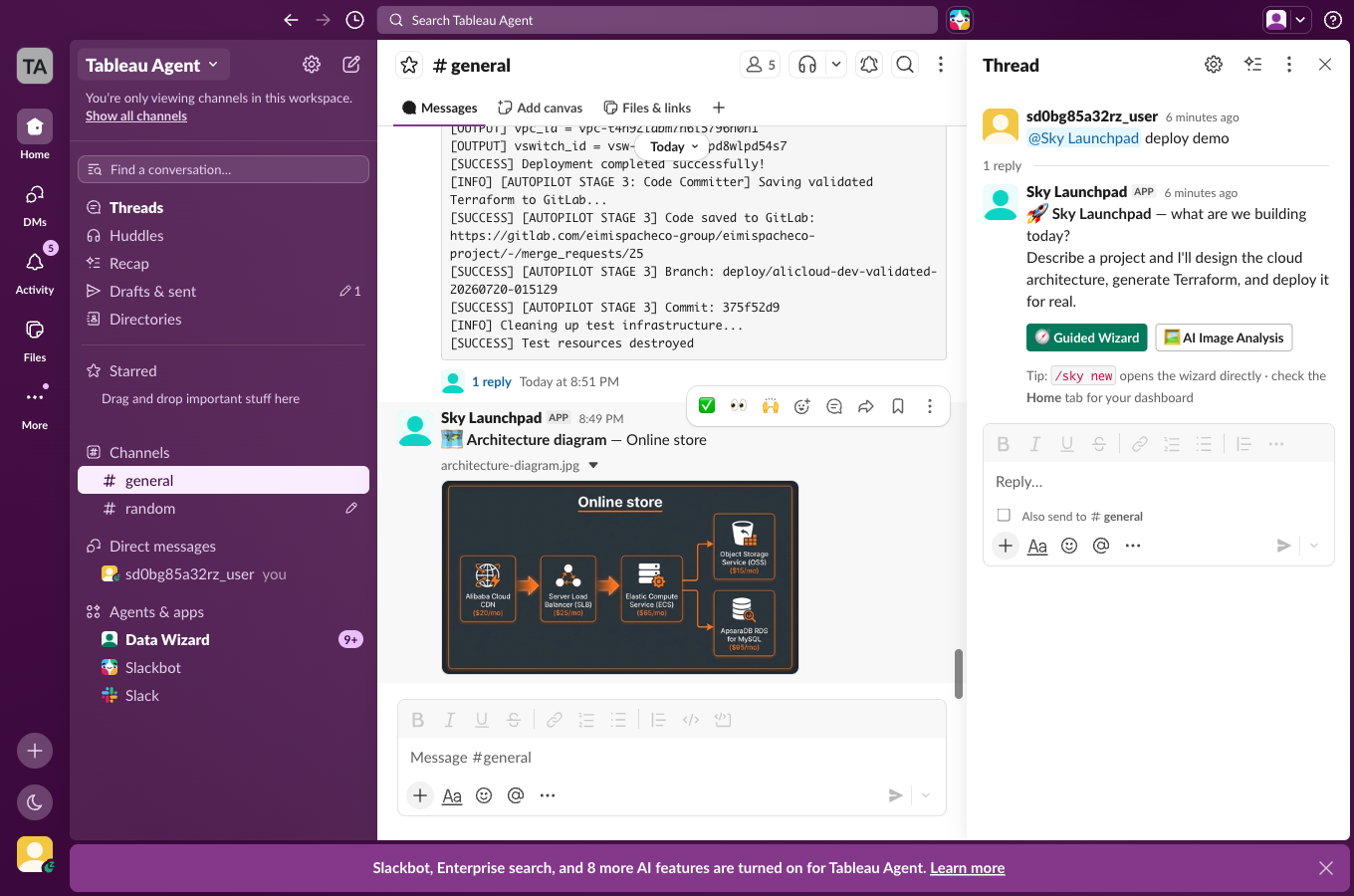
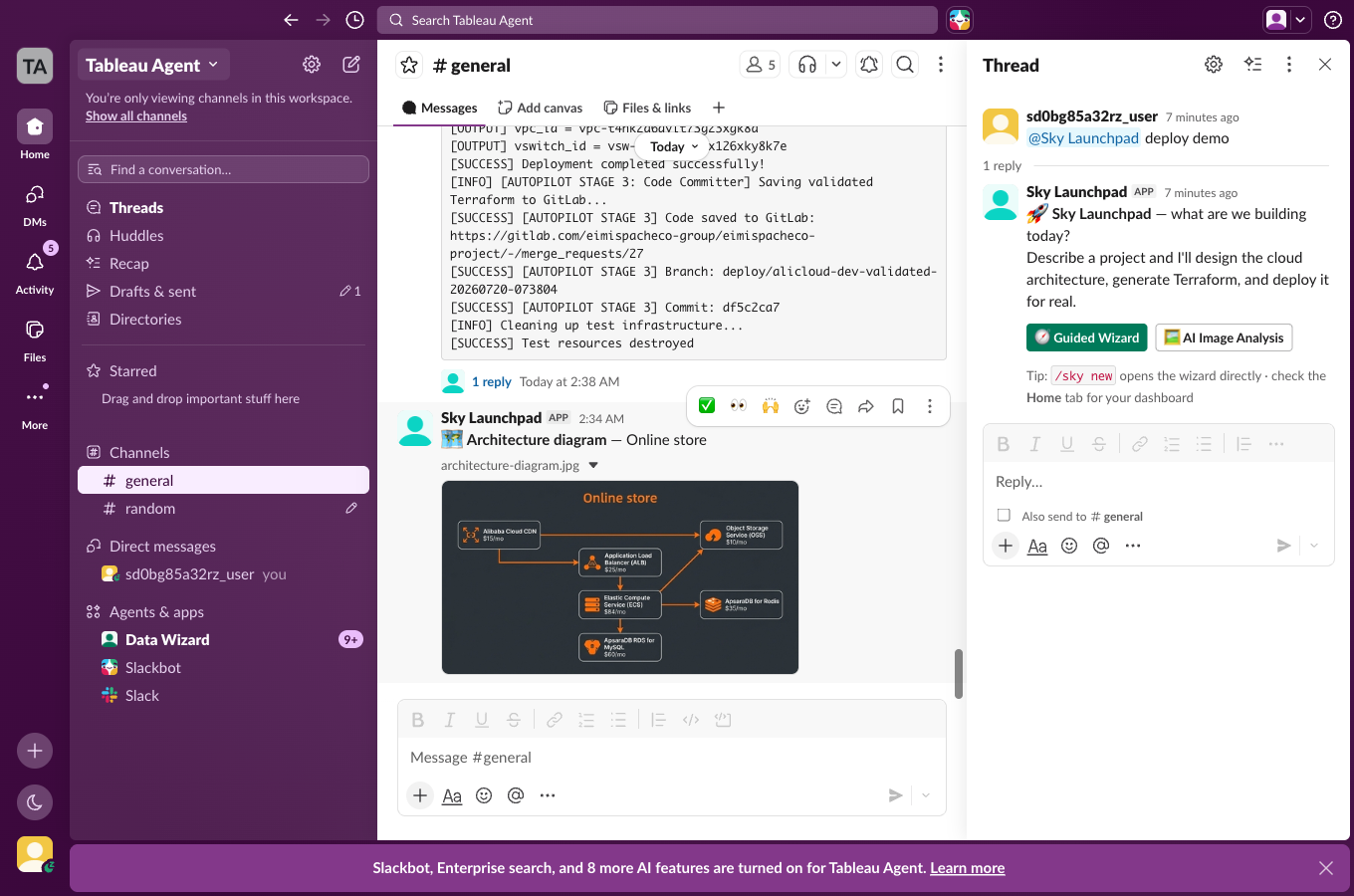
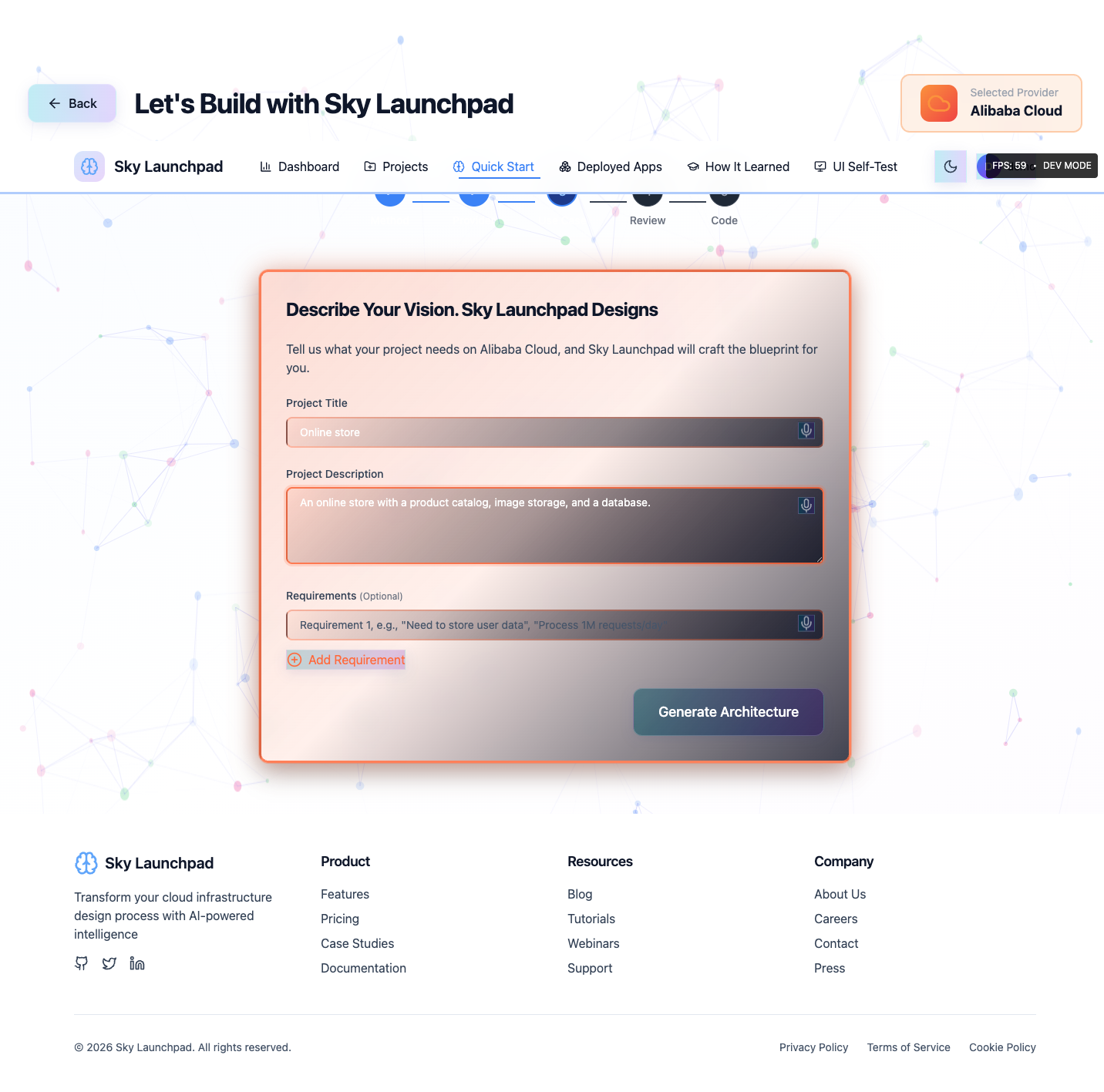
Inside Slack I type something like "an online store with a product catalog, image storage, and a database." In seconds Qwen designs the full architecture — every component, a realistic monthly cost, and a diagram — right in the channel. I can flip between Cost Optimized and Performance Optimized to see the tradeoffs instantly, or swap any single component for a cheaper or faster one. One click writes production-ready Terraform. Another click deploys it for real to Alibaba Cloud, and opens a GitLab merge request when the infrastructure actually stands up.
The interesting part is what happens when a deploy fails:
- It reads the Terraform and cloud error logs.
- It researches the exact error on the live web — turning on Qwen's web search to check the provider's current docs — on the very first failure, not as a last resort.
- Qwen (
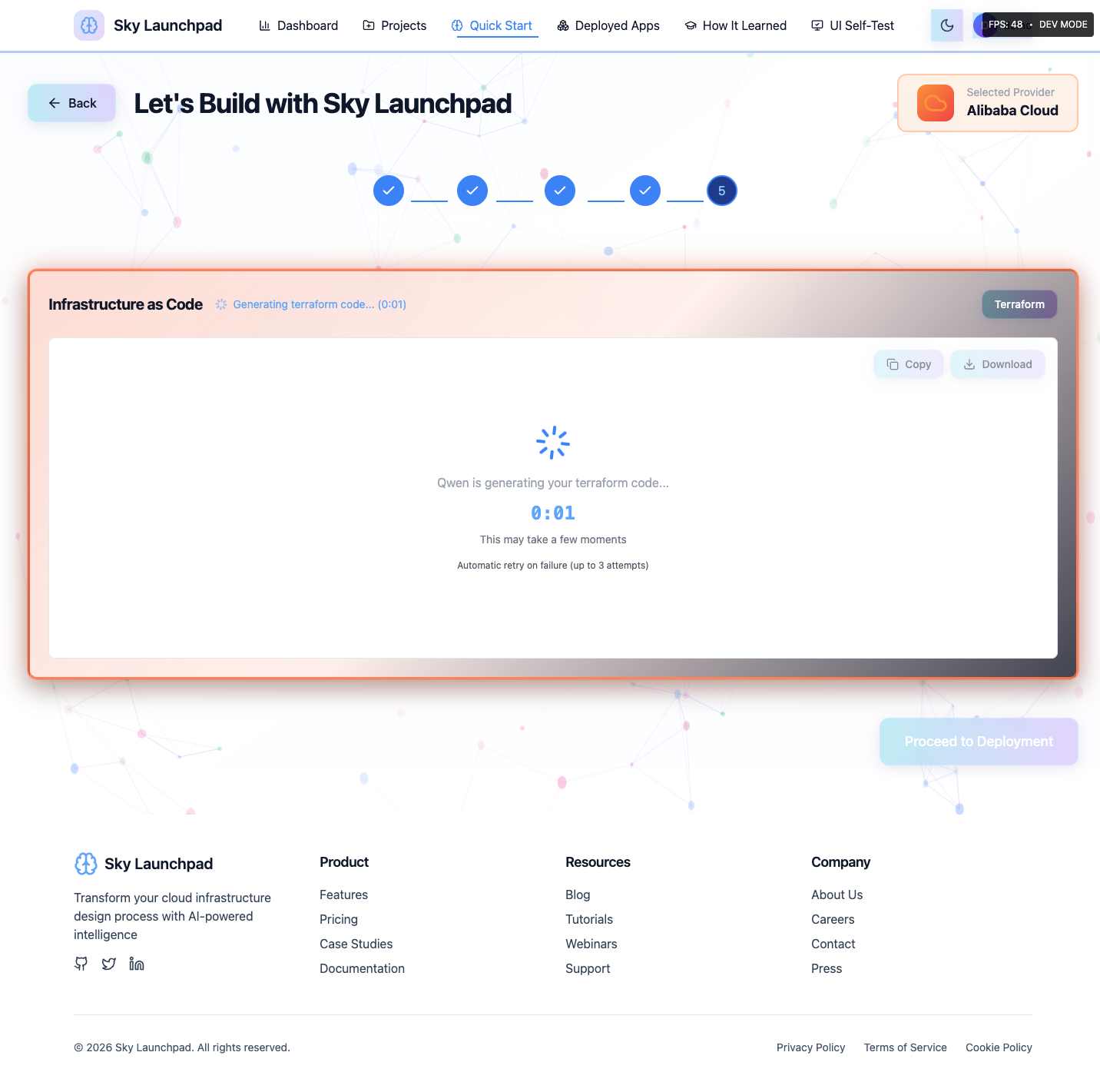
qwen3.7-max) then diagnoses the root cause with that research in hand, fixes the HCL, and authors a generalized, reusableSKILL.md— not "fix line 42", but "check the VPC CIDR before creating the VSwitch" — and retries. The cycle repeats on every failure until it succeeds — fail → research → learn → retry → succeed. - Every learned skill is embedded and remembered, so the next deploy retrieves it by similarity and never repeats the mistake.
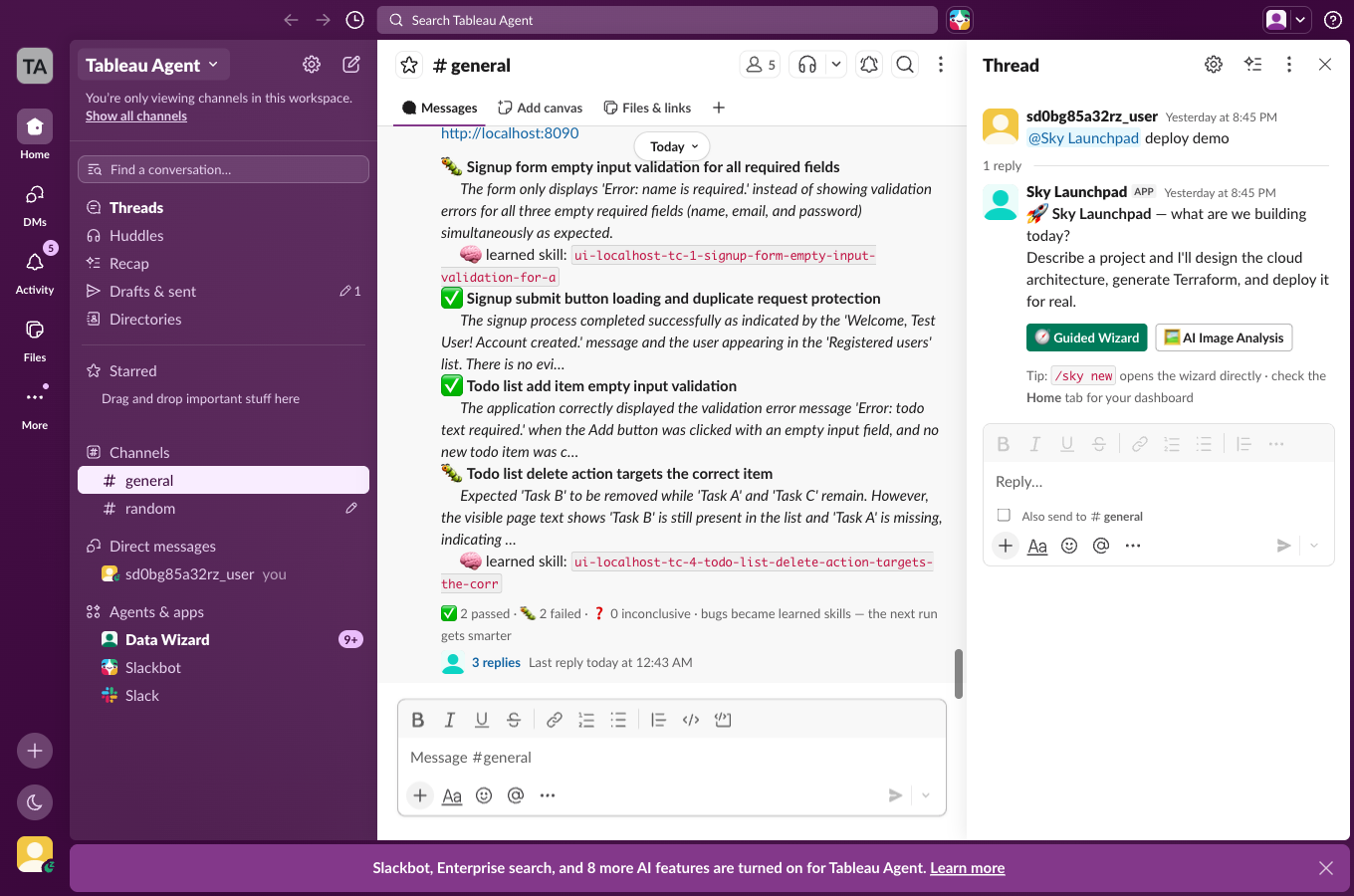
Then it can test the deployed app like a human. The Testing agent (qwen3.7-max) writes its own test cases from scratch — for each one it invents a title, the exact click-by-click steps, and the expected outcome, guided by the pitfalls it learned on earlier runs. It then drives a real browser through each case (reading the page's interactive elements so its clicks always land) and, for every case, reports a clear verdict:
- ✅ pass — the expected outcome was confirmed, or
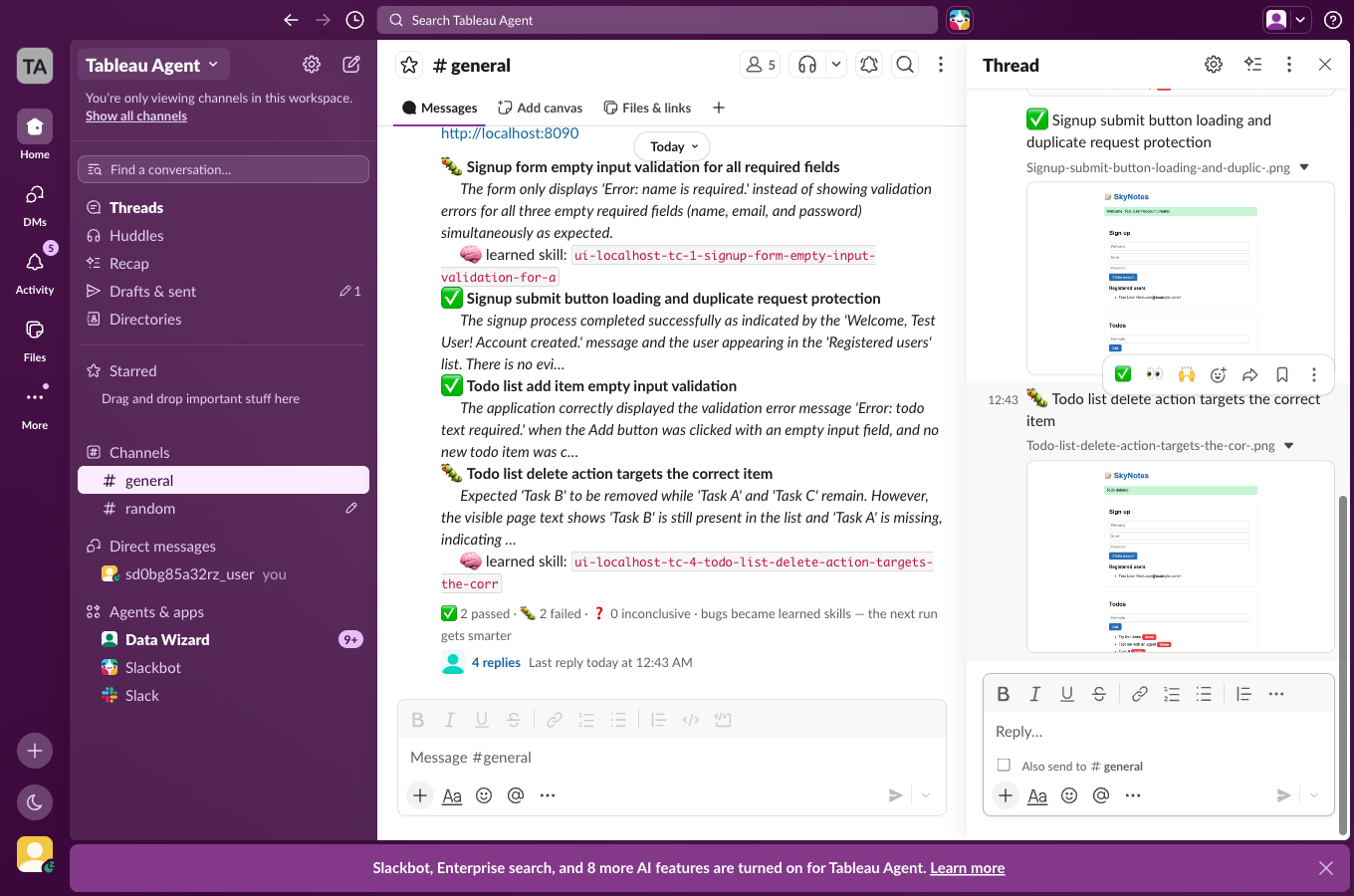
- 🐛 fail — a bug. And when it fails it tells you three things: why (the exact evidence it saw on the page), a 🔧 suggested fix (one concrete sentence for the developer — which validation or handler to add), and a screenshot of the moment. Each bug is also distilled into a reusable skill, so the next run already knows to check for that class of problem.
In one real run against a demo app it authored its own cases and caught two genuine bugs: a signup form that accepted empty required fields (fix: "collect and display all validation errors at once"), and a delete button that removed the wrong item (fix: "the handler must remove the specific todo from state") — each with the evidence, the fix, and a screenshot.
Two ways in, one brain
Everything above works in two interchangeable interfaces — Slack and a React web app — on one shared backend. They are the same product with different surfaces:
Slack is where a team designs, deploys, and reviews together in a channel — Block Kit cards for the architecture, cost/performance tabs, component swaps, the deploy, and the test results.
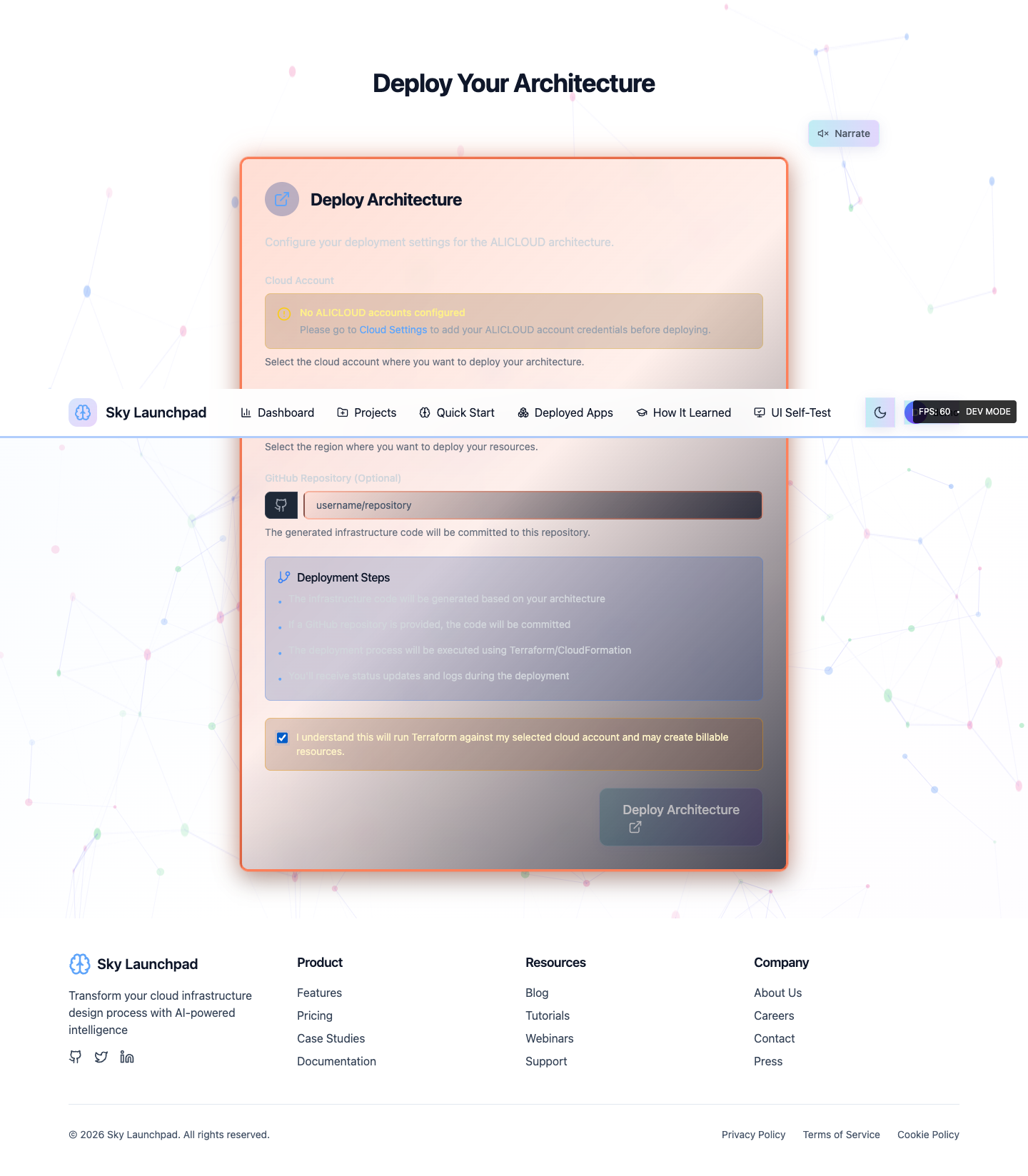
The web app is the same flow with a visual architecture canvas, plus a live "How It Learned" view of the skill memory and a "UI Self-Test" page.
Because both talk to the same FastAPI backend, the behavior is identical — you can start a design in the web app and finish it in Slack, or run both at the same time, side by side. Same brain, different UI.
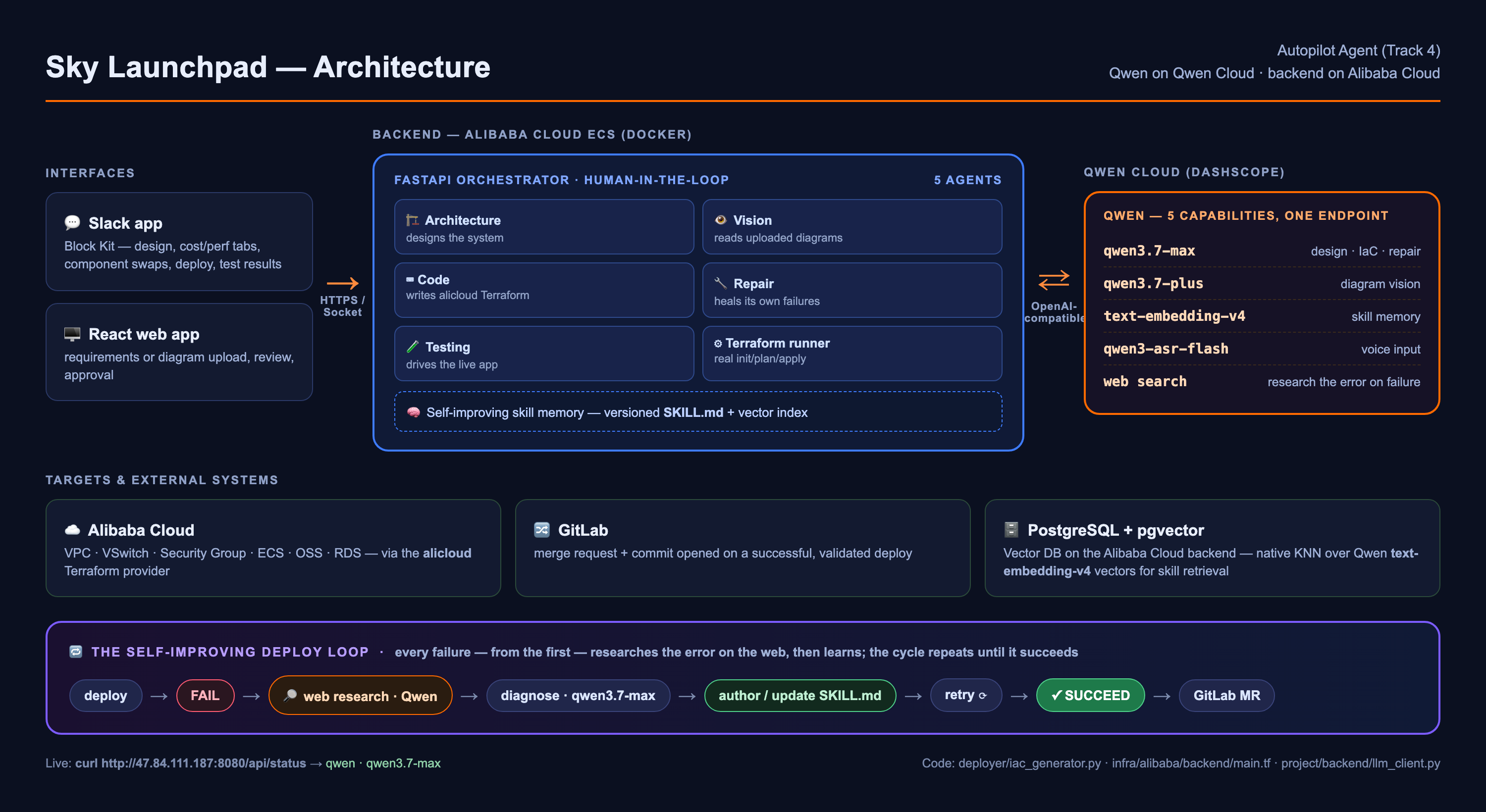
It's a team of five specialized agents, each powered by Qwen: an Architecture agent that designs the system, a Vision agent that reads uploaded diagrams, a Code agent that writes Terraform, a Repair agent that heals its own failures, and a Testing agent that drives the live app.
How I built it
Qwen Cloud is load-bearing across five capabilities, not one call bolted onto a template engine — all through the OpenAI-compatible DashScope endpoint:
| Capability | Model / feature |
|---|---|
| Architecture design, Terraform generation, failure repair | qwen3.7-max |
| Diagram image → structured architecture (vision) | qwen3.7-plus |
| Self-improving memory (skill embeddings) | text-embedding-v4 |
| Voice input | qwen3-asr-flash |
| Live web research on every failure (from the first) | Qwen web search (enable_search) |
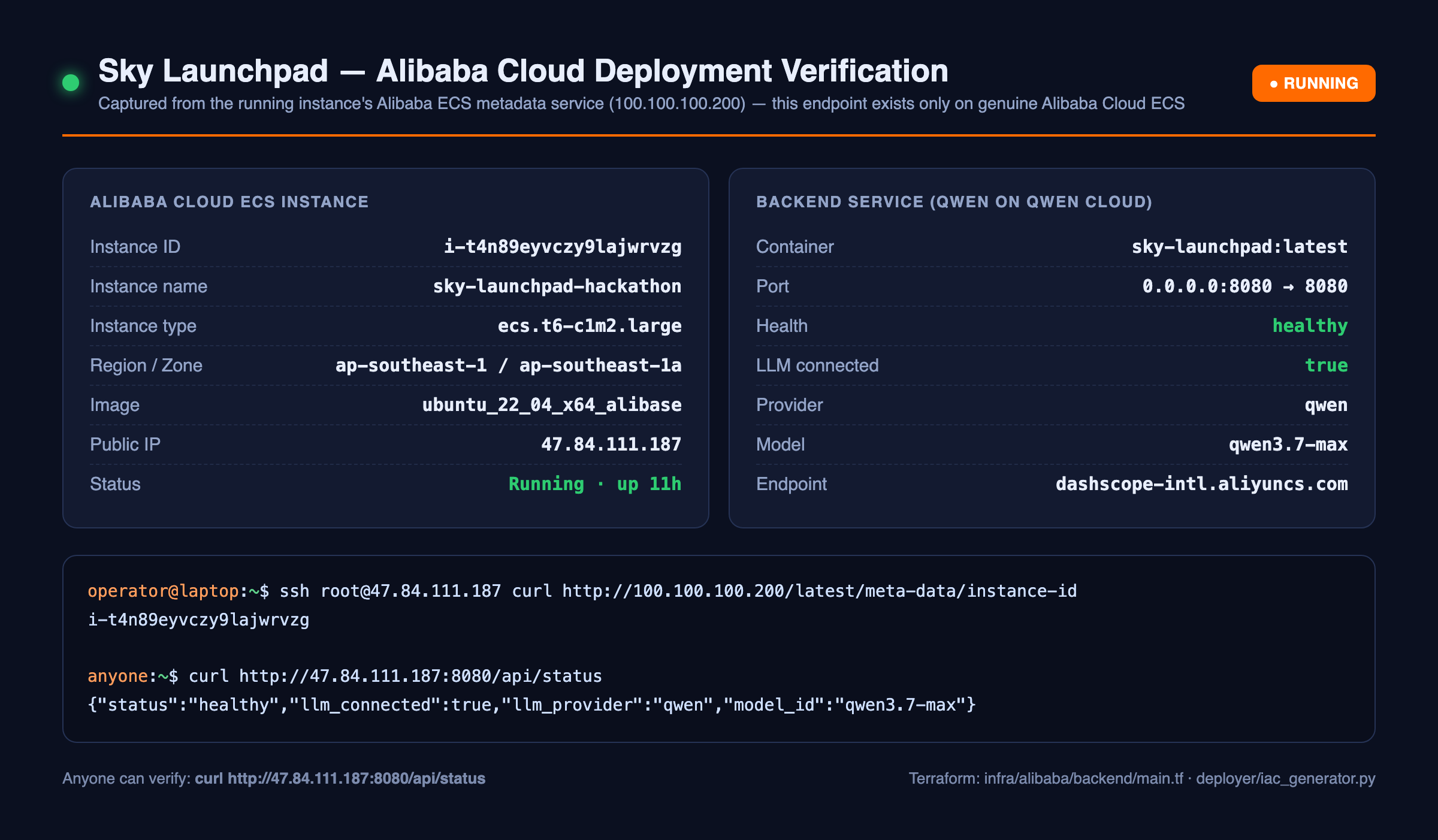
The backend is FastAPI, containerized with Docker, and runs on Alibaba Cloud ECS — provisioned by Terraform (infra/alibaba/backend/main.tf) into a VPC, VSwitch, and security group. The infrastructure the app generates also targets Alibaba Cloud: deployer/iac_generator.py emits alicloud Terraform that terraform apply runs for real. The self-improving skill library persists every
lesson as a versioned SKILL.md plus a vector in PostgreSQL + pgvector running on Alibaba Cloud, so skill retrieval is native cosine KNN over the Qwen embeddings. The Slack app is Bolt for JavaScript (Socket Mode, Block Kit); the web app is React + Vite. The browser-testing agent is built on Playwright, grounded in the page's accessibility tree so its clicks always land.
Challenges I ran into
- Making the loop actually learn, not just patch. The self-healing loop first lived only in a CLI. I had to wire skill-authoring into the same HTTP deploy path the product calls, so the differentiator fires for real users.
- The backend dying under its own deploy. A five-minute
terraform applyspiked memory and the single uvicorn worker got OOM-killed — nginx stayed up, so the API looked alive but every request timed out. I added a respawn supervisor, swap, and multiple workers so a slow deploy can't starve the fast endpoints. - Reliable browser testing. My first tester decided clicks from screenshot pixels and constantly missed by tens of pixels. I rebuilt it to read the DOM's interactive elements and act by index — same "acts like a human" behavior, but clicks that always land.
- Forcing the failure story to be honest. To demonstrate the recursive arc I built a two-stage fault: one error Terraform catches at plan time, and one the Alibaba API only rejects at apply time — so a single fix isn't enough, and the agent has to research, learn, and retry across two real failures before it succeeds.
- Getting the illustrated diagram to actually appear in Slack (it was being buried in a collapsed thread reply, and the image format didn't match its filename).
Accomplishments that I'm proud of
- The full recursive arc, working end-to-end on real Alibaba Cloud infrastructure: a deploy that fails, researches the error on the live web, learns a skill and retries, fails again on a second fault, researches and updates the skill, and succeeds on the third attempt — then opens a GitLab MR. Not a mock; a real
terraform apply. - A browser-testing agent that finds real bugs — empty-field validation and a wrong-item delete — and screenshots the evidence, all decided by Qwen.
- Qwen doing five different jobs through one endpoint, including live web search on every repair.
- A backend genuinely running on Alibaba Cloud that anyone can verify with a single unauthenticated
curl.
What I learned
- Qwen Cloud's OpenAI compatibility made a genuinely multi-capability agent simple: text, vision, embeddings, ASR, and web search behind one client and one key.
- A self-improving system only matters if the learning lives on the path users actually take — the loop has to fire in the product, not in a script.
- Grounding beats raw vision for reliability: reading the DOM made the testing agent trustworthy where pixel-guessing never was.
- "It works" isn't a claim you make from unit tests — you make it by driving the real interface and watching it happen. Half of what I fixed only showed up when I stopped mocking and drove the live app.
What's next for Sky Launchpad
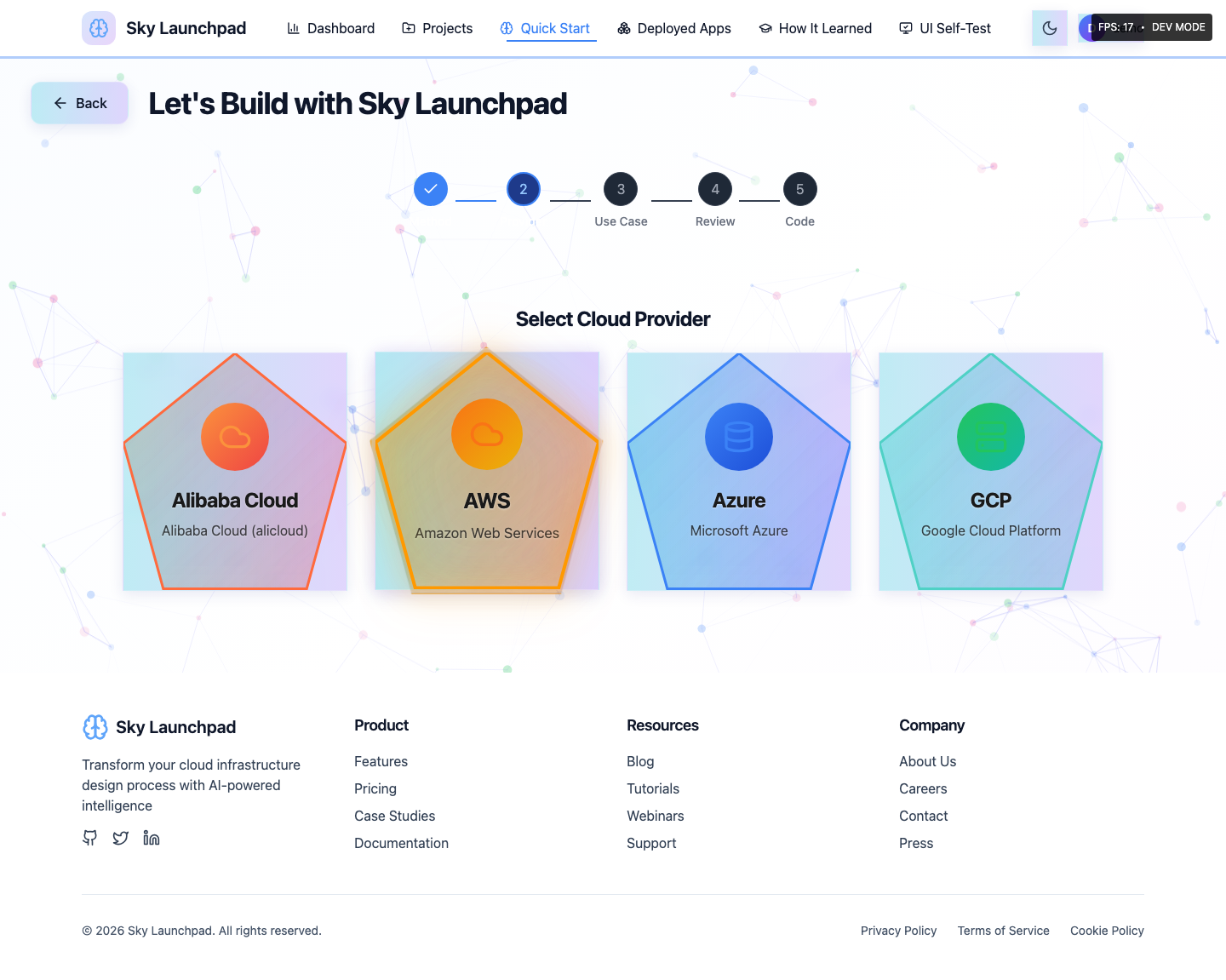
- Broader cloud coverage — the generator already emits AWS/GCP/Azure Terraform; bringing the self-healing loop to full parity across all four.
- A shared, growing knowledge base — learned skills that transfer across teams and projects, so the memory compounds organization-wide.
- More autonomy with the right guardrails — approving a real deploy should stay human, but drift detection, cost alerts, and auto-remediation shouldn't.
- Polishing the web app's deploy path to full parity with Slack, and richer live narration of the repair loop.
Sky Launchpad is not a chatbot that answers questions. It is a team of autonomous agents that think, deploy, test, and improve — powered end to end by Qwen on Qwen Cloud, and running on Alibaba Cloud. Professional cloud architecture for everyone.
Built With
- alibaba
- qwen-cloud


Log in or sign up for Devpost to join the conversation.