-
-
-

Logo

Inspiration
We are members of GDG Hanoi—dedicated individuals who have tirelessly contributed to the tech community for many years, bringing Google technology closer to Vietnamese developers. Before joining this competition, our team self-developed event websites, check-in applications, and more, to optimize event organization.
Driven by the urgent issue of missing women and children due to kidnapping, trafficking, and illegal activity, we came together to plan and develop an application—a powerful tool to aid in the search and rescue of victims.
According to statistics from the Ministry of Public Security, in the first quarter of 2024, human trafficking in Vietnam has become more complex, with an increase in cases compared to the same period in 2023. Illegal activities, such as unauthorized labor migration, forced labor, and online fraud, have escalated in some Southeast Asian and European countries. Victims, especially women and young girls, face both labor and sexual exploitation. Criminals exploit economic hardship, gullibility, and a lack of awareness to deceive and traffic women, particularly in rural, remote, and border areas.
Since kidnapping organizations often operate in complex ways, the process of tracking and locating victims can take time, sometimes resulting in missed opportunities to rescue them, leading to tragic outcomes. This reality has motivated us to think of more practical solutions because, for victims, every second counts in a rescue operation.
For us, this project is not just an innovation; it’s a humanitarian solution that promises to make rescue operations more effective and impactful.
What it does
If some current systems take around 240 hours to locate a missing person—often too late to determine if they are still alive—a specialized investigation to find victims can take several months. Our system provides an additional, more precise method for search and rescue. Every second counts as a golden moment, increasing the chance of survival for many people.
Moreover, while some rescue methods cannot pinpoint the exact location of a missing person, our method enables rescuers to locate individuals precisely, including altitude, coordinates, and even a visual through data transmitted to the server.
Even in cases where missing persons are in remote areas without cell service, the system can detect them through the local Wi-Fi signals emitted by personal devices, such as phones, earbuds, or smartwatches. Instead of direct searching as with traditional methods, the system locates missing individuals by detecting Wi-Fi probe frames emitted from personal devices that women carry, such as phones, smartwatches, and earbuds. This approach reduces the manpower needed for searches and enables real-time pinpointing of the missing person’s current location.
To participate in a missing person search, combining personnel and tools is quite straightforward and includes: 1 person using the app (only 2 hours of training is needed for new users), 1 person skilled in professional drone operation, 1 drone + Raspberry Pi 4 kit.
How we built it
This solution originally came from Hoàng's idea of searching for missing persons in general. After learning about this Hackathon competition, we teamed up to develop an application that optimizes the rescue of women and children in response to the growing problem of human trafficking in Vietnam.
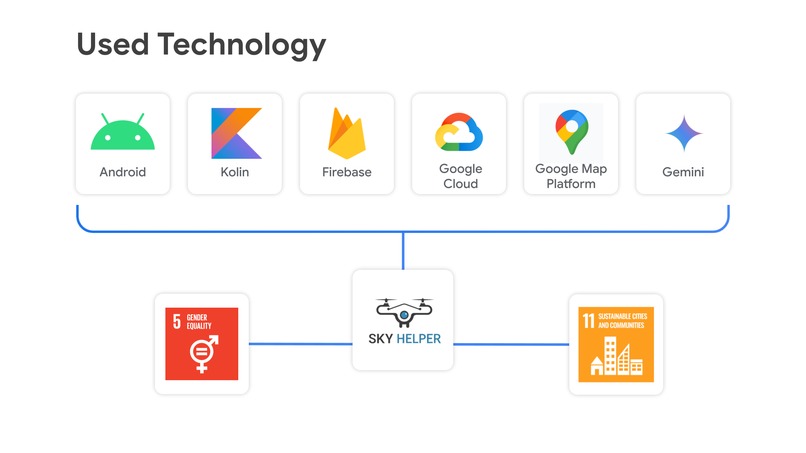
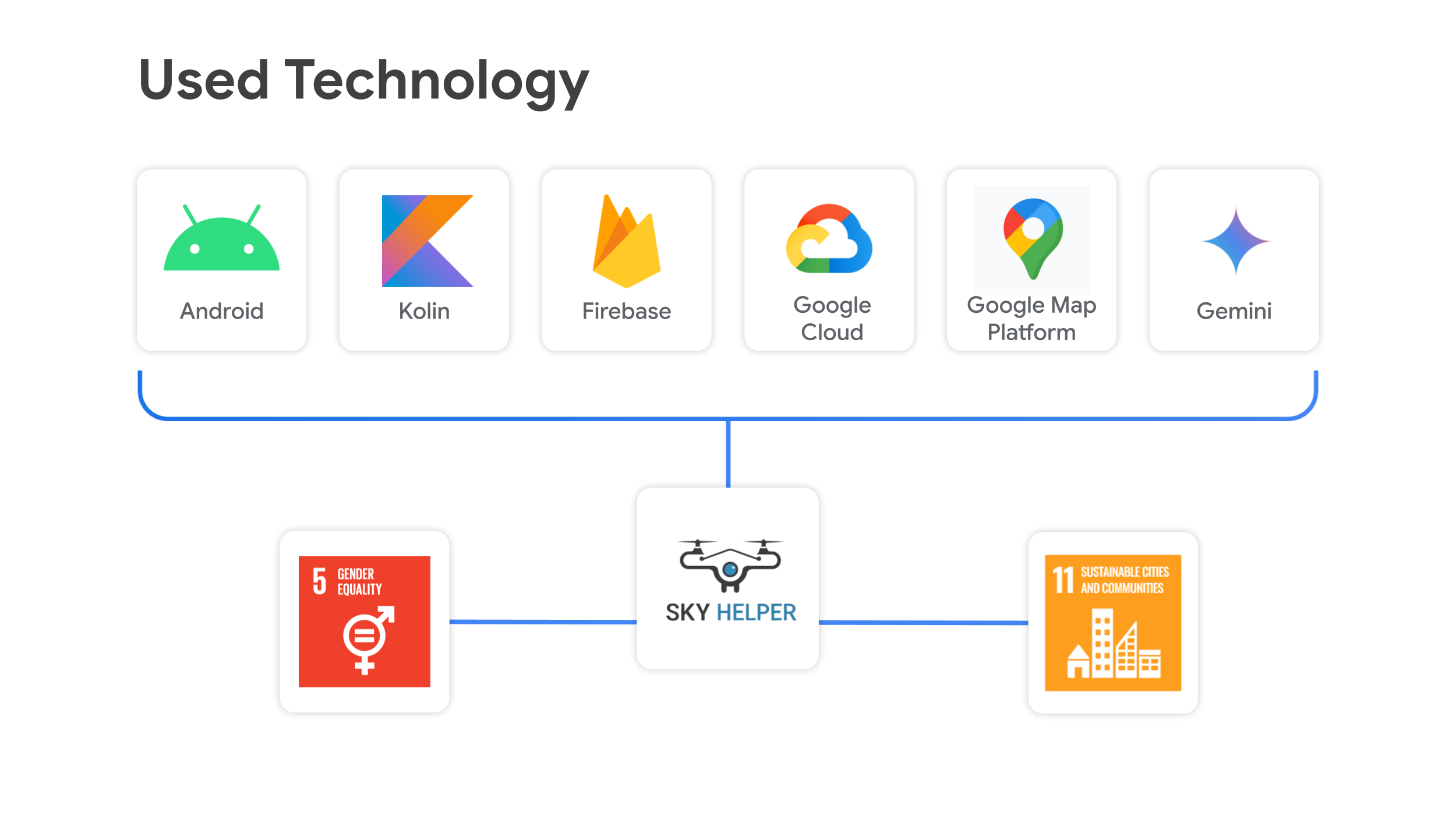
SkyHelper is built on advanced Google technologies to optimize development time and streamline processes. For real-time tracking, we use Firebase Realtime Database as our data foundation, Google Maps Platform for location visualization, and Android for mobile app development. Additionally, the Gemini virtual assistant provides guidance and real-time assessment during searches. The entire system is hosted on Google Cloud to ensure high availability and responsiveness across multiple platforms.
To support users, the system collects important data including speed, wind direction, distance, location, Wi-Fi signal strength, and live images from the UAV. All of this data is sent to Gemini, acting as a virtual assistant, which analyzes and provides recommendations on the approach and guides the next steps for handling the situation.
To expand the search range, we equip the UAV with a Raspberry Pi 4 kit and a Wi-Fi card to detect Wi-Fi signals from personal devices. The system records the Wi-Fi signal strength (RSSI) and the MAC address of the device, then calculates the estimated distance and location of the missing person. The data is sent to Firebase, and the Android app retrieves the data from Firebase to visualize it on the rescue team's devices. The entire process is automated, making it easy to use even for individuals with no technical background.
Challenges we ran into
Recently, our team and friends tested the product in various weather conditions, from normal environments to the mountainous areas of Sóc Sơn (Hanoi) and even stormy regions in Central Vietnam, including border areas where illegal trafficking of women often occurs.
Time constraints limited our testing. “Test, test, and test” is the phase we always aim to execute thoroughly. However, as the product is new, we haven’t had the chance to conduct extensive real-world testing.
Additionally, in some cases, Gemini’s data output can still be somewhat generalized. However, we believe that in the future, Gemini will be able to meet more complex requirements.
Accomplishments that we're proud of
Through testing, this product has demonstrated the capability to support up to 500 search devices, covering an area of 10,000 square meters, with a flight altitude of up to 100 meters and a margin of error of just around 2 meters. The devices can fly continuously for up to 30 minutes.
Additionally, a quick internal survey at the Hanoi Post and Telecommunications Institute of Technology showed strong interest and support from IT faculty teachers thanks to the high applicability of the product, giving us further motivation to continue this meaningful journey.
Currently, in Vietnam and many other countries, there is no similar system capable of locating and rescuing victims based on Wi-Fi signals and personal devices. We believe—and are proud—that this solution, 100% made in Vietnam, holds great potential for the near future.
What we learned
We recognize that today’s technology, especially the Google product ecosystem, is highly advanced and can significantly support the development of social solutions, addressing more and more pressing issues. For instance:
Utilizing Google’s technologies helps reduce development time substantially and ensures performance efficiency. Gemini, acting as a virtual assistant, will analyze and provide recommendations on approaches and next steps when it receives image data from drones. Firebase’s Realtime Database and Google Cloud are selected for real-time data storage and updates, allowing for the latest tracking and monitoring of missing persons' locations to improve search capabilities. Additionally, Google Maps enables a visual display of data, making it easy to see missing persons' movements. Users can conveniently access and view marked locations on the map, guiding and enhancing the search process.
This is why we aim to bring this solution nationwide, refining it to become a reliable safety tool for everyone, especially women.
Our current priority is to effectively apply technology while enhancing our responsibility to user privacy. Additionally, we are constantly learning and staying updated on new technology trends to create more value, strengthen the role of technology, reduce research and development time, and optimize resources.
What's next for SkyHelper
Our dream for this project is that it can be implemented in practice as soon as possible. As we know, every passing second is critical for rescue efforts in saving victims.
Small steps that matter. Our app is initially designed to support government authorities in locating and rescuing victims as quickly as possible. We will work to bring this solution closer to the government, collaborating closely with government agencies, human rights organizations, and others.
In the future, beyond government use, we aim to optimize and integrate an SOS feature that enables victims and their families to send emergency alerts through images, voice, and more. This feature will go beyond reducing human trafficking of women and children and could be extended to address other issues, such as domestic violence and more effective searches for missing persons.


Log in or sign up for Devpost to join the conversation.