Skovan
An AI-operated fundraising service for school communities
Category: Small Business Services
1. The problem
School communities need additional funding, but fundraising depends heavily on volunteer time.
Parentkind's 2022 data reported average annual fundraising of £7,814 per PTA, supported by approximately 3.98 million committee volunteer hours across roughly 12,700 PTAs.
And those figures do not capture all the parents who bake, staff stalls, sell tickets or clear up afterwards.
For busy families, the constraint is often not willingness to help. It is time.
Generosity is not the constraint. Time is.
2. The solution
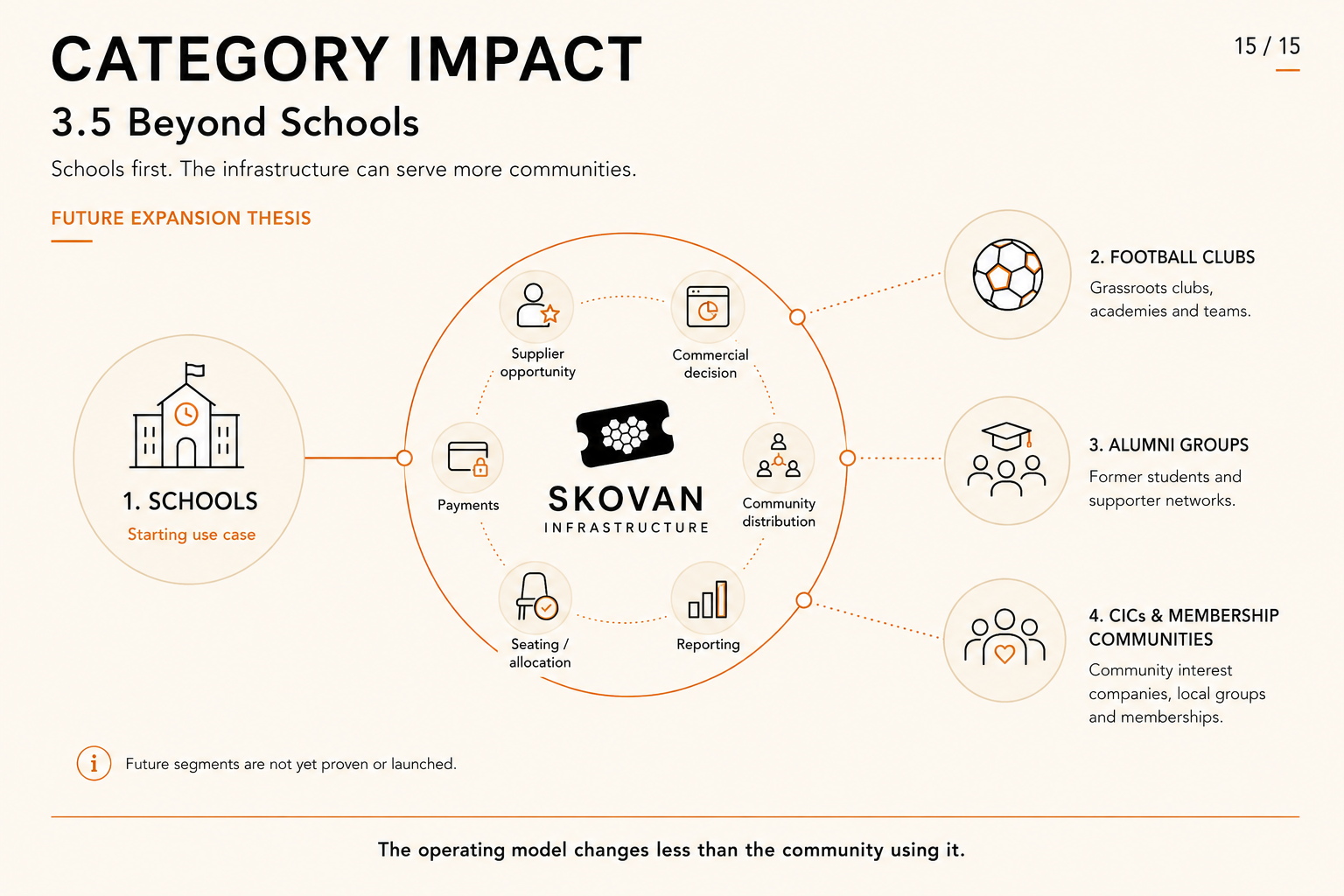
Skovan creates an additional fundraising stream for school communities by turning discounted theatre group bookings into school income.
The school does not need to design or operate the fundraiser.
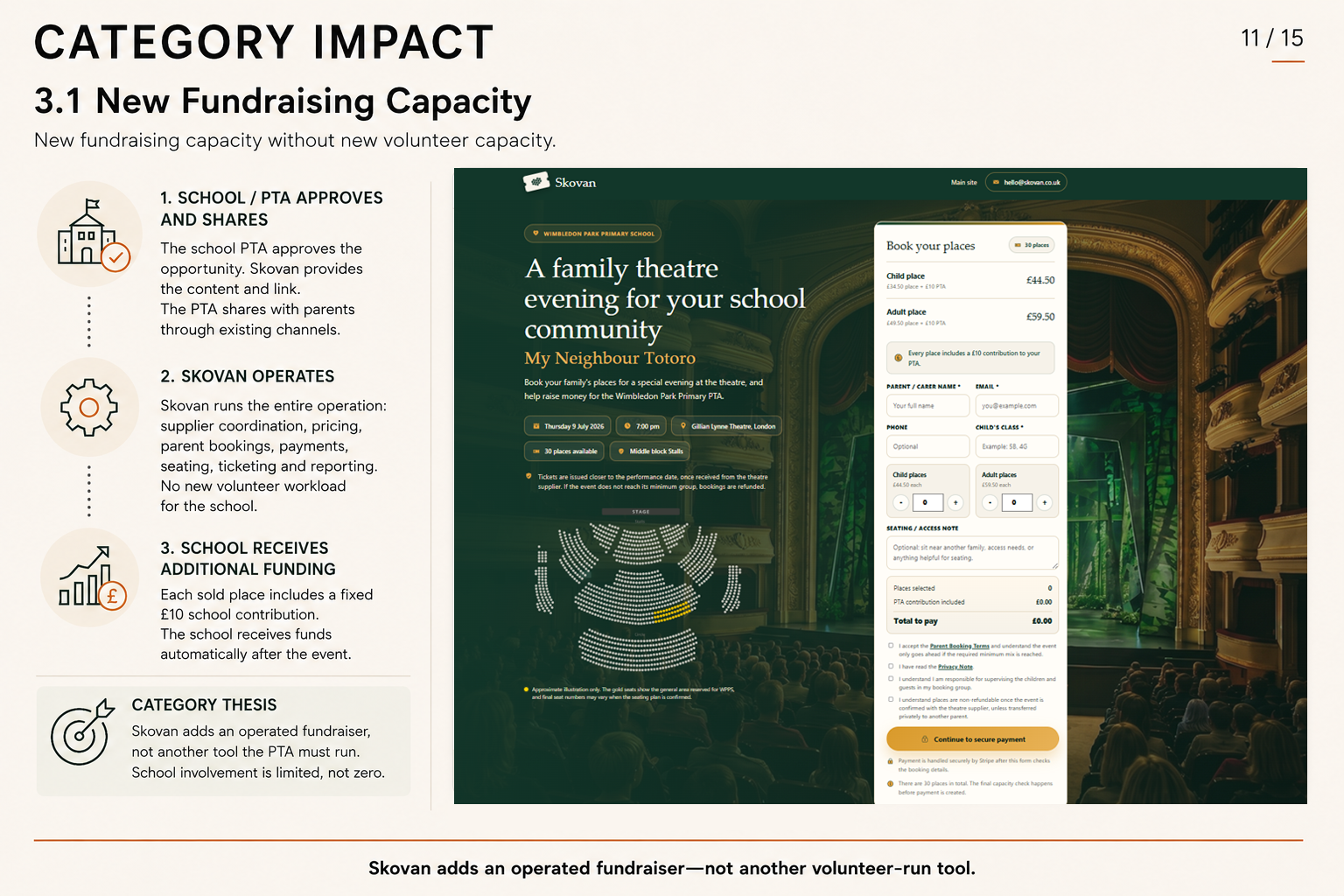
It approves an opportunity and shares a booking link with its parent community.
Skovan runs the rest: supplier coordination, pricing, bookings, payments, seating, ticketing and reporting.
How one booking creates value
West End suppliers can offer substantial discounts for sufficiently large group bookings.
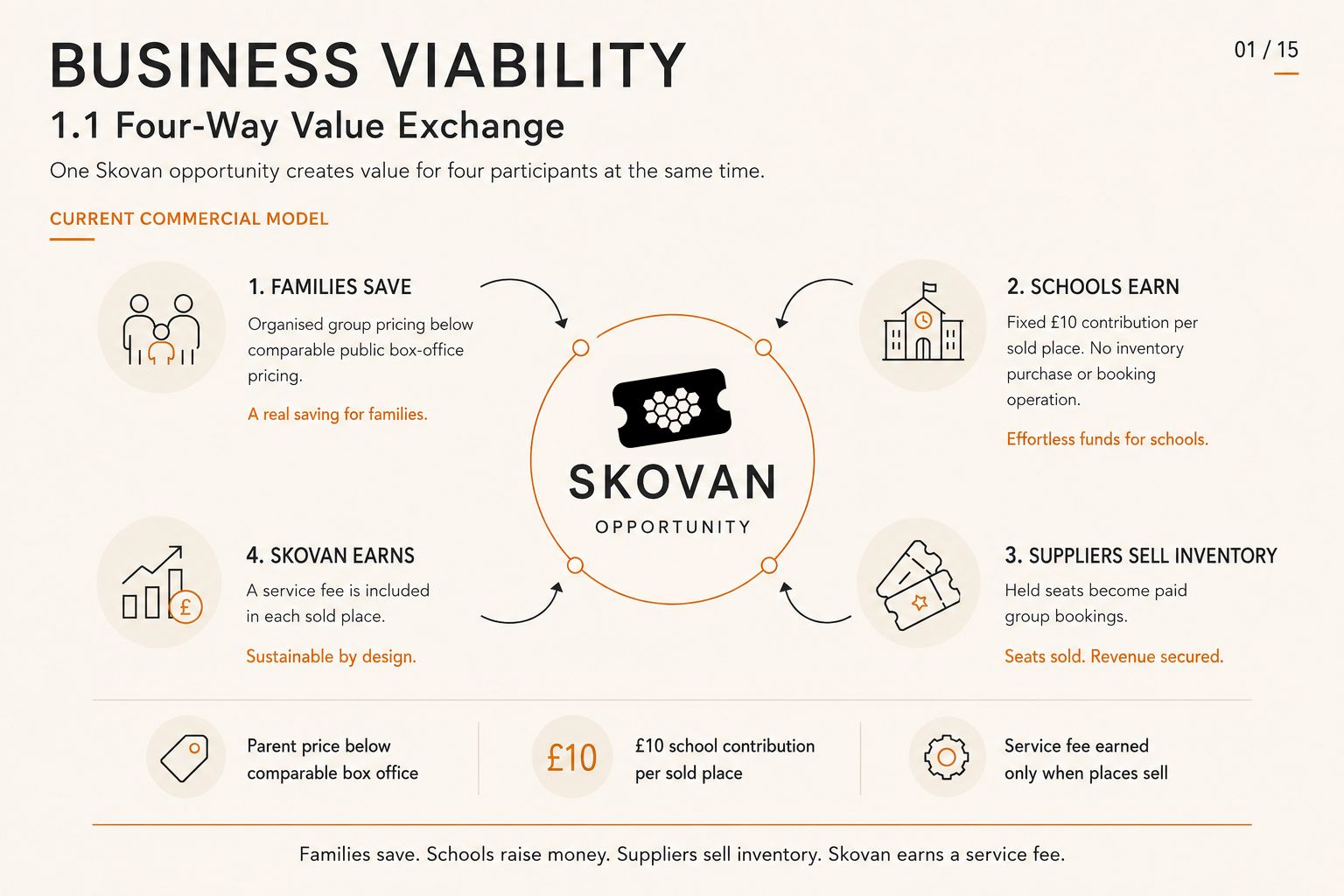
That margin supports four parties at once:
| Participant | Value created |
|---|---|
| Parents | Pay at least 15% below comparable box-office prices |
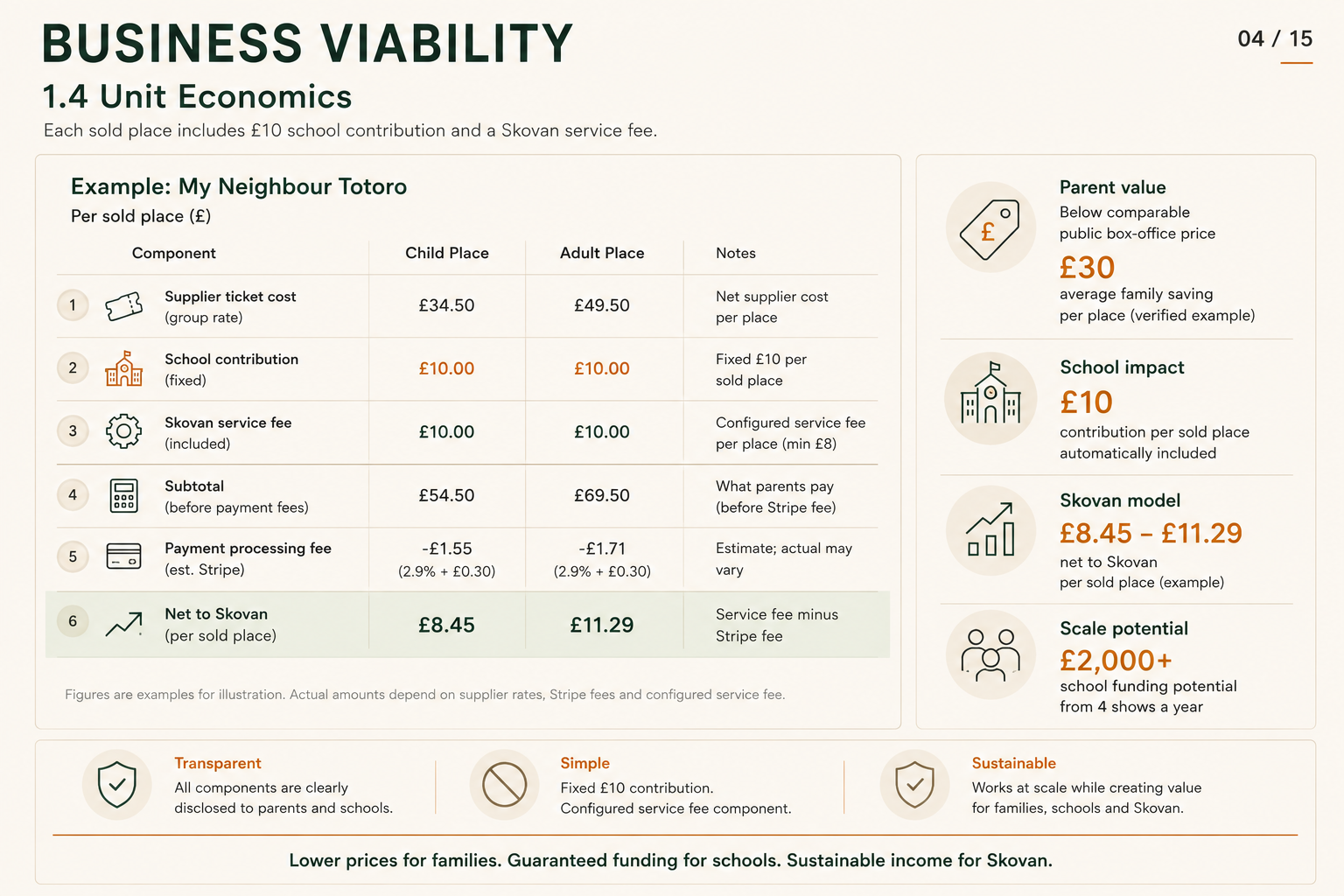
| School | Receives £10 from every place sold |
| Supplier | Sells organised group inventory |
| Skovan | Earns a service fee for operating the opportunity |
A simple example:
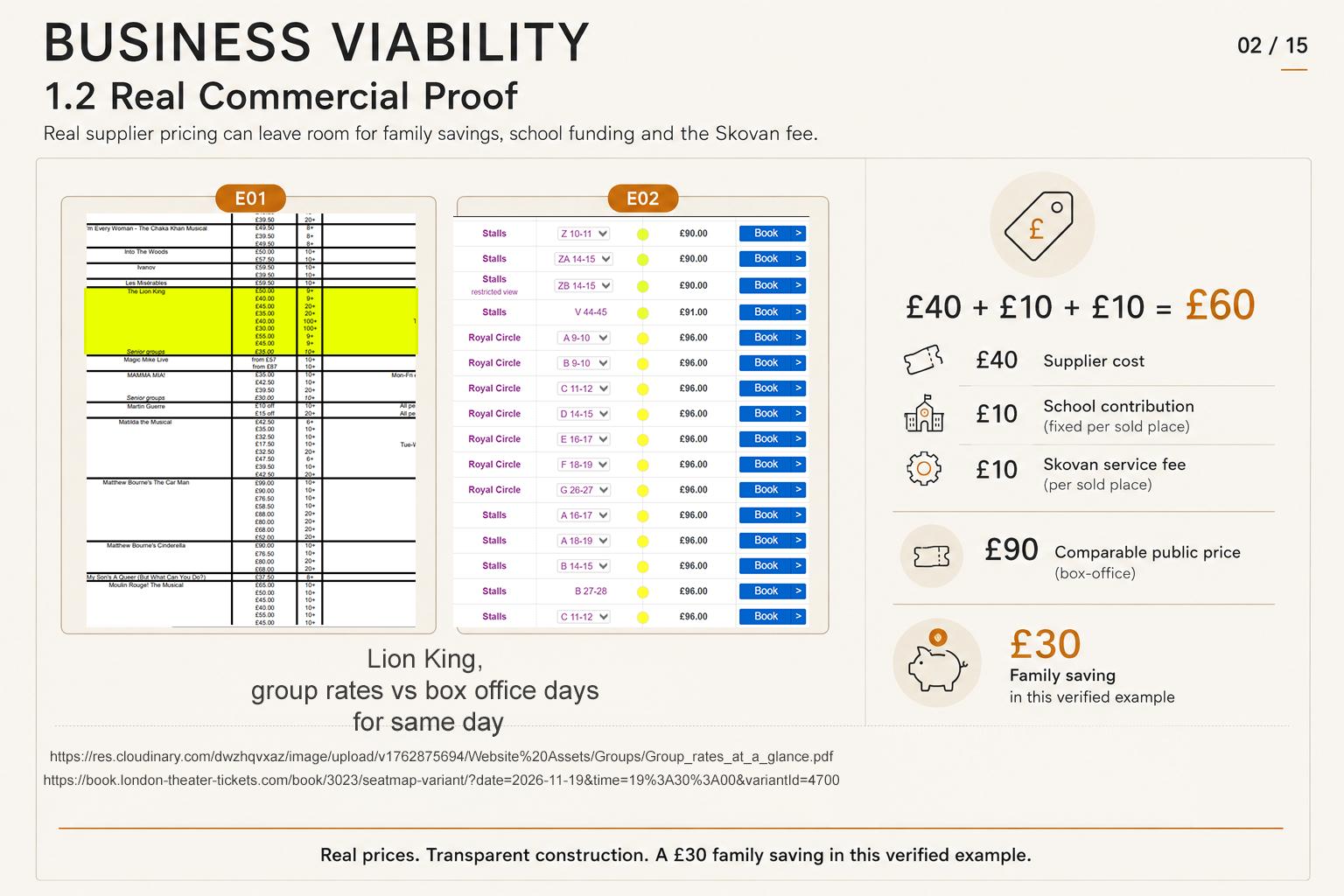
£40 supplier cost + £10 school contribution + £10 Skovan fee = £60 parent price
If the comparable seat is £90, the parent saves £30 while both the school contribution and Skovan economics remain intact.
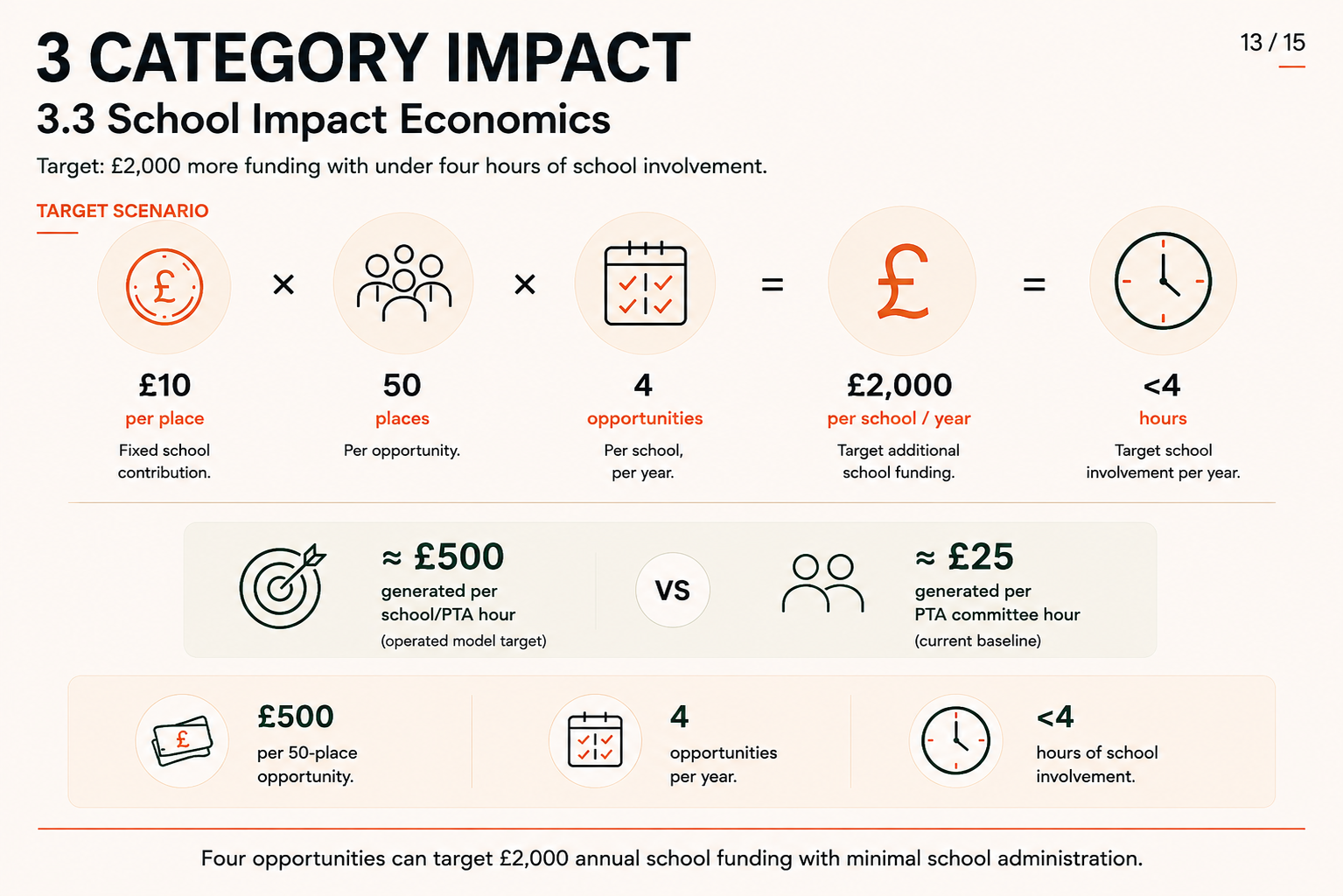
At 50 places, one opportunity raises £500 for the school.
Four opportunities a year raise:
£2,000 additional school funding
The target is to achieve that with under four hours of school involvement across the year, no upfront cost and no financial underwriting.
3. Business Viability
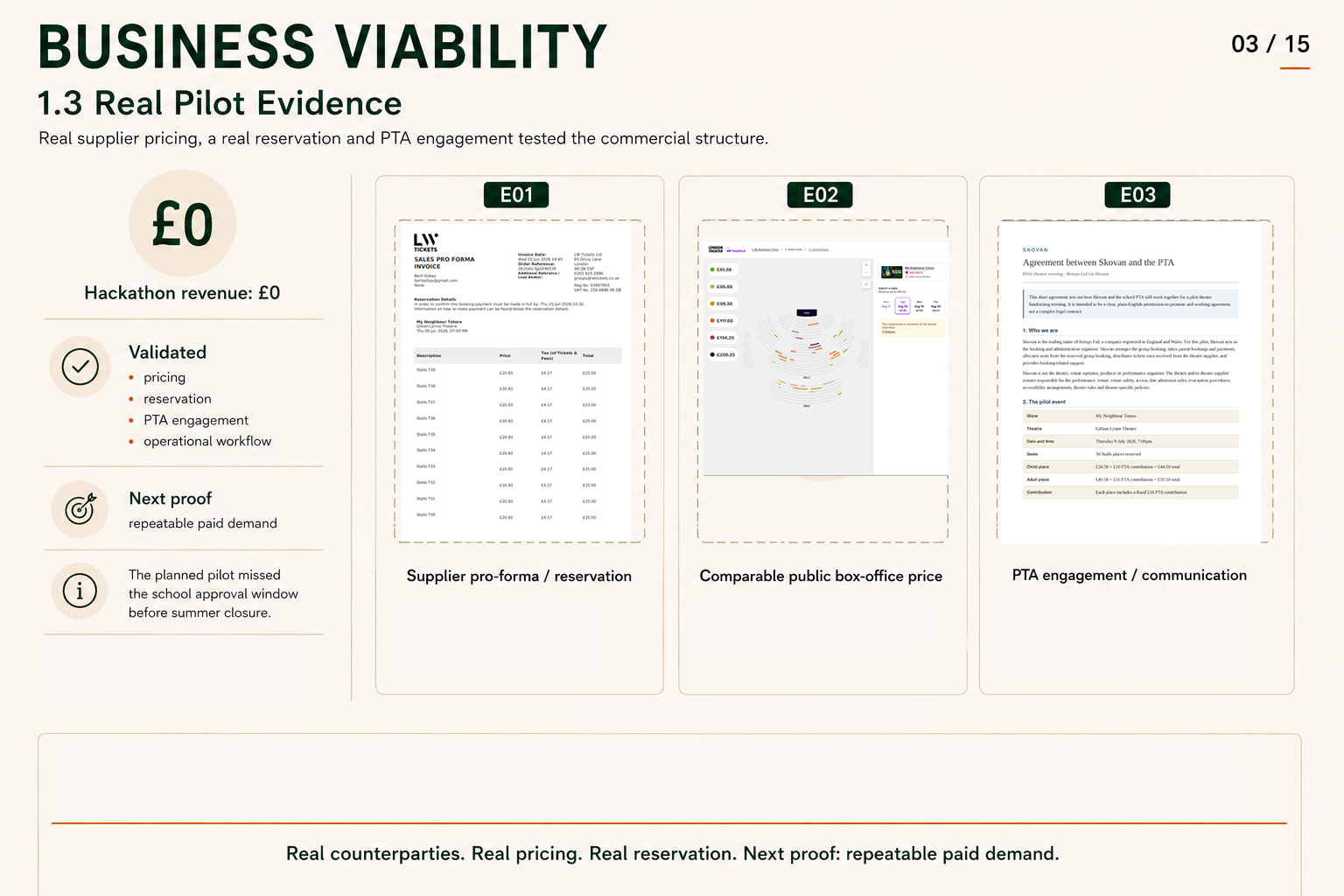
Skovan has generated £0 earned revenue to date. The first paid pilot was prepared for June using a real supplier reservation and live PTA discussions, but the school approval window was missed before the summer closure.
Sustainability of the Business Model
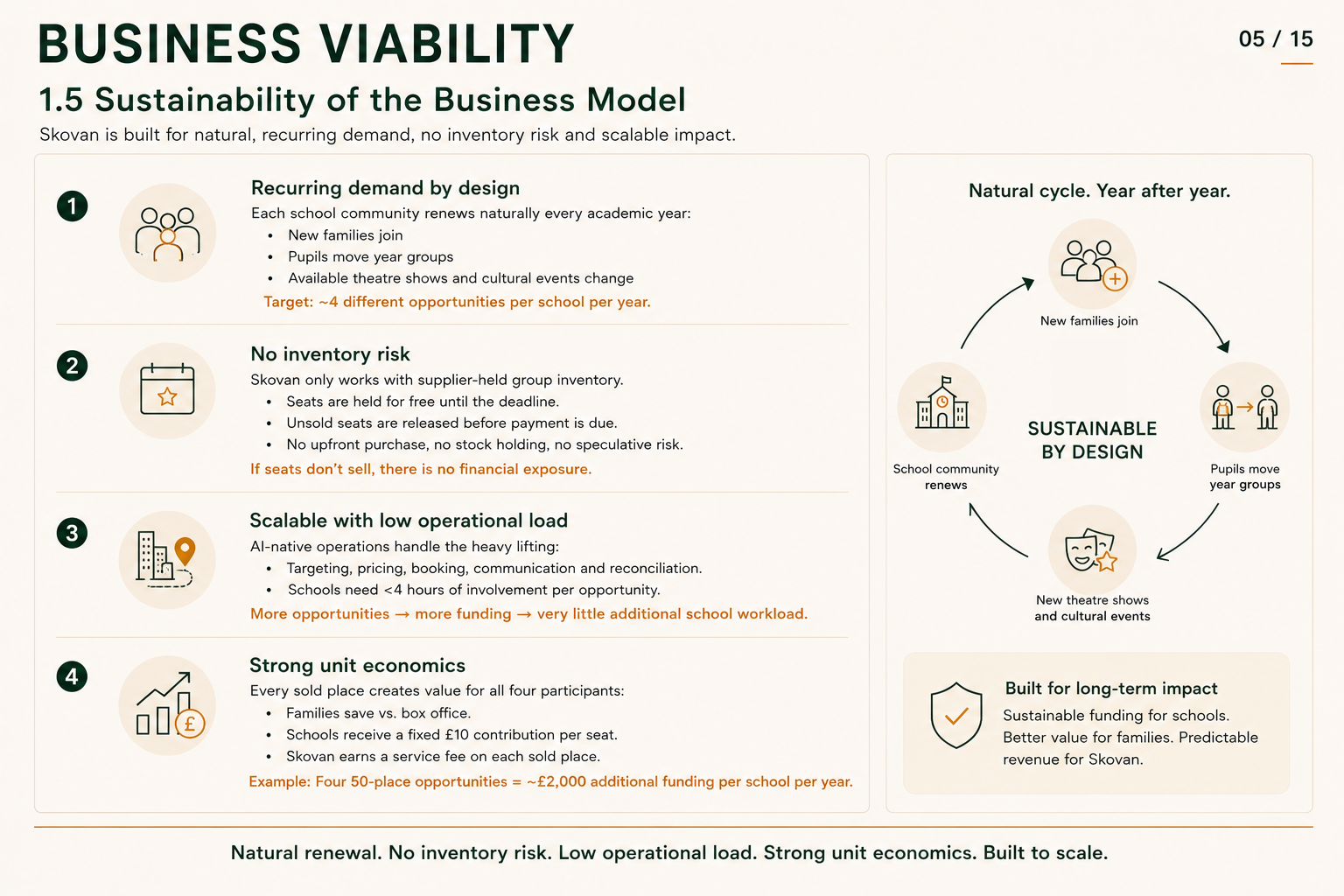
1. Naturally recurring demand
Each school community renews every academic year: new families join, pupils move year groups, and new theatre shows and cultural opportunities become available.
Skovan therefore does not depend on repeatedly selling the same opportunity to the same audience. The target is around four different opportunities per school per year.
2. Four-way value exchange
| Participant | Value |
|---|---|
| Families | Pay below comparable box office |
| Schools | Receive £10 per place sold |
| Suppliers | Reach organised community demand |
| Skovan | Earns a service fee per place |
The model works because every successful transaction creates value for all four parties.
3. Capital-light model
Group seats can be held until a supplier deadline and unsold places released before payment.
Skovan therefore does not carry speculative inventory, reducing working-capital and stock risk.
4. AI-enabled scale
Gemini enables a very small team to manage pricing, school selection, inventory deployment and seating across many opportunities.
This allows event volume to grow faster than headcount.
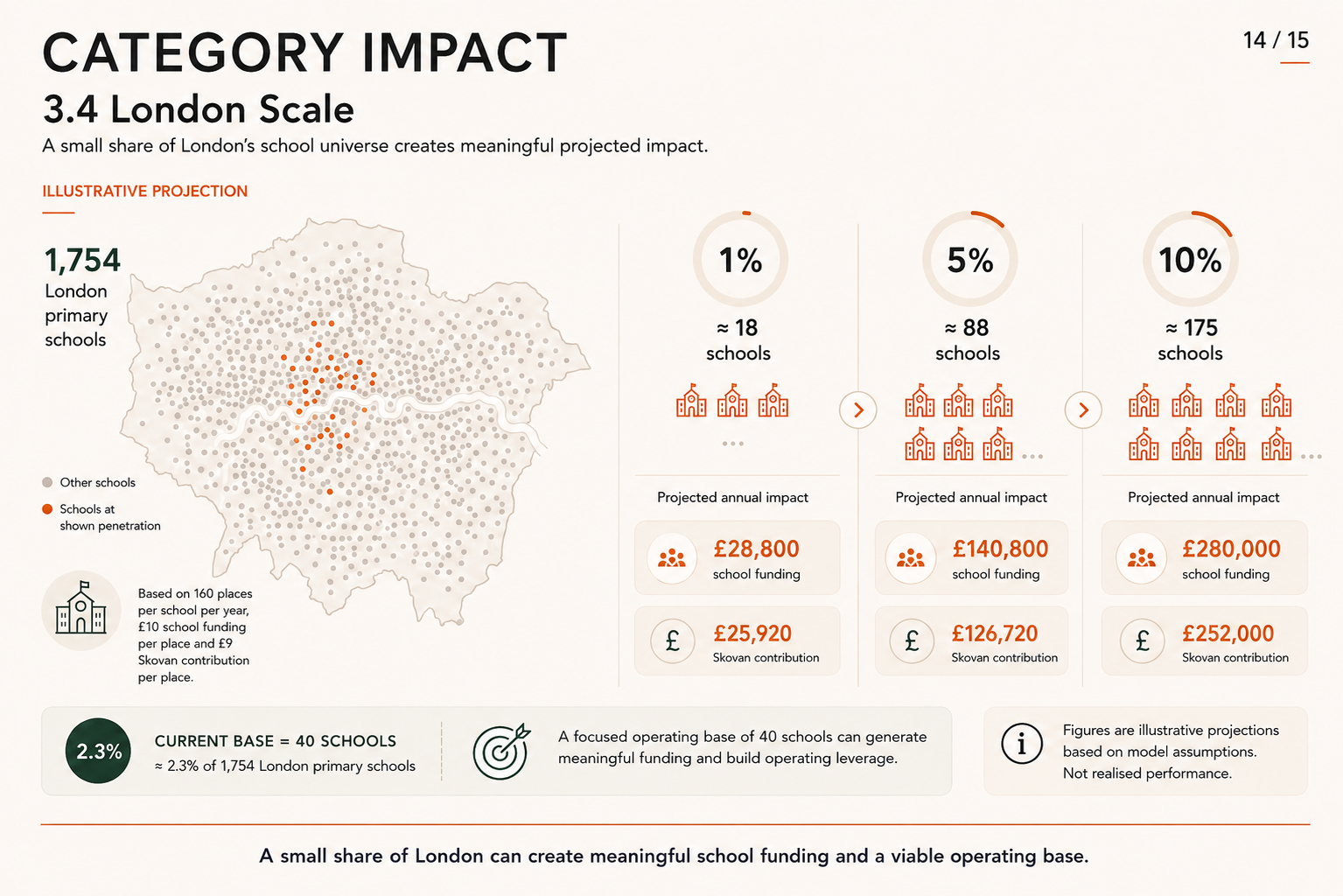
At around 40 active schools, just 2.3% of Skovan's London directory, the base model projects approximately £64,000 annual funding for schools and £52,600 operating profit.
4. AI-Native Operations
Running one theatre opportunity manually is possible.
Running many opportunities across many schools means repeatedly interpreting supplier documents, comparing schools, setting prices, reconciling bookings, solving seating constraints and reporting outcomes.
That is where Skovan OS operates.
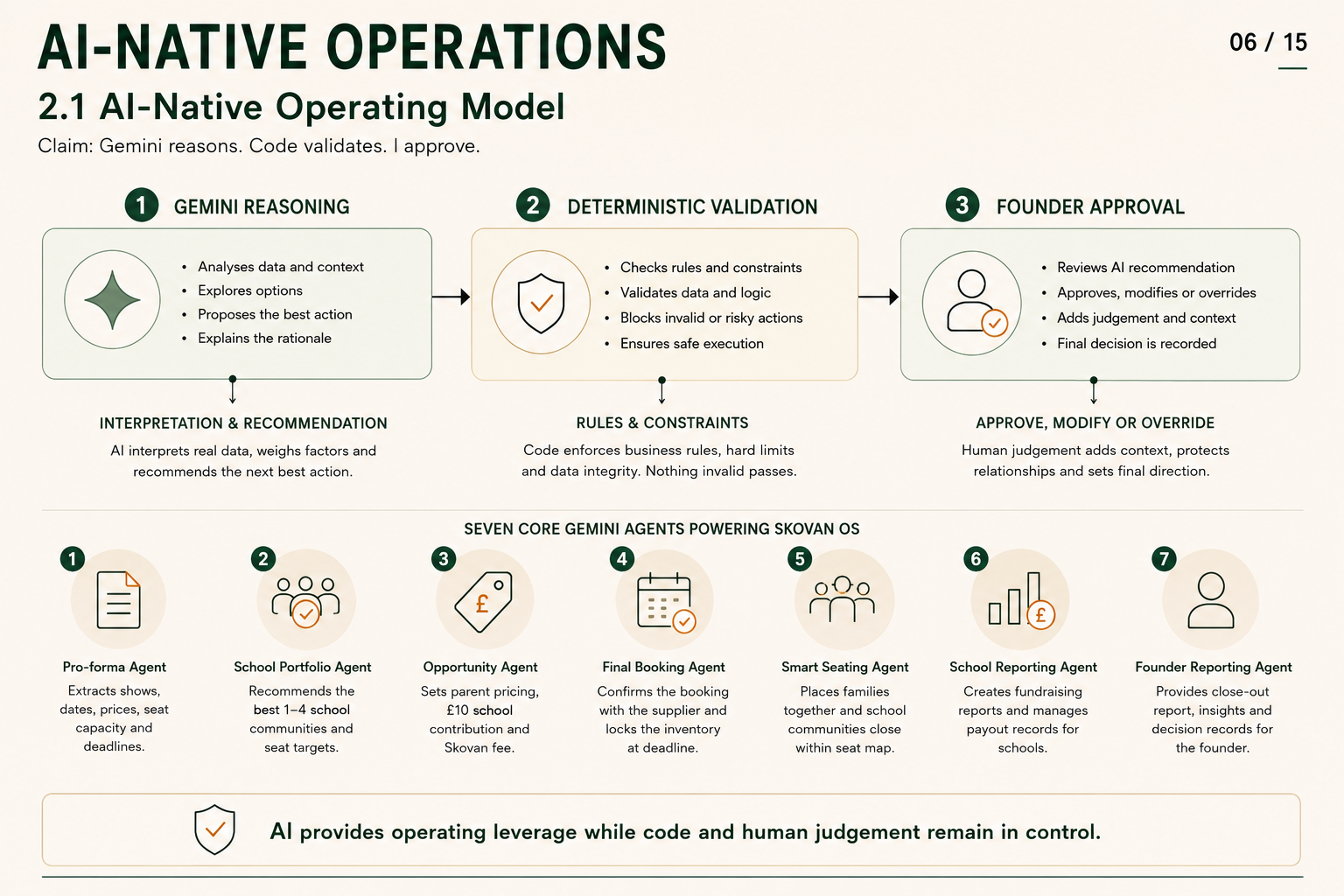
Seven core Gemini agents handle the reasoning-heavy parts of the workflow:
| Agent | Operational role |
|---|---|
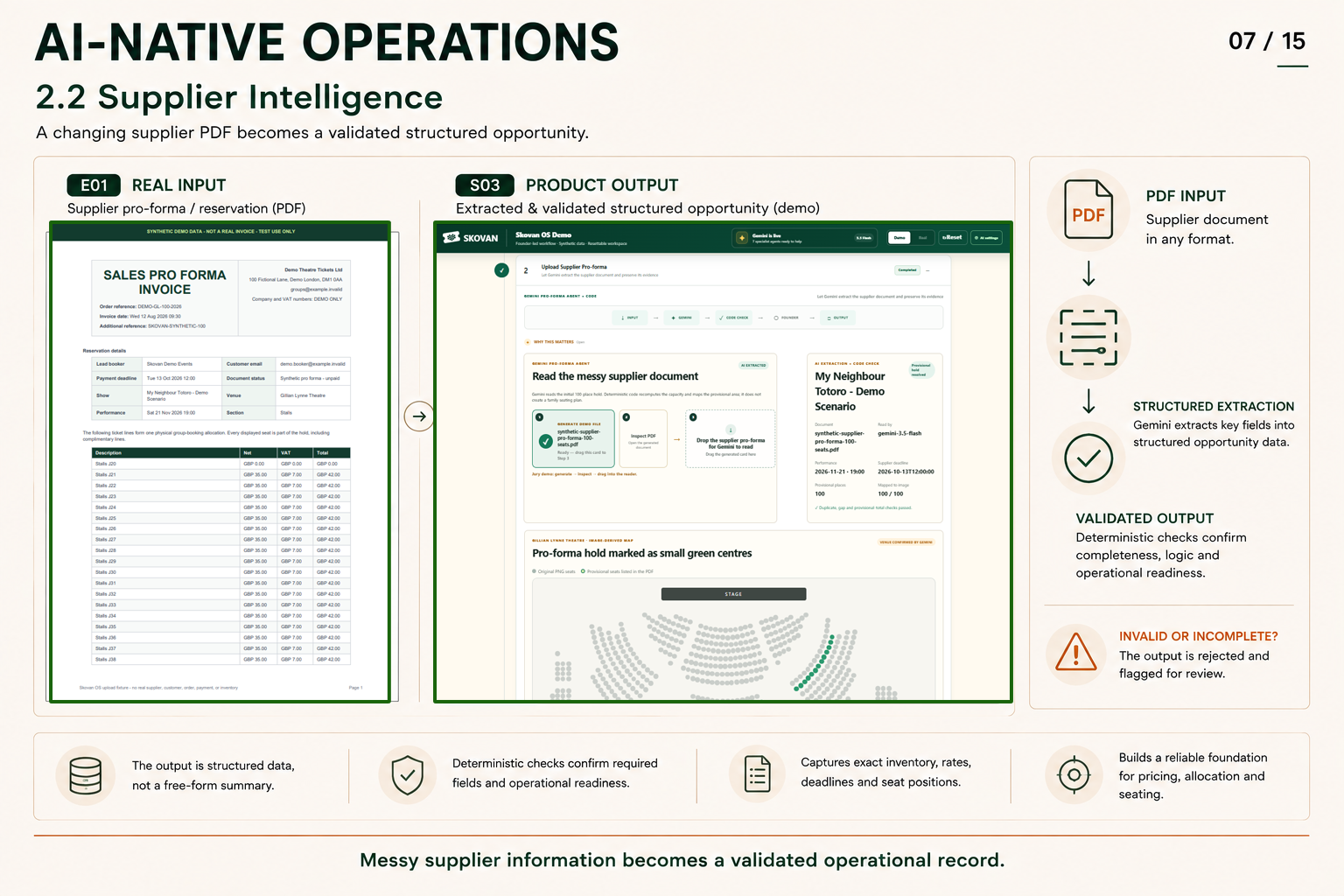
| Pro-forma | Extracts structured facts from irregular supplier PDFs |
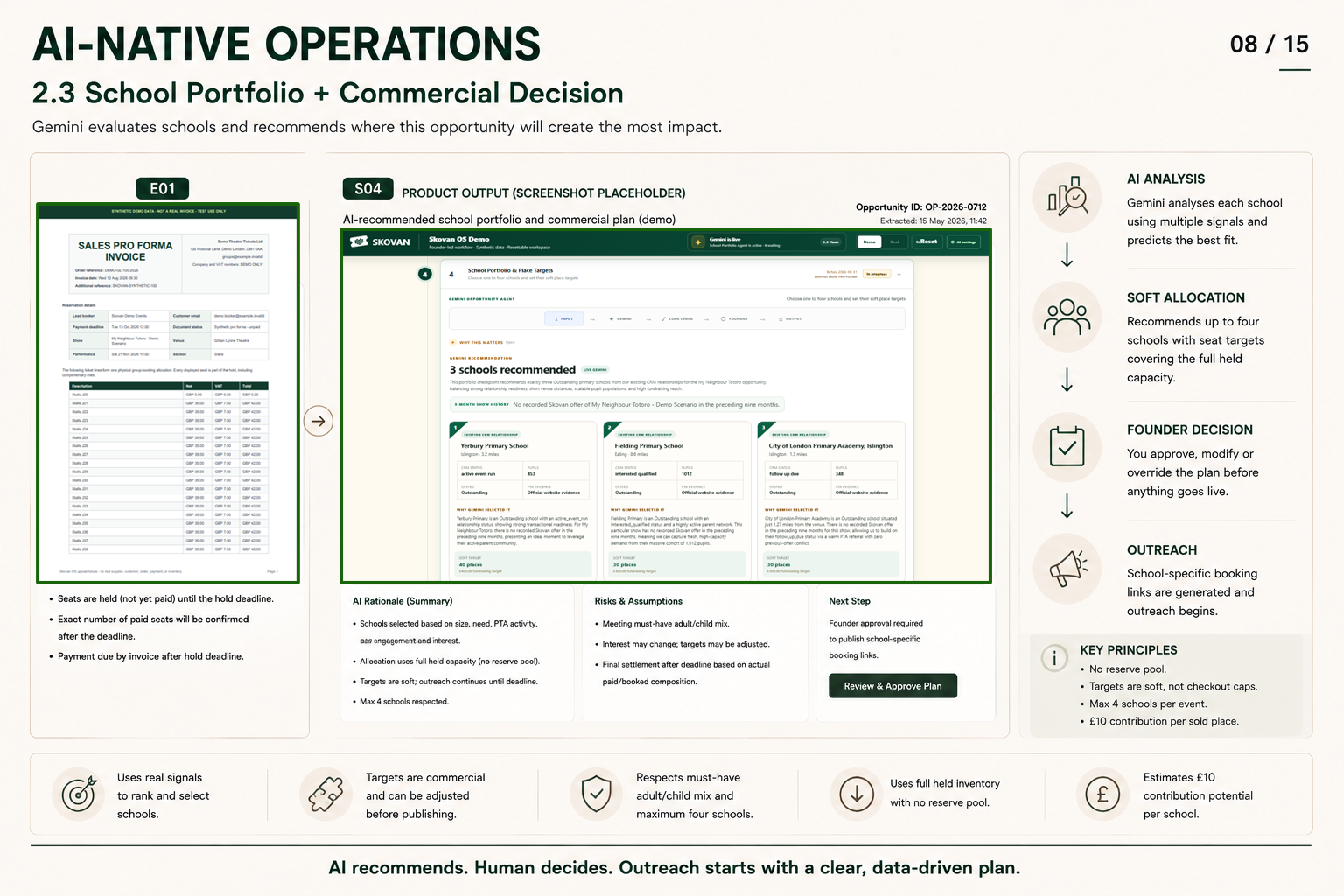
| School Portfolio | Recommends one to four schools for an opportunity |
| Opportunity | Recommends parent prices and place targets |
| Final Booking | Reads the supplier's confirmed booking |
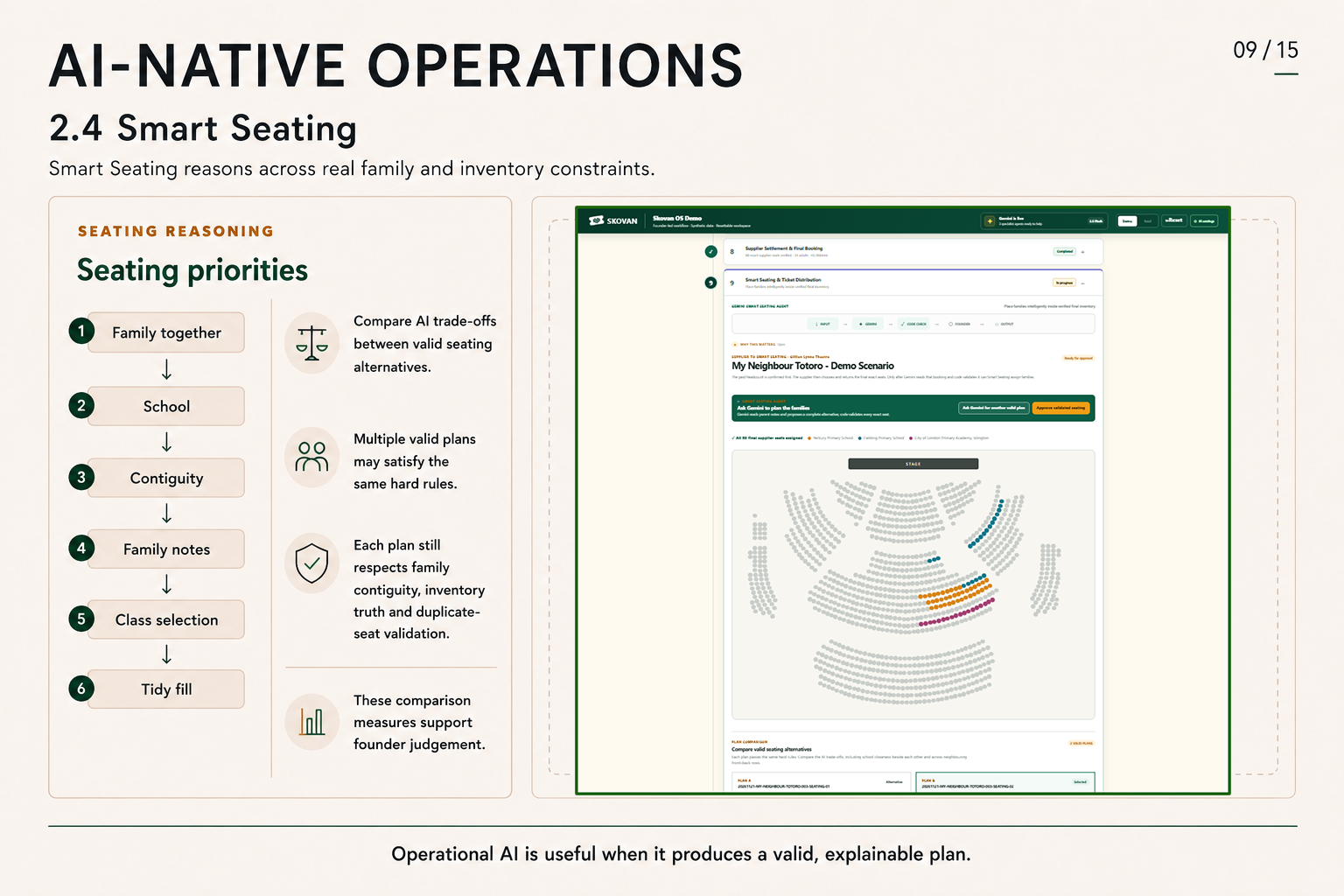
| Smart Seating | Assigns families to physical seats using booking context and parent notes |
| School Reporting | Produces fundraising and payout records |
| Founder Reporting | Analyses the completed operation and recommends improvements |
An optional School Targeting Agent identifies which school relationships Skovan should develop before a specific theatre opportunity exists.
The agents return structured JSON that becomes operational state, rather than general chat advice.
AI reasons. Code validates. I approve.
Not everything belongs to an LLM.
Deterministic code enforces:
- maximum four schools
- exact inventory reconciliation
- £10 school contribution
- minimum £8 Skovan fee
- prices at least 15% below box office
- paid bookings only
- valid, non-duplicated seats
- family contiguity and aisle boundaries
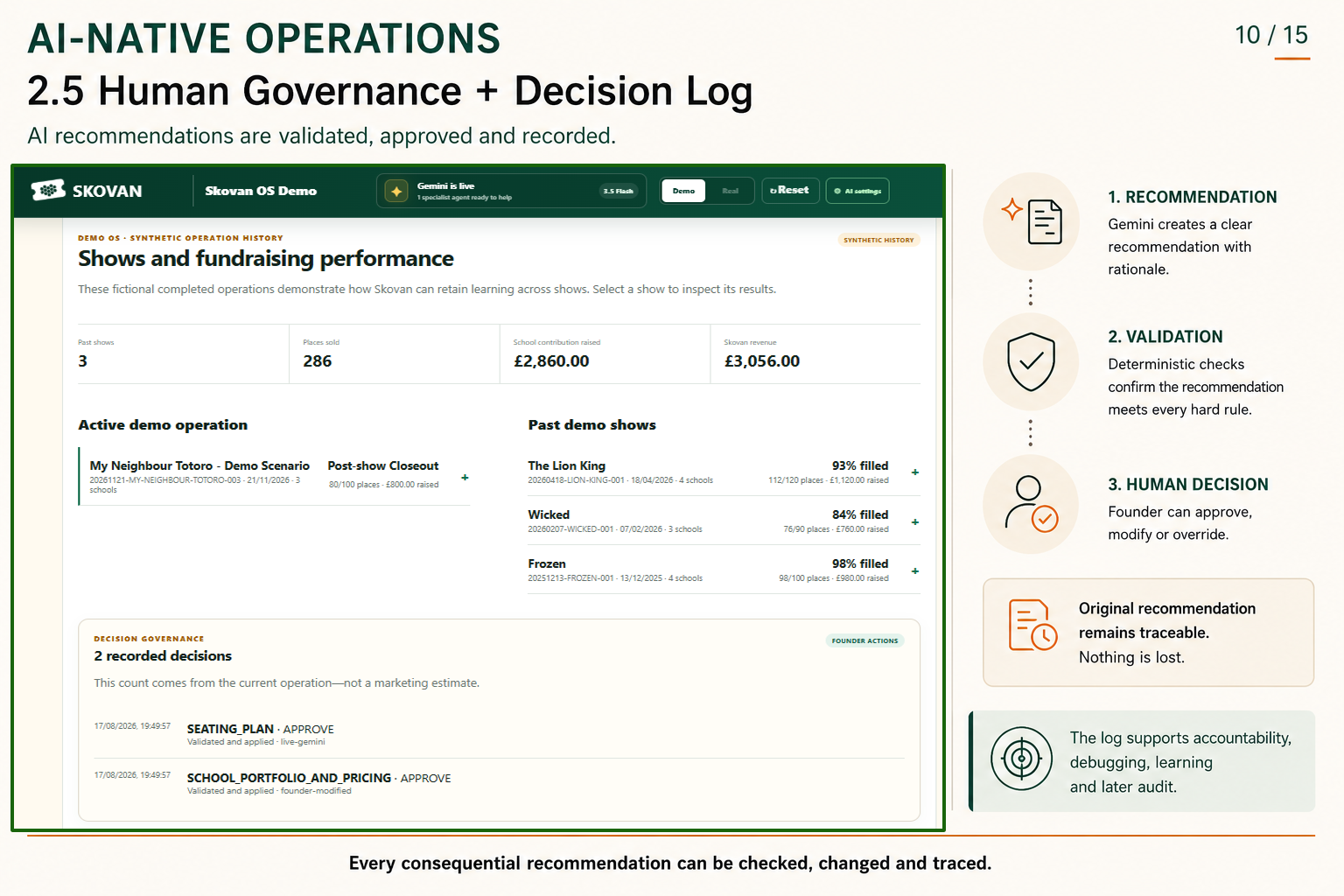
I approve consequential commercial and seating decisions.
My overrides are not privileged. If I change Gemini's recommendation, my version must pass the same validators before it becomes operational state.
Gemini reasons. Code validates. I approve.
Every key decision is logged and auditable.
5. Category Impact
Skovan does not ask PTAs to become better event operators.
It creates additional fundraising capacity that Skovan operates for them.
The traditional relationship is:
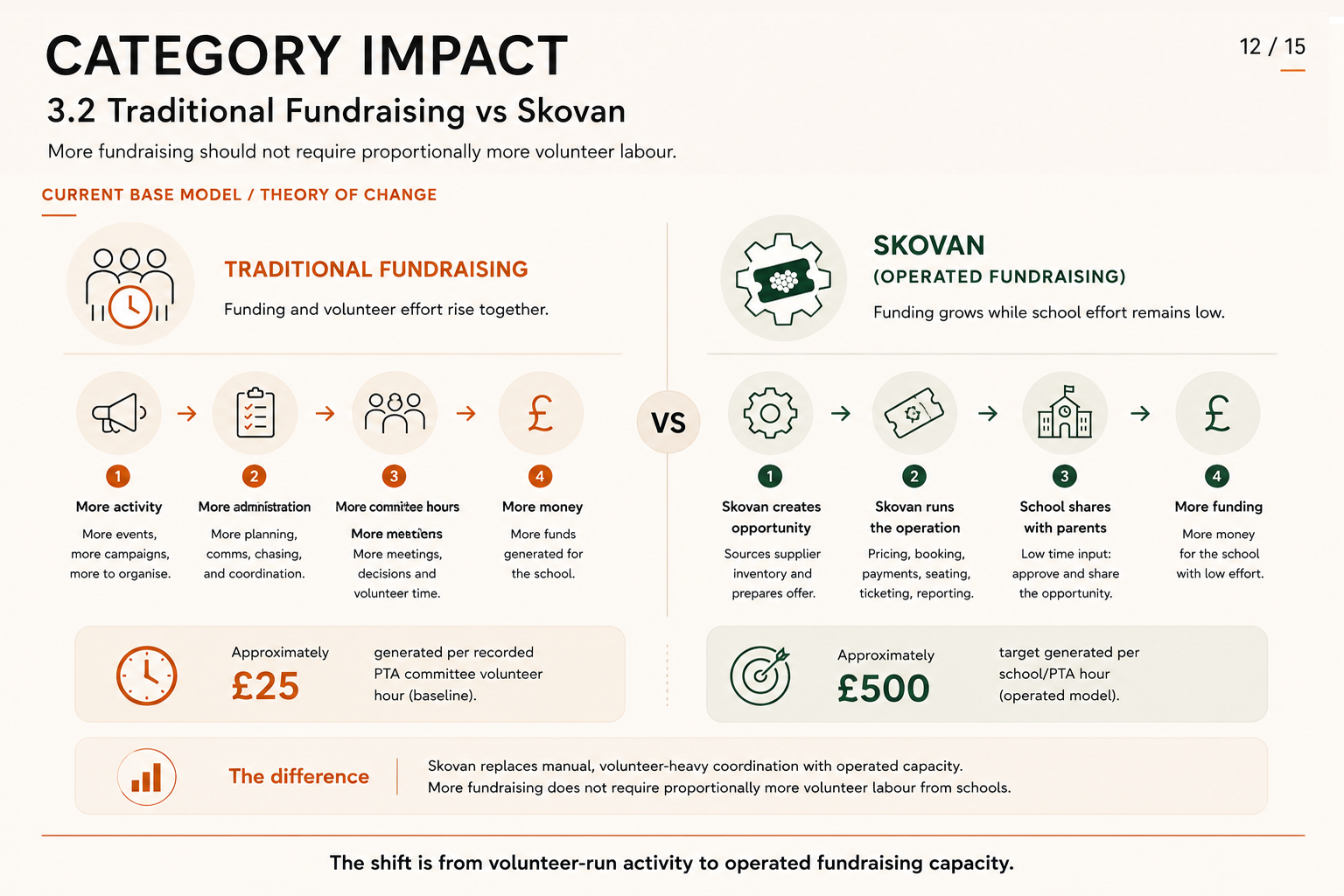
more fundraising → more volunteer work
Skovan is testing a different relationship:
more fundraising → more Skovan-operated opportunities → very little additional school workload
At four 50-place opportunities, the target is:
£2,000 additional annual funding from under four hours of school involvement
Parentkind's figures imply roughly £25 raised per recorded committee volunteer hour.
Skovan's target is approximately:
£500 generated per hour of school involvement
That is close to 20 times the baseline, while adding roughly 25% to the annual fundraising of an average PTA.
Families also benefit from lower theatre prices, while suppliers gain organised community demand.
This is why Skovan fits Small Business Services.
AI gives a very small company enough operational capacity to deliver sophisticated commercial infrastructure to organisations that could never realistically build or staff it themselves.
The change is not that AI makes an existing fundraiser faster.
It is that fundraising capacity stops depending on volunteer capacity.
Built With
- cloudflare
- cloudflaredurableobjects
- cloudflareworkers
- css3
- geminiapi
- google-cloud
- googleaistudio
- googlegemini
- html5
- javascript
- leaflet.js
- node.js
- restapi
- typescript

Log in or sign up for Devpost to join the conversation.