Inspiration
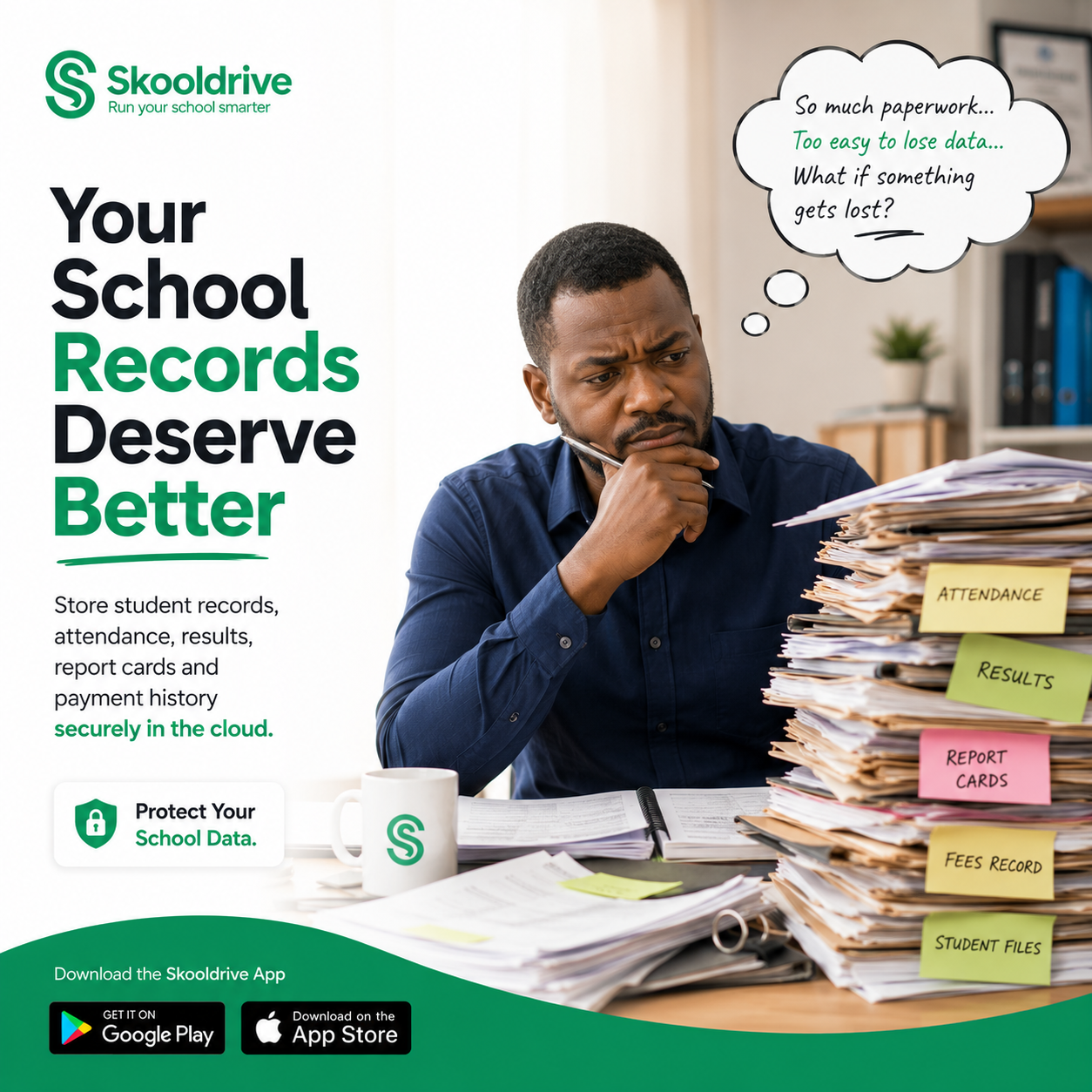
SkoolDrive was inspired by a very real problem we saw in Nigerian schools: many schools still run daily operations with paper records, WhatsApp groups, scattered spreadsheets, manual fee tracking, manual result computation, and disconnected communication between admins, teachers, parents, and students.
For school owners and administrators, this creates stress and poor visibility. For teachers, it adds repetitive manual work. For parents, it means they often do not get timely updates about their children. For students, it means learning support is often limited to what happens only inside the classroom.
We wanted to build something simple enough for everyday school use, but powerful enough to handle real school operations end to end.
The deeper inspiration behind SkoolDrive was this question:
What if every school, even a small or mid-sized school in Nigeria, could have access to the kind of digital and AI-powered infrastructure usually reserved for large institutions?
SkoolDrive was born from the idea that modern school management should not only digitize records, but also help schools make better decisions, reduce repetitive work, and support students, teachers, parents, and administrators intelligently.
What it does
SkoolDrive is a full school management platform for schools, teachers, parents, students, and platform administrators.
It helps schools manage:
- Student records and profiles
- Staff and teacher accounts
- Classes, arms, subjects, and academic sessions
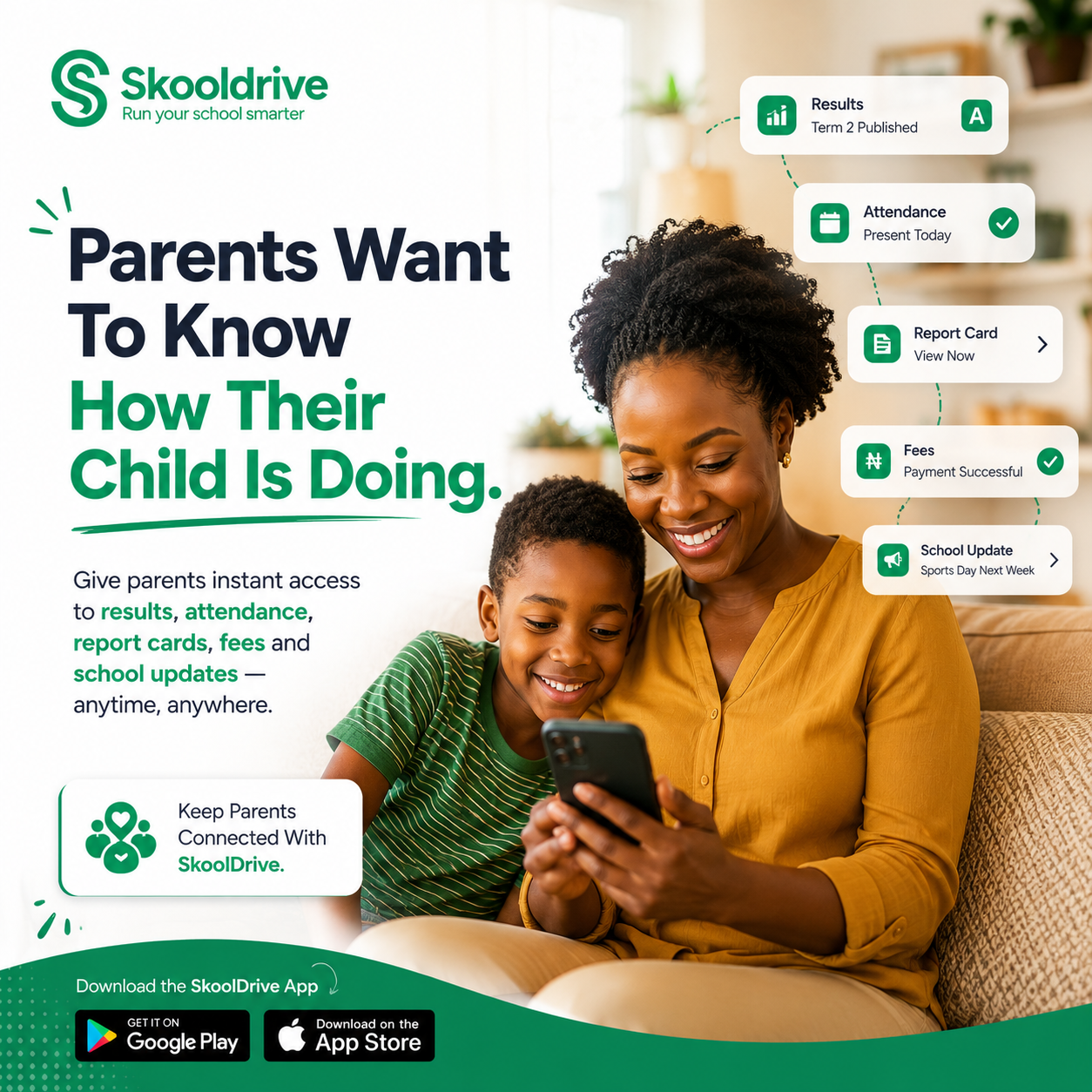
- Attendance tracking with parent notifications
- Fees, invoices, billing, and payment tracking
- School subscriptions and plan-based feature access
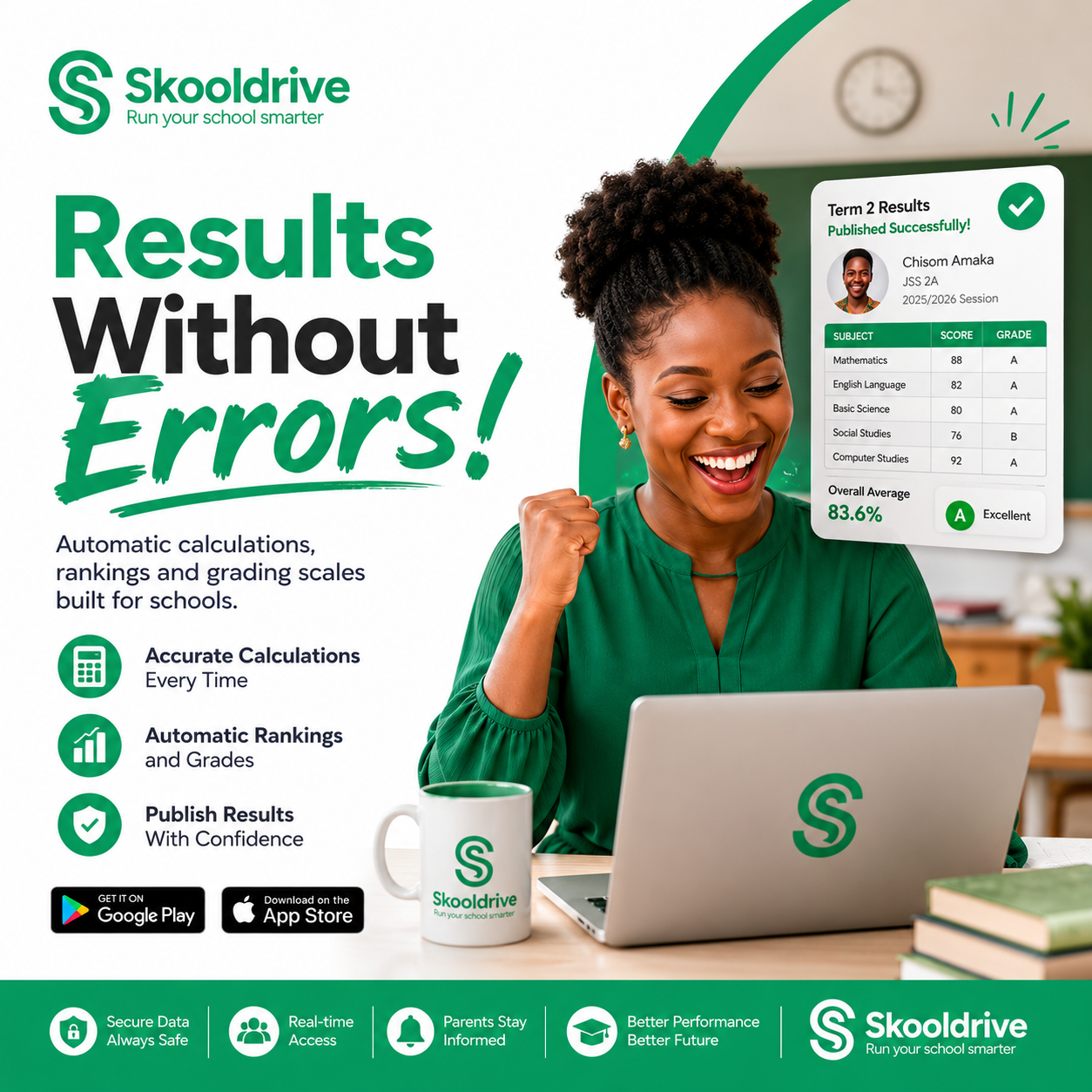
- Result management and report cards
- CBT tests and question banks
- In-app chat between school users
- File and image sharing in chat
- Announcements and school communication
- Mobile app update control
- Super admin operations across multiple schools
SkoolDrive also includes AI-powered workflows designed to make school operations easier.
Some of the AI features include:
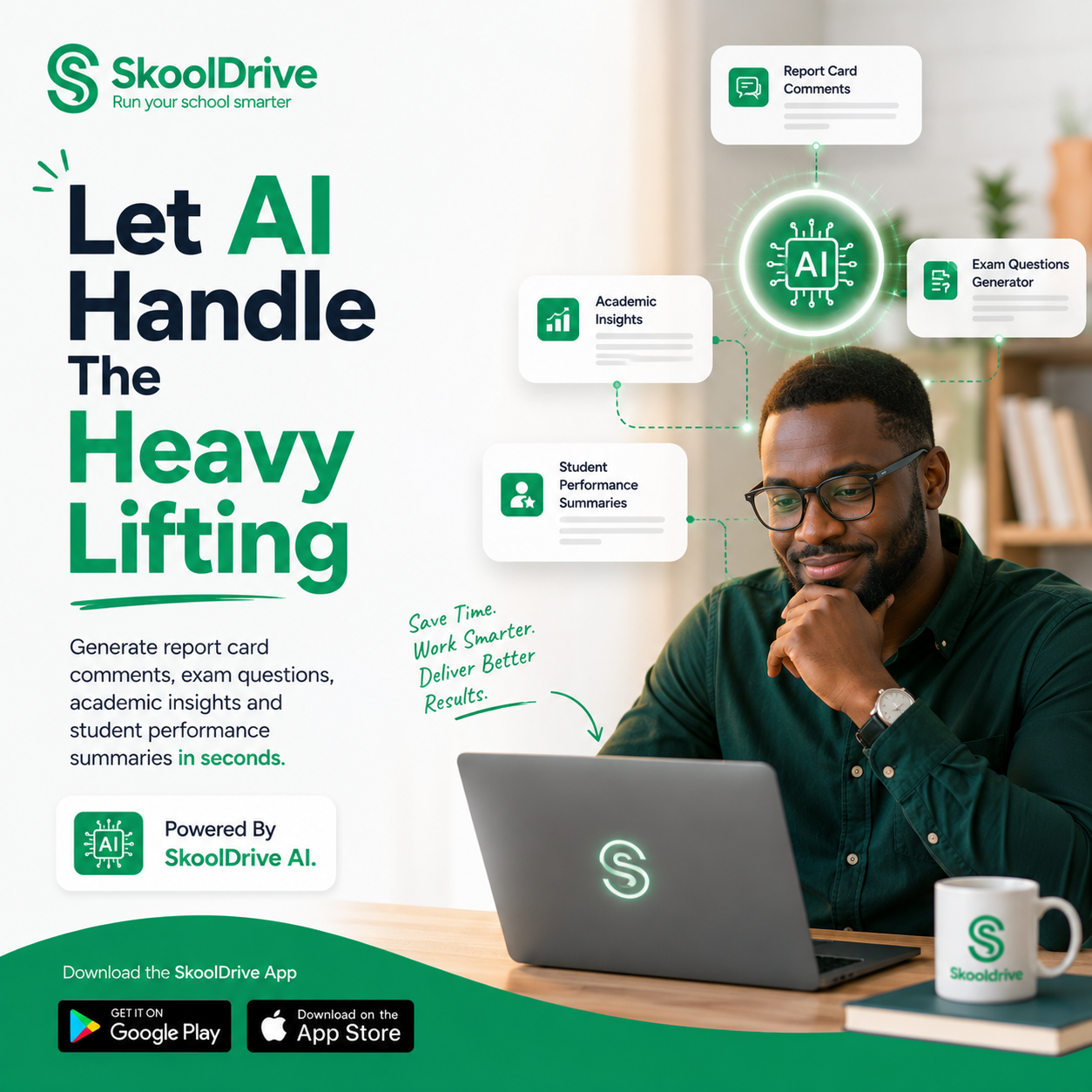
- AI school insight for administrators, summarizing attendance, fees, enrolment, results, and school health
- AI class insight for teachers, helping them understand class performance and students who may need attention
- AI child insight for parents, summarizing how a child is doing academically and behaviorally
- AI report-card comments, helping teachers write personalized student remarks faster
- AI report-card summaries for parents and students
- AI fee reminder drafting, helping admins write clearer reminders before sending them to parents
- AI Challenge, where students can generate practice quizzes and receive AI-assisted marking and feedback
- Handwritten answer transcription, allowing students to take a photo of an answer and convert it to text
- SkoolDrive AI chat, a role-aware assistant inside the platform
- AI usage and cost tracking for platform admins, so AI features can be controlled responsibly
The goal is not to replace teachers or administrators. The goal is to reduce repetitive work and help them make faster, better decisions.
How we built it
We built SkoolDrive as a production-grade full-stack application, and OpenAI Codex was deeply involved throughout the build process as our AI engineering partner.
The backend is built with FastAPI, PostgreSQL, Redis, Celery, Docker, and Docker Compose. With Codex, we designed and implemented the backend architecture around multi-school separation, role-based access control, background jobs, notifications, payment workflows, subscription plans, production-safe migrations, and AI usage metering.
Codex helped us reason through complex backend decisions like how to structure subscription plans, how to gate premium features, how to safely remove an old billing model, how to protect production schools during database migrations, and how to design APIs that could support both web and mobile clients cleanly.
The web frontend is built with React and TypeScript. Codex helped us build dashboards for school admins and super admins, including subscription management, billing, leads, school controls, AI usage, feature access management, premium feature indicators, and plan upgrade flows. It also helped us refine the user experience so standard-plan users can clearly see which features are premium instead of running into confusing errors.
The mobile app is built with Expo React Native. Codex helped us build and debug mobile workflows including OTA updates, production/staging environment handling, native file opening, image/file downloads, chat attachments, app update prompts, and AI-powered experiences for parents, students, and teachers.
For AI, we built a shared AI service layer that powers multiple product features from one controlled backend entry point. Codex helped us design this layer so AI could be reused safely across different workflows while tracking usage, cost, school-level limits, and feature access. The AI features are role-aware, so a parent, teacher, student, and school admin do not receive the same kind of context or output.
SkoolDrive uses AI to make school workflows easier in practical ways: school-health insights for administrators, class insights for teachers, child-progress insights for parents, report-card comment generation, report-card summaries, fee reminder drafting, AI-generated practice quizzes, AI-assisted quiz marking, handwritten answer transcription, and a role-aware SkoolDrive AI chat assistant.
For infrastructure, we initially used Railway, then migrated SkoolDrive to a Contabo VPS with separated staging and production environments. Codex guided us through the DevOps process step by step: setting up Docker-based deployments, configuring GitHub Actions CI/CD, separating staging and production environments, validating DNS changes, monitoring containers with Portainer, handling production database migration carefully, and keeping environment variables and secrets separated.
Codex also helped us work like a senior engineering team: planning changes before implementation, reviewing risk before production deployments, debugging logs, writing safer migrations, testing locally with Docker, pushing through Git workflows, and keeping staging and production aligned.
In short, we did not use AI only as a feature inside the product. We also used AI as part of the way we built the product. Codex helped us move faster, make better architectural decisions, avoid production mistakes, and turn SkoolDrive from an idea into a working SaaS platform.
Challenges we ran into
One major challenge was subscription and billing logic. We moved from a simple per-student pricing model to a more flexible plan-based model where super admins can control pricing, student bands, premium features, manual school access, and payment status.
Building AI into a school system also required careful thinking. We had to make sure AI features were useful, controlled, and safe. AI needed to support real workflows, not just feel like a gimmick. That meant designing AI around school-specific context: attendance, fees, results, classes, students, parents, and teacher responsibilities.
Mobile file handling was also challenging. We had to support a WhatsApp-like experience where senders can view files immediately, receivers download files locally first, and downloaded files are stored locally for future access.
We also had to solve real operational problems like push notifications, role permissions, teacher deletion safety, premium feature gating, staging/production deployment separation, clean update flows for Android and iOS, and AI budget tracking.
Accomplishments that we're proud of
We are proud that SkoolDrive is not just a prototype. It is a working product with real schools, real data, production deployments, staging environments, and real operational workflows.
Some accomplishments we are especially proud of:
- Migrated production safely from Railway to a VPS without data loss
- Built separated staging and production infrastructure
- Added GitHub Actions deployment for staging and production
- Built a flexible subscription and premium feature system
- Added super admin control over school access, pricing, and features
- Implemented CBT end to end
- Built AI-powered school, class, and child insights
- Added AI-generated report-card comments and summaries
- Added AI Challenge for student practice and AI-assisted marking
- Added handwritten answer transcription
- Added AI usage and cost monitoring for platform admins
- Improved chat with media/file download behavior
- Added attendance notifications for parents
- Built mobile OTA update workflows
- Added app update prompts with force/optional update control
- Improved monitoring with Portainer
- Continued shipping while keeping production users safe
The biggest accomplishment is that SkoolDrive now feels like a real SaaS platform, not just a school app. It combines school management, communication, payments, reporting, mobile access, and AI assistance in one system.
What we learned
We learned that building software for schools is not just about features. It is about trust, reliability, simplicity, and operational discipline.
A school management system touches sensitive data: student records, fees, attendance, communication, results, and parent information. That means every feature needs to be built with care.
We also learned that AI becomes much more powerful when it is connected to real workflows. A generic chatbot is helpful, but an AI assistant that understands school context can do much more. It can help an admin understand school health, help a teacher write better remarks, help a parent understand a child’s progress, and help a student practice more effectively.
We also learned how important infrastructure is. A beautiful app is not enough if deployments are fragile, logs are hard to read, or environments are mixed together. Moving to a VPS taught us a lot about Docker, CI/CD, DNS, monitoring, backups, and production safety.
On the product side, we learned that schools need flexibility. Pricing, subscription access, premium features, AI limits, and school operations cannot be too rigid. The super admin needs enough control to support different types of schools.
What's next for SkoolDrive
Next, we want to make SkoolDrive even more intelligent, reliable, and valuable for schools.
Our roadmap includes:
- More advanced AI-powered school insights for administrators
- Predictive alerts for attendance drops, unpaid fees, and academic risk
- Better parent engagement analytics
- More advanced CBT and exam workflows
- AI lesson-plan and question-generation tools for teachers
- Automated fee reminders and payment intelligence
- Richer reporting for school owners
- Offline-friendly mobile experiences
- Stronger audit logs and compliance tools
- Better onboarding for new schools
- More automation for teachers and admins
- Deeper analytics across attendance, academics, payments, and communication
Our long-term vision is for SkoolDrive to become the operating system for modern schools in Nigeria and beyond — a platform where school data, communication, payments, learning, and AI all work together to make education easier to manage and easier to understand.
Built With
- ai
- celery
- docker
- docker-compose
- edtech
- expo.io
- fastapi
- github-actions
- mobile-app
- nginx
- openai-codex
- paystack
- portainer
- postgresql
- push-notifications
- python
- react
- react-native
- redis
- saas
- school-management
- typescript
- vps

Log in or sign up for Devpost to join the conversation.