Inspiration
Most skincare purchases happen in a 30-second window on a product page, guided by a "for oily skin" label and a few reviews. We kept buying products that did nothing for our skin, or made it worse, and only found out weeks later. YouCam's Skin AI gives a precise, per-concern read of someone's skin. The missing step was turning that read into a decision: this product, for this face, right now?
What it does
SkinVerdict meets people at the three moments they actually think about their skin.
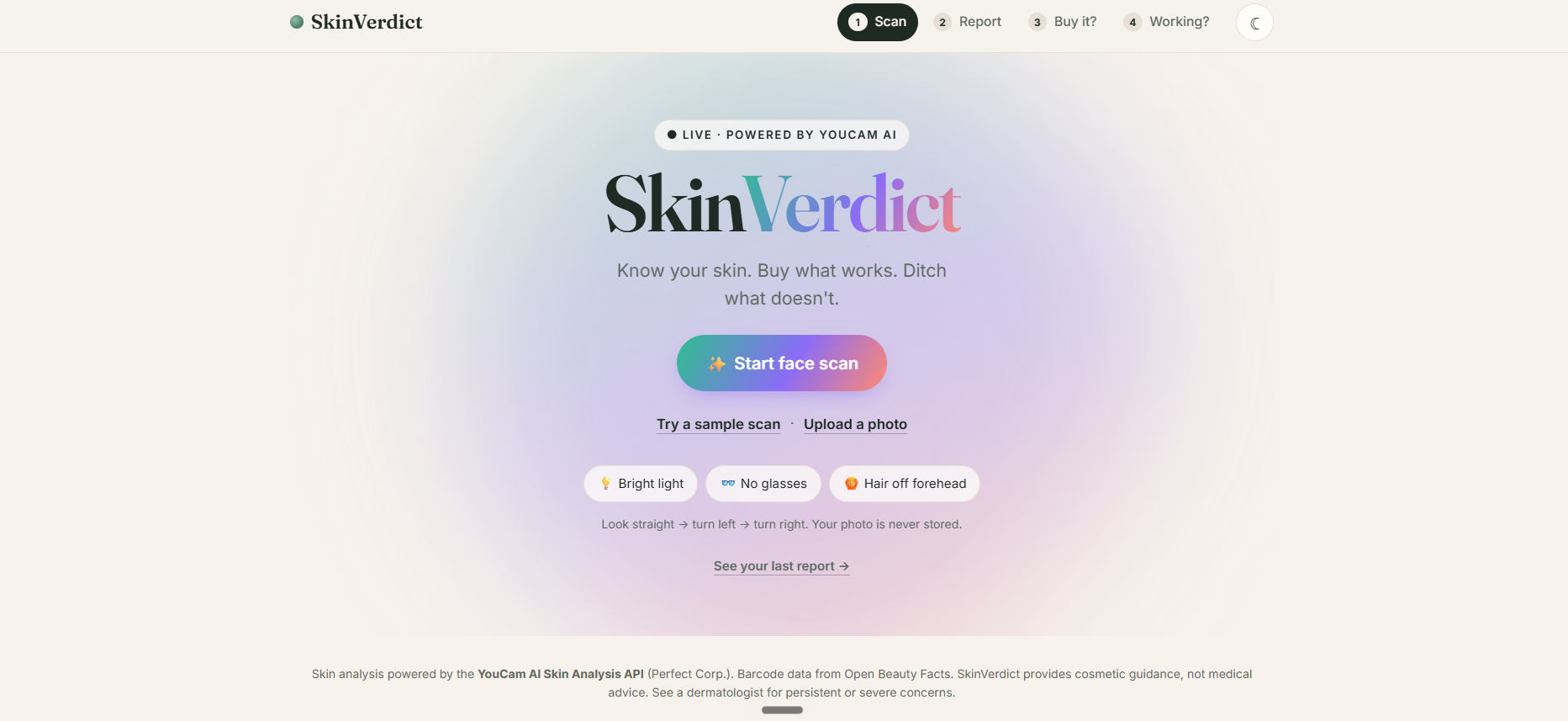
1. Scan: A live face scanner with a face-shaped guide, a real-time 3D face mesh, and coaching (light, glasses, hair over the forehead, distance), followed by a guided sweep: straight, left, right. Before any API credits are used, the photo's lighting and sharpness are checked on the device. The front photo is analyzed by the YouCam AI Skin Analysis API.
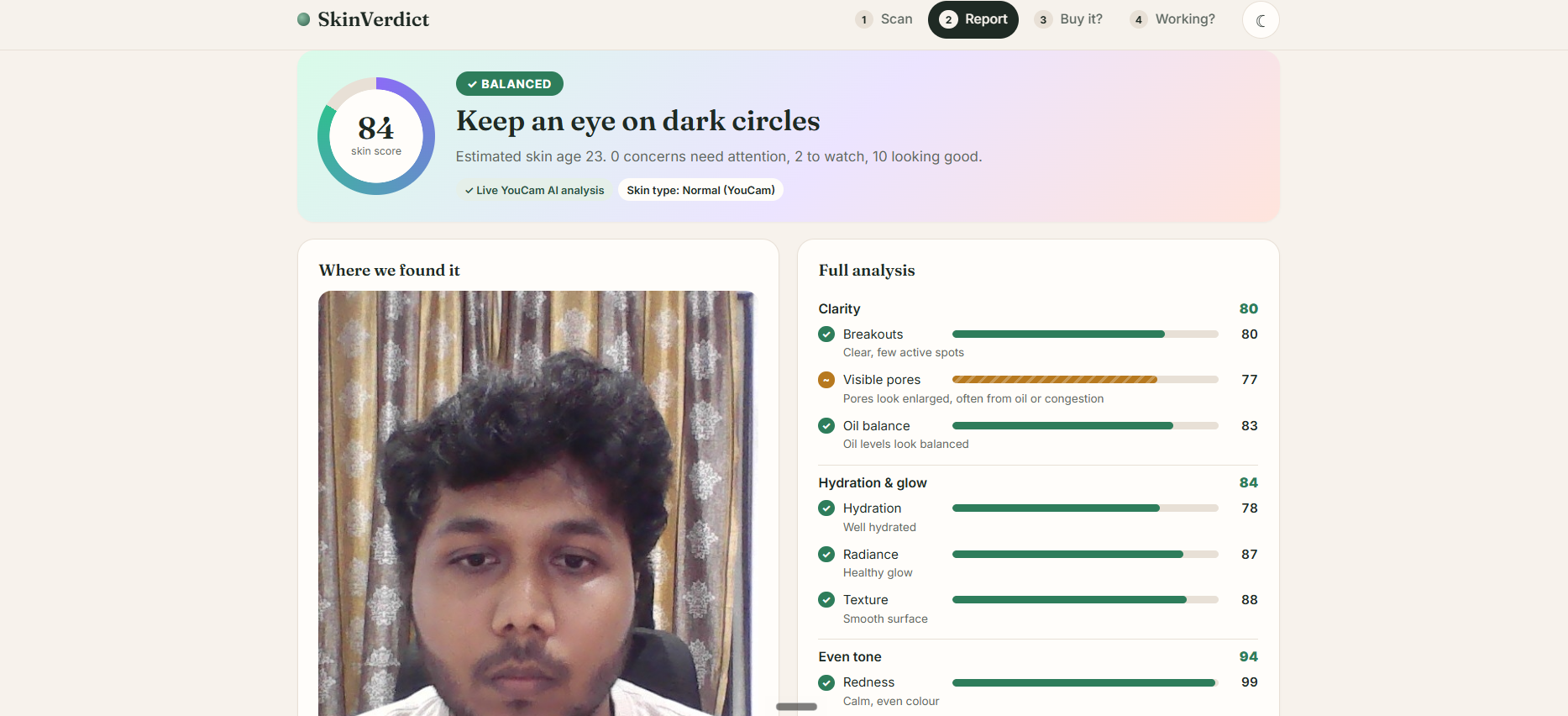
2. Report: Balanced or not, skin score, skin age, and skin type. All 12 concerns are grouped (Clarity, Hydration & glow, Even tone, Firmness & lines, Eye area) with what each score means, plus YouCam's detection maps showing where each concern is. The three lowest scores become a personal shopping list of what to look for and what to avoid.
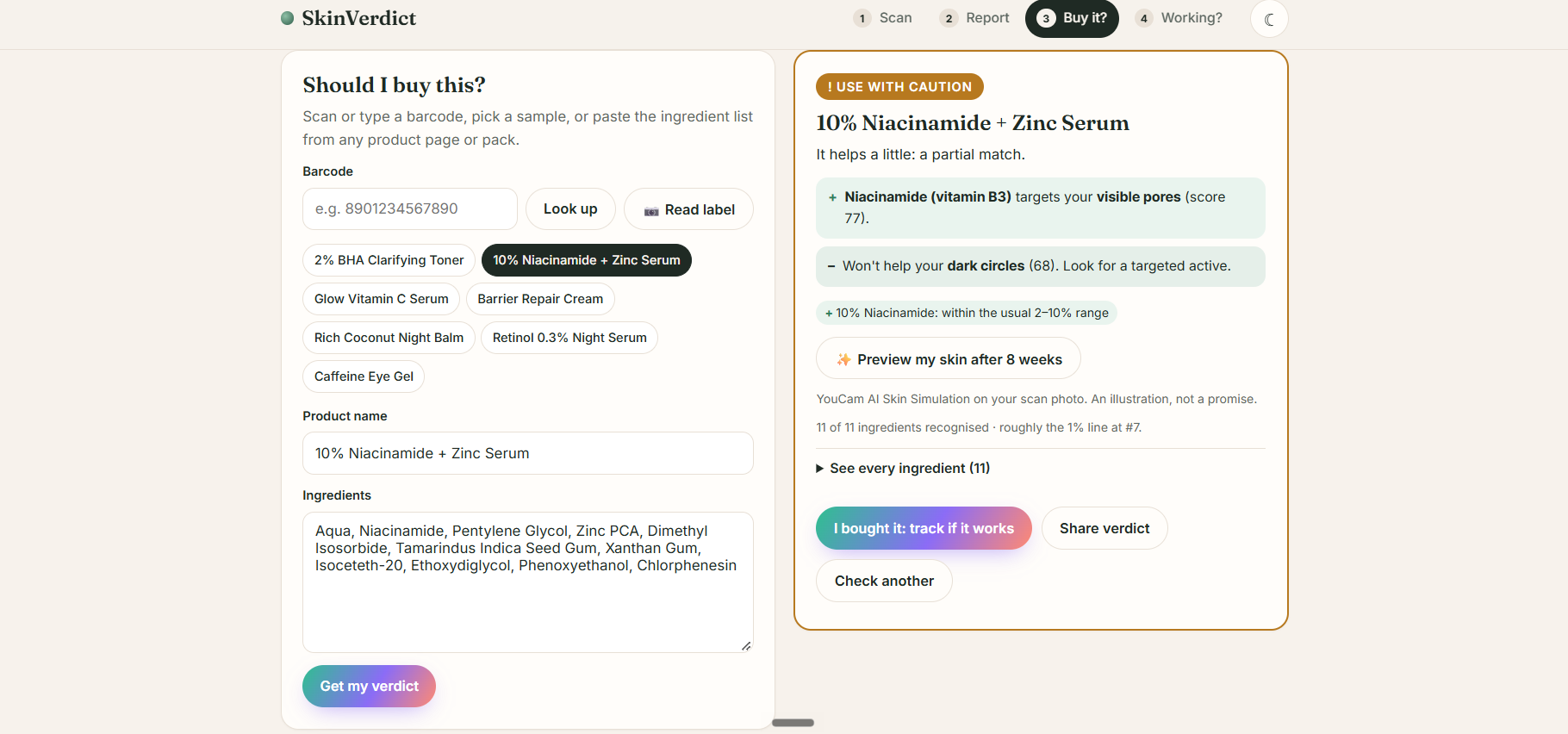
3. Should I buy it? Paste an ingredient list, enter a barcode, or photograph the label. Every ingredient is checked against your scores: actives that target your weak spots, ingredients that clash with them (fragrance on reactive skin, pore-cloggers on acne-prone skin, drying alcohol on dehydrated skin), actives listed too late to matter, and what the product won't fix. One clear verdict: Good match / Use with caution / Skip.
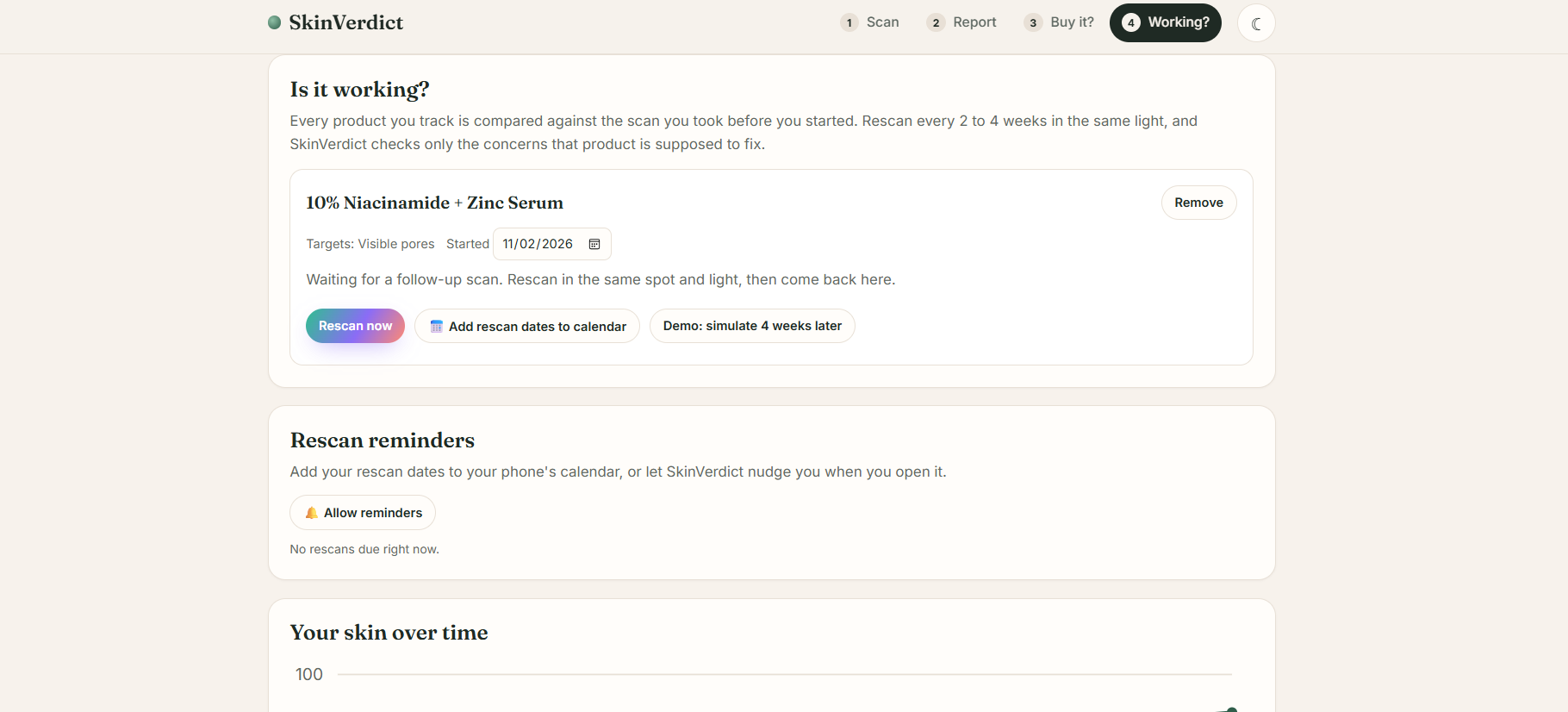
4. Is it working? Your scan becomes a baseline. Rescan in 2 to 4 weeks, and SkinVerdict compares only the concerns that product targets. It ignores normal photo-to-photo noise, watches for irritation, and knows that actives take weeks. The answer: Keep going / Give it time / Switch / Stop.
Also included: a foundation shade match with on-device try-on (YouCam Facial Color Tones Analyzer), a "your skin after 8 weeks" preview (YouCam Skin Simulation), rescan reminders, encrypted cross-device sync, and a one-line retailer widget that adds "Check against my skin" to any product page.
How we built it
- YouCam APIs: AI Skin Analysis (upload → task with 12 concerns → polling → scores and detection masks), plus the Facial Color Tones Analyzer and Skin Simulation.
- Backend: Node.js + Express. The API key is kept server-side, and the server enforces rate limits, daily scan quotas, a strict Content Security Policy, and structured logs.
- Frontend: Vanilla JavaScript, installable as a PWA, with dark mode and accessibility built in.
- Live scanner: MediaPipe Face Landmarker for the 3D mesh, real-time coaching and the guided sweep.
- Decision engine: A unit-tested ingredient database of 62 actives, 8 watch-out groups and 21 functional ingredient families, with concentration checks.
- Privacy: Photos are never stored. Scores stay on the user's device.
Challenges we ran into
- Making verdicts personal instead of generic: every reason quotes the user's own score.
- Telling real improvement apart from photo noise and from "too early to tell".
- Getting first-time users a usable photo on the first try, which is why we built live coaching and quality checks before spending API credits.
Accomplishments that we're proud of
A complete loop (scan → decide → buy → verify) that a first-time user understands in seconds, built on a real YouCam API integration with 34 automated tests, not a mockup.
What we learned
Skin analysis is most valuable right before and a few weeks after a purchase, not as a one-off report.
What's next for SkinVerdict
- Expert review: have a dermatologist or cosmetic chemist review the ingredient rules (an export for this is already built in).
- Scanner calibration: calibrate the live coaching checks on a diverse set of faces.
- Retailer pilots: test the "Check against my skin" widget and the shade match with real brand shade ranges.
Built With
- css
- express.js
- html
- javascript
- mediapipe
- node.js
- youcam
