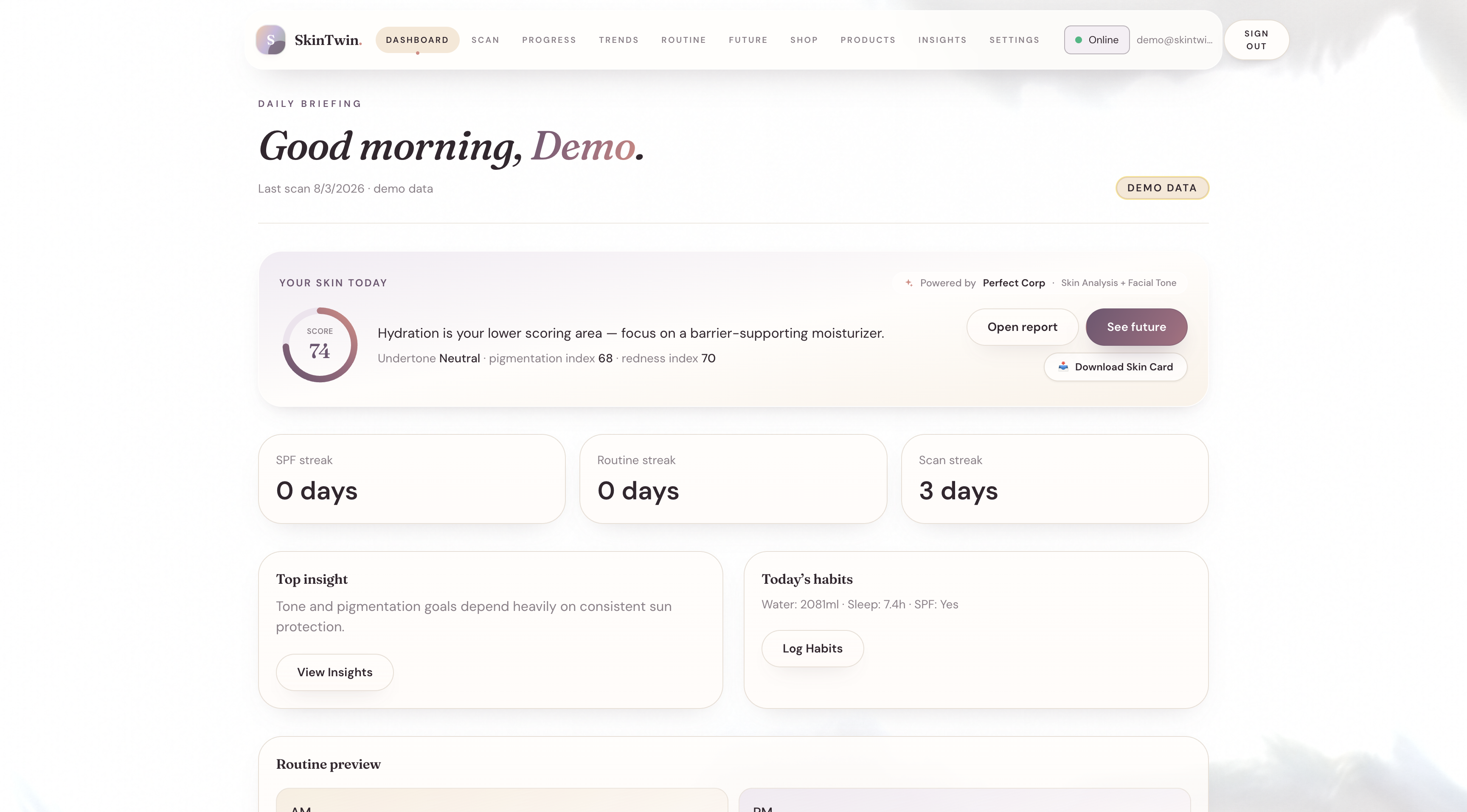
SkinTwin is a skincare wellness app that turns a selfie into measured skin data, then keeps measuring — so a person can finally tell whether their routine is actually working.
Most skincare decisions are made from memory and mirror-checking. People buy a serum, use it for a month, and have no idea whether their skin changed, whether the change came from the serum, from sleeping better, or from the season. SkinTwin closes that loop: it uses Perfect Corp's YouCam APIs to score ten dimensions of skin from a photo, logs the habits and products in between scans, and produces a scan-to-scan progress report that says what moved, by how much, and what was happening in the user's routine while it moved.
Project description
Skincare is a category where people spend for years and get almost no feedback. A serum goes on the shelf, a month passes, and the only evidence anyone has is a memory of what their face looked like in a different bathroom light. SkinTwin fixes the missing measurement.
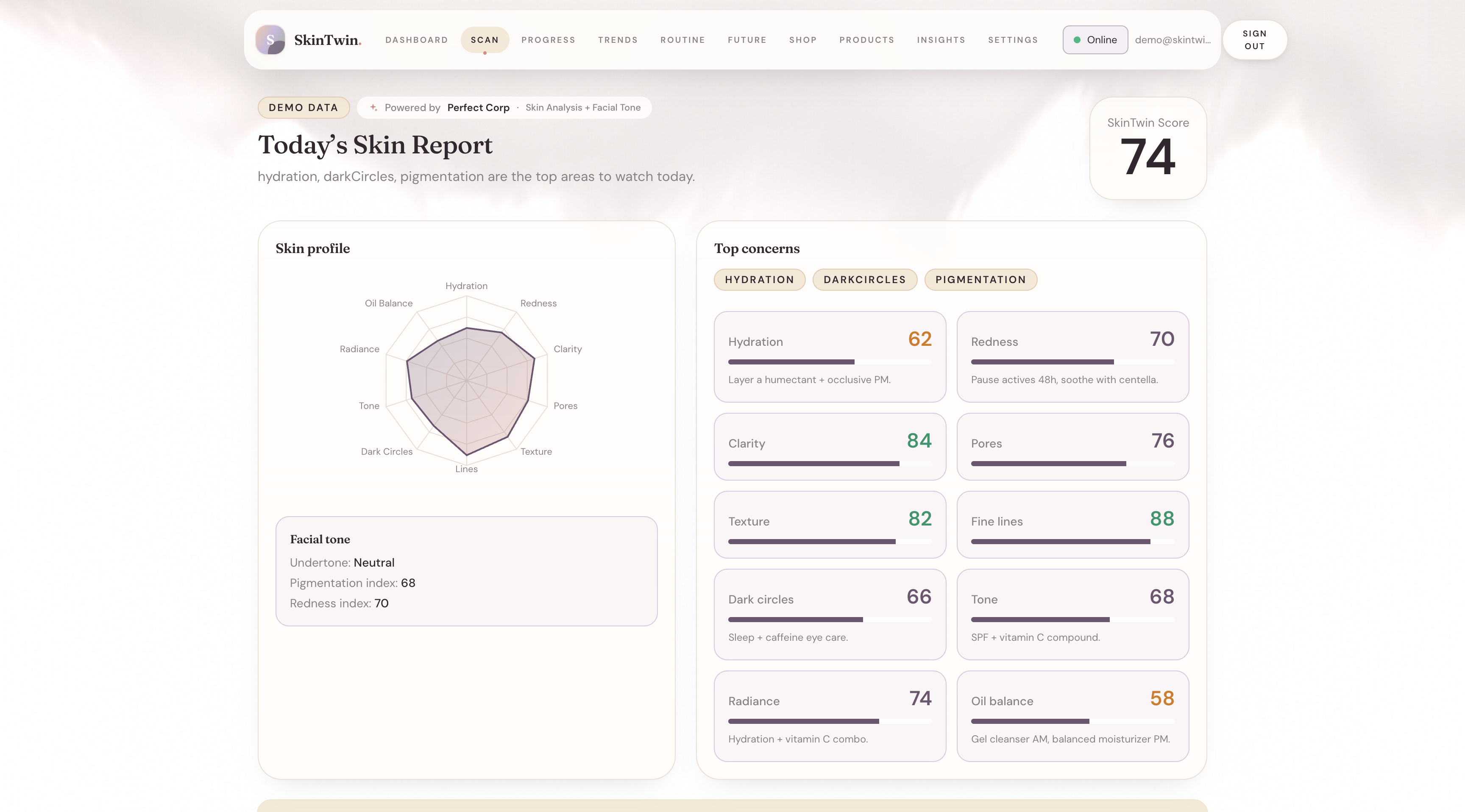
Take a selfie. SkinTwin runs it through Perfect Corp's YouCam AI Skin Analysis API and returns a scored reading across ten dimensions — hydration, redness, acne, pores, texture, wrinkles, dark circles, pigmentation, radiance, and oiliness — rolled into a single SkinTwin Score, with mask overlays that show where on the face each concern was detected. The YouCam Facial Color Tones API adds undertone and tone indices; the YouCam Skin Simulation API renders the user's own face on four future trajectories, including the one where they keep skipping SPF.
Then keep living. Log sleep, water, SPF, and stress. Add products to a shelf with start and stop dates. The app builds a sensitivity-aware AM/PM routine from the measured scores, ranks catalog products against the user's actual concern deficits, undertone, skin type, and budget, and surfaces patterns — missed SPF against pigmentation, a new exfoliant against rising redness, short sleep against dark circles.
Then scan again. This is where SkinTwin earns its name. The progress report compares two scans and explains the delta using what was logged in between: what improved, what declined, what held steady, which products were running, and how consistent the habits were. It is deliberately honest — dimensions measured in only one scan are excluded rather than guessed, moves inside ±3 points are called noise rather than progress, and habit and product links are labeled as timing overlaps with a confidence grade, never as proven cause. The app will tell a user their product did nothing. That is the feature.
Why it matters commercially. Diagnostic-led recommendation converts better and returns less than quiz-led guessing, because it is grounded in a real reading of a real face. Scanning is inherently recurring, so measurement itself becomes the retention loop. And the progress report gives a brand something marketing copy cannot buy: individual, timestamped evidence that a customer's skin changed while their product was on the shelf — stated with a confidence grade the customer can trust. For the consumer, it converts skincare from a purchase habit into a measurable practice. For a retailer, it converts a catalog into a diagnostic service with first-party skin data underneath it.
SkinTwin is wellness guidance, not medicine. It recommends ingredient families and product categories, grades its own confidence, and points persistent or severe concerns to a dermatologist.
The YouCam APIs in SkinTwin
SkinTwin is built on Perfect Corp's YouCam / Perfect Corp server-to-server (S2S) APIs. Three are integrated, each backing a distinct product surface.
1. AI Skin Analysis — the core measurement engine
Where: /scan, /scan/[scanId], /dashboard, /progress, /trends
Code: lib/perfect/skinAnalysisPipeline.ts, lib/perfect/perfectClient.ts
This is the API the whole product stands on. Every score, chart, routine, recommendation, and progress report in SkinTwin traces back to a Skin Analysis task.
The full S2S v2.1 flow is implemented end to end:
POST /s2s/v2.1/file/skin-analysiswith content type, filename, and byte size to obtain afile_idand a presigned upload target.PUTthe raw image bytes to the presigned URL with the headers Perfect returns.POST /s2s/v2.1/task/skin-analysiswithsrc_file_id, the requesteddst_actions, andminiserver_args: { enable_mask_overlay: true }.GET /s2s/v2.1/task/skin-analysis/{task_id}on a 2-second poll (up to 45 attempts) untiltask_statusissuccess.
HD-first with an SD fallback. SkinTwin requests the ten HD concerns by default —
hd_moisture, hd_redness, hd_acne, hd_pore, hd_texture, hd_wrinkle, hd_dark_circle,
hd_age_spot, hd_radiance, hd_oiliness — because they map 1:1 onto the ten dimensions the UI
renders. If the account lacks HD entitlement, the pipeline detects that the actions were rejected
(rather than the photo) and retries once on the SD triad acne, wrinkle, age_spot, reusing the
already-uploaded file. HD and SD are never mixed in one task. PERFECT_DST_ACTIONS overrides the
set. Each scan is stored with the tier that actually ran.
Only measured dimensions are shown. Perfect's output[] rows are mapped to app metric keys, and
the app records exactly which keys came back (analyzedMetricKeys). Anything Perfect did not
measure is excluded from the radar chart, the metric grid, and every scan-to-scan comparison rather
than being rendered at a placeholder value — a fake 50 sitting next to real readings reads as a real
reading, which is exactly the kind of thing that erodes trust in a consumer health-adjacent product.
Mask overlays. Because tasks are submitted with enable_mask_overlay, each concern comes back
with a per-concern overlay image showing where on the face it was detected. SkinTwin extracts
those URLs, copies the images into its own Supabase Storage bucket (Perfect's presigned links
expire), and renders them in an interactive viewer on the scan result page and side-by-side in
progress reports (components/SkinMaskViewer.tsx, components/ProgressMaskCompare.tsx,
lib/supabase/persistMasks.ts). This is what turns a number into something a user can see.
Honest error handling. Perfect's rejection codes are translated into actionable guidance instead
of a generic failure — error_src_face_too_small becomes "use a well-lit photo where your face
fills most of the frame," error_src_face_out_of_bound becomes "center your head and avoid tight
crops." Photo rejections never silently degrade into mock data.
2. AI Facial Color Tones Analyzer — undertone and tone indices
Where: scan results, /recommendations
Code: lib/perfect/facialTonePipeline.ts
Runs the same file → task → poll flow against /s2s/v2.1/*/facial-color-tones, returning the user's
undertone (warm / cool / neutral / olive) plus pigmentation and redness indices. Undertone feeds the
product recommendation engine's undertoneFit matching, so shade- and tone-sensitive
recommendations reflect the user's actual skin rather than a generic average.
3. AI Skin Simulation — future-trajectory scenarios
Where: /future
Code: lib/perfect/skinSimulationPipeline.ts
Uses Perfect's Skin Simulation v2 flow (/s2s/v2.0/*/skin-simulation) to render what the user's own
face plausibly looks like on four different trajectories. Each scenario is a distinct intensity
profile across ten simulation dimensions (wrinkle, radiance, oiliness, acne, eye bags, dark circle,
spots, pores, texture, redness) so the scenarios are visibly different rather than four copies of
one image:
| Scenario | Framing |
|---|---|
consistent_spf_routine |
Daily SPF and routine consistency held |
current_trajectory |
Current habit consistency continued |
skip_spf |
Inconsistent sun protection |
stop_routine |
Skincare abandoned |
Results are shown through a before/after slider (components/BeforeAfterSlider.tsx) and labeled as
illustrative simulations, not predictions.
Graceful degradation
If PERFECT_API_KEY / PERFECT_API_BASE_URL are absent, every pipeline returns deterministic mock
responses so the app is fully explorable without credentials. Anything mock-backed is labeled in the
UI (components/DataModeBadge.tsx, mockFallbackNote), and simulation fallbacks carry a plain
explanation of why the real call didn't complete. Real analysis is never quietly swapped for fake
numbers.
What the app does
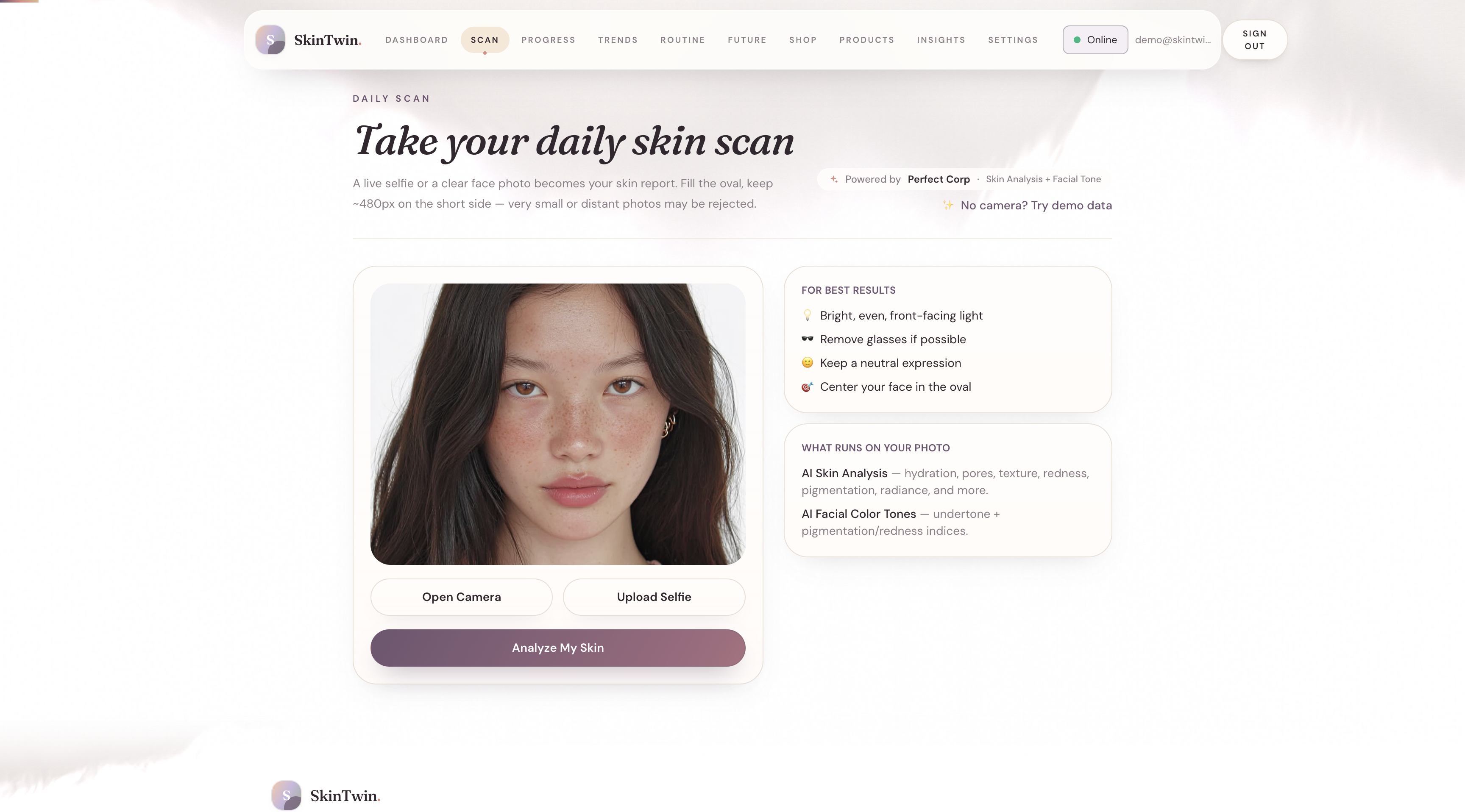
Scan
Live camera selfie capture with an upload fallback. The photo runs through Skin Analysis and Facial Color Tones, and returns a SkinTwin Score (a weighted composite across measured dimensions — hydration and radiance weigh heaviest, oiliness is directional and excluded from the score), the top concerns, the ten-dimension radar, and the per-concern mask overlays.
Progress — the differentiating feature
/progress compares any two scans and explains the change using what was logged in between. It is
deliberately conservative, because an over-confident health claim is worse than no claim:
- Only dimensions measured in both scans are compared; the rest are explicitly listed as not comparable.
- Moves within ±3 points are reported as steady, since Perfect's scores carry real lighting and framing noise between sessions.
- Habit and product links are framed as timing overlaps, never as proven cause, and each carries a confidence grade derived from window length and logging consistency.
- The report also surfaces adherence: SPF rate, average sleep, water, stress, and log rate over the window, plus which products were started, running, or stopped during it.
- Mask overlays from both scans are shown side by side, so a change in a pigmentation score can be checked against where the pigmentation actually is.
Trends
Scan history charted over time, per dimension, so slow movement becomes visible.
Habits
Daily logging of sleep, water, SPF, stress, and exercise. This is the input that makes progress reports explanatory rather than merely descriptive.
Products
A personal product shelf with active ingredients, AM/PM usage, frequency, and start/stop dates. Start and stop dates are what allow the progress engine to line a product up against a window of change.
Routine
A generated AM/PM routine derived from measured scores plus the user's profile (skin type, sensitivity, experience, budget, goals). It is rule-driven and safety-aware: high sensitivity suppresses acid and active-treatment steps and populates an explicit avoid for now list; low logged sleep paired with low dark-circle scores adds a sleep-consistency step instead of pushing another eye product.
Recommendations / Shop
Products from a catalog scored 0–100 against the user's ranked concern deficits, skin type, undertone, and budget, each with a plain-language "why this matches you" headline and explicit warnings when a product carries a high-risk active for sensitive skin.
Insights
Pattern detection across scans, habits, and products — low sleep against dark circles, missed SPF days against pigmentation, a newly introduced exfoliant against rising redness, low water intake against hydration. Every insight ships with its evidence, a recommended action, and a confidence level.
Future
The four Skin Simulation scenarios, as a motivation surface rather than a diagnostic one.
Onboarding, auth, and demo mode
Goal/sensitivity/budget onboarding, Supabase Auth when configured with a local demo session otherwise, and a one-click demo seed so the full experience can be evaluated in seconds.
Consumer and retail value
For the consumer. Skincare is one of the few categories where people spend continuously for years with almost no feedback signal. SkinTwin replaces "I think my skin looks better" with a measured, repeatable reading of ten dimensions, an image showing where each concern sits on the face, and a report that connects the change to the SPF they did or didn't wear and the serum they started three weeks ago. That converts skincare from a purchase habit into a measurable practice — and it tells users the uncomfortable thing too, which is the part that builds trust: that a product did nothing, or that the ±2 point "improvement" is noise.
For brands and retailers. The same loop is a commercial engine:
- Diagnostic-led merchandising. Recommendations are grounded in a real reading and the user's undertone, skin type, sensitivity, and budget — not a quiz. Grounded recommendations convert better and get returned less.
- Proof of efficacy at the individual level. The progress report is the first thing a brand can point a customer at to show their product coincided with a measured change, with an honest confidence grade attached. That is a repurchase argument no marketing copy can make.
- Retention through measurement. Scanning is inherently recurring. Every scan is a session, every progress report is a reason to come back, and the habit tracker gives a reason to open the app on days without a scan.
- Regimen expansion at the right moment. Concern deficits surface the specific gap in a customer's shelf — and the routine engine only recommends into it when sensitivity signals allow.
- Sun-care behavior change. SPF adherence is tracked, tied to pigmentation outcomes, and
visualized through the
skip_spfsimulation — the single highest-leverage behavior in the whole category. - First-party skin data. Cohort-level concern distributions, adherence rates, and before/after outcomes, generated as a byproduct of a service users want to use.
Where it stays in its lane. SkinTwin is wellness guidance, not medicine. It does not diagnose, treat, or prevent medical conditions, it recommends product categories and ingredient families rather than making clinical claims, it grades its own confidence, and it surfaces a disclaimer pointing persistent or severe concerns to a licensed dermatologist.
Built With
- github
- supabase


Log in or sign up for Devpost to join the conversation.