Inspiration
People wonder about their skin right before a purchase, and right when they are standing in front of a mirror deciding whether a product is working. I have been there: four weeks into a new serum, with no idea whether it was doing anything. The mirror changes with the light, and most beauty apps show deliberately encouraging scores.
So I tested the measurement first. On day one I took two guided captures of my own face, three minutes apart, under the same light. The YouCam skin scores moved on their own: pore by +17.3, acne by +15.0, radiance by -7.9, oiliness by +7.5, firmness by +6.7, droopy upper eyelid by -6.2, tear trough by -5.5 and droopy lower eyelid by +5.2. The remaining aspects moved 3.5 points or less, and skin type came back identical. That is one person's day-1 measurement, not a claim about accuracy in general, but it made the point: a tracker that reads that movement as progress would be telling you stories. SkinLedger is built around that finding.
What it does
SkinLedger is a responsive web app (installable as a PWA) that gives a person an honest answer to "is this product working?" before they rebuy it.
- Profiles with consent. Adults 18+ only. Each person has their own profile, consent record and delete button.
- Guided capture or quick try. The YouCam JS Camera Kit guides light, distance and pose for repeatable weekly captures. A quick photo upload is available for first-time visitors with an invite code.
- Skin analysis. Each capture runs the YouCam AI Skin Analysis API: 15 numeric skin scores plus skin type. SkinLedger stores the
raw_scoreof each aspect and the analysis masks. It never stores or shows the display score, because that score is adjusted to look more favourable. - Your own noise band (the key idea). Day 1 takes two captures. For each aspect, the band is the larger of the difference between the two captures and a 3-point floor. An aspect whose band is wider than 10 points is shown as "Unstable for your setup" and is left out of verdicts. SkinLedger tells you which metrics are reliable for you before it gives a verdict. In my own day-1 pair, pore and acne moved more than 10 points between two captures taken three minutes apart, so they would be flagged for me.
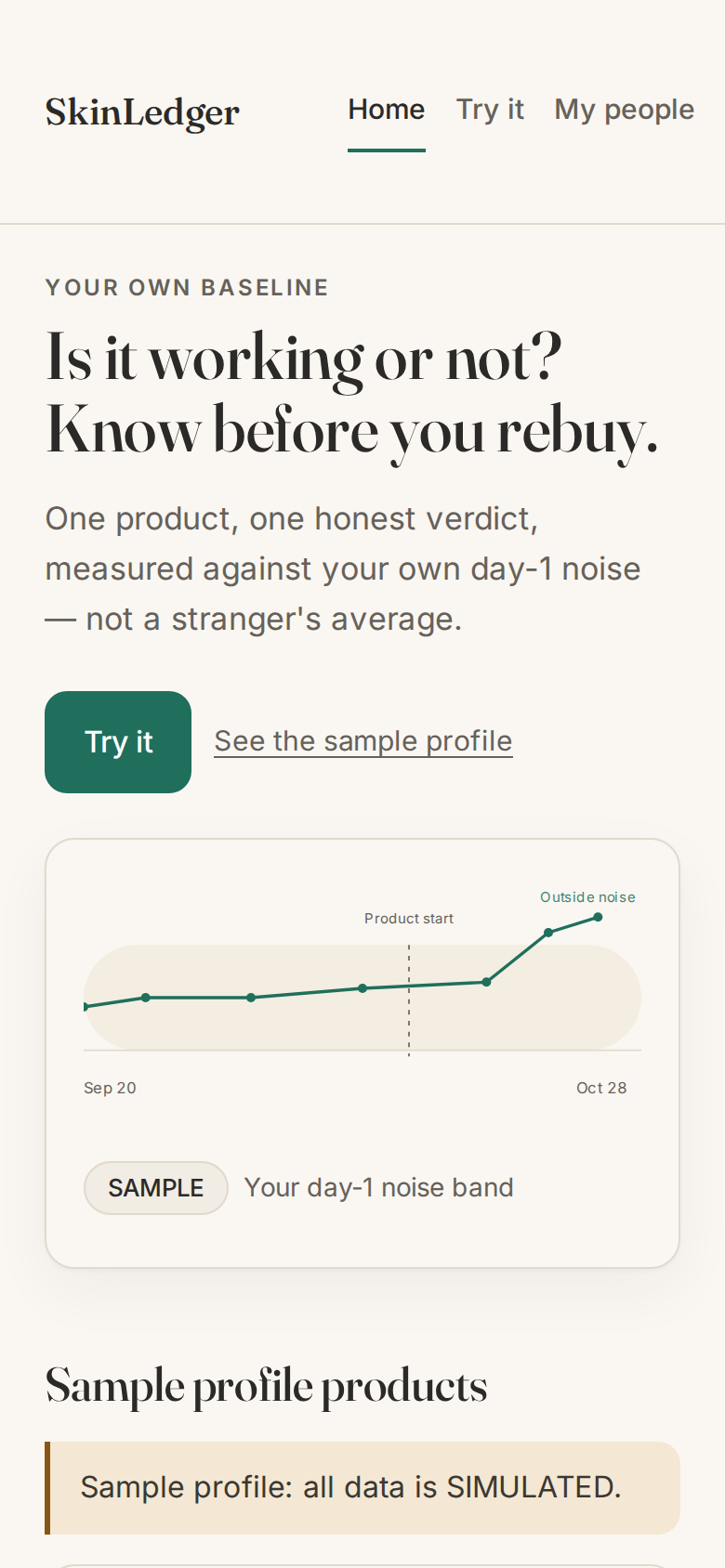
- Timeline per aspect. One chart per aspect with the day-1 noise band shaded around your baseline. Only changes outside the band count, and every REAL, SIMULATED or SAMPLE point is labelled.
- Product log and verdict. Log what you started, when, and which 1–4 aspects it should change. At day 14 and day 28 a check-in compares your target aspects with your baseline and the band, and returns Keep ("The change is bigger than your noise band."), No measurable change ("Reconsider before rebuying."), Worse ("Pause and look at what changed.") or Too early ("Check back on day 14."), with the aspects that changed most. It warns when another product changed in the same window.
- AM/PM routine and generic shopping list. Fixed rules map your lowest stable aspects to ingredient categories (no brands).
The shipped interface
The UI is "The Quiet Lab": a warm ivory and sage palette, with Fraunces for display type and Inter for interface text, both self-hosted under the SIL Open Font License 1.1. It is responsive at phone (390 px), tablet (768 px) and laptop (1440 px) widths. Every aspect has its own noise band; aspects wider than 10 points are labelled "Unstable for your setup" and left out of verdicts. Verdicts are KEEP / NO_CHANGE / WORSE / TOO_EARLY, shown as Keep / No measurable change / Worse / Too early with the messages above. "Higher score = healthier-looking skin, for every aspect", following the YouCam AI Skin Analysis docs (Inputs & Outputs): https://docs.perfectcorp.com/reference/ai_skin_analysis.
Data labels: REAL, SIMULATED, SAMPLE
Everything on screen carries a label.
- REAL: an actual analysis of a real capture (my day-1 captures, and visitors' own analyses).
- SIMULATED: generated scores for demo data (no photos, no masks). The public sample profile is entirely SIMULATED and its banner says "Sample profile: all data is SIMULATED." A real profile with attached demo history shows "Demo: day 14/28 check-ins are SIMULATED. Day 1 is real."
- SAMPLE: fixtures and example products (for instance "Niacinamide serum (SAMPLE)"). No real product brands appear anywhere.
Two weeks of real history cannot exist at the time of submission, so the public sample is entirely SIMULATED and labelled as such. My own day-1 pair is REAL wherever it appears.
Privacy by design
Adults 18+ only. Every analysis requires ticking "This is my own face and I am 18 or older." SkinLedger never stores your photo: it is held in memory, sent to the YouCam API for analysis and discarded, with no disk, no object storage and no cache. We store only the scores (raw_score), the result JSON without signed URLs, and the masks. YouCam may keep uploaded files for up to 30 days under its own terms. Photos are never sent to any other AI. You can delete your profile at any time, which removes everything SkinLedger stores.
Cosmetic skin insights, not a medical diagnosis. Scores are AI estimates and vary with lighting. See a dermatologist for persistent acne, changing moles, rashes or pain.
Powered by YouCam API.
How we built it
- YouCam AI Skin Analysis API (V2, SD). The asynchronous 4-step flow: create the file entry, upload the image to the signed URL, create the skin-analysis task, then poll the task until it reports success or error. 15 numeric aspects with
raw_score(wrinkle, droopy upper eyelid, droopy lower eyelid, firmness, acne, moisture, eye bag, dark circle, age spot, radiance, redness, oiliness, pore, texture, tear trough) plus skin type. Masks are downloaded in the same job because result links are short-lived. - YouCam JS Camera Kit v2.5 in
skincaremode with strict quality checks for consistent captures. It runs in the browser and sends photos only to the YouCam service. - Backend: Python 3.12 with uv, FastAPI, Jinja templates, HTMX for interaction, SQLite, httpx.
- Frontend: Pico CSS, Chart.js (vendored, no CDN), Fraunces and Inter self-hosted under the SIL Open Font License 1.1, installable PWA.
- Deploy: Railway with a persistent volume at
https://skinledger.focampo.com. - Guards on the shared link: invite code to run a real analysis, 2 real analyses per person, a daily unit cap and a hard total unit cap, all set by environment variables. The API key lives only in environment variables on the server; the browser never talks to the YouCam REST API.
- Testing: mocked API client and fixtures labelled SAMPLE; no test uses a real photo.
Challenges we ran into
- The measurement moves on its own. Two captures three minutes apart gave different scores, which became the core feature rather than a bug to hide.
- Using
raw_score, not the display score. The API's display score is adjusted to look more favourable, so SkinLedger tracks onlyraw_score. - Result links expire quickly. Masks and scores are stored immediately after a successful analysis.
- Showing results without keeping photos. The image arrives as the raw request body, stays in memory, goes to YouCam and is dropped; no code path writes it to disk.
- Consent, attestation and delete. Face analysis needs explicit consent, an own-face and 18+ attestation on every analysis, and a delete that really removes everything we store.
- Protecting a shared link's unit budget. Invite code, per-person limit, daily and total caps, so judges and friends cannot exhaust the demo.
- Camera Kit integration details. Getting the SDK to initialise and the guided capture to complete reliably on a phone took real debugging.
Accomplishments that we're proud of
- A real end-to-end guided capture on my phone, analysed and stored, and a measured day-1 noise band from my own two captures.
- A product whose headline feature is saying "this metric is not reliable for you yet".
- A consent-first, photo-never-stored design that I would be comfortable using for my family.
- An honest demo: my real day-1 pair is labelled REAL, and the public sample profile is entirely SIMULATED and labelled as such.
What we learned
- Skin scores are estimates, and light changes them as much as skincare does. Any tracker has to measure its own noise before it claims progress.
- Showing "No measurable change" is a feature: it can save someone from rebuying a product that is not doing anything measurable for them.
- A short test-retest check on day one is cheap and reveals which aspects to trust.
What's next
- Proper accounts (passkeys or OAuth) so a profile follows you across devices.
- More check-in prompts and reminders beyond day 14 and day 28.
- Export your scores and verdicts.
Built with (tags)
python, fastapi, htmx, sqlite, chart.js, youcam-api, pwa, railway
Try it out (links)
- Live demo: https://skinledger.focampo.com
- Repo: https://github.com/focampok/skinledger (MIT licence)
- Video: https://youtu.be/Syo0nqcsYgc

Log in or sign up for Devpost to join the conversation.