-
-
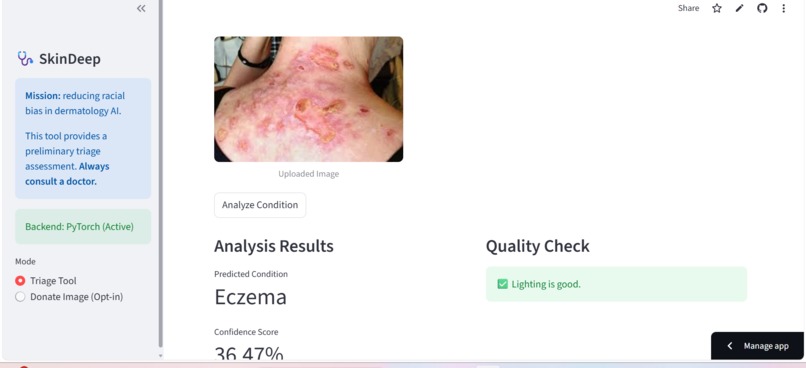
The website look
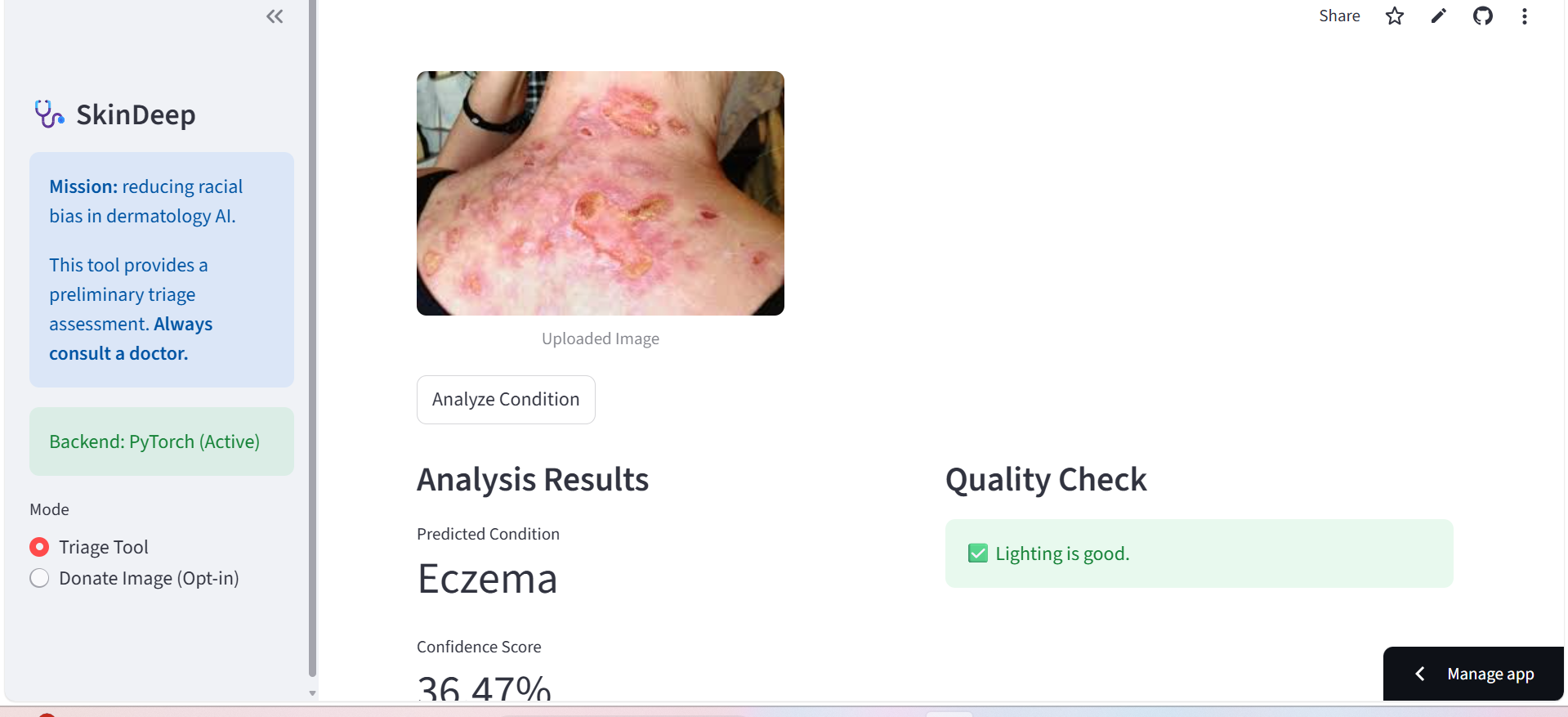
Inspiration
The inspiration for SkinDeep came from discovering that many popular open-source dermatology datasets are heavily biased toward lighter skin tones. This "data gap" means that modern AI models often fail to diagnose life-threatening conditions like melanoma on darker skin. We wanted to build a tool that explicitly tackles this health equity issue.
What it does
SkinDeep is a bias-free dermatology triage tool.
- Conditions Recognition: Identifies common skin conditions (rashes, eczema, moles) using an AI model trained on diverse skin types.
- Lighting Quality Check: A unique feature that warns users if their photo is too dark or washed out—a critical factor for accurate diagnosis on darker skin.
- Confidence Score: Transparently displays how unsure the model is.
- Community Donation: Allows users to "donate" anonymized images to the open-source community to help train fairer models in the future.
How we built it
- Backend AI: We used PyTorch and transfer learning with EfficientNet. We implemented a 2-stage training pipeline (Warmup -> Fine-Tuning) to ensure the model learns deep texture features.
- Frontend: Built with Streamlit for a fast, responsive web interface.
- Image Processing: Used Pillow/Numpy to analyze histograms and brightness levels in real-time.
- Dataset Strategy: We designed our data loader specifically for the Fitzpatrick 17k dataset, which categorizes images by skin type to ensure balanced representation.
Challenges we ran into
Our biggest challenge was environment compatibility. We were developing on a cutting-edge system with Python 3.14, which wasn't compatible with standard libraries like TensorFlow or OpenCV. We had to:
- Pivot our entire backend to PyTorch.
- Rewrite our image processing logic to remove OpenCV dependencies.
- Implement a "Demo Mode" fallback to keep the UI working while we fixed the backend.
Accomplishments that we're proud of
- Successfully implementing a native PyTorch pipeline that runs on the latest Python version.
- Creating a Lighting Check algorithm that provides immediate, actionable feedback to the user.
- Building a UI that prioritizes ethical transparency (disclaimers/confidence scores) over blind automation.
What's next for SkinDeep
- Full Dataset Training: We plan to train the model on the complete 17k image dataset on a GPU cluster.
- Mobile App: Porting the logic to React Native for easier access in remote areas with limited healthcare.
- Federated Learning: Implementing privacy-preserving training so users can improve the model without their raw images ever leaving their device.

Log in or sign up for Devpost to join the conversation.