-
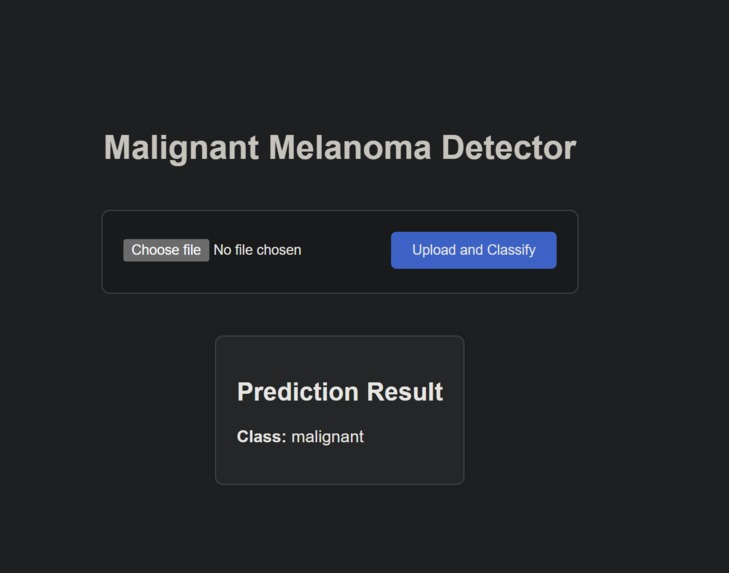
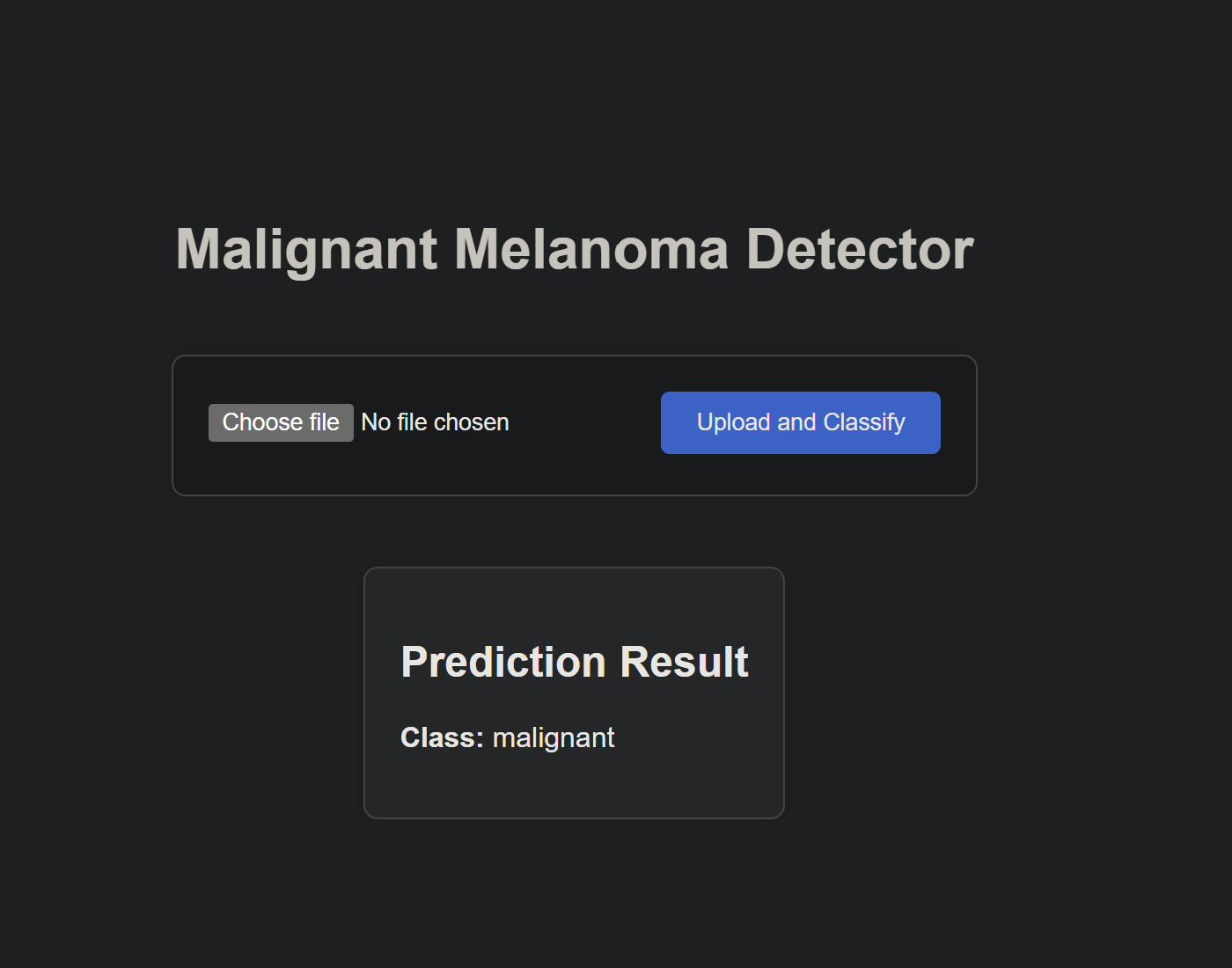
Prediction result of uploading
Inspiration
Early skin cancer detection can be life-saving, but access is limited. We wanted to build an AI tool that makes diagnosis more accessible-starting with just a photo.
What it does
Our web application allows users to upload an image of a nevus to determine the probability it is either benign or malignant.
How we built it
We built the application as a Flask web application using AWS as the cloud server to host the ResNet18 model we trained.
Challenges we ran into
Throughout the development process, we encountered several challenges:
- A highly imbalanced dataset, with significantly more benign cases than malignant ones.
- Difficulty interpreting feature maps from the CNN, which complicated explainability.
- The technical complexity of managing and preprocessing large-scale image and metadata pipelines.
Accomplishments that we're proud of
We are proud of:
- Our model reached a validation accuracy of 96.75%.
- Successfully completed full-stack development, integrating both model training and deployment with a user-friendly interface.
- Our data exploration revealed clinically relevant insights that deepened our understanding of the problem space.
What we learned
Throughout this project, we learned:
- Training and optimizing convolutional neural networks for medical image classification.
- Leveraging metadata to complement image-based models and provide richer insights.
- Building interpretable machine learning systems that enhance user trust in model predictions.
What's next for Malignant Melanoma Detector
Looking ahead, we plan to:
- Scale the application to include the full dataset.
- Incorporate multimodal learning by combining image and metadata features more holistically.
- Improve fairness across demographic groups such as age and sex.
- Develop enhanced interpretability tools to make the model’s decision process more transparent and clinically useful.


Log in or sign up for Devpost to join the conversation.