Inspiration
Skin cancer is the most common cancer in the world, yet millions lack access to early screening—especially in rural or underserved communities. We were inspired by this critical gap in care. Melanoma is 99% curable if caught early, but far too often it goes undetected. We wanted to create an accessible, AI-powered tool that empowers anyone, anywhere to take control of their health—without needing a dermatologist or expensive equipment.
What it does
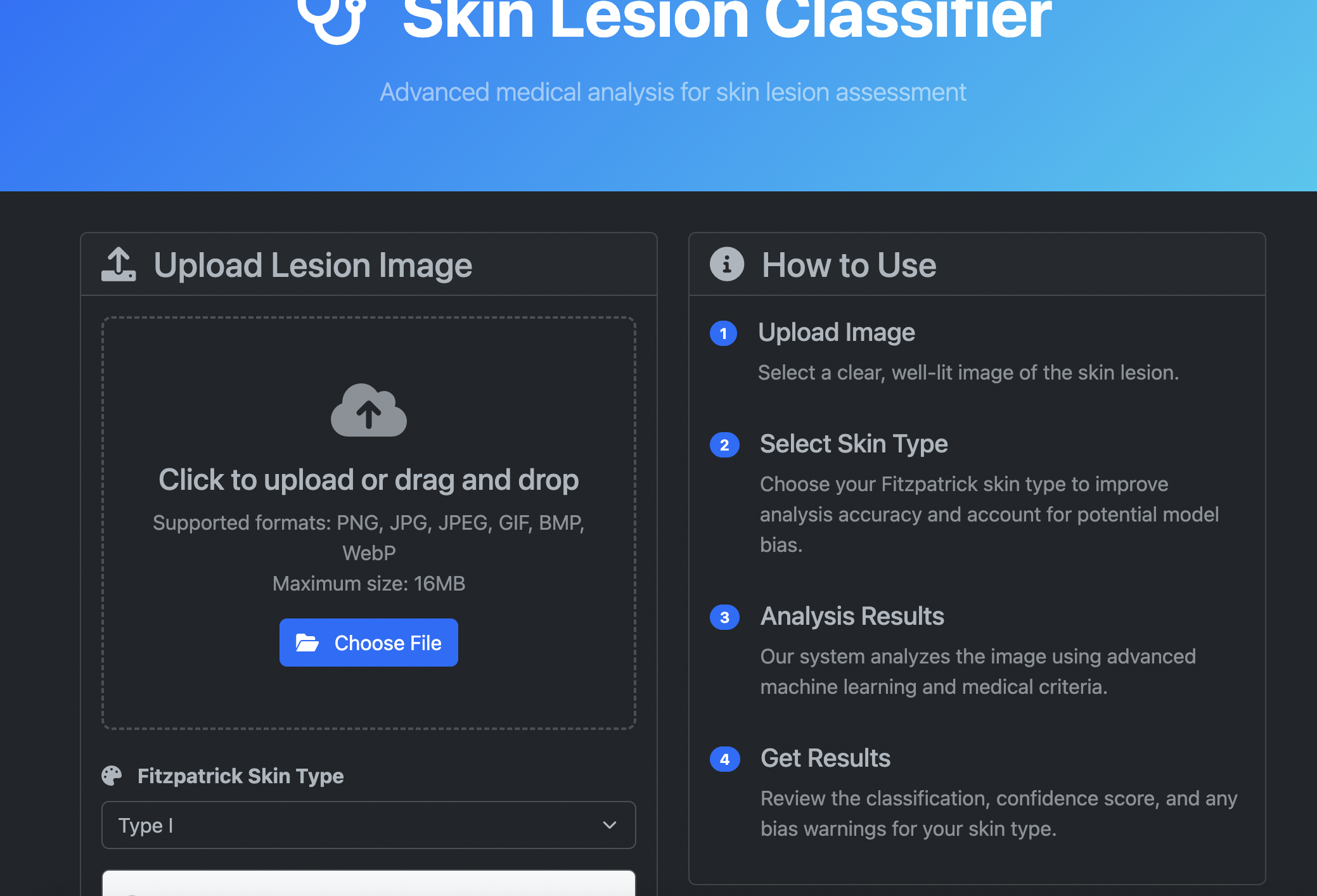
Skin Lesion Classifier is a web-based AI tool that analyzes skin lesion images using a deep learning model (MobileNetV2) fine-tuned on the ISIC dataset. It detects the likelihood of malignancy and provides personalized recommendations based on:
CNN-based image analysis
Automatically or manually detected Fitzpatrick skin type
User-entered metadata (e.g. age, lesion location, UV exposure, family history)
ABCDE feature detection for detailed clinical insight
The result: near-instant, tailored risk assessments that can help users decide whether to monitor a lesion or consult a professional.
How we built it
We used a transfer learning approach with MobileNetV2, training and fine-tuning on publicly available datasets from the International Skin Imaging Collaboration (ISIC). The backend is built with Python and Flask, while the frontend uses HTML, CSS, and JavaScript. For image preprocessing and model inference, we use OpenCV and PyTorch. Skin tone classification is implemented using computer vision techniques and mapped to the Fitzpatrick scale. To enhance accuracy, we designed a multi-factor scoring system that combines CNN predictions, metadata inputs, and clinical ABCDE features.
Challenges we ran into
Data bias: Many public datasets underrepresent darker skin tones. We implemented skin tone detection and acknowledged this as a limitation, planning to expand the dataset in future iterations.
Balancing accuracy and speed: Ensuring real-time predictions while maintaining accuracy required careful model optimization.
Integrating multiple risk factors: Building a composite scoring system that combined AI predictions, user metadata, and clinical features was complex but essential for realism.
Deployment: Model deployment was difficult due to the large CNN file size and free-tier hosting limits
Accomplishments that we're proud of
What we learned
How to write a script to fine-tune pre-trained CNNs for medical imaging tasks The importance of fairness and bias detection in healthcare AI Practical implementation of skin tone detection and metadata fusion User experience design for health tools—simplicity is everything when it comes to accessibility
What's next for Skin Lesion Classifier
Expanding the dataset, especially with more diverse skin tones Adding real-time lesion segmentation for more precise ABCDE analysis Building a mobile-first experience and offline version

Log in or sign up for Devpost to join the conversation.