-
-
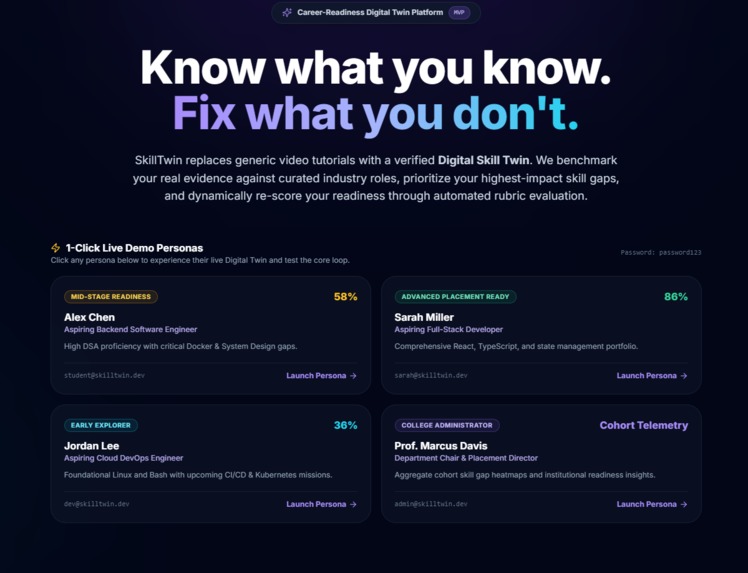
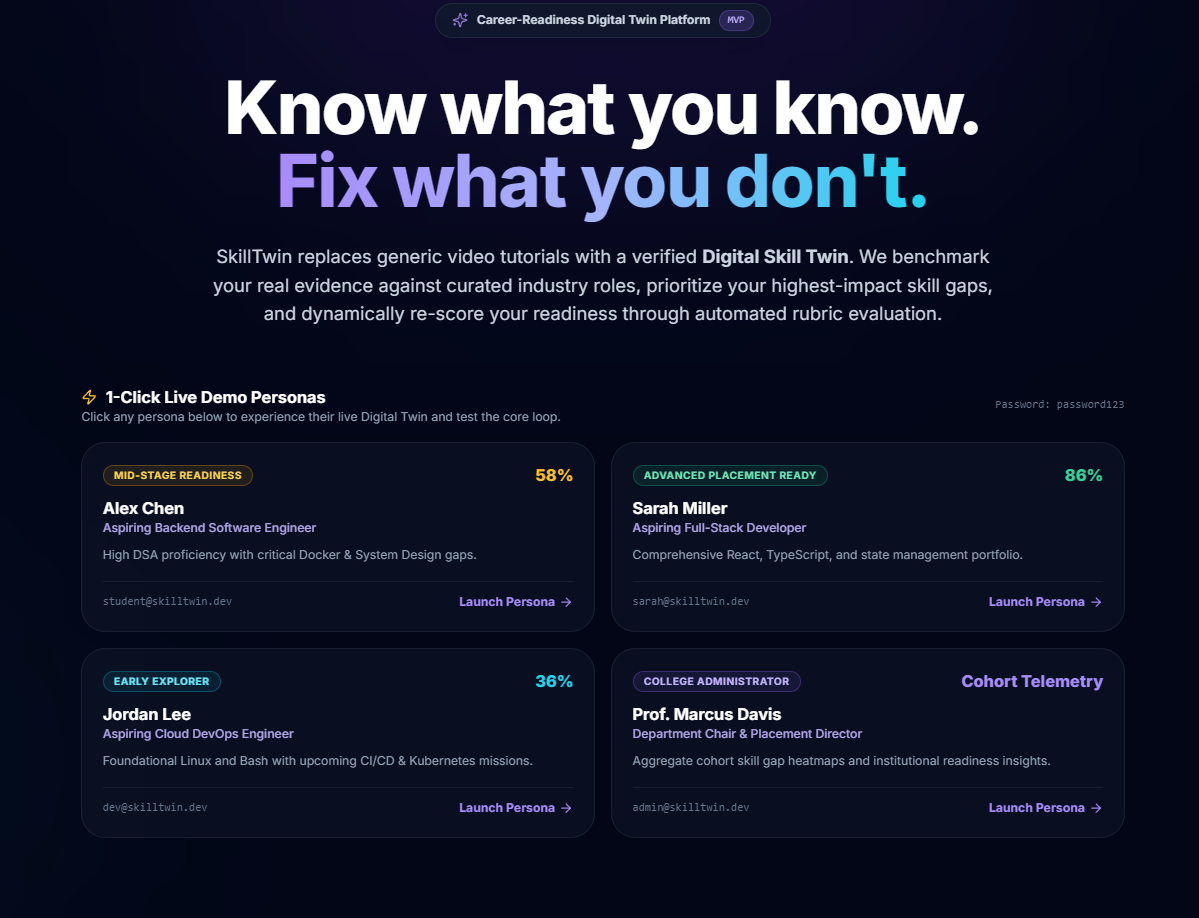
Explore SkillTwin’s Digital Career Twin through interactive student personas and real-time career-readiness scenarios.
-
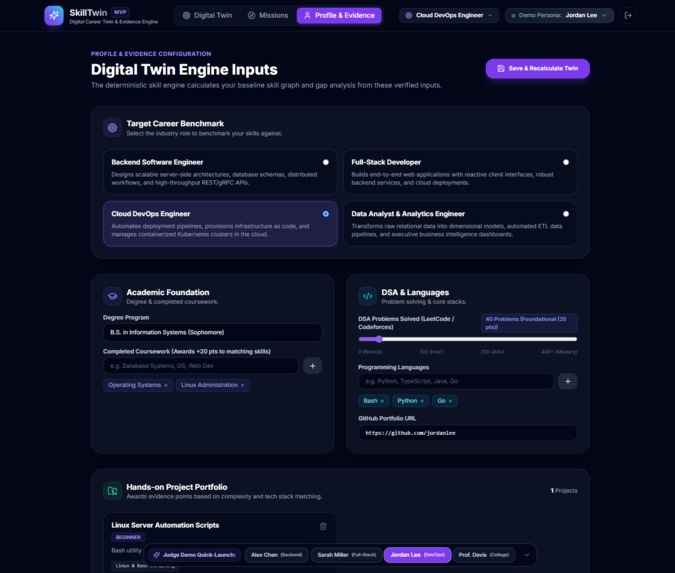
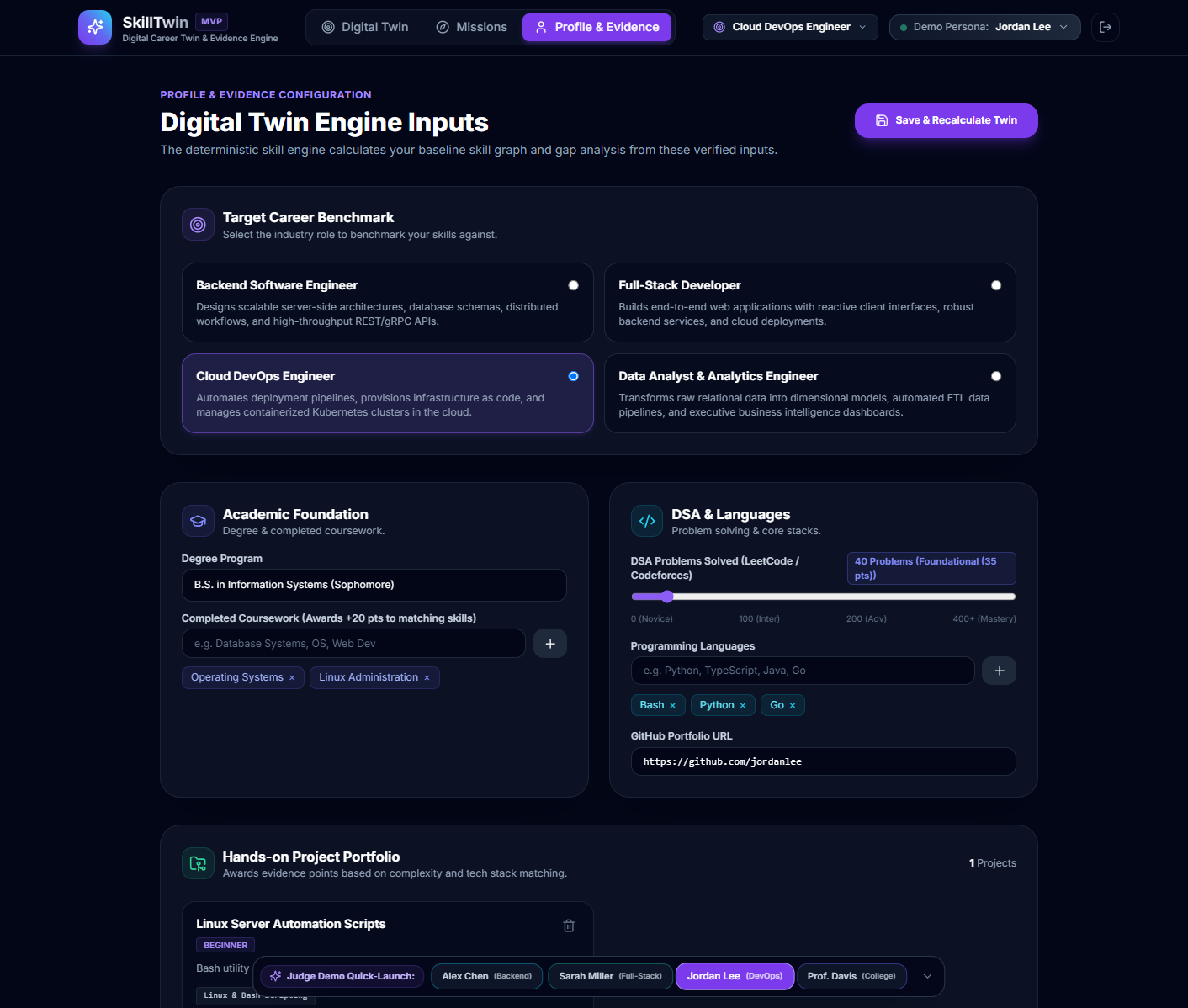
Build your Digital Skill Twin using academics, DSA performance, programming skills, projects, and verified evidence.
-
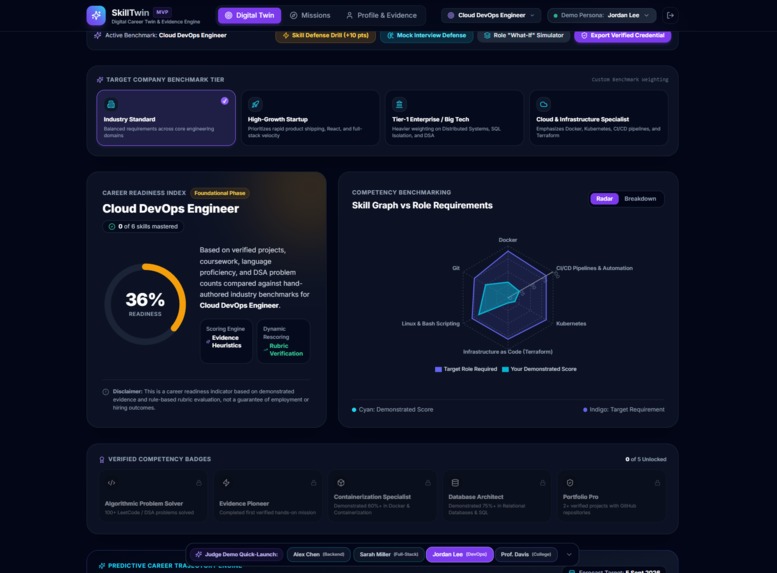
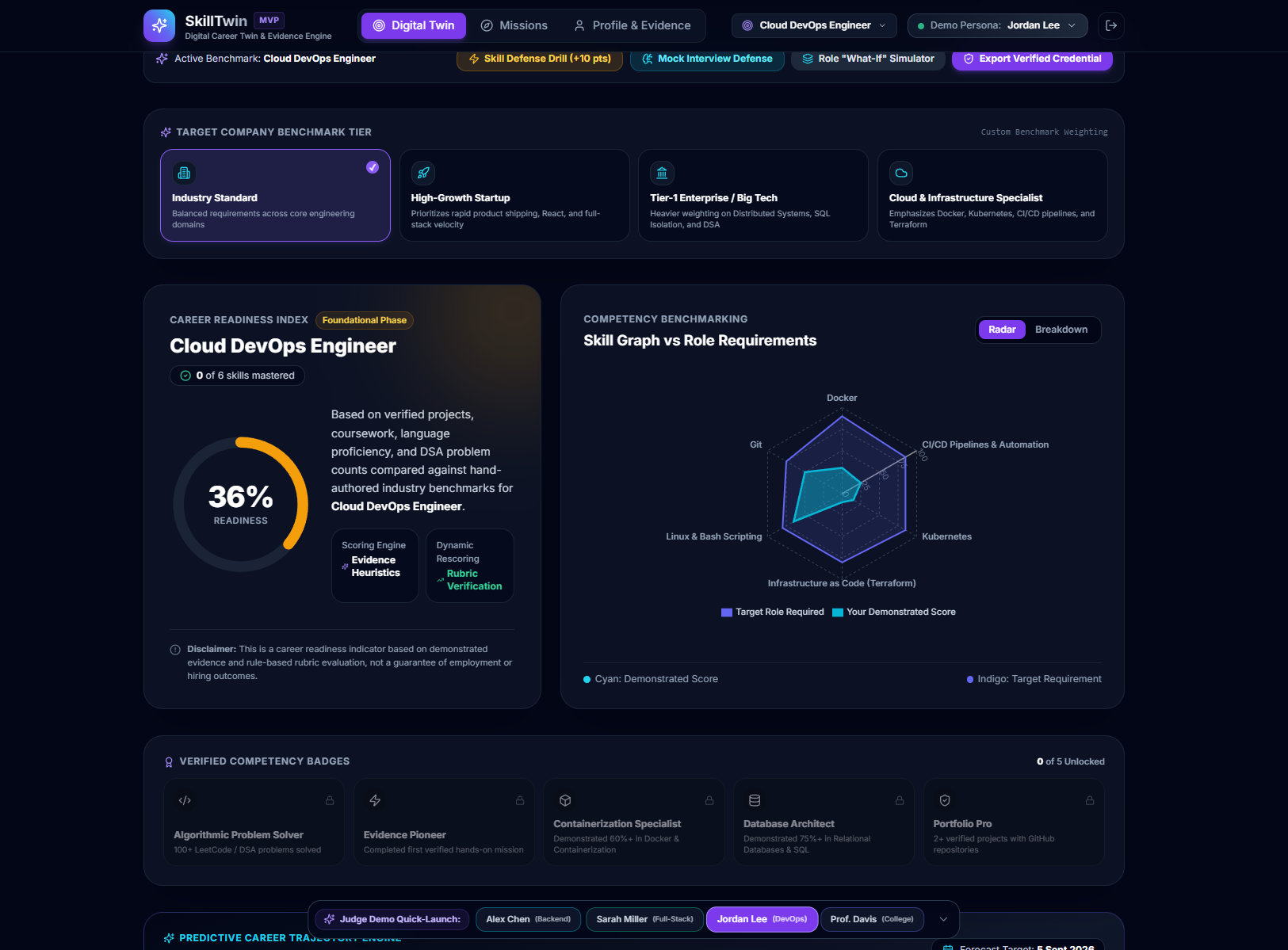
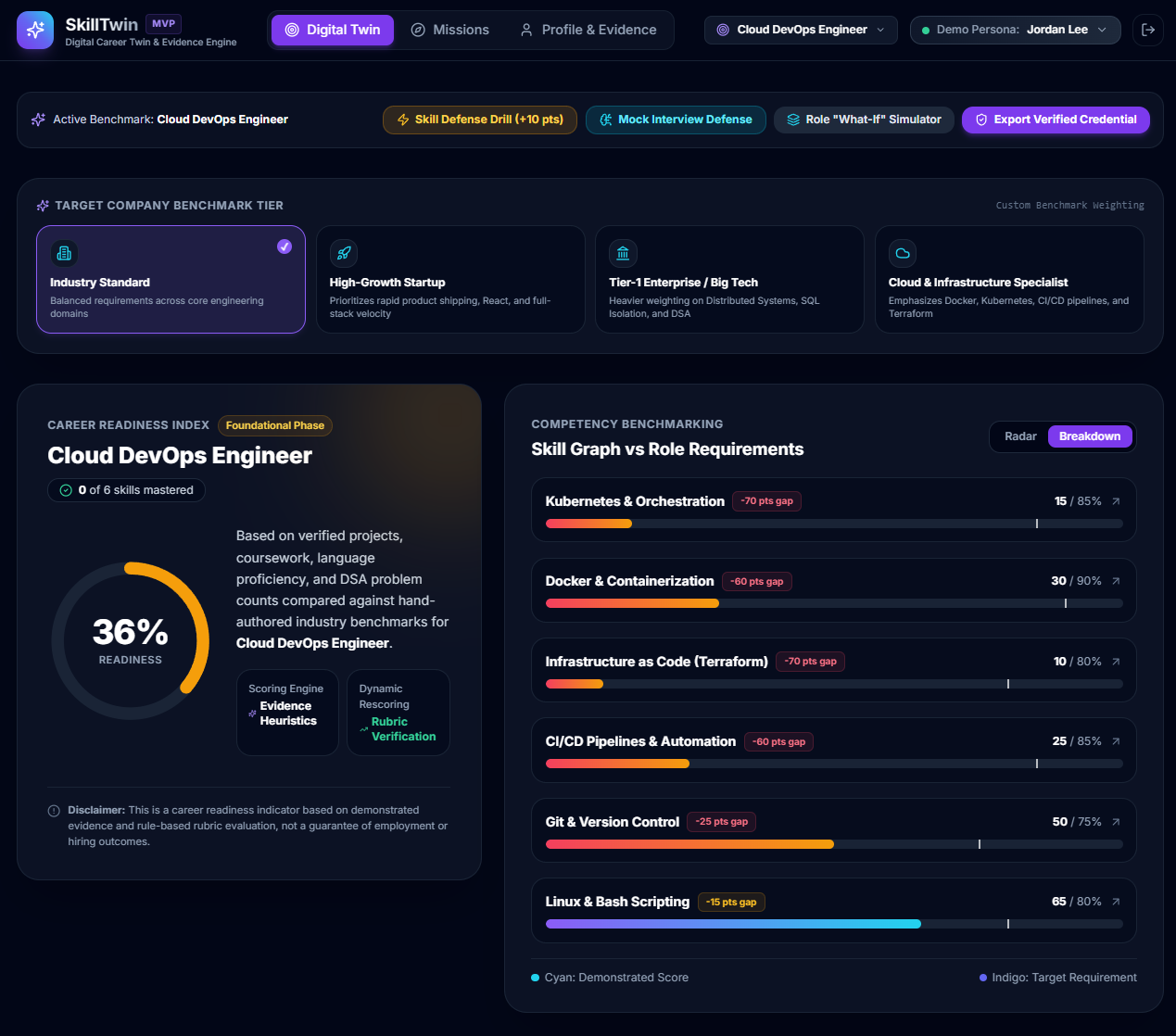
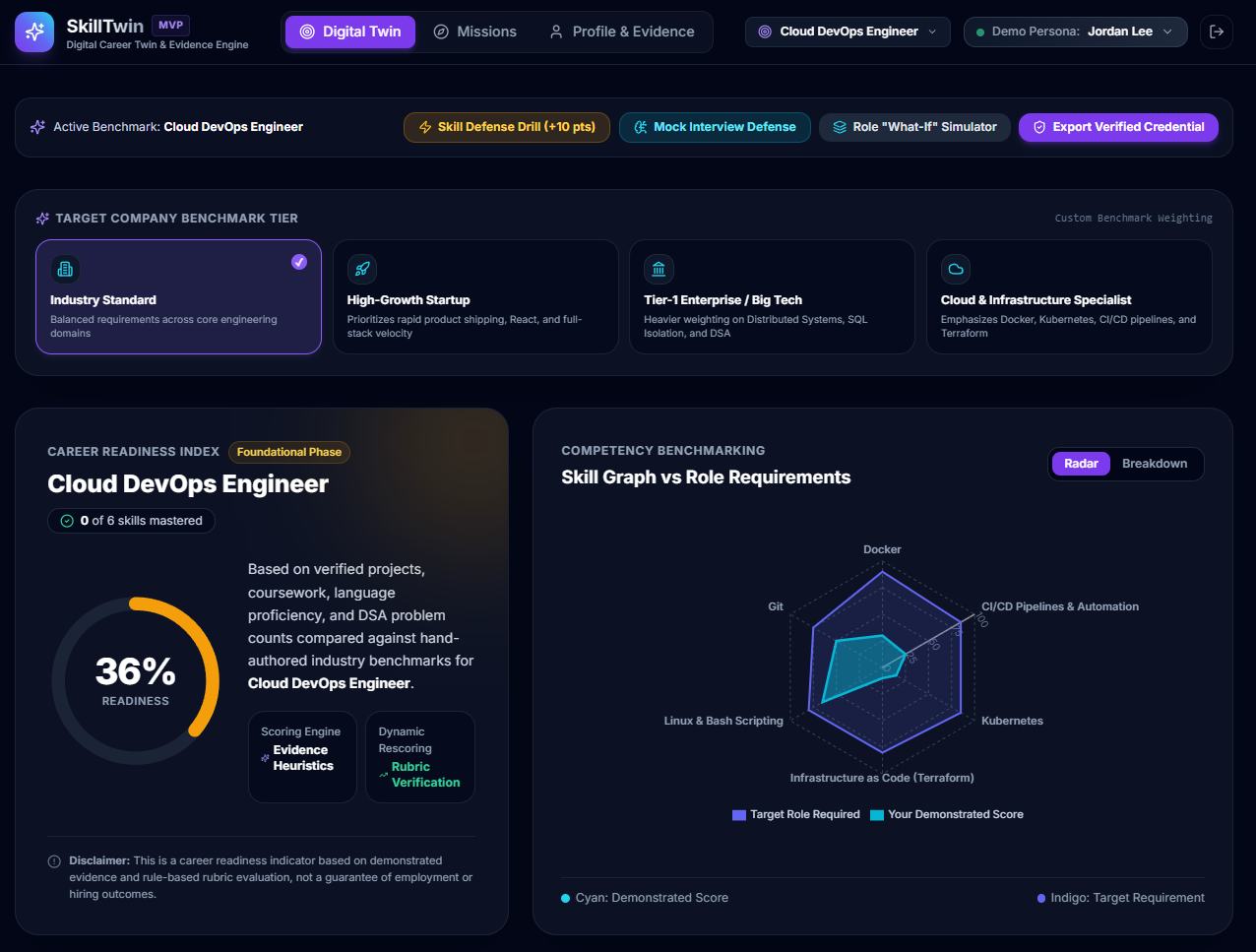
Compare your demonstrated skills with industry requirements and identify the most critical competency gaps.
-
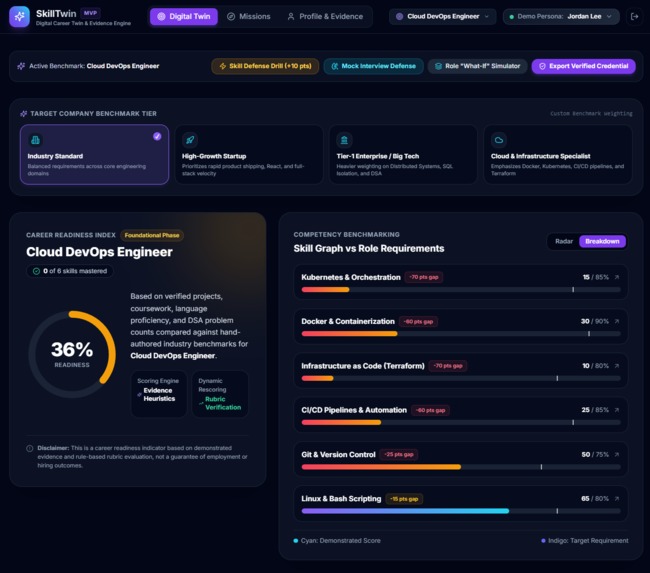
See exactly where your current skills fall short of your target role and prioritize the gaps that matter most.
-
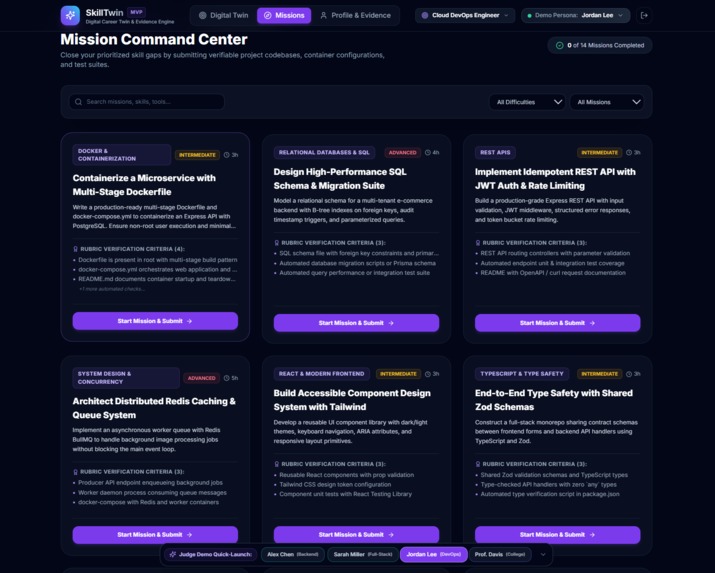
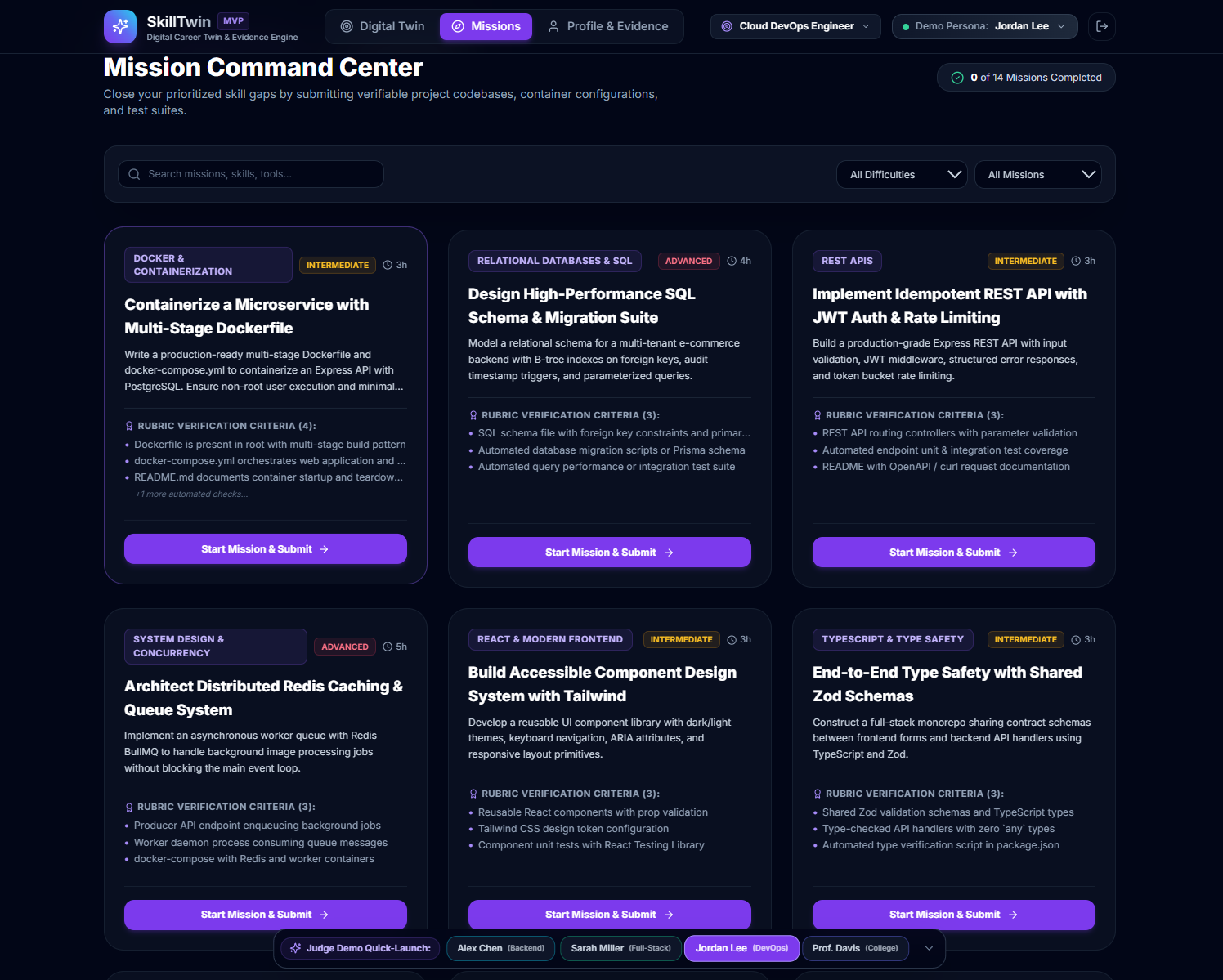
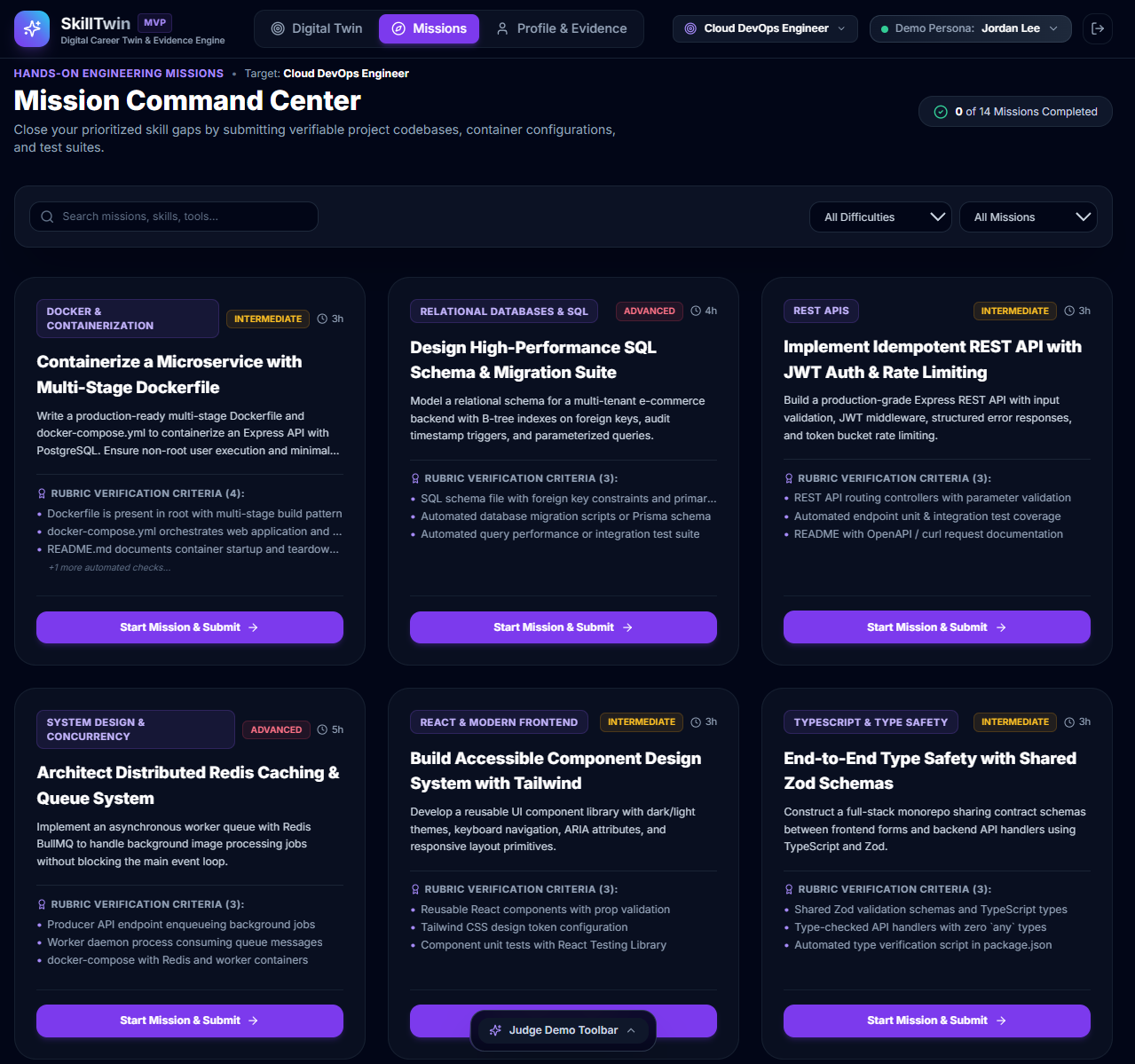
Turn skill gaps into hands-on engineering missions with clear objectives and automated verification criteria.
-
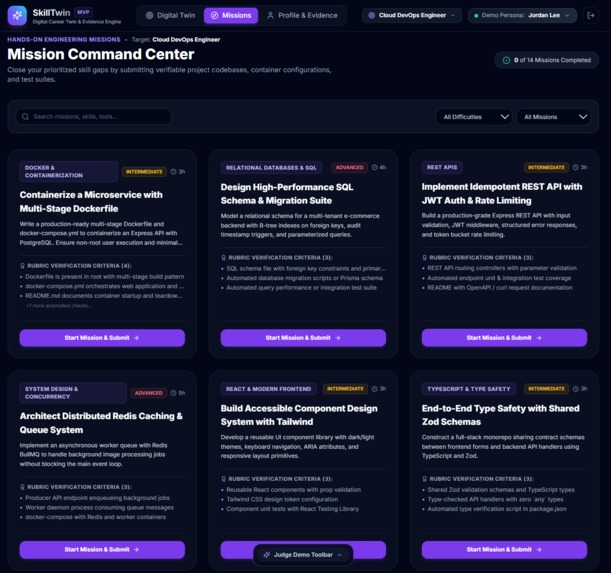
Access personalized challenges across Docker, SQL, REST APIs, system design, React, TypeScript, and more.
-
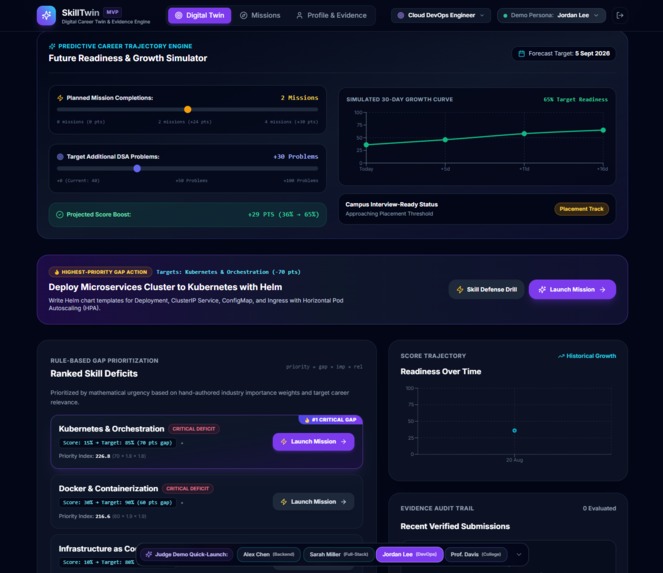
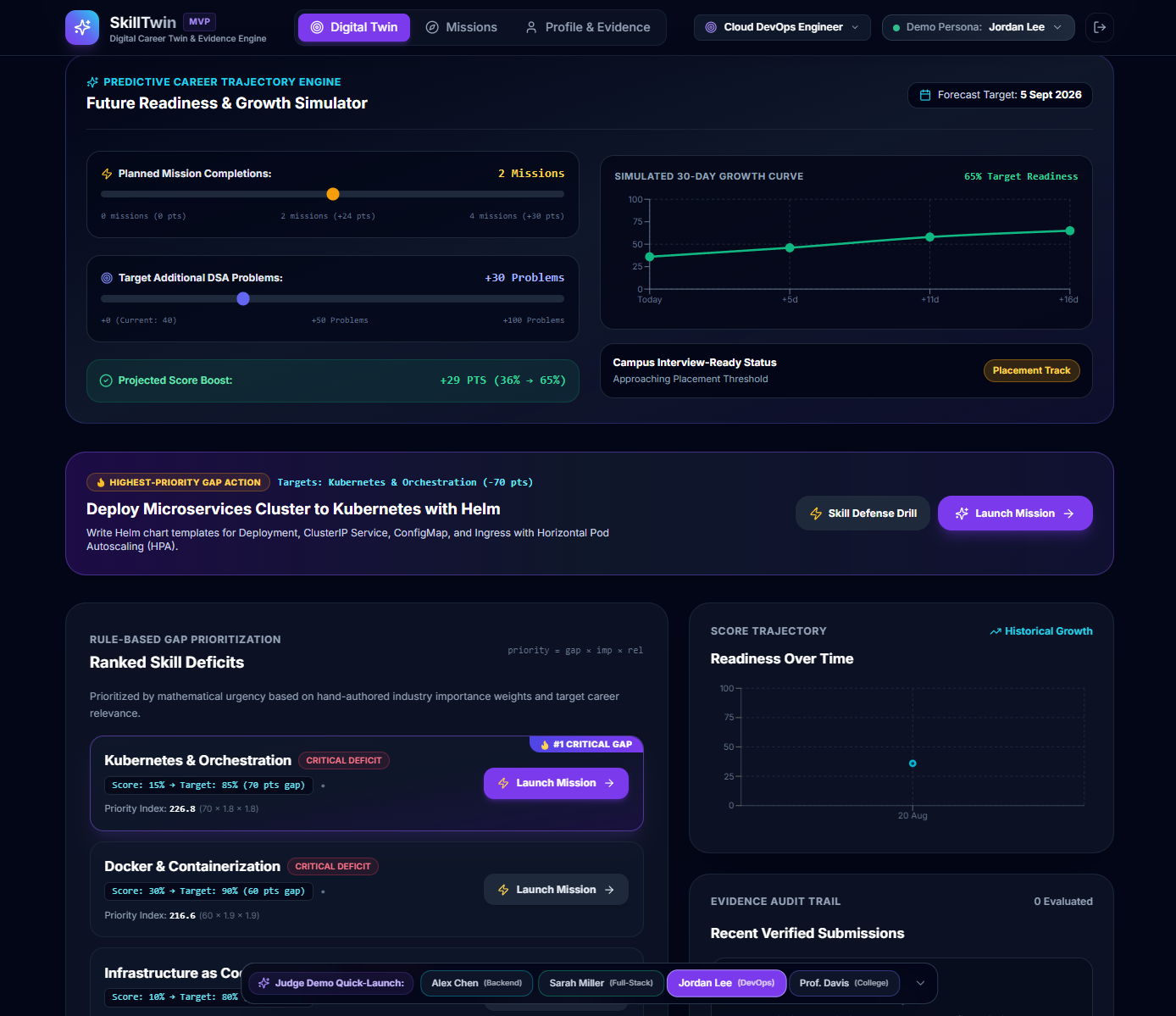
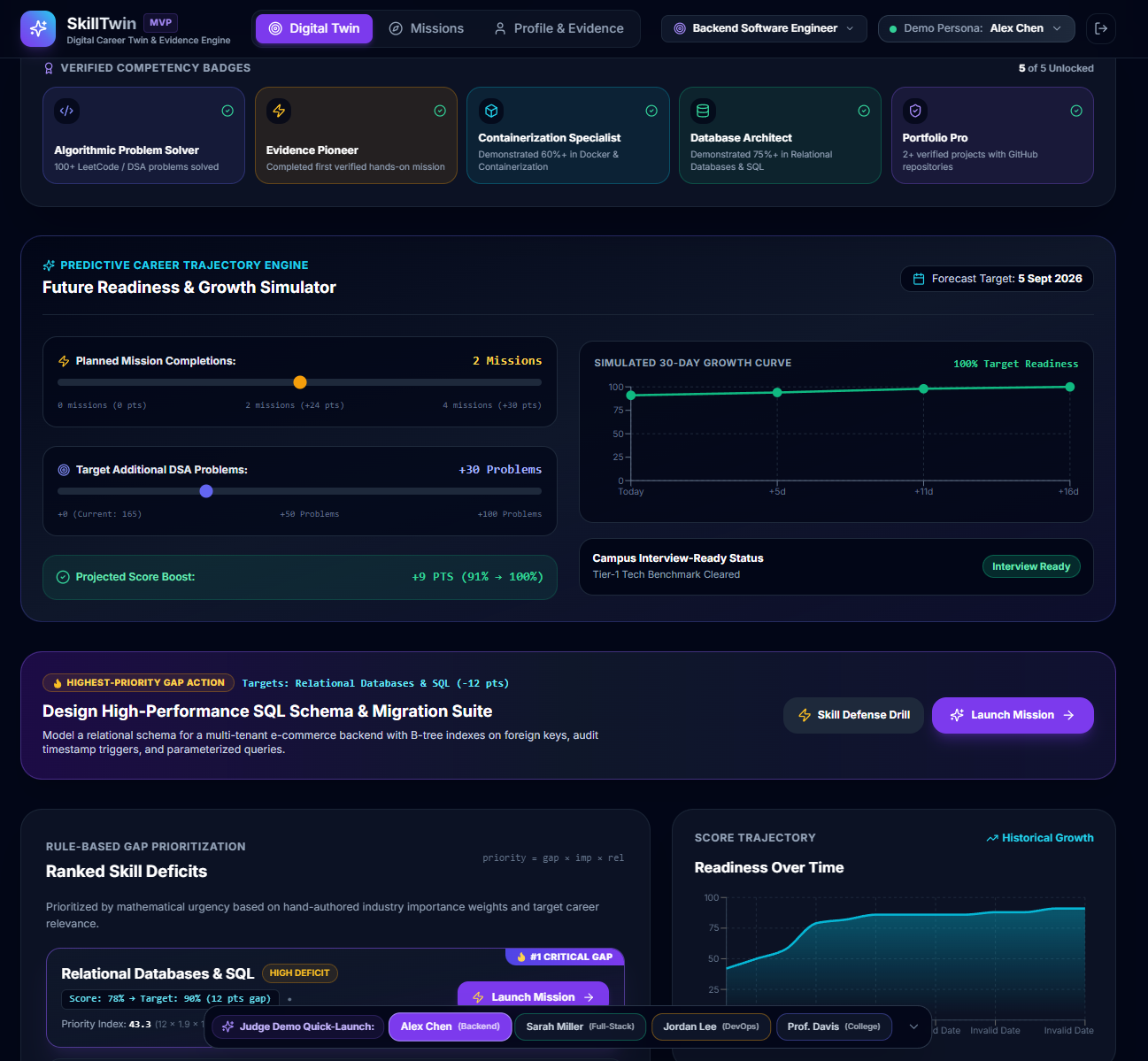
Predict how completing missions and improving skills can increase your career-readiness score over time.
-
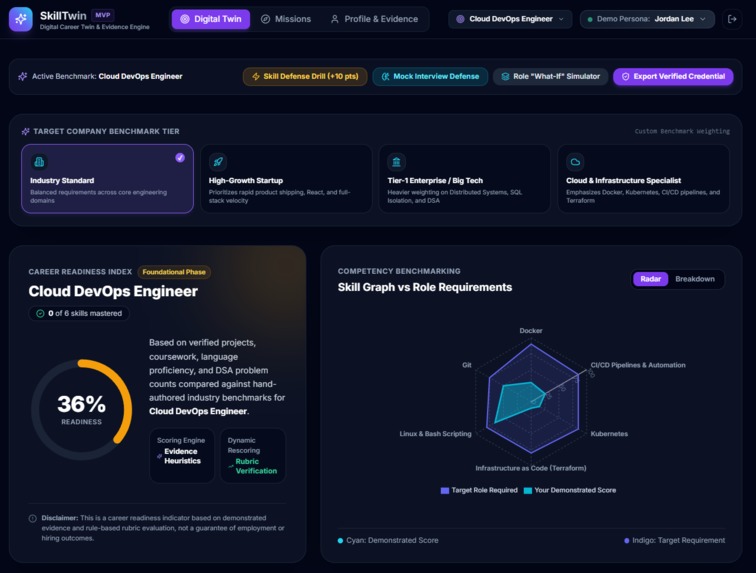
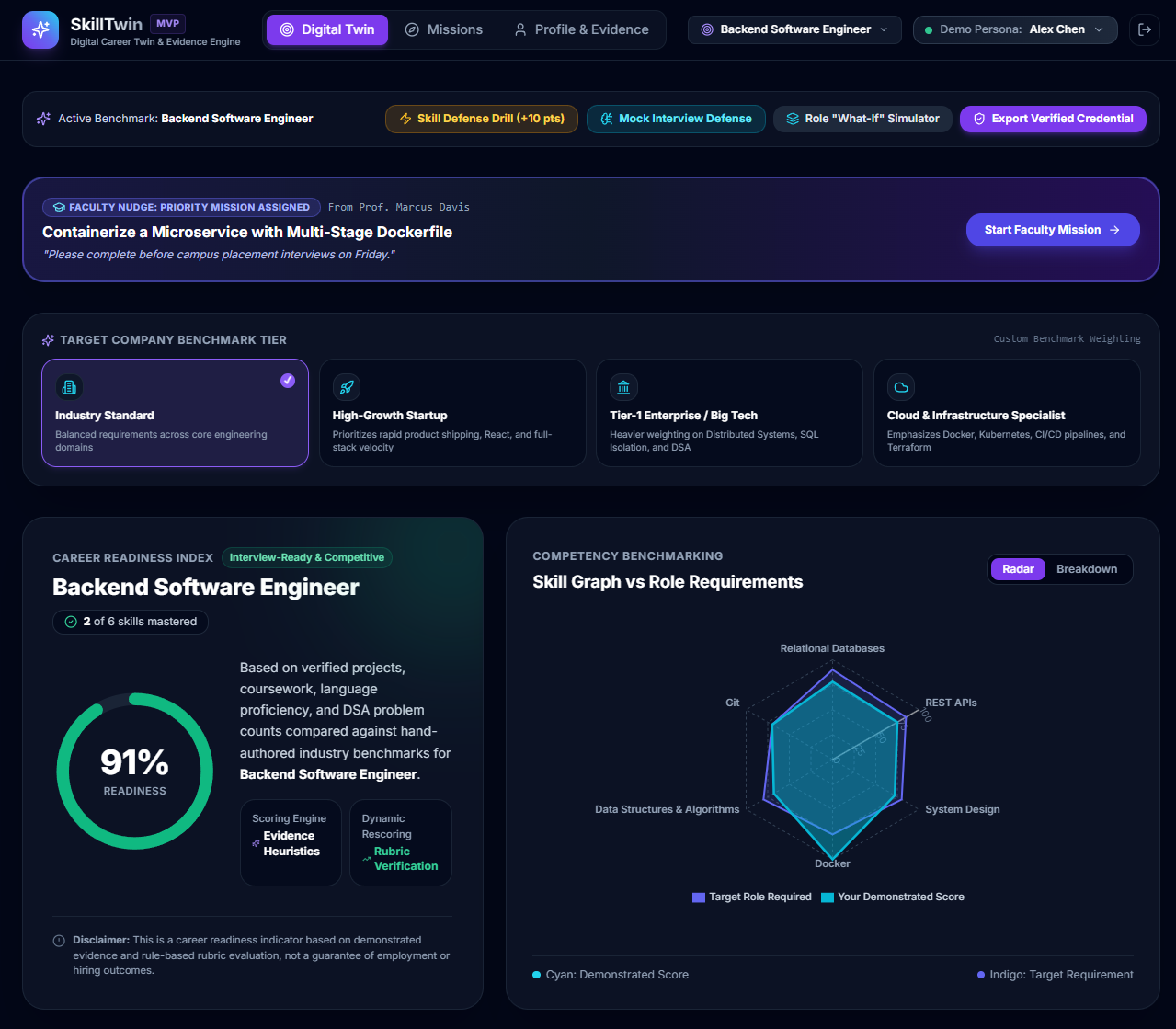
Visualize your demonstrated competencies against industry benchmarks through an intuitive skill comparison graph.
-
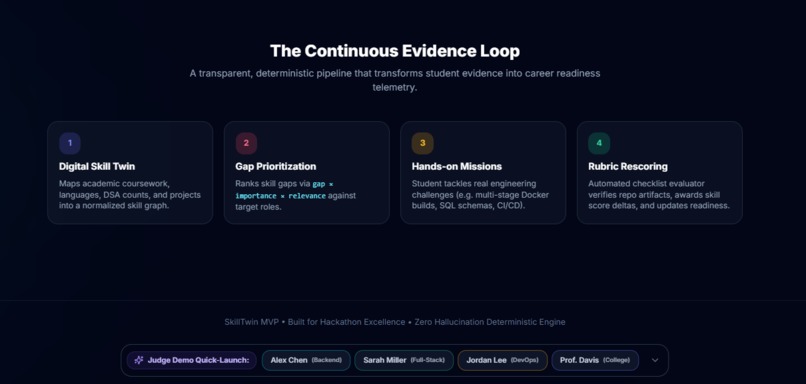
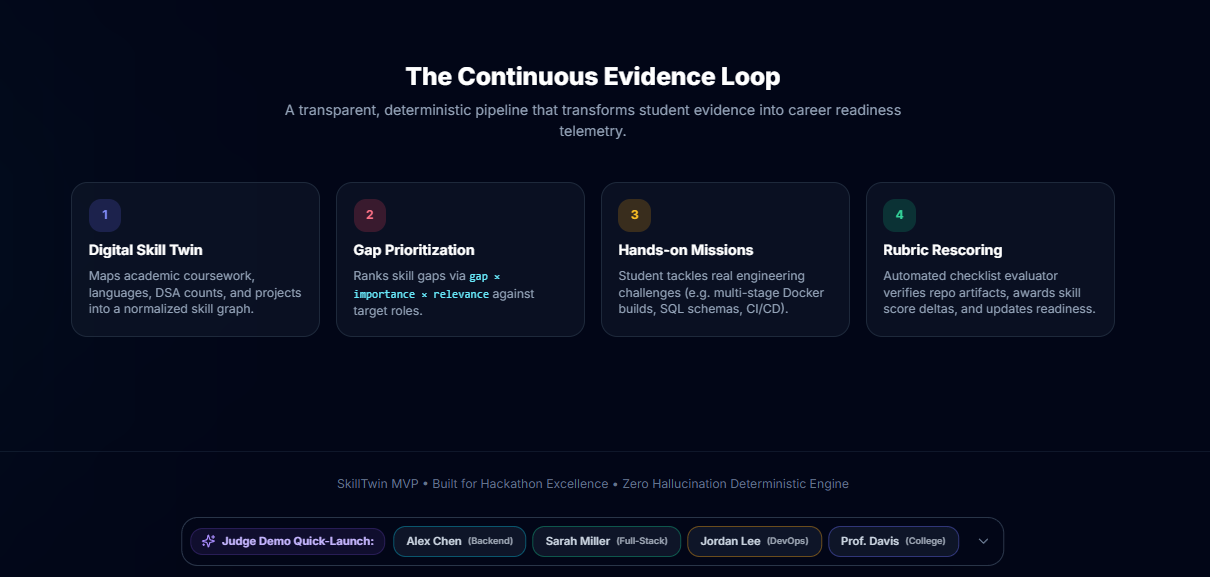
Transform evidence into skill scores, prioritize gaps, complete missions, and continuously update career readiness.
-
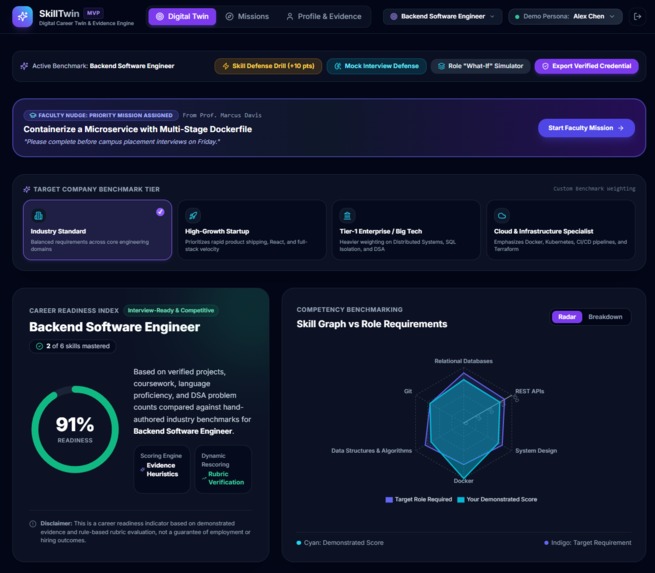
Compare demonstrated skills with backend industry benchmarks and measure verified career readiness at 91%.
-
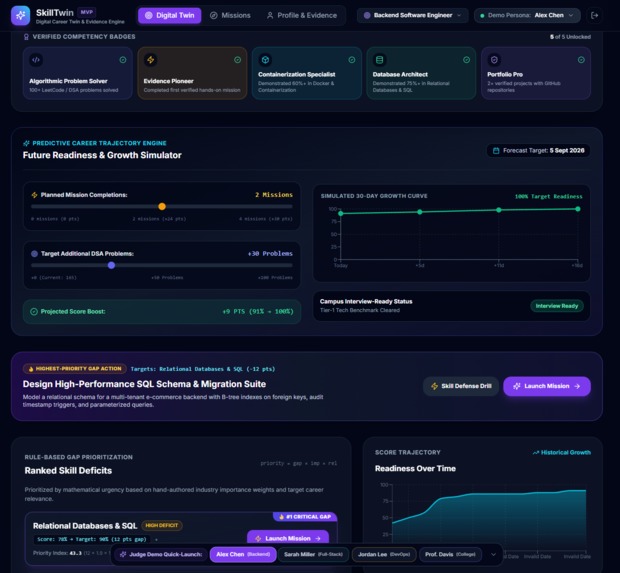
Track projected career growth, prioritize remaining skill gaps, and simulate how missions can improve interview readiness.
Challenge 5: Career Readiness
Inspiration
We kept hearing the exact same story from final-year engineering students: "I’ve solved 350 DSA problems, built three projects, and completed two certifications — but I still got rejected in the technical round without knowing why."
The problem is fragmented signals:
- Coding platforms track LeetCode count, not engineering depth.
- Course platforms track video completion, not demonstrated ability.
- Resumes show self-proclaimed buzzwords that recruiters distrust.
- GitHub repositories sit unverified.
None of these systems communicate with each other, and none answer the single question that actually matters: "Am I truly ready for the exact engineering role I want?" We built SkillTwin to diagnose, prioritize, and close competency deficits before the interview, turning speculative resumes into evidence-verified digital career twins.
What it does
SkillTwin creates a dynamic Digital Skill Twin of a student and continuously benchmarks it against real industry requirements for their target engineering career:
- Evidence-Backed Skill Graph: Ingests academic milestones, DSA problem counts, project repositories, languages, and certifications into a scored competency graph \( (0 - 100\%) \).
- Deterministic Priority Formula: Ranks skill deficits using a transparent mathematical formula: $$ \text{Priority Score} = \text{Skill Gap} \times \text{Industry Importance Weight} \times \text{Career Relevance Weight} $$ Ensuring students focus on mission-critical deficits rather than over-optimizing skills they've already mastered.
- Interactive Hands-On Evidence Missions: Generates targeted technical missions for the #1 critical gap (e.g., containerizing microservices, writing database indexing benchmarks, or configuring CI/CD test automation).
- Direct In-Modal Code & Artifact Evaluator: Students can either submit GitHub repositories or use our in-browser syntax editor to inspect and test
Dockerfile,compose.yml, andtests/with instant rubric evaluation and artifact tree matching. - "Skill Defense" & Mock Interview Simulations: 60-second interactive scenario drills and mock architecture defenses that test real-world trade-offs (cache stampedes, row-level locks, zero-downtime rolling deploys) with immediate evidence bonus rewards \( (+5 \text{ to } +10 \text{ pts}) \).
- Cross-Role & Predictive "What-If" Simulators:
- Cross-Role Matrix: Benchmarks the twin across 4 roles simultaneously (Backend, Full-Stack, DevOps, Data Analyst).
- Predictive Trajectory Engine: Interactive sliders project 30-day readiness growth curves and forecast exact campus interview-ready dates.
- Verified Digital Credential Export: Generates shareable, printable credential cards with verifiable IDs (
ST-2026-XXXXX), QR verification codes, and an audit trail for LinkedIn and recruiter applications. - Institutional Telemetry & Faculty Intervention:
- College admins access institutional skill deficit heatmaps and 1-click cohort CSV exports.
- Curriculum Intervention Generator: Automatically designs 2-week faculty lab syllabi tailored to the cohort's #1 gap.
- Faculty Nudge Loop: Professors can assign priority missions directly to students with custom coaching notes.
How we built it
We built SkillTwin as a high-performance, zero-friction full-stack monorepo designed for 100% deterministic reliability:
- Frontend: React 18, Vite, Tailwind CSS, Recharts (Radar, Bar, and Forecast Trajectory charts), Lucide Icons, and Canvas Confetti.
- Backend & Core Engine: Node.js, Express, and a custom universal database engine implementing the Prisma ORM API for portable, zero-dependency persistence.
- Scoring & Rubric Engine: Hand-authored industry weighting matrices, deterministic heuristic scoring, and a regex/file-tree pattern-matching rubric evaluator.
- DevOps & Testing: Multi-stage
Dockerfile,docker-compose.yml, GitHub Actions CI/CD automation matrix, and a comprehensive Node test suite (5/5 tests passing). - Persistent Judge Demo Toolbar: A floating toolbar enabling 1-click persona switching (Alex Chen [58%], Sarah Miller [86%], Jordan Lee [36%], Prof. Davis [Admin]) with zero setup friction.
Challenges we ran into
- Avoiding Black-Box AI Hallucinations: Initial instincts leaned toward using LLMs to grade arbitrary code repositories. Recognizing that unpredictable model outputs ruin credibility and live demos, we deliberately engineered an automated, rule-based rubric matcher and file-tree inspector that produces deterministic, explainable results every single run.
- Designing Fair Gap Weighting: Raw arithmetic percentage gaps penalized students unfairly on low-importance secondary skills. Developing our triple-weighted formula \( (\text{gap} \times \text{importance} \times \text{relevance}) \) produced natural, career-accurate prioritization.
- Ethical Framing of Career Readiness: We ensured the Career Readiness Index is explicitly presented with a transparent disclaimer: "An evidence-backed readiness indicator based on demonstrated proof, not an employment guarantee."
Accomplishments that we're proud of
- Complete End-to-End Feedback Loop: Seamless progression from profile evidence \( \to \) gap prioritization \( \to \) code artifact evaluation \( \to \) skill delta award \( \to \) updated readiness score.
- Multi-Role & Predictive Simulators: Students can visualize cross-career applicability and forecast their exact interview-readiness trajectory with interactive sliders.
- Two-Way Institutional Workflow: Bridging college administrators and students through automated curriculum syllabus generation and faculty mission nudges.
- 100% Verifiable & Demo-Ready: Built with zero mock placeholders, featuring instant 1-click test templates, complete automated test suites, and containerized CI/CD.
What we learned
- Students need clarity over content: Students don’t suffer from a lack of learning materials; they suffer from navigational ambiguity. Knowing the exact priority deficit to fix changes student behavior faster than another 40-hour course ever could.
- Evidence beats claims: Verifiable artifacts (passing tests, Docker health checks, indexed queries) are infinitely more valuable to recruiters than unverified resume bullet points.
- Scoping with discipline creates superior products: Building a robust, deterministic core with rich interactivity creates a far more convincing, pitch-ready platform than an ungrounded AI wrapper.
What's next for SkillTwin
- AI-Assisted Deep Code Review: Introduce bounded LLM sidecars to provide nuanced semantic code reviews atop our deterministic rubric checks.
- Live Job Market Ingestion: Dynamically calibrate role skill weights by ingesting live job postings from real-time API feeds.
- Institutional College Pilots: Partner with engineering college placement cells to benchmark cohort skill twins against actual placement conversion rates.
- Corporate Recruiter Talent Search: Launch the employer portal allowing hiring managers to search, filter, and shortlist pre-verified candidates by demonstrated skill evidence. ```
Built With
- algorithms
- b2b-saas
- career-readiness
- data-visualization
- digital-twin
- docker
- docker-compose
- edtech
- express.js
- github-actions
- github-api
- heuristics
- html5
- javascript
- json-web-token
- monorepo
- node.js
- prisma
- react
- recharts
- rest-api
- rubric-evaluation
- sqlite
- tailwindcss
- vite

Log in or sign up for Devpost to join the conversation.