
Inspiration
We're students looking for tech work in Canada, and the market is tight. Immigrants who landed in Alberta in the last five years face 10.4% unemployment, and Calgary's job vacancy rate has fallen from 4.8% to 2.8% since mid-2022 (Statistics Canada). Of the tech posts we classified, 72% want senior or lead people (155 of 214), and only 14 are junior or intern.
Every job post lists a pile of skills. Nobody tells you what's most in demand, which ones you already have, or what to learn to prove the rest. We wanted a map that answers that from real job posts, not opinions.
What it does
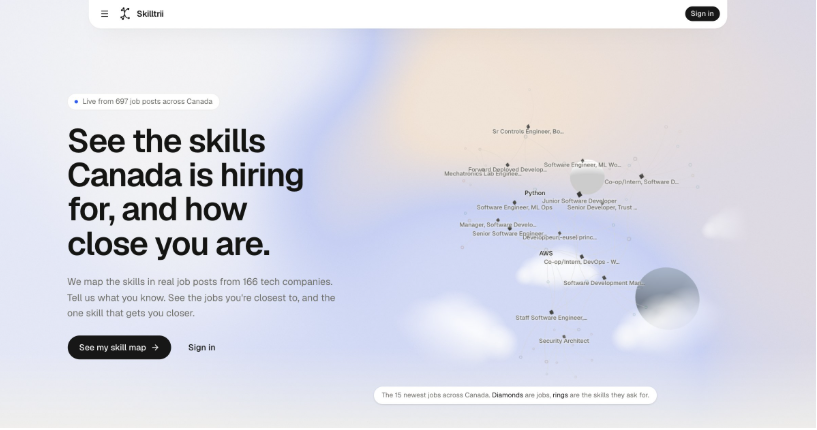
Skilltrii shows the in demand skills Canada is hiring for, and how close you are.
- Tell us what you know. Upload a resume. It's read in memory, matched against our skill list with no AI, and never saved.
- See the jobs you're closest to. Every real job gets a match score from its must-have skills, so you see what you have and what's missing.
- Learn the next skill. We pick the missing skill your closest jobs ask for most, then show its weekly demand, who's hiring, free places to learn, and an Impact project built on real public data. Get access to a network of relevant sills and associated listings.
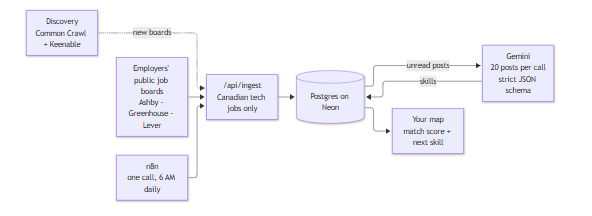
- An AI agent that collects listings daily. Every morning an n8n workflow makes one call and collects listings daily and uses Gemini to parse skills from each listing and store data in our database.
For a job, you must have $x$ specific skills and you may only $y$ skills:
Your next skill is the missing must-have that appears most often among your closest jobs.
How we built it
- Collect. Every morning an n8n workflow makes one call to our ingest route. The server fetches company job boards from Ashby, Greenhouse and Lever, 20 at a time, keeps tech roles in Canada, and saves them to Postgres on Neon. A board that fails three days in a row switches itself off.
- Find more companies. Discovery searches Common Crawl (monthly) and Keenable (weekly) for new job boards and checks each one before adding it. It has found 4,364 boards so far.
- Read the posts. Gemini reads unread posts in batches with a strict JSON schema and returns each post's skills, whether each skill is a must-have, and the seniority. Our code only keeps answers for posts we sent and categories we know, and merges spellings like "ReactJS" and "React.js" into one skill.
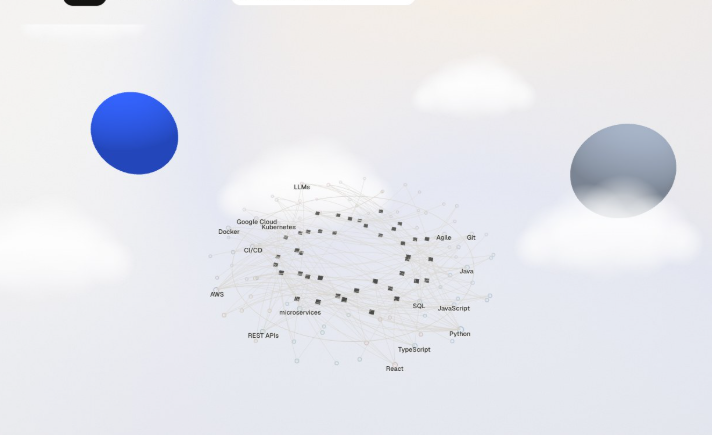
- Match and show. Plain SQL scores the jobs. The front end is Next.js 16 with shadcn/ui, and the map is a 3D force graph (three.js) where diamonds are jobs and rings are the skills they ask for. It respects reduced motion.
- Sign-in and hosting. Auth0 for Google or email sign-in, Vercel for hosting.
As of 8 Nov 2026: 2,171 Canadian tech jobs from 374 companies, 247 skills on the map, and 36 of 36 unit tests passing, that are expected to increase over time.
Challenges we ran into
- Gemini's free tier counts requests, not jobs. We send many posts per call to make the most of each request. But a bigger batch takes longer and risks running past Vercel's 60-second limit or returning cut-off JSON, so we tuned the batch size.
- Staying inside 60 seconds. The daily run has a 40-second budget split into deadlines (fetch, then discovery, then checking new boards). Each step saves its progress, so whatever doesn't fit continues the next morning.
- Common Crawl is slow. Its index often times out. We split discovery into small resumable steps so a timeout only pauses it.
- Messy feeds. Greenhouse sends descriptions as HTML encoded twice, every system formats locations differently, and many large Calgary employers use Workday, which has no public API. We stuck to public feeds rather than scraping.
- Calgary is a small slice. Early on we had only about 150 Calgary tech jobs, so discovery became as important as fetching.
Accomplishments that we're proud of
- A full pipeline from public job boards to a personal skill map, refreshing on its own every day.
- Privacy by default: secure auth0 authentication, resumes never stored, and one-click "Delete my data."
- Real data only: every job links to the employer's own post, and every number in an Impact project comes from the public series it cites.
- Five people on five separate parts, joined through one shared database and clear ownership.
What we learned
- Treat AI output as untrusted input. A strict schema plus our own checks keeps the database clean even when the model gets something wrong.
- Design for running again. Upserts, "read" flags and saved progress made every step safe to repeat, which mattered every time something timed out.
- Keep AI narrow. Gemini does one job, reading posts. Matching, scoring and recommendations are plain SQL that anyone can check.
What's next for Skilltrii
- More job board systems, especially ones smaller Calgary companies use.
- Internships and co-ops as their own view for students.
- Better accessibility for the 3D map, including a full text and list view.
- Opening it up to career switchers, educators and employers, who are already joining the waitlist.
- More accessibility features.
AI disclosure
- In the product: Gemini reads job posts and lists their skills. It also writes the text of Impact projects and project ideas ahead of time, from real public data. Both are labelled in the app.
- Building it: we used AI coding assistants, including Claude Code to help us translate UI into front-end code, and provide brief assistance implementing certain scripts.
Built With
- auth0
- commoncrawl
- geminiapi
- godaddy
- keenable
- n8n
- neondb
- next.js
- postgresql
- react
- tailwind
- typescript
- vercel

