-
-
Home Page
-
-
Inspiration
Hackathons often begin with excitement but quickly become disorganized when team members struggle to assign roles effectively. Many teams waste valuable time debating who should handle what instead of building. SkillSync was inspired by this challenge, the idea that team formation and role delegation could be automated through intelligent data analysis. Our goal was to create a tool that understands both technical and soft skills, enabling teams to collaborate efficiently and make data-driven decisions about task distribution.
What it does
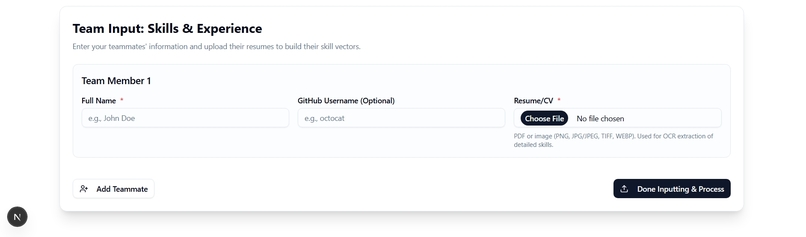
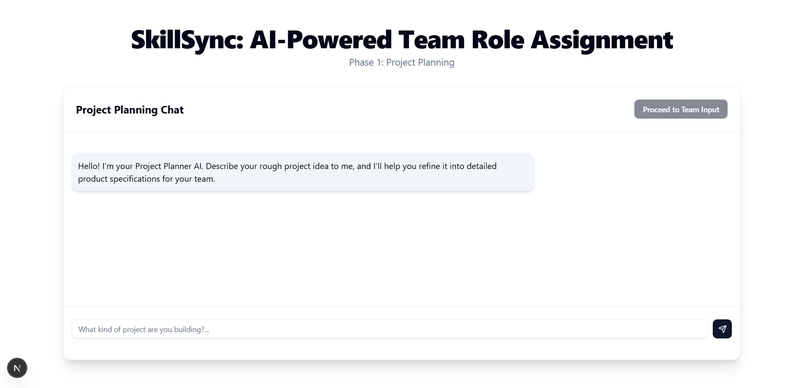
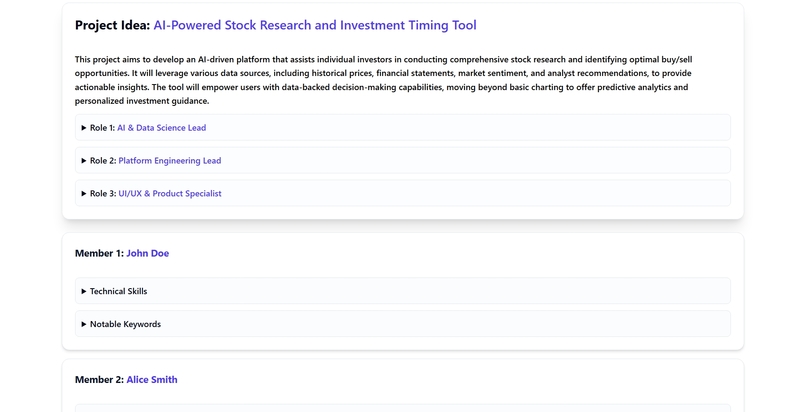
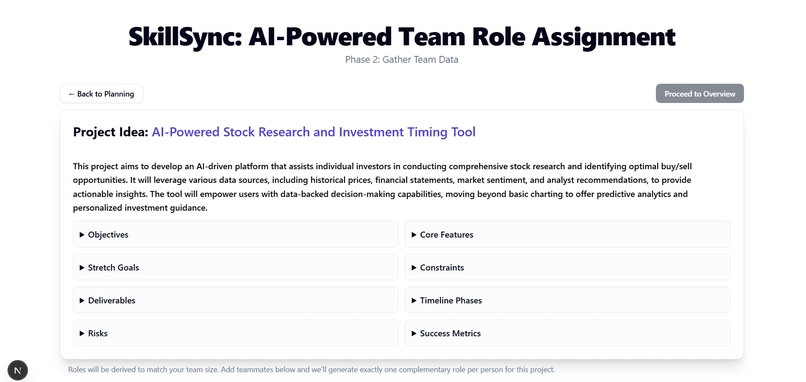
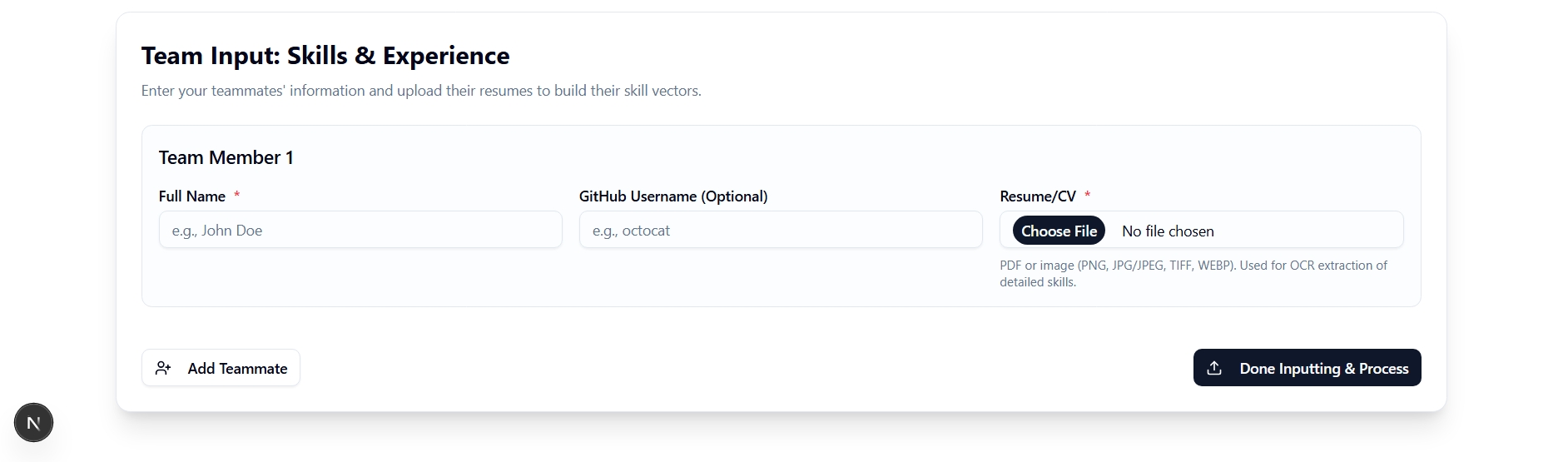
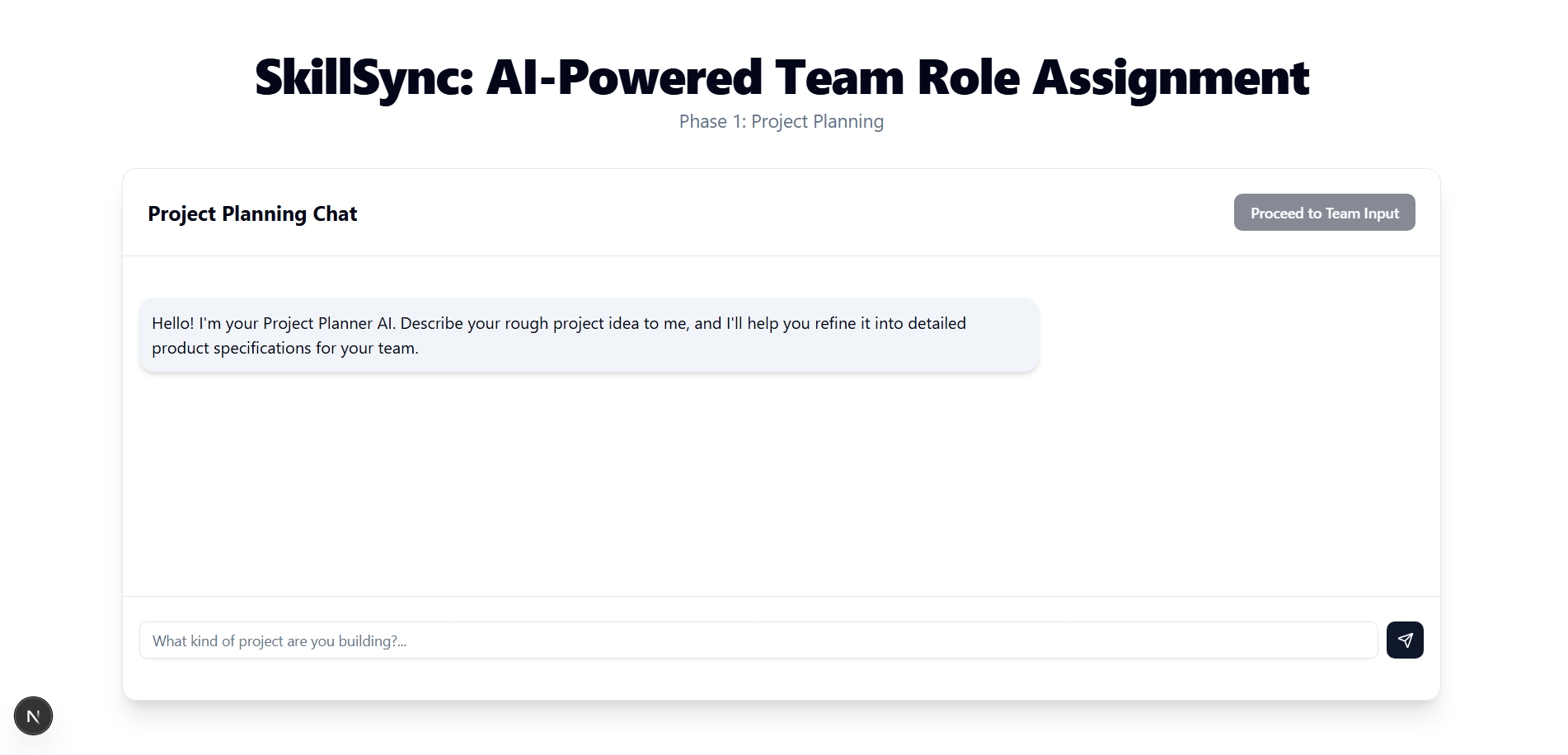
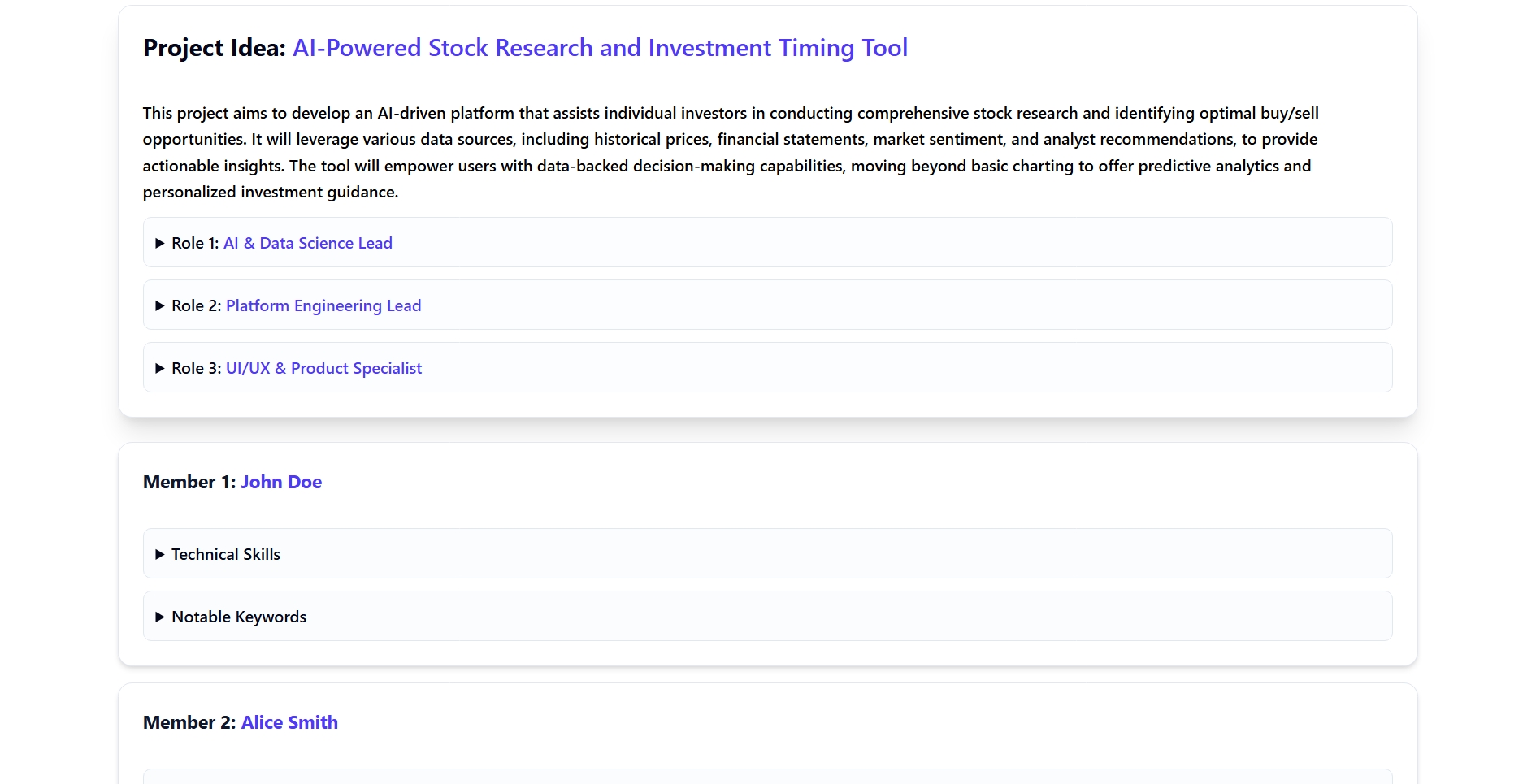
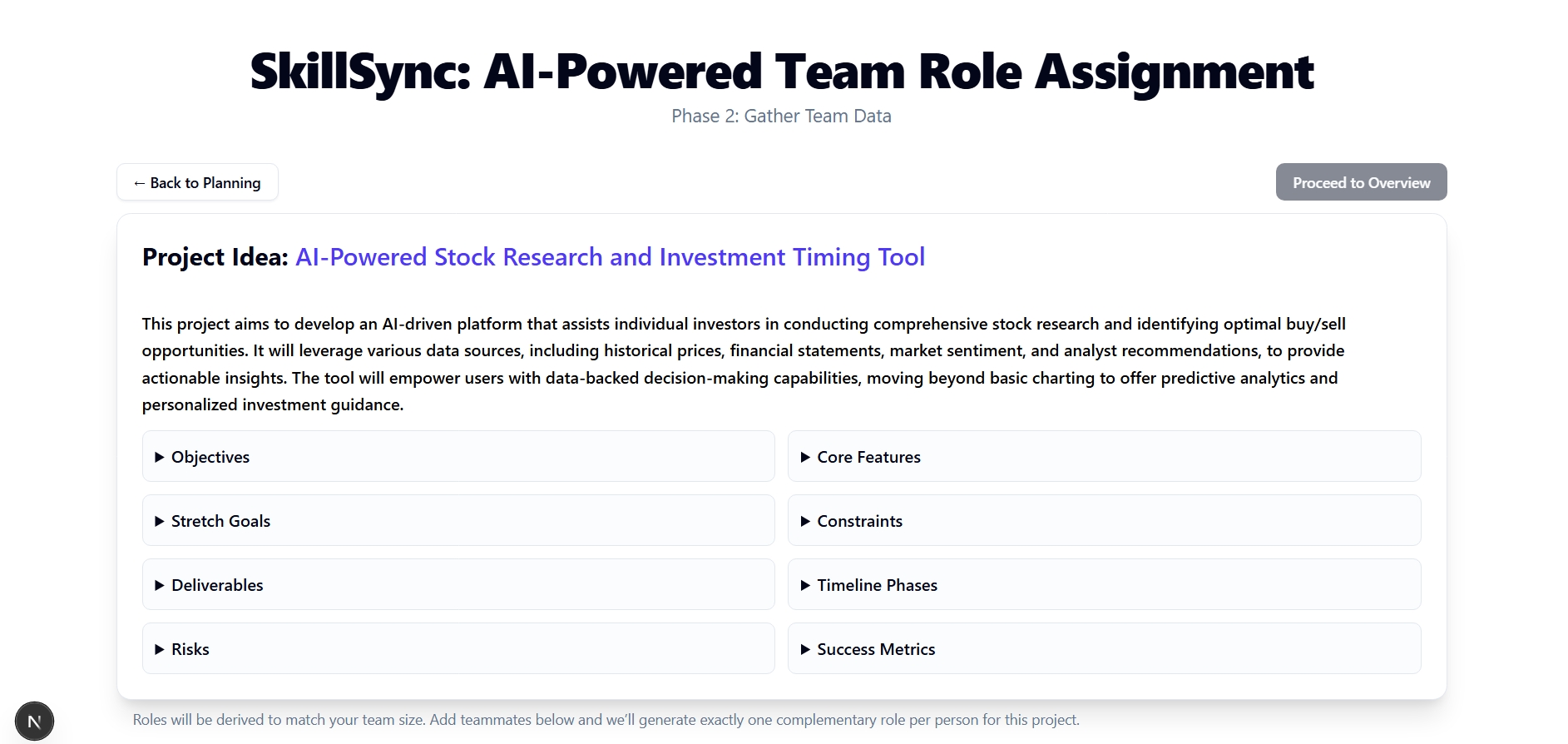
SkillSync helps teams plan, organize, and execute projects intelligently. Users start by interacting with an integrated chatbot that assists in designing and refining project ideas. Once the plan is approved, the system analyzes each team member’s GitHub profile and resume to extract technical expertise, programming languages, and interpersonal strengths. Using this information, SkillSync generates project roles and recommends which members should lead specific tasks based on their skills, experience, and collaborative fit.
How we built it
The project was built using a React and Next.js frontend that communicates with a FastAPI backend through REST API endpoints. The frontend allows users to chat with the project-planning assistant, review generated plans, and upload team member GitHub links and resume files. All interactions are handled asynchronously through API routes, ensuring a seamless and responsive user experience.
On the backend, we developed a modular FastAPI system consisting of multiple endpoints that handle resume parsing, GitHub analysis, skill extraction, and role matching. Data persistence is managed through structured JSON files, which store processed team data and extracted attributes for each member.
For skill extraction, we implemented a hybrid OCR + NLP pipeline using pdfplumber for text-based PDFs and Google Cloud Vision for scanned documents, with the Gemini API used for semantic classification of technical and soft skills. GitHub analysis leverages both the REST and GraphQL APIs to collect repository metadata, programming language distributions, and contribution histories.
Our role-matching algorithm combines weighted skill vectors and semantic similarity scoring to recommend optimal task assignments. The chatbot planner, built on an LLM-driven reasoning framework, helps users iteratively refine project requirements before team analysis begins.
Together, this architecture connects a structured AI-assisted planning interface with a robust backend that automatically translates human input and team data into actionable task delegation.
Challenges we ran into
We faced several technical hurdles, including data inconsistency across GitHub repositories, handling scanned resume images that required OCR fallback, and integrating outputs from different models into a unified schema. Another challenge was normalizing overlapping skills between resumes and GitHub data while maintaining semantic accuracy. Optimizing response times under hackathon constraints also required efficient caching and parallel processing.
Accomplishments that we’re proud of
We successfully built a working end-to-end system that autonomously extracts, interprets, and synthesizes team data into actionable insights. The chatbot’s ability to guide users through structured project ideation and the backend’s automatic role assignment engine are major milestones. We’re proud that SkillSync delivers real, data-driven team coordination, not just analytics.
What we learned
We learned how to integrate multiple AI models into a cohesive pipeline and how to balance human interpretability with machine inference. Our team gained experience with multi-agent workflows, asynchronous API design, and using LLMs for information extraction rather than simple text generation. We also deepened our understanding of the nuances of teamwork, both human and algorithmic.
What’s next for SkillSync
We plan to expand SkillSync into a full collaborative platform with real-time dashboards, project tracking, and adaptive skill analytics that evolve as members gain experience. Future updates will include sentiment and communication pattern analysis to measure teamwork dynamics. Ultimately, we aim to make SkillSync a scalable tool for companies, research teams, and educational programs seeking to form balanced, high-performing teams.


Log in or sign up for Devpost to join the conversation.