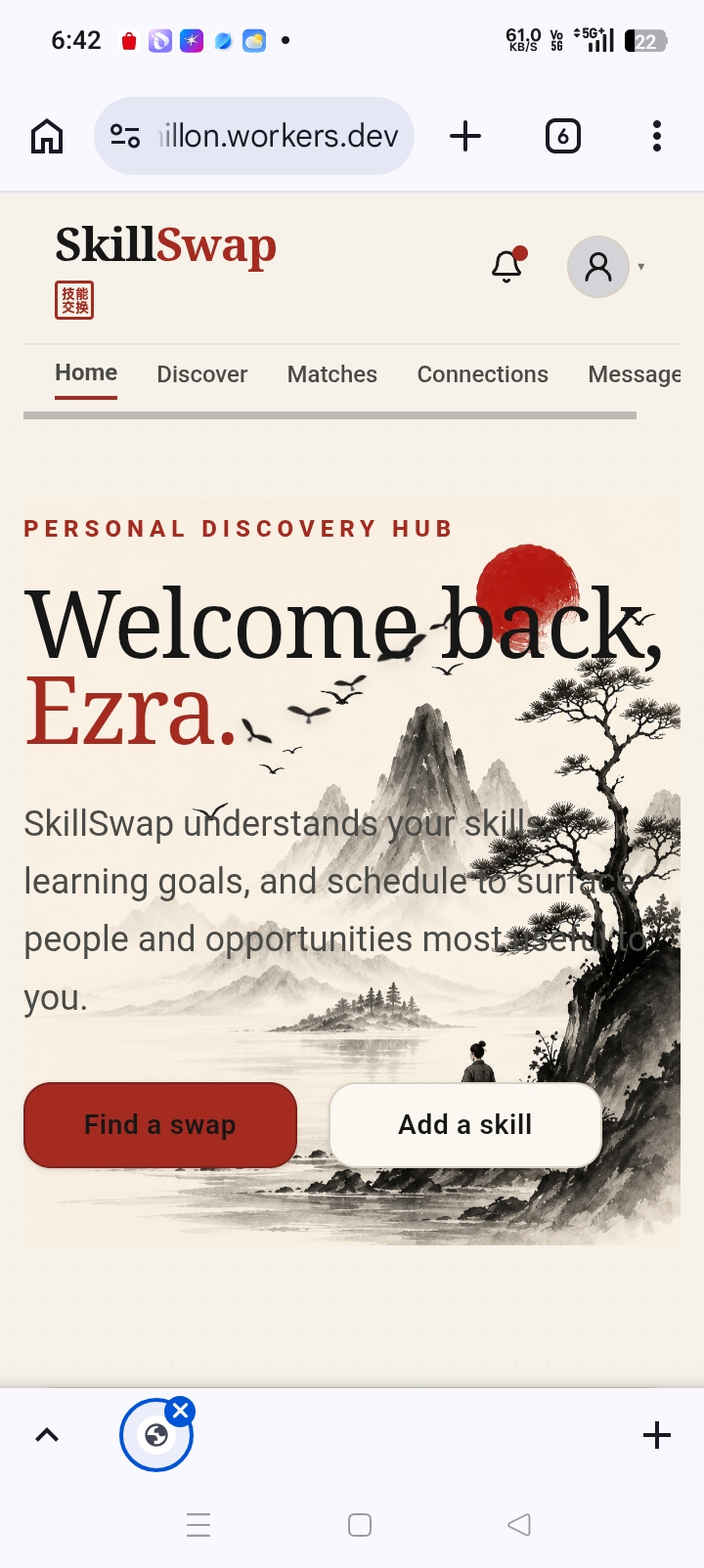
SkillSwap — AI Skill Broker
The Problem
Students are often told what skills they should learn for their future careers, but not how to practically acquire those skills.
A student may know JavaScript and video editing but struggle with React. Another student may be strong in React but need help with video editing. Existing career platforms, course marketplaces, and tutoring platforms generally treat learning as a one-way transaction: someone teaches, someone pays.
We wanted to explore a different model:
«What if the skills people already have could become a way to access the skills they need?»
Our Solution
SkillSwap is an AI-powered Skill Broker designed for the future workforce.
A student describes their career goal, current skills, and what they can contribute. SkillSwap's AI analyzes their capabilities, identifies relevant skill gaps, and searches for peers whose skills can help close those gaps.
Instead of simply recommending a course or a person, the AI coordinates a potential reciprocal skill exchange.
For example:
«"I want to become a frontend developer. I know JavaScript and HTML/CSS, but I need help with React. I can help someone with video editing."»
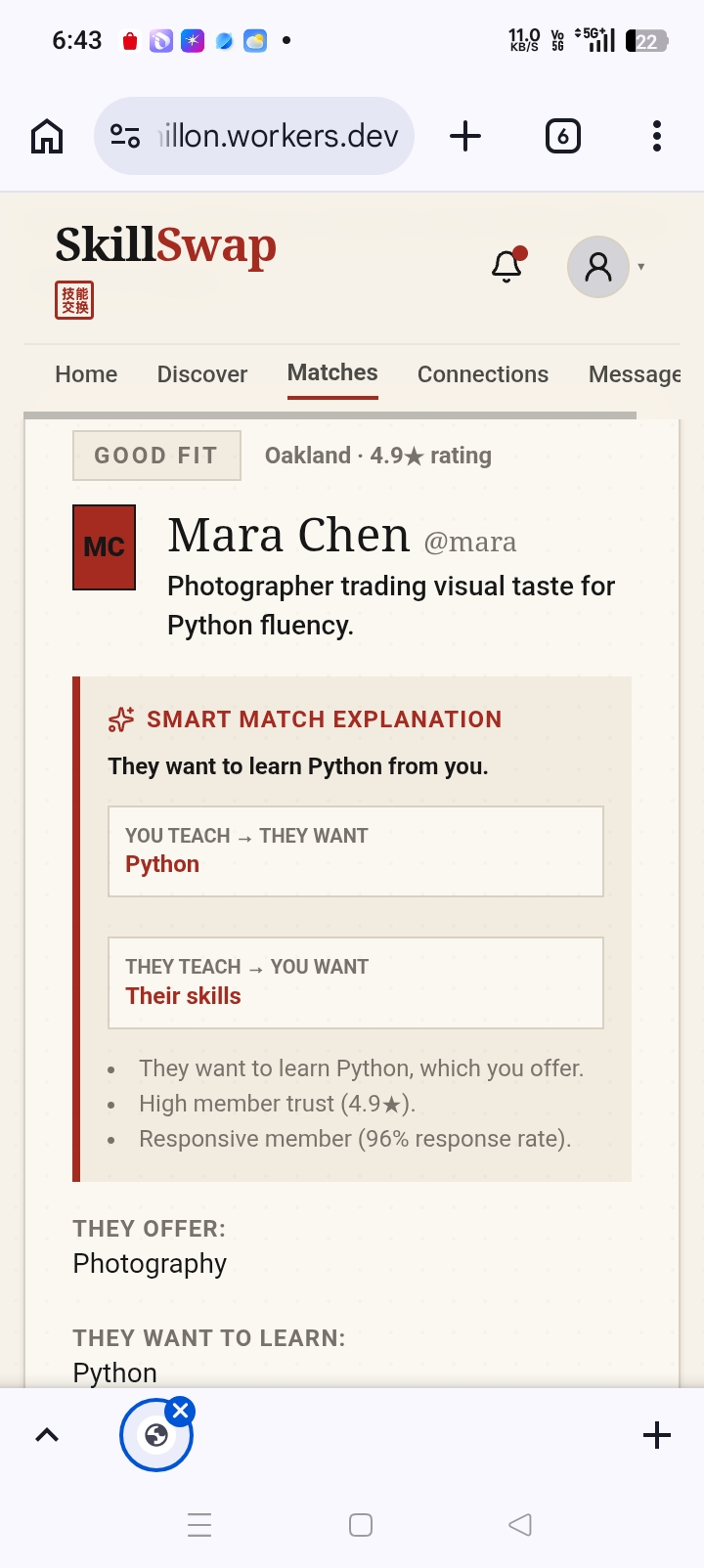
SkillSwap can identify the React skill gap, find a compatible peer, explain why the person is a good match, estimate the effort involved, and propose a fair credit-based exchange.
How the AI Works
The AI Skill Broker follows a structured pipeline:
Career Goal → Skill Analysis → Skill Gap → Semantic Matching → Trust & Availability → Exchange Recommendation → Credit Estimation → User Approval
The system uses AI to understand natural-language requests and normalize different ways of describing similar skills.
It then combines semantic skill similarity with factors such as availability, reliability, previous outcomes, and exchange compatibility.
Importantly, the AI does not make an unexplained black-box decision. Each recommendation includes a human-readable explanation of why the match was selected.
The Skill Economy
SkillSwap's credit system is more than gamification.
Credits act as an internal coordination mechanism for exchanging value without requiring every interaction to involve money.
A contribution earns credits after verified completion. When users agree to an exchange, credits can be reserved and released after completion. Reputation is tracked separately using signals such as reliability, completion rate, and peer feedback.
This creates a simple loop:
Contribute a skill → Earn credits → Access another skill → Build reputation
The system also considers cancellation, disputes, suspicious activity, and other failure cases so that the credit economy is tied to real contributions rather than arbitrary points.
What Inspired Us
The idea came from a simple observation: many students simultaneously have something useful to teach and something they urgently need to learn.
A student may have a valuable skill that is difficult to monetize, while also being unable to afford help for a small but important problem.
We wanted to test whether AI could make these complementary abilities discoverable and coordinate them into useful exchanges.
Our core insight became:
«The scarce resource is not always money. Sometimes it is trusted access to complementary skills.»
What We Built
The prototype focuses on the core transaction rather than trying to build another large social marketplace.
The main workflow is:
- A student describes their career goal and current capabilities.
- AI structures their skills and identifies gaps.
- The Skill Broker searches for complementary peers.
- Candidates are ranked using skill fit and trust-related signals.
- The system explains the recommended match.
- A transparent credit value is estimated from task effort and difficulty.
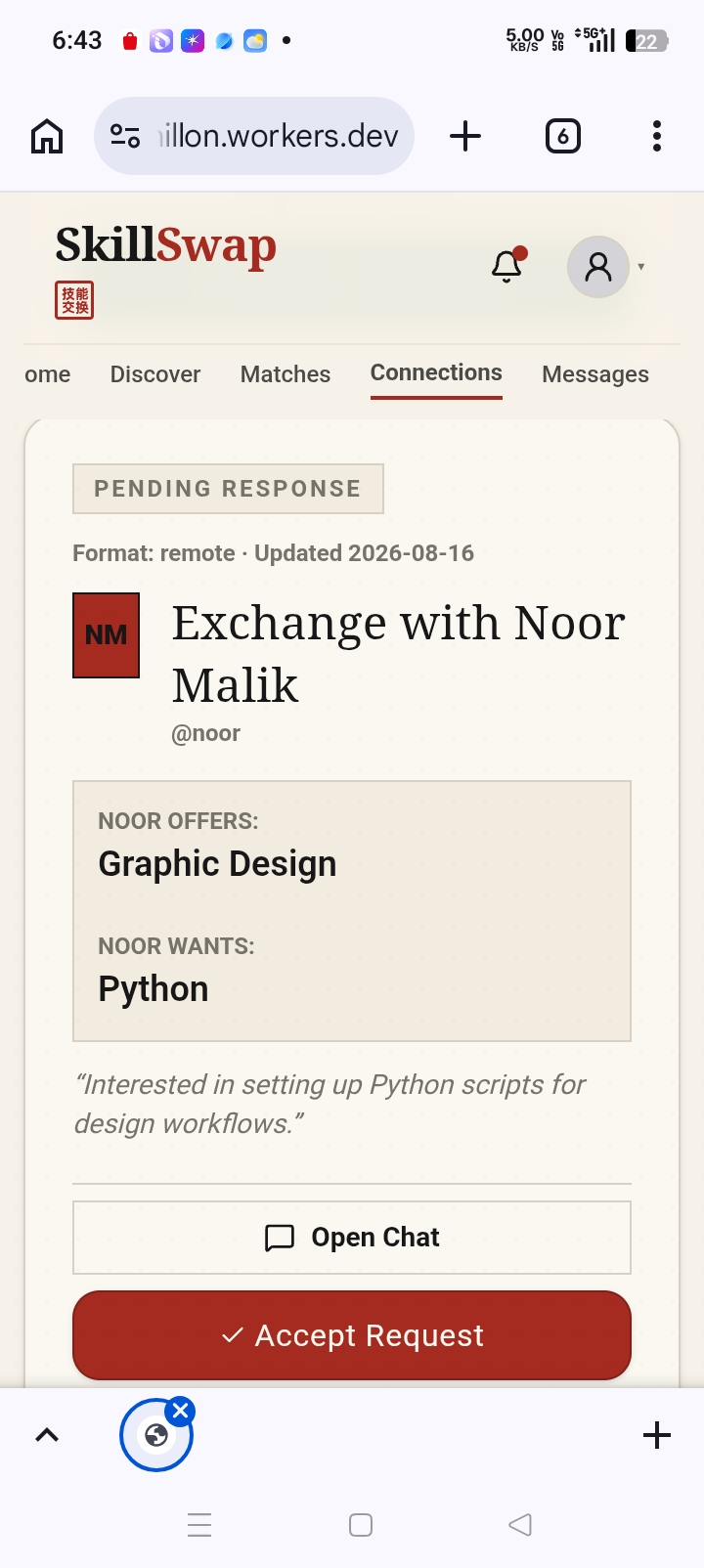
- Users approve the exchange.
- Credits are reserved and later released after completion.
- The outcome contributes to the user's reputation and future matching.
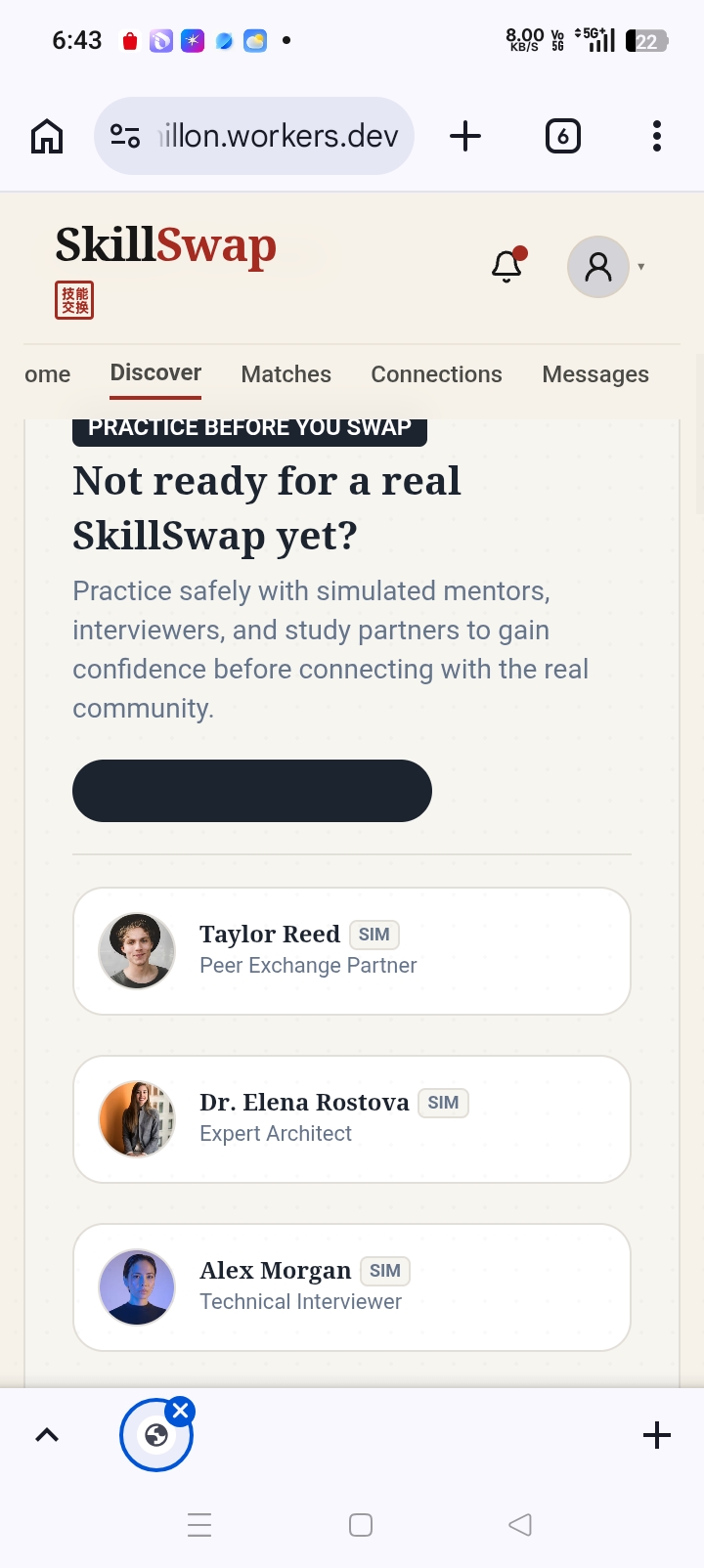
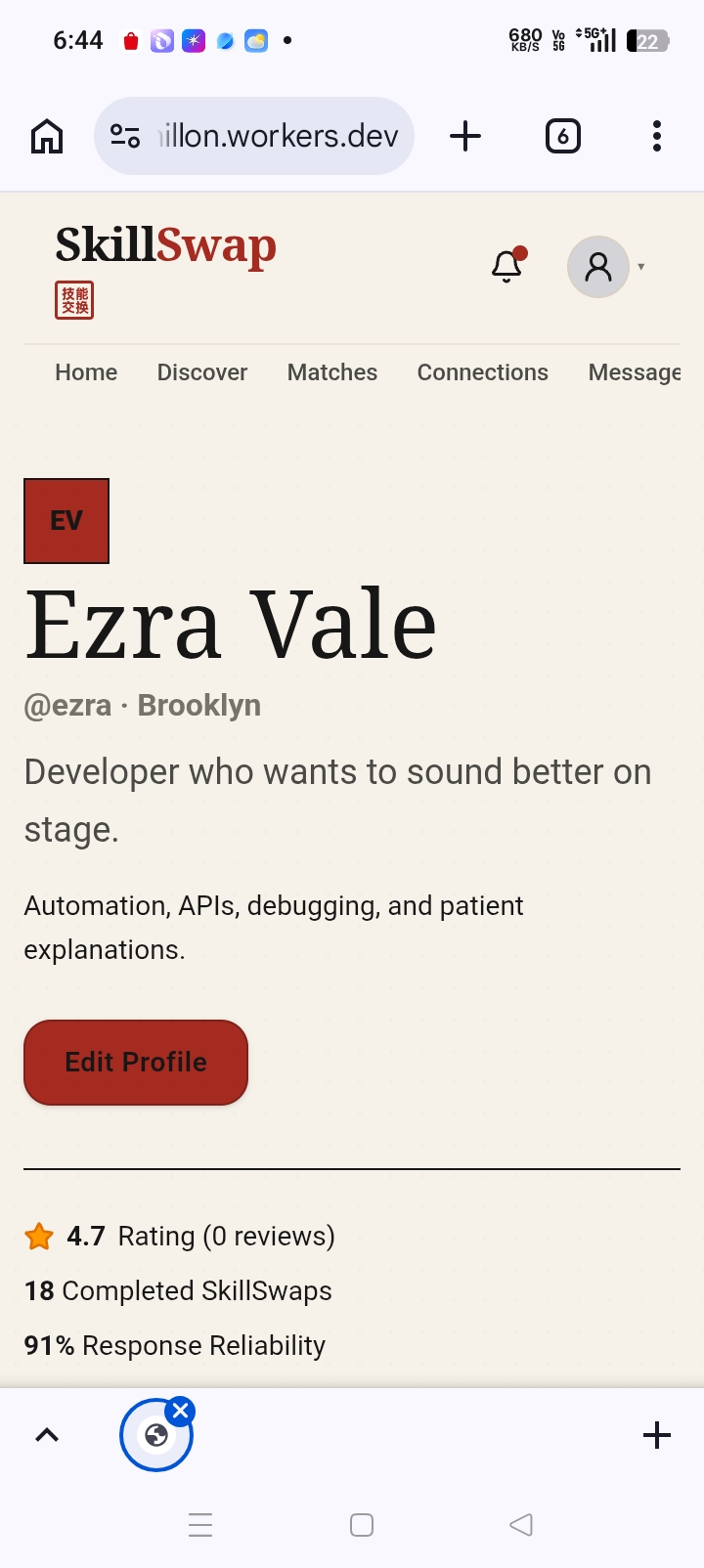
Profiles, discovery, messaging, and other platform functionality support this central mechanism rather than replacing it.
What We Learned
One of our biggest lessons was that building an AI product is not simply about adding an AI model.
Our earlier version of SkillSwap presented many features—profiles, discovery, messaging, credits, and matching—but did not clearly demonstrate what the AI was actually doing.
We learned that a stronger AI product needs to make its mechanism visible:
Input → AI reasoning → decision → explanation → measurable outcome.
We also learned that the credit system becomes meaningful only when it is connected to verified contributions, transparent pricing, trust, and failure handling.
Challenges
The hardest parts were designing a matching system that was more useful than basic keyword search, creating a credit mechanism that did not feel arbitrary, and maintaining trust between people who may not know each other.
We therefore designed the system around several safeguards:
- Explainable match recommendations
- Transparent credit estimation
- Verified contribution before earning credits
- Escrow-style credit handling
- Reputation separate from credit balance
- Cancellation and dispute states
- Human confirmation before exchanges
- Privacy-conscious handling of user information
We also recognize that matching quality, credit calibration, and the cold-start problem require larger real-world datasets and user testing.
Why SkillSwap Matters
Career guidance should not stop at telling someone what they are missing.
It should help them find a practical path to acquire it.
SkillSwap aims to turn students from passive consumers of courses and career advice into active participants in a peer-powered skill economy.
Our long-term goal is to explore whether AI can help people transform their existing abilities into access to new capabilities—and ultimately become more prepared for the future workforce.
Built With
- ai
- cloudflare
- coding
- javascript
- next.js
- react
- tailand
- typescript
- vibe

Log in or sign up for Devpost to join the conversation.