SkillSwap: A Credit-Based Peer-to-Peer Skill Exchange Ecosystem
Abstract
SkillSwap is a collaborative digital platform designed to democratize access to skill development by enabling individuals to exchange knowledge through a credit-based economy rather than direct monetary transactions. The platform operates on a reciprocal model where users earn credits by teaching skills and spend those credits to learn new ones. This structure promotes a sustainable ecosystem of peer-to-peer education, community engagement, and knowledge sharing.
Courses on the platform are organized into structured categories with credit values determined by demand and popularity. Users can participate either as instructors, learners, or both. SkillSwap integrates quality assurance mechanisms including standardized skill verification tests, instructor credential validation, and course feedback systems.
In addition to the knowledge exchange ecosystem, the platform includes a reward marketplace, allowing users to redeem accumulated credits for products and services offered by partner organizations. An emergency credit purchase mechanism ensures that learning opportunities remain accessible even when users have not yet accumulated sufficient credits.
Through its combination of collaborative learning, structured incentives, and community-driven education, SkillSwap establishes a scalable framework for equitable skill development.
1. Vision and Motivation
The modern economy increasingly rewards individuals who continuously develop new skills. However, access to education and skill-building opportunities is often constrained by financial limitations, geographical barriers, and unequal distribution of resources.
At the same time, many individuals possess valuable knowledge that remains underutilized due to the absence of accessible platforms through which it can be shared. Retired professionals, experienced hobbyists, and skilled community members frequently have decades of expertise that could benefit others but lack structured channels to pass on this knowledge.
SkillSwap addresses these challenges by introducing a knowledge exchange ecosystem where skills can be traded in a structured, collaborative environment.
Instead of relying primarily on financial transactions, SkillSwap allows individuals to contribute knowledge and receive access to learning opportunities in return.
The platform is guided by several key principles:
- Accessibility: Removing financial barriers to learning
- Reciprocity: Encouraging mutual knowledge exchange
- Community engagement: Connecting individuals through teaching and learning
- Sustainability: Creating a self-regulating credit economy
- Lifelong learning: Supporting continuous personal development across all age groups
A particularly meaningful application of this platform is for retired individuals who may possess extensive expertise but lack opportunities to share it. SkillSwap enables retirees to teach skills accumulated throughout their careers while simultaneously learning new skills themselves, helping them remain intellectually engaged and socially connected.
2. Core Platform Concept
SkillSwap operates on the principle that knowledge itself can function as a form of currency. Rather than paying for courses directly with money, users participate in a credit-based system that rewards contributions and facilitates learning.
Users earn credits by teaching skills through structured courses or sessions. These credits can then be used to enroll in courses taught by other users.
The system forms a circular knowledge economy:
- Users contribute knowledge by teaching
- They earn credits for their contributions
- They use those credits to learn new skills
This cycle ensures that value within the platform is generated primarily through knowledge sharing rather than financial exchange.
The system is structured around five fundamental components:
- Credit-based knowledge economy
- Structured course marketplace
- Skill verification and instructor validation
- Community moderation and feedback systems
- Reward and incentive ecosystem
Together, these elements create a stable and trustworthy learning environment.
3. Credit-Based Knowledge Economy
3.1 Credit Generation Through Teaching
Users earn credits by offering courses, workshops, seminars, or mentorship sessions on the platform.
Courses may be delivered in multiple formats:
- Seminar-style courses with group learning sessions
- One-to-one mentoring sessions with personalized instruction
- Session-based workshops conducted over multiple sessions
Each course is assigned a credit value that learners must spend to participate. After successful completion, the instructor receives those credits.
3.2 Credit Usage for Learning
Credits are the primary mechanism through which users access courses on the platform.
When a user enrolls in a course, the required credits are deducted from their account and transferred to the instructor.
Example exchange:
- A user teaches a data analysis workshop and earns 40 credits
- The user later spends those credits to enroll in a language learning seminar
This establishes a balanced exchange system.
3.3 Emergency Credit Access
While the platform emphasizes knowledge exchange over financial transactions, users may occasionally wish to enroll in a course before accumulating sufficient credits.
SkillSwap therefore provides an emergency credit purchase option, allowing users to temporarily acquire credits through monetary payment.
However, the platform's primary ecosystem remains focused on knowledge exchange.
4. Course Marketplace Structure
SkillSwap hosts a structured marketplace where users can create, browse, and enroll in courses across many disciplines including:
- Programming and technology
- Creative arts and design
- Language learning
- Academic tutoring
- Professional development
- Hobbies and lifestyle skills
Each course listing includes:
- Course title
- Skill category
- Skill level
- Course format
- Credit cost
- Instructor profile
- Course description
5. Category-Based Credit Ranges
Courses are organized into categories with credit ranges between 10 and 100 credits depending on demand, complexity, and time commitment.
| Category | Credit Range |
|---|---|
| Programming & Technology | 30–100 |
| Creative Arts | 20–70 |
| Language Learning | 25–80 |
| Academic Tutoring | 30–90 |
| Hobbies & Lifestyle | 10–40 |
Instructors may select a credit value within the allowed range.
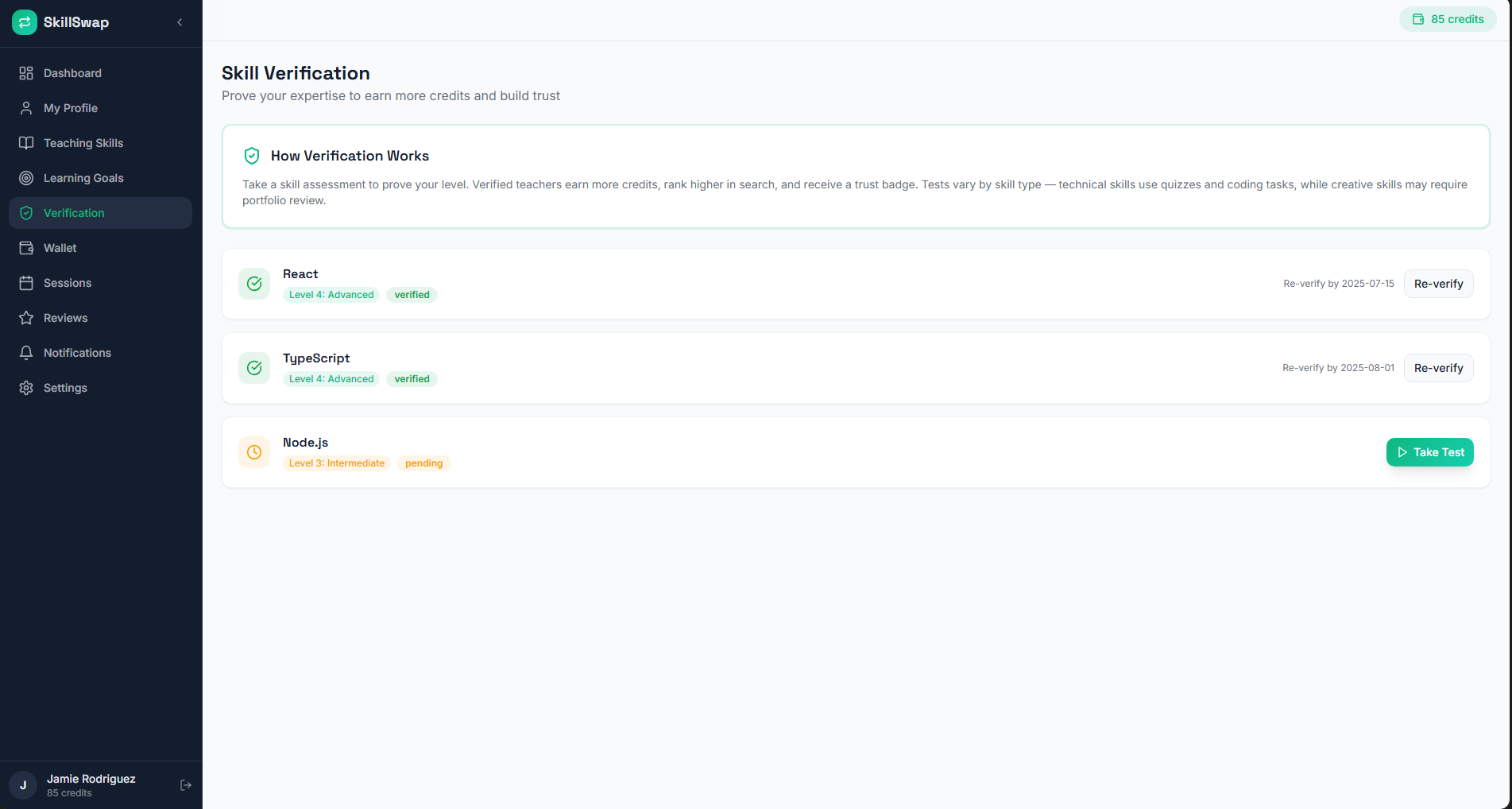
6. Skill Verification and Instructor Qualification
To maintain instructional quality, instructors must demonstrate their proficiency through verification methods such as:
- Platform standardized assessments
- Certification submission
- Portfolio evidence
- Verification of professional qualifications
This ensures that instructors possess the necessary expertise.
7. Course Formats and Learning Structure
Seminar-Based Courses
Seminar courses involve group learning sessions with structured teaching and collaborative discussions.
Participants receive weekly progress reports summarizing topics covered.
One-to-One Mentorship
Personalized instruction where learners receive:
- Customized lesson plans
- Direct feedback
- Tailored skill development
Progress reports are generated after each session.
In-Person Learning
Users located within the same area may optionally conduct sessions in person to support local learning communities.
8. Progress Tracking and Learning Reports
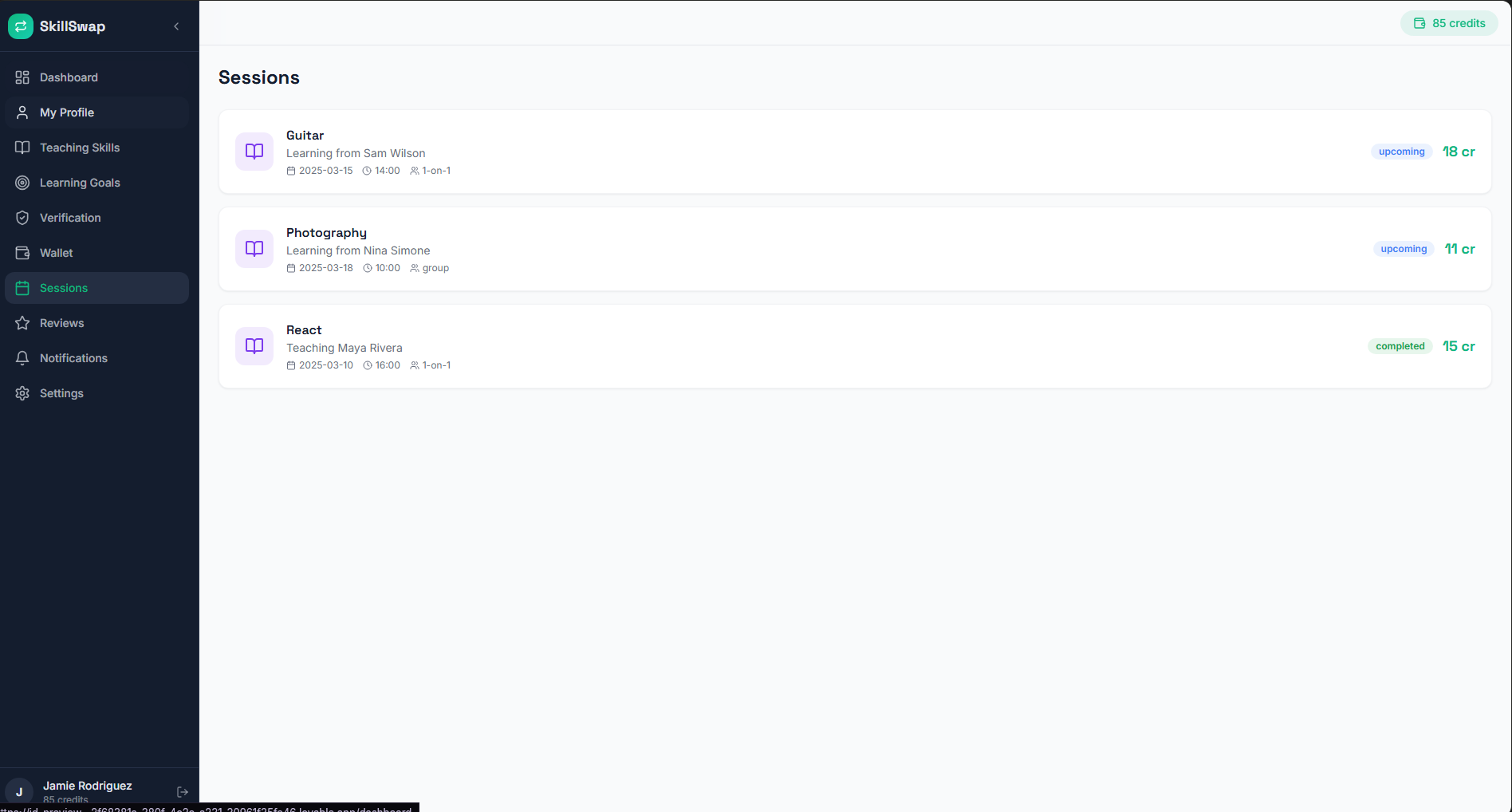
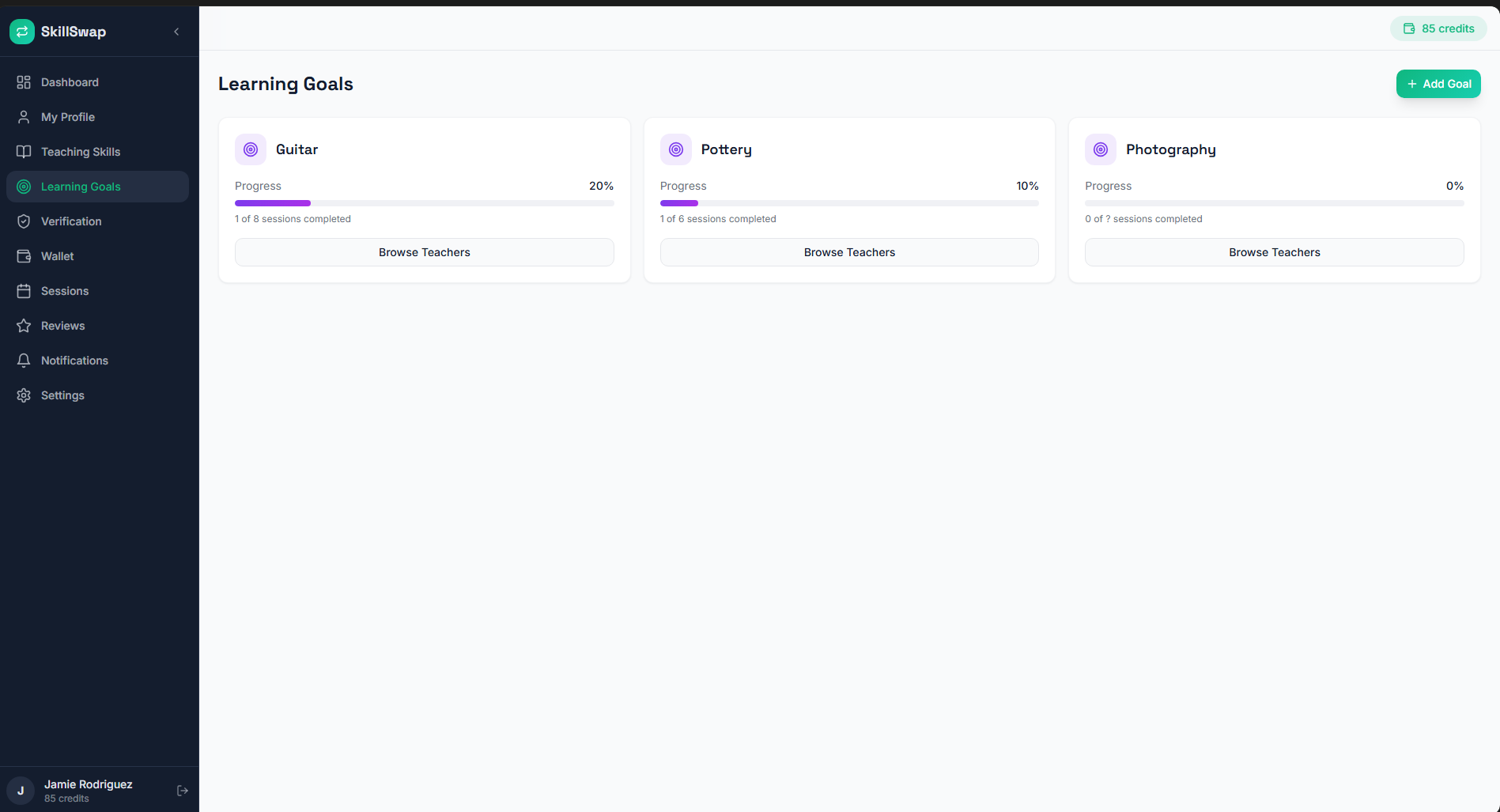
SkillSwap includes structured progress tracking.
Reports may include:
- Topics covered
- Learner engagement
- Instructor feedback
- Suggested improvement areas
This improves transparency and accountability.
9. Moderation and Community Feedback
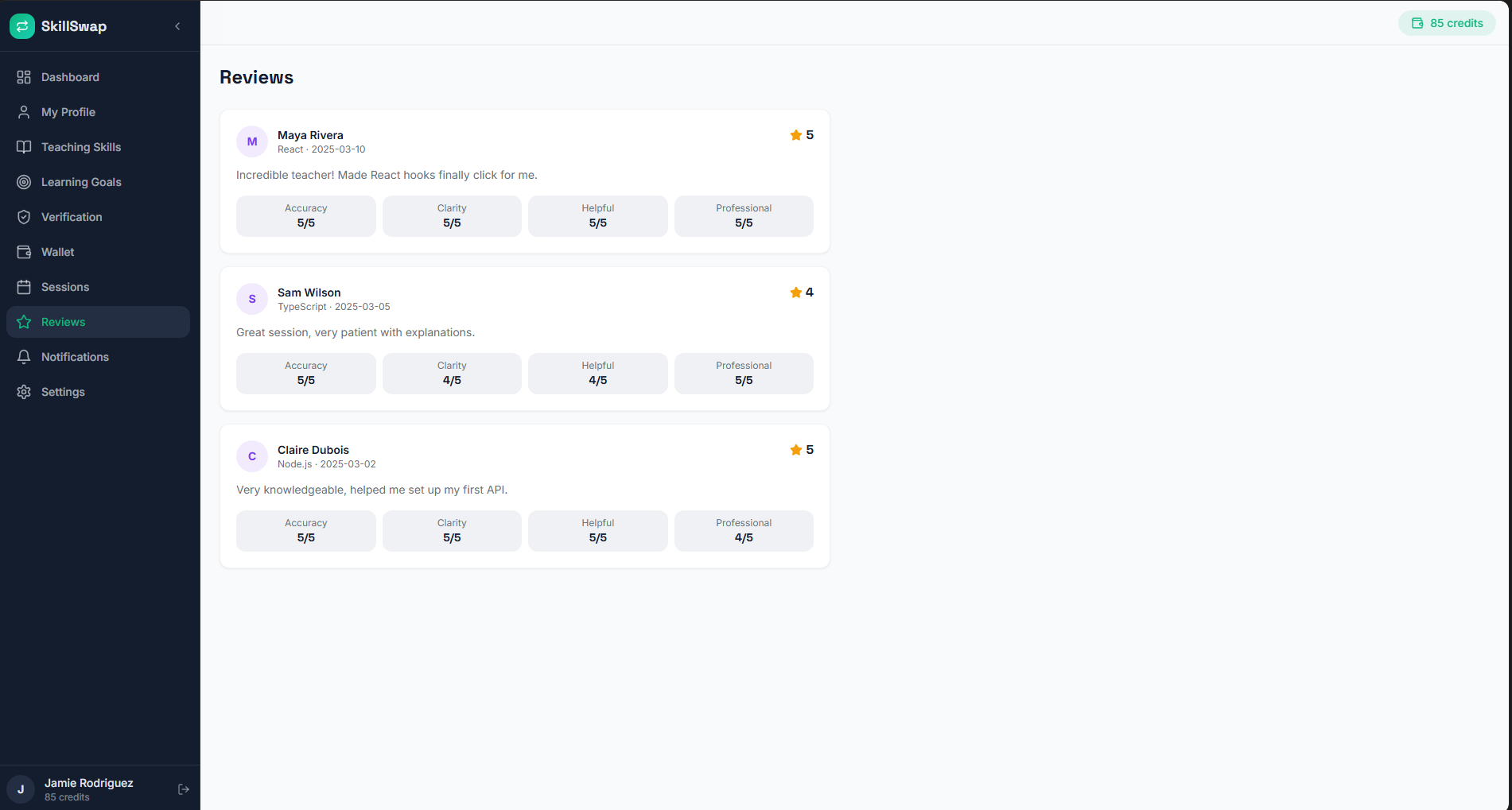
Learners submit feedback after completing courses, evaluating:
- Course quality
- Instructor clarity
- Effectiveness of instruction
- Overall satisfaction
These reviews contribute to instructor reputation scores.
10. Reward and Incentive Ecosystem
SkillSwap includes a reward marketplace where users may redeem credits for partner products or services.
Examples include:
- PlayStation 5
- Sports jerseys
- Streaming subscriptions
- Productivity tools
- Educational software
This system motivates contributions and helps remove excess credits from circulation.
11. Economic Stability of the Credit System
The credit economy remains balanced through:
- Course enrollment spending
- Reward redemption
- Category credit limits
- Credit circulation through teaching and learning
These mechanisms maintain the value of credits.
12. Community Impact
SkillSwap has significant social benefits.
Expanding Access to Education
The credit system reduces financial barriers to learning.
Utilizing Untapped Expertise
Retirees, professionals, and hobbyists can share valuable knowledge.
Strengthening Community Connections
Peer learning fosters collaboration across communities.
Supporting Lifelong Learning
Users can continuously learn throughout their lives.
13. Future Development Opportunities
Intelligent Skill Matching
AI-driven systems could match learners and instructors based on goals and skill levels.
Structured Learning Pathways
Guided multi-course learning tracks could help users progress from beginner to advanced levels.
Verified Instructor Tiers
Instructor credibility levels could be introduced based on feedback and teaching experience.
Institutional and Corporate Partnerships
Universities and companies could integrate SkillSwap into training programs or sponsor courses.
14. Conclusion
SkillSwap introduces a scalable model for collaborative education by transforming knowledge into a tradable resource within a structured digital ecosystem.
By enabling individuals to both teach and learn through a credit-based exchange system, the platform promotes accessibility, collaboration, and lifelong learning.
15. Platform Implementation and Development
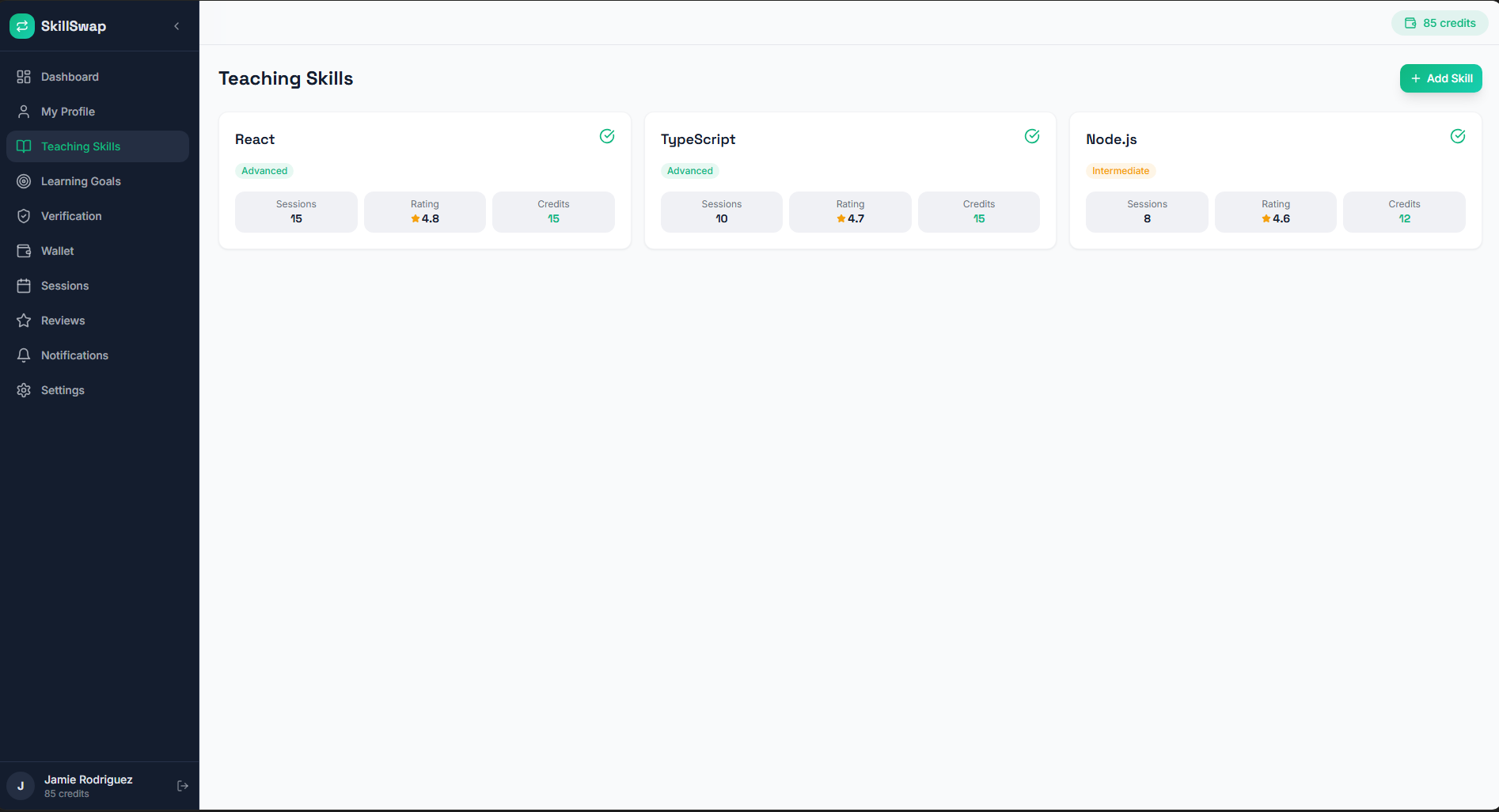
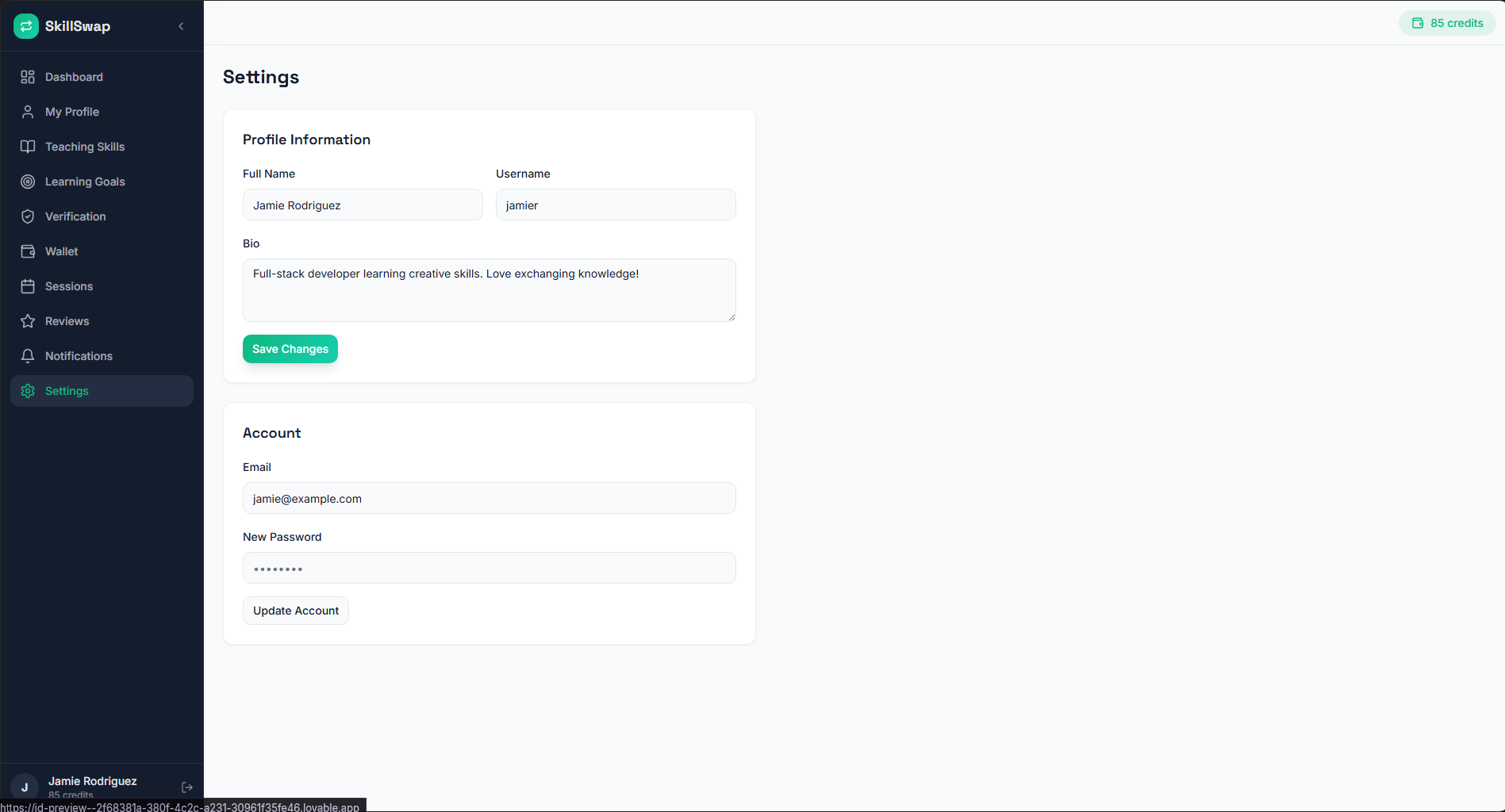
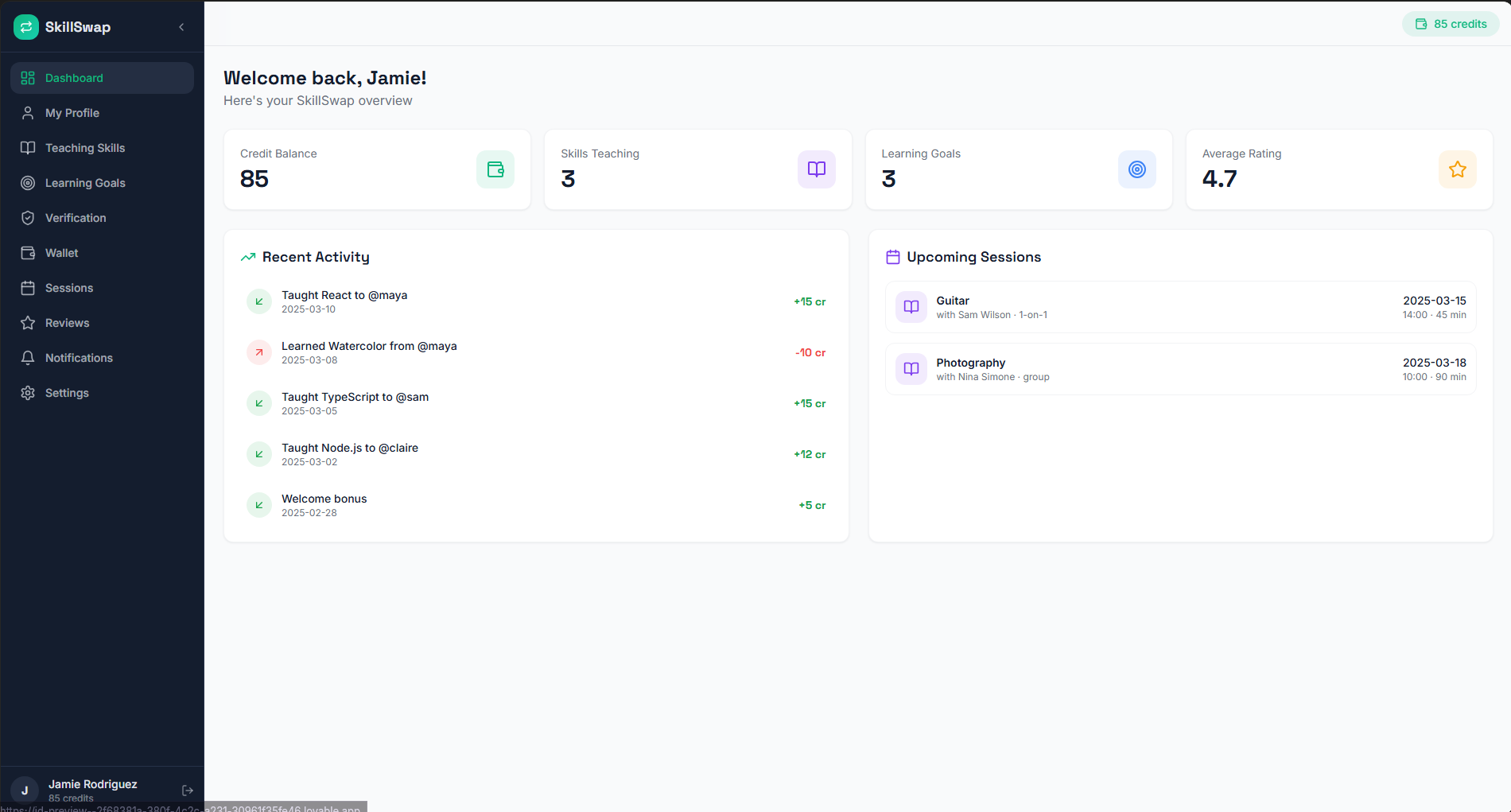
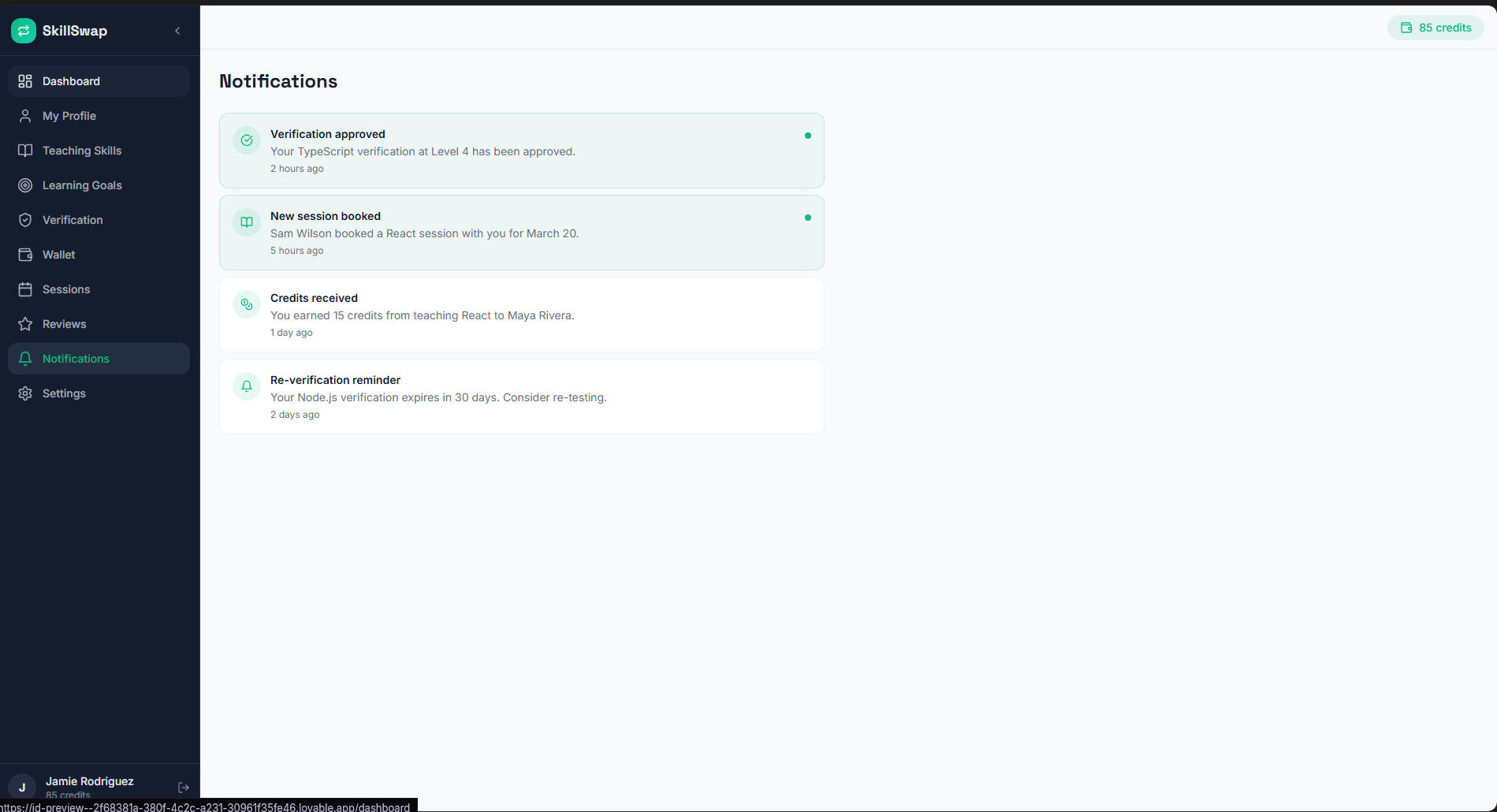
The SkillSwap platform was developed as a functional web prototype demonstrating the feasibility of the credit-based knowledge exchange model.
The system includes:
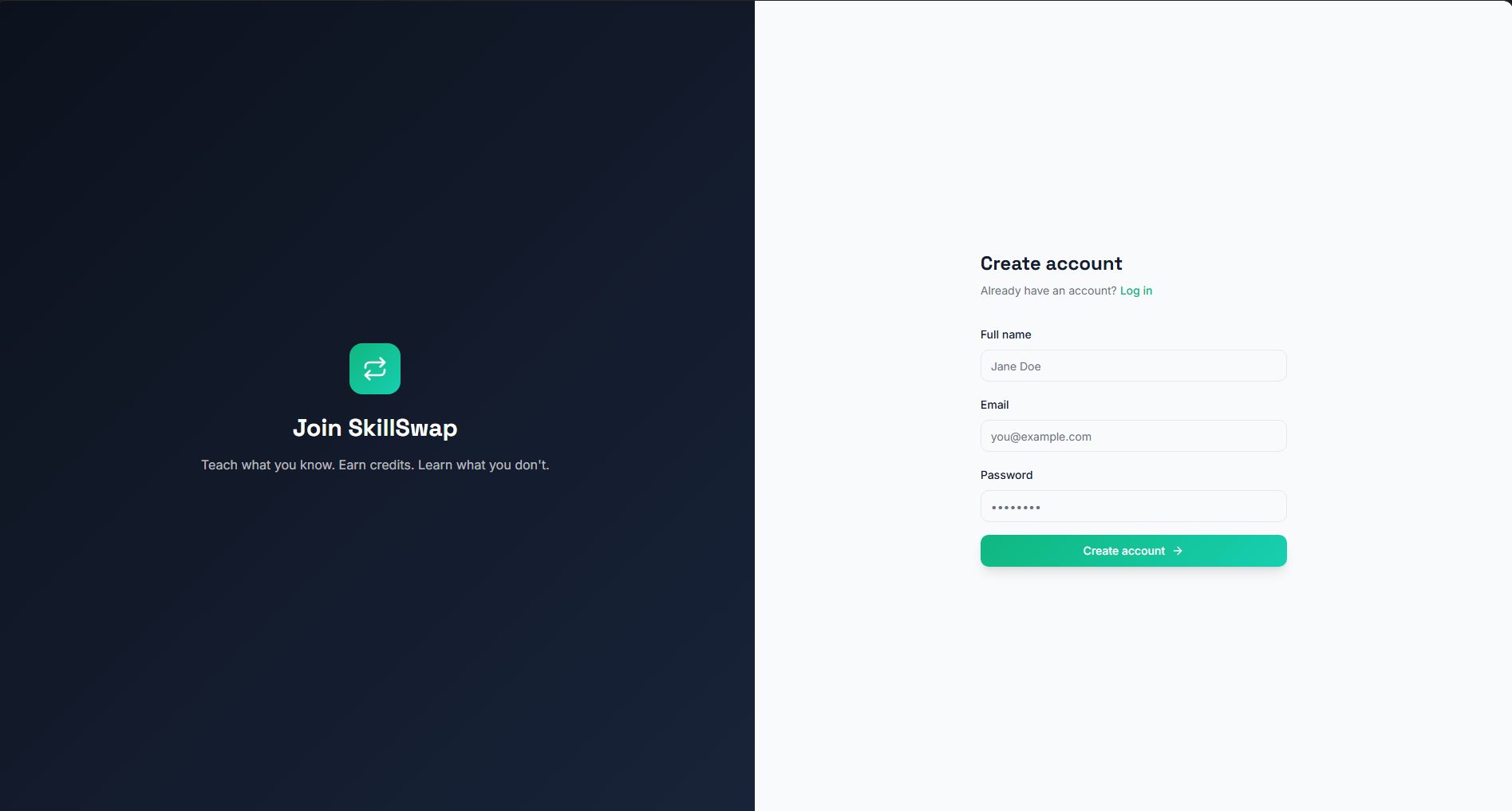
- user authentication
- course creation and discovery
- credit balance tracking
- instructor verification
- progress reporting
- course feedback systems
- reward redemption functionality
Users interact through a unified dashboard that allows them to transition between instructor and learner roles.
16. Core Website Features
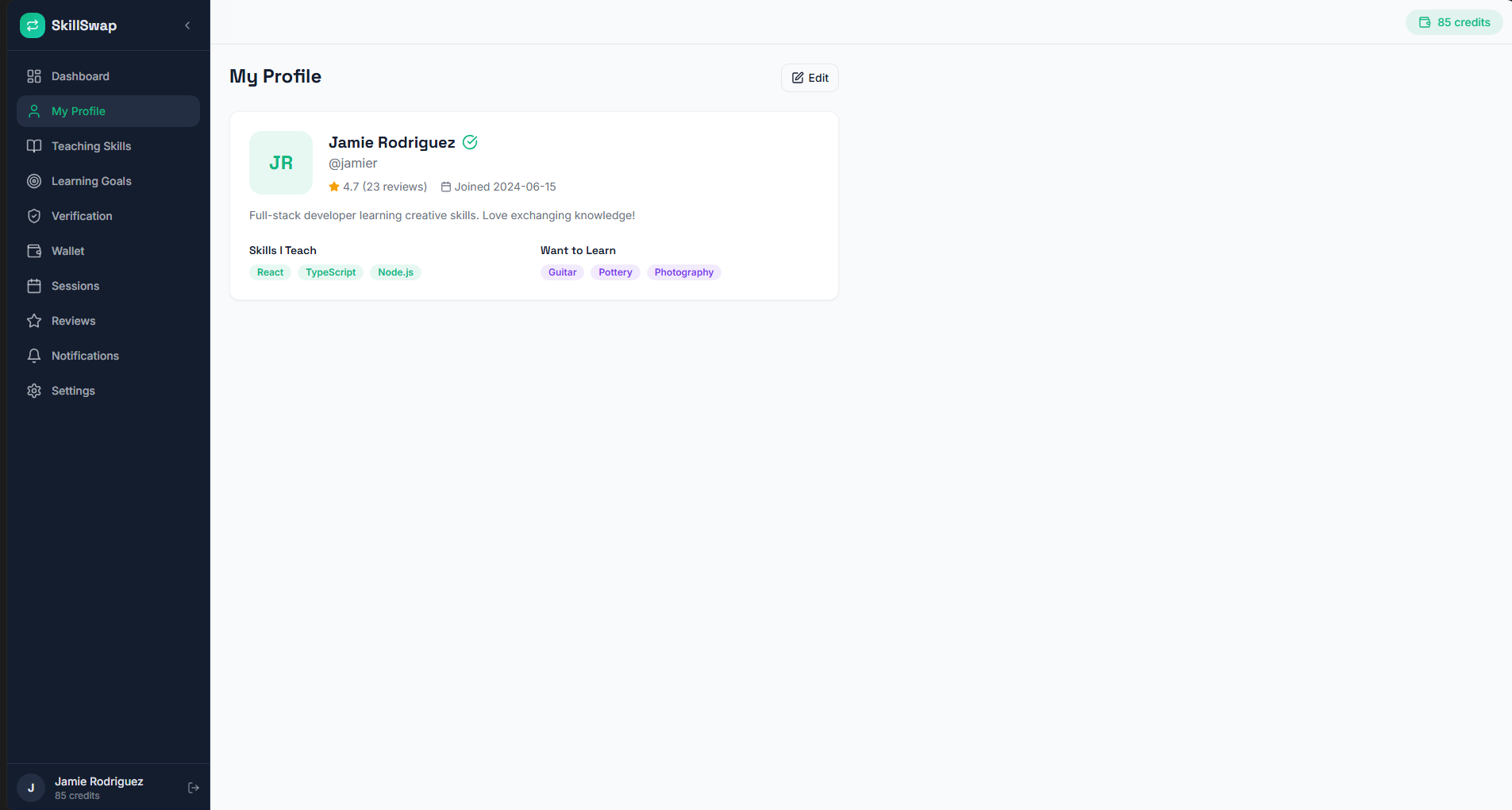
User Profiles
Profiles include:
- skill categories
- verification status
- available courses
- enrolled courses
- credit balance
- reputation score
Course Creation
Users create courses by specifying:
- course title
- category
- skill level
- format
- credit cost
- course description
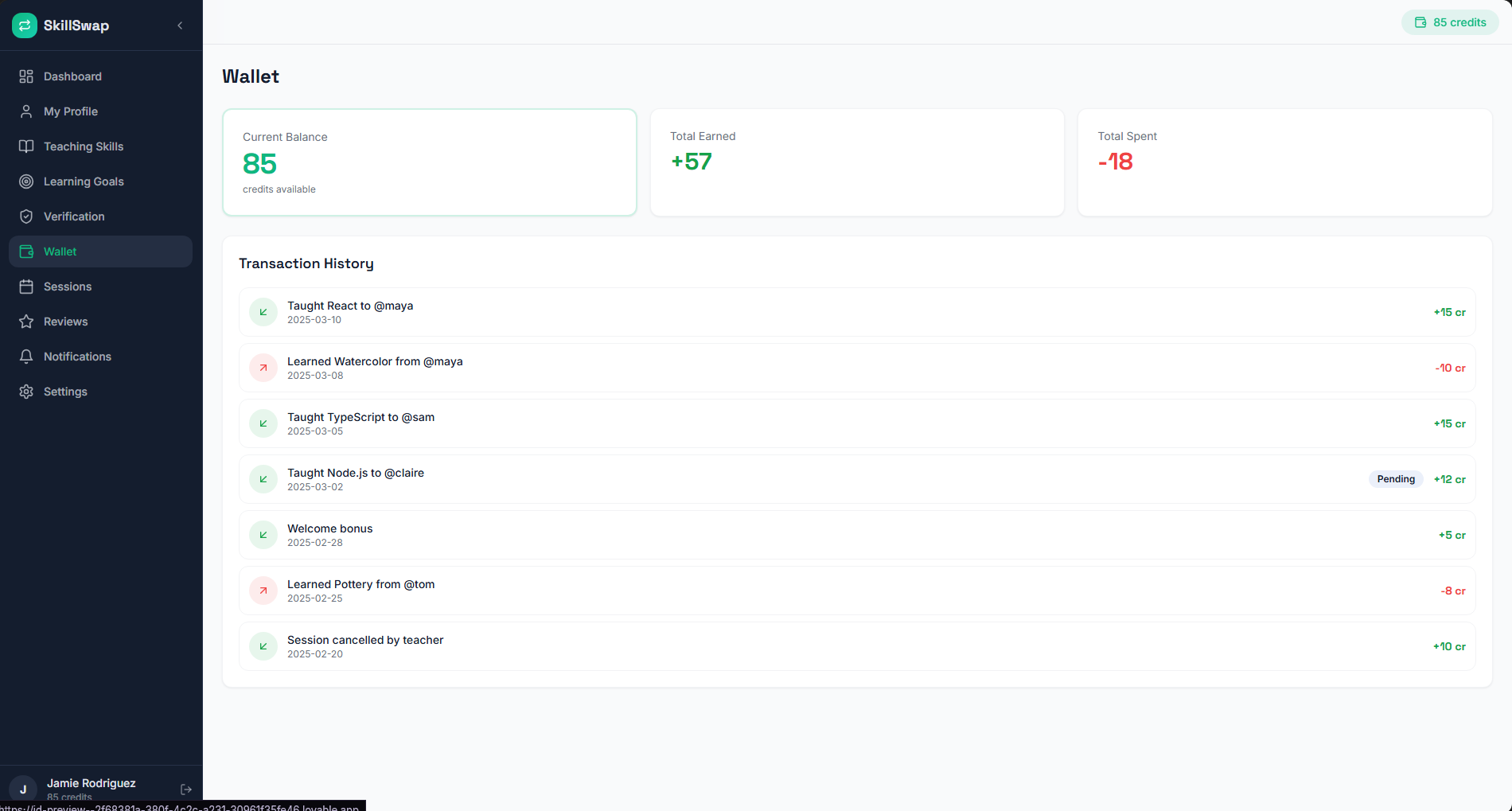
Credit Balance System
Users can track:
- earned credits
- spent credits
- available credits
- reward progress
17. Development Challenges
Credit Economy Design
Balancing credit supply and demand required implementing:
- credit ranges
- reward redemption
- limits on purchased credits
Skill Verification
Ensuring quality while maintaining accessibility required multiple verification pathways.
User Experience Design
The credit system required clear UI elements so users could easily understand how credits function.
Hybrid Learning Support
Supporting both online and in-person sessions required flexible scheduling and course management systems.
18. Prototype Limitations
As a hackathon prototype, the current version focuses on demonstrating core mechanics.
Future production versions would include:
- automated verification pipelines
- advanced AI recommendation systems
- large-scale moderation tools
- integrated video learning systems
19. Scalability Considerations
Future expansions could include:
- AI course recommendation engines
- intelligent instructor matching
- real-time virtual classrooms
- automated moderation systems
These improvements would allow SkillSwap to scale to a global user base.
Built With
- css
- html
- lovable
- typescript
- vite


Log in or sign up for Devpost to join the conversation.