-
-
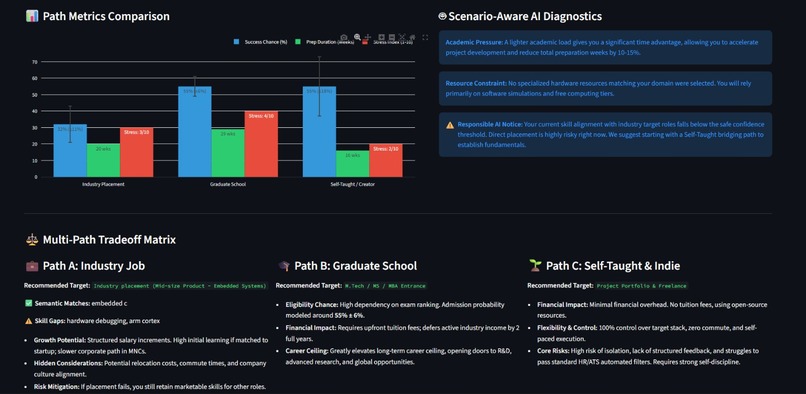
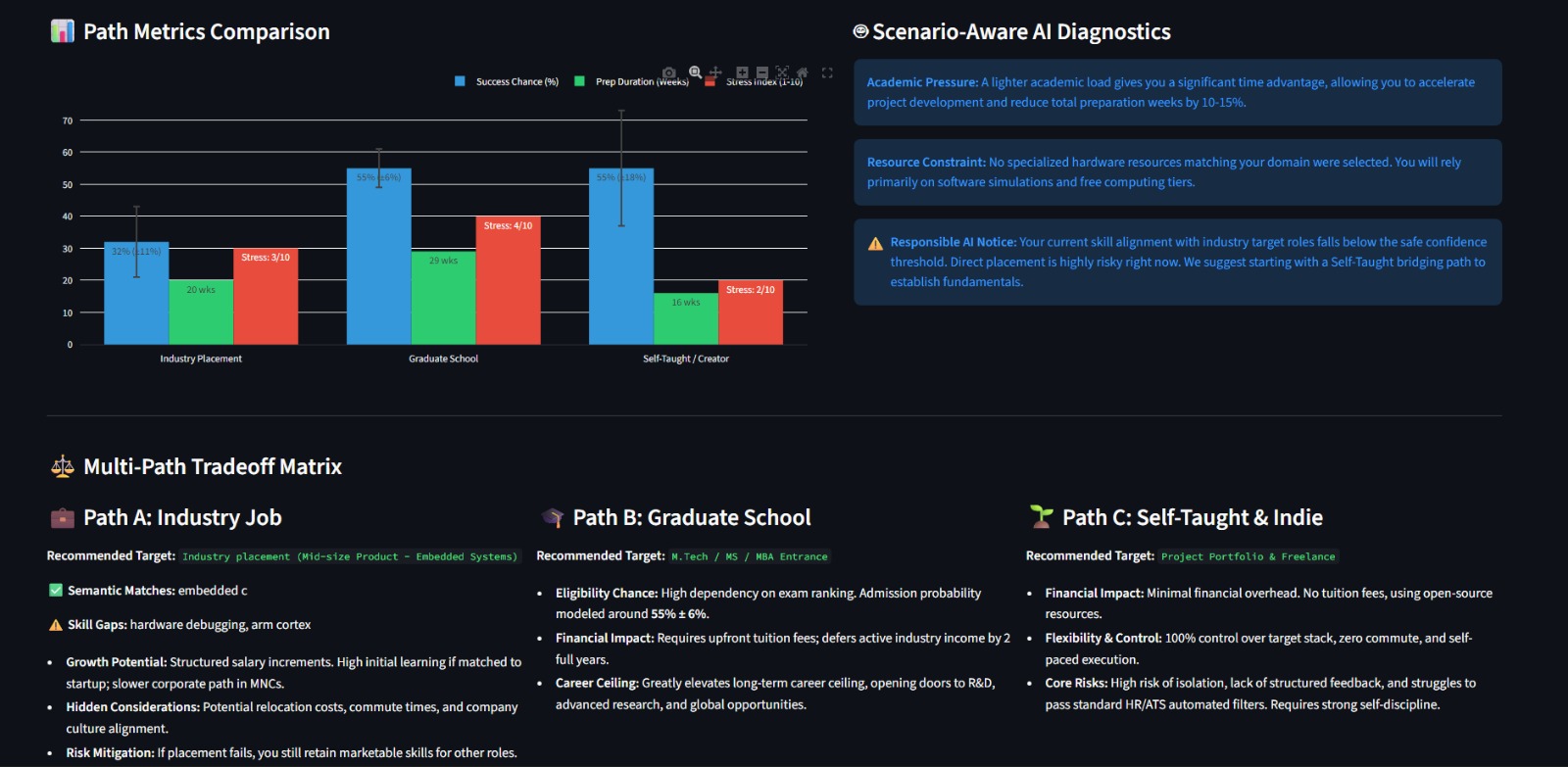
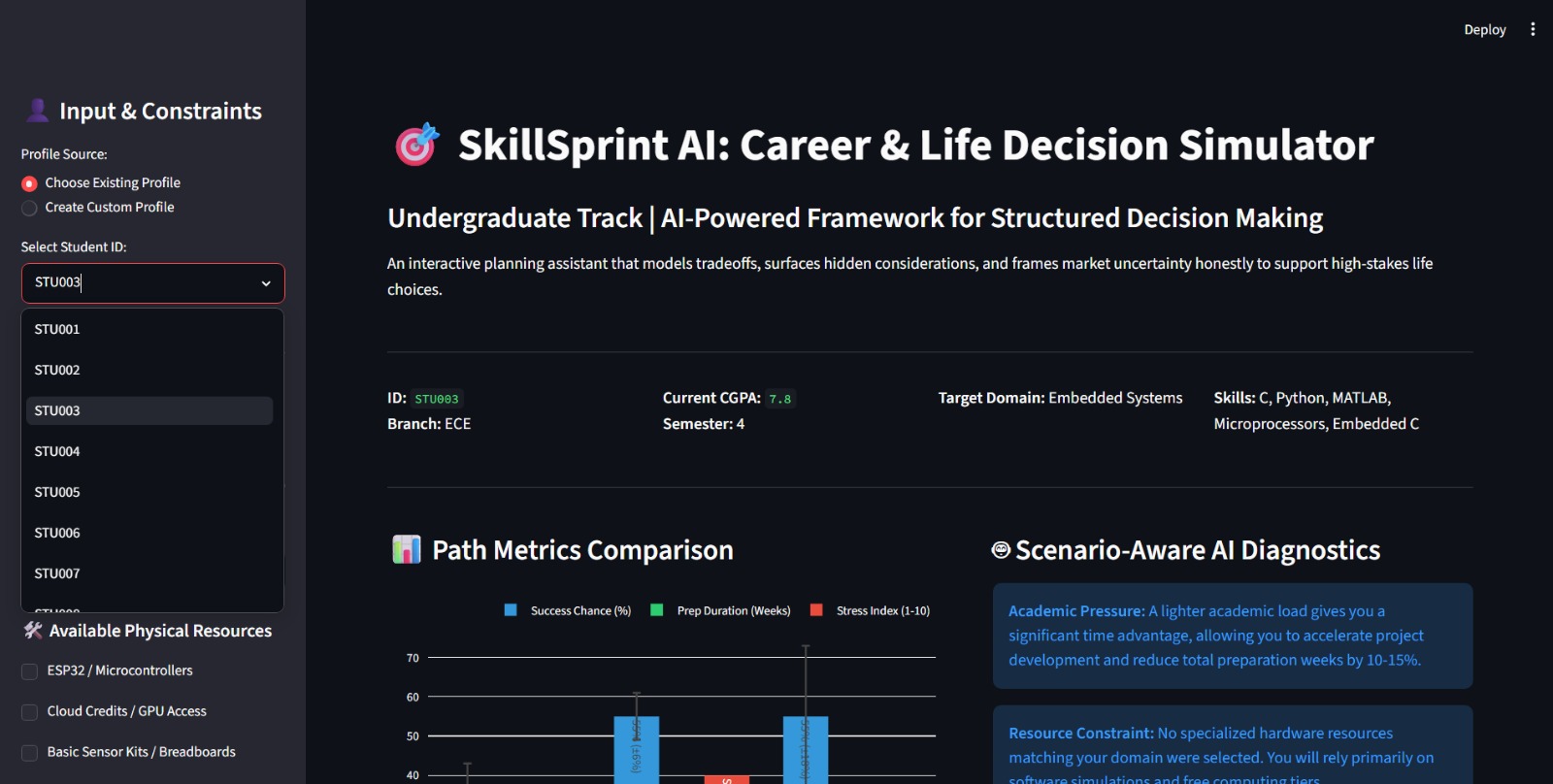
AI-Powered Diagnostics: Multi-path comparison matrix using semantic similarity to visualize success rates, stress indices, and skill gaps
-
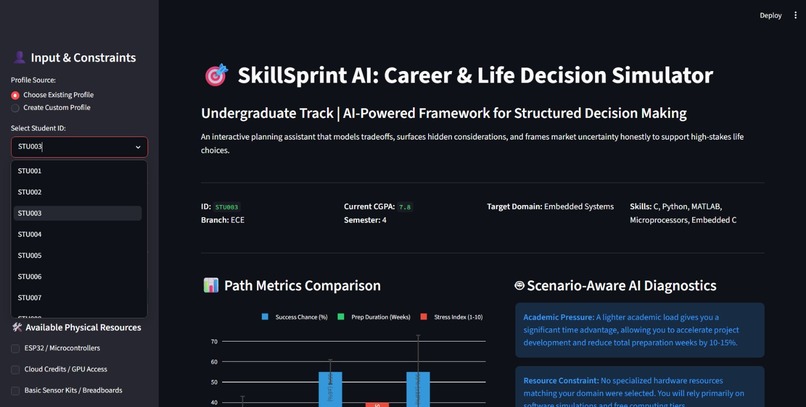
Personalized Career Simulation: Interactive dashboard for evaluating academic and professional pathways
-
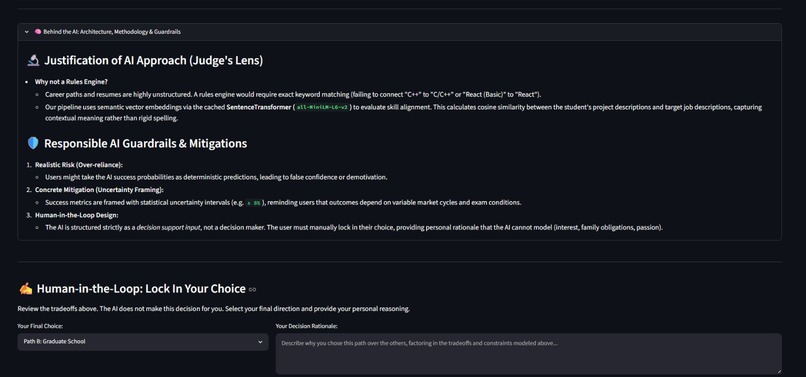
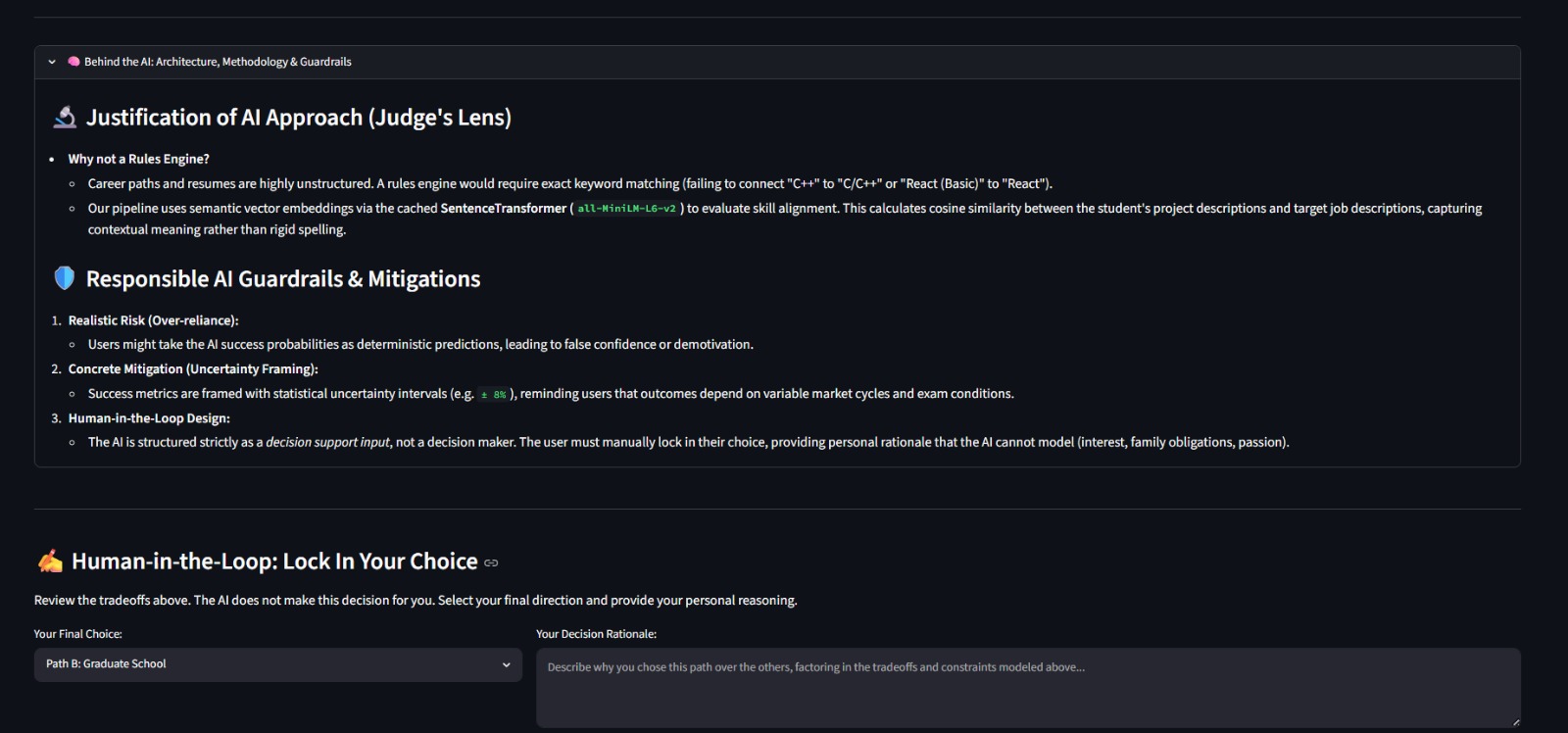
Responsible Design: A commitment to ethical AI through uncertainty modeling and human-in-the-loop decision-making.
Inspiration
As students, we often face major career decisions with limited information and conflicting advice. Choosing between an industry internship, graduate studies, or a self-taught path can significantly impact our future. Existing career platforms usually provide generic recommendations and rarely consider real-life constraints such as study time, academic workload, risk tolerance, and available resources. We wanted to build an AI-powered system that helps students evaluate these choices realistically and confidently.
What it does
SkillSprint AI is a Life & Career Decision Simulator that helps students compare different career paths. The system analyzes a student's skills, projects, study hours, academic workload, and available resources to generate realistic insights. Using semantic AI and constraint-aware reasoning, it visualizes tradeoffs such as preparation effort, stress level, and success probability while encouraging users to make their own final decision through a human-in-the-loop process.
How we built it
We built the application using Streamlit for the user interface, Sentence Transformers (all-MiniLM-L6-v2) for semantic skill understanding, Scikit-Learn for cosine similarity calculations, Pandas and NumPy for data processing, and Plotly for interactive visualizations.
Instead of traditional keyword matching, we generate embeddings for skills and project descriptions and calculate semantic similarity using:
$$ \text{Similarity}(A,B)=\frac{A \cdot B}{||A|| ||B||} $$
The resulting similarity scores are combined with resource constraints, study availability, and workload considerations to evaluate multiple career paths and generate actionable recommendations.
Challenges we ran into
One of our biggest challenges was designing a system that remains realistic and responsible. Career outcomes depend on many external factors that no AI can perfectly predict. We had to ensure that the platform communicated uncertainty rather than false confidence.
Another challenge was implementing meaningful semantic matching. Traditional keyword-based approaches often failed to identify related skills and projects, requiring us to experiment with embedding models and similarity thresholds to improve accuracy.
Accomplishments that we're proud of
- Successfully implemented semantic skill matching using transformer embeddings.
- Built a constraint-aware decision engine rather than a simple recommendation system.
- Incorporated Responsible AI principles through uncertainty ranges and human-in-the-loop decision making.
- Developed an interactive dashboard that clearly visualizes career tradeoffs.
- Created a working end-to-end prototype within the hackathon timeline.
What we learned
Through this project, we gained practical experience with NLP embeddings, vector similarity, data visualization, and AI-powered decision support systems. We also learned the importance of Responsible AI design and how technology should assist human decision-making instead of replacing it.
What's next for SkillSprint AI
Our future roadmap includes integrating real-world labor market data, personalized learning recommendations, adaptive roadmap generation, and long-term career simulations. We also plan to expand support for entrepreneurship, interdisciplinary careers, and more personalized guidance based on evolving user goals.


Log in or sign up for Devpost to join the conversation.