SkillsHub
Inspiration
Have you ever seen a great internal prompt disappear in a chat thread?
Have you ever watched two teams solve the same AI problem twice because they could not find each other's playbook?
Have you ever needed to share sensitive workflow knowledge fast, but had no secure, simple place to do it?
In big companies, AI knowledge is growing faster than teams can align around it. Every day, people create AGENTS.md, CLAUDE.md, prompt libraries, and reusable skills — but this markdown content ends up fragmented across chats, drives, and silos.
The result: slow handoffs, duplicated work, and no secure, simple way to share best practices within teams and across teams.
We built SkillsHub to solve exactly that.
What it does
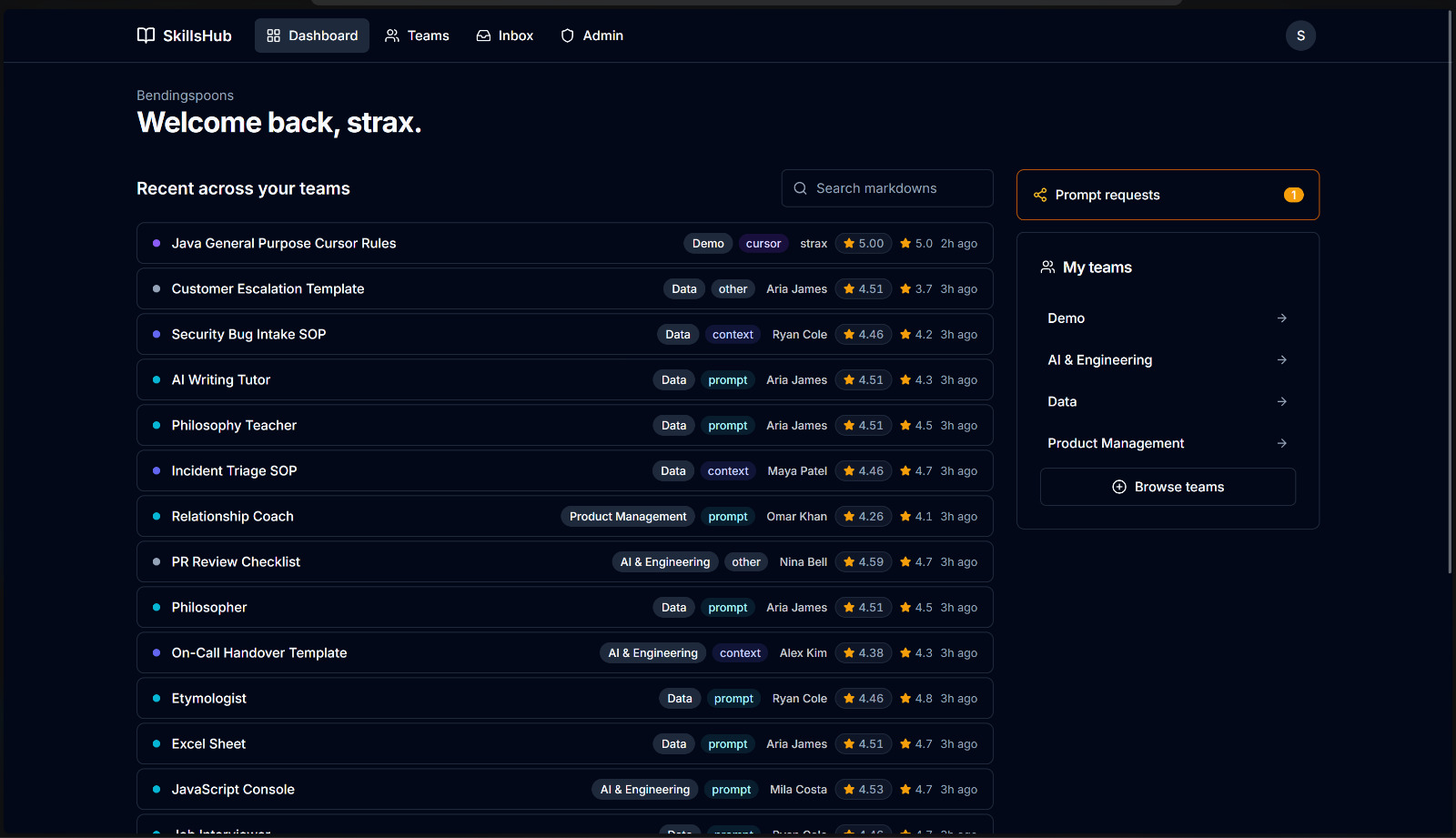
SkillsHub is a private, company-internal markdown platform for AI collaboration. It gives teams one secure place to manage and scale living assets like AGENTS.md, CLAUDE.md, Cursor rules, prompt libraries, and reusable skills.
Private-by-Default Workspace
- All knowledge stays internal to the organization.
- Teams can share safely without exposing sensitive workflows outside the company.
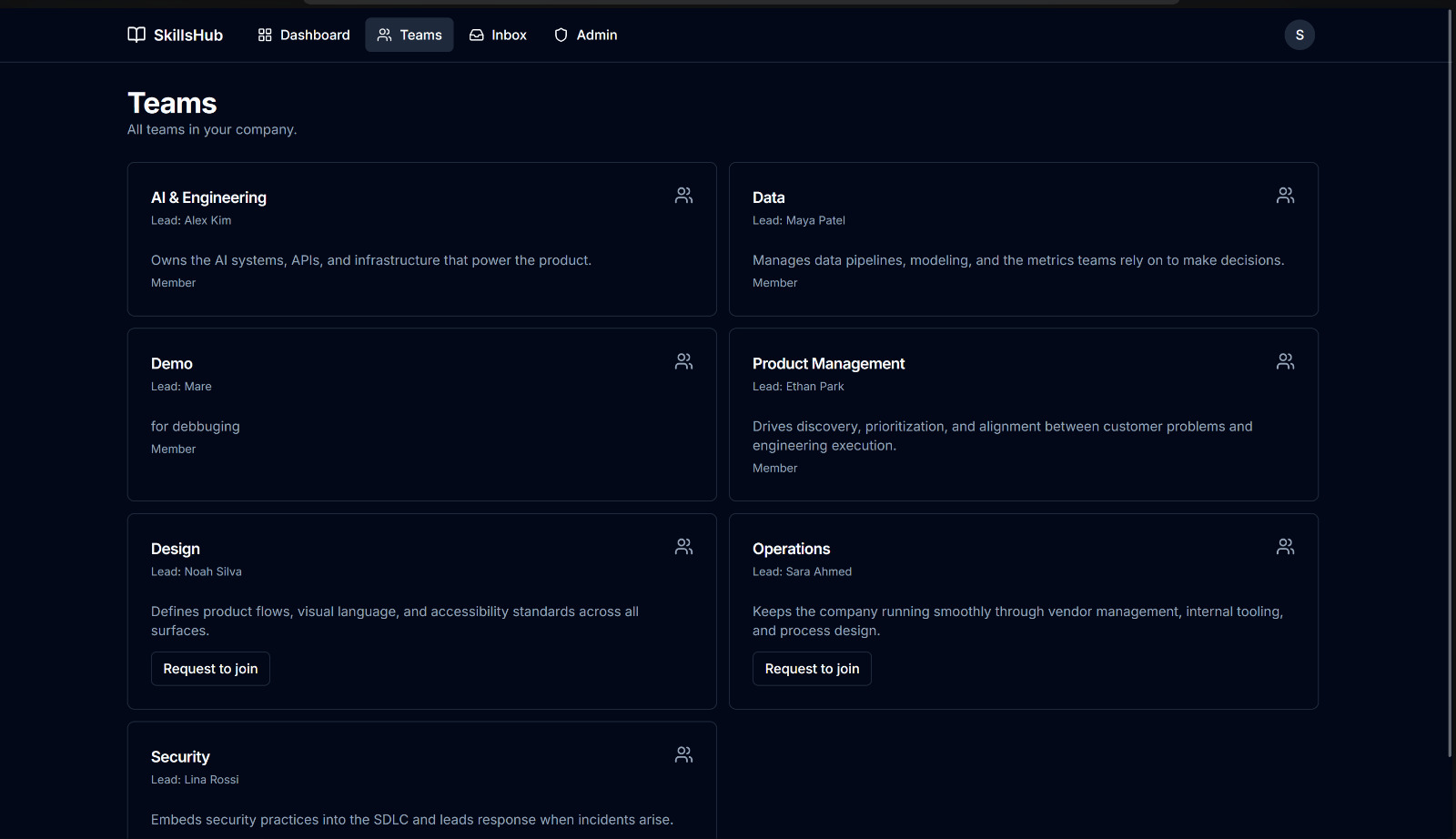
Team + Cross-Team Sharing
- Content can be shared within a team or across teams when needed.
- Breaks silos so proven practices spread quickly across departments.
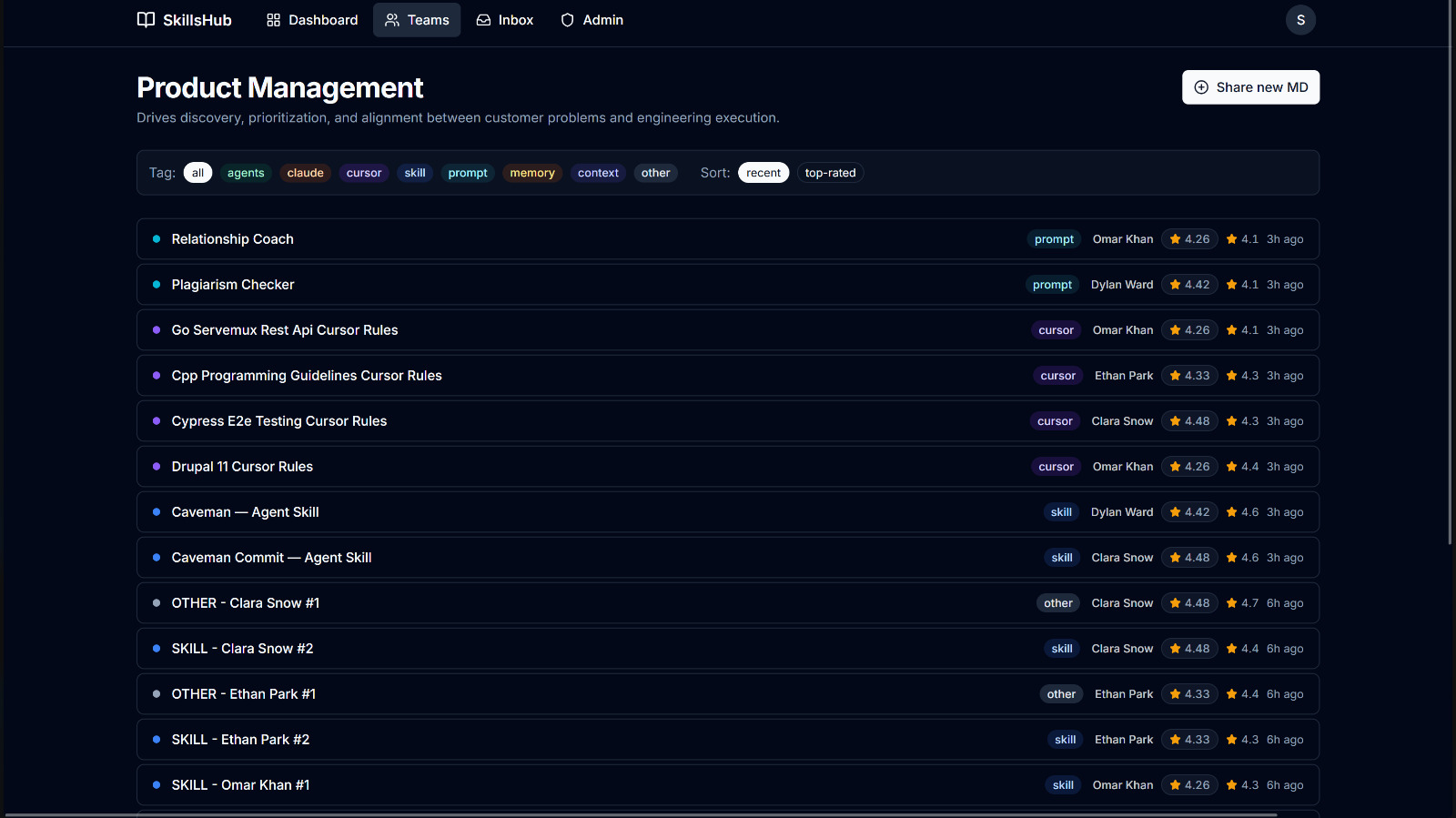
Structured Markdown Knowledge Hub
- Centralizes AI documentation instead of scattering it across chats, drives, and docs.
- Keeps operational knowledge searchable, reusable, and easy to maintain.
Reusable AI Assets
- Save and reuse prompts, rules, and skills as building blocks.
- Reduces repeated work and speeds up onboarding for new teammates.
Fast Iteration on Evolving Workflows
- AI playbooks are living documents; teams can continuously refine them.
- Encourages agile experimentation while keeping everyone aligned.
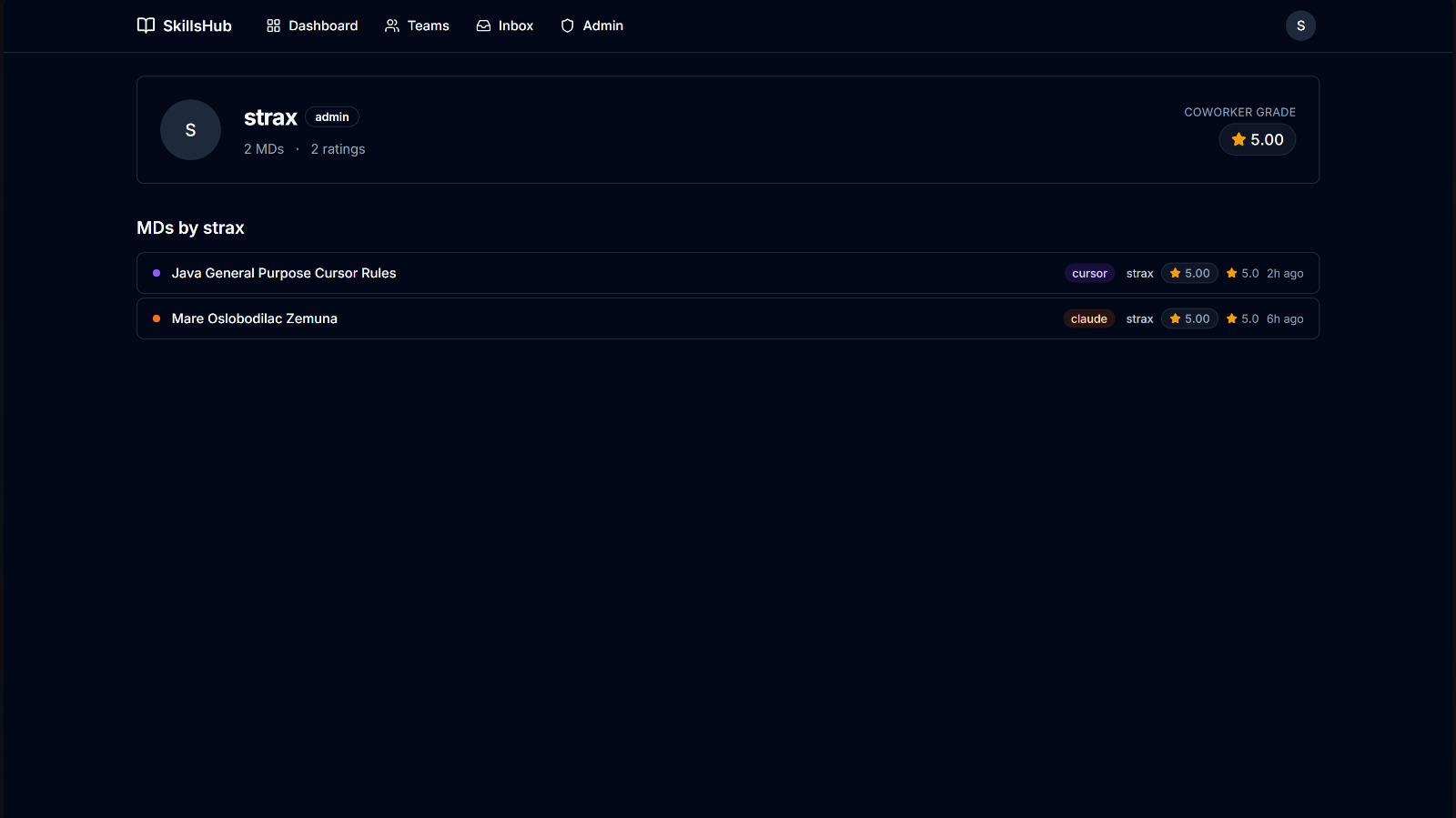
Quality and Trust Layer (Coworker Grade)
- Team members can rate contributions and provide feedback.
- Surfaces reliable contributors and helps teams identify high-impact knowledge.
Consistency at Scale
- Shared standards (
AGENTS.md,CLAUDE.md, rules) help teams work with consistent quality. - Improves delivery speed while reducing confusion between teams.
SkillsHub turns fragmented markdown files into a secure, agile execution system — so teams move faster, collaborate better across the company, and build trusted AI workflows that compound over time.
How we built it
Tech Stack
| Category | Technology |
|---|---|
| Frontend | Next.js 14 (App Router), React 18, TypeScript |
| Styling / UI | Tailwind CSS, shadcn/ui, Radix UI, lucide-react, next-themes |
| Utilities | class-variance-authority, clsx, tailwind-merge |
| Backend | Supabase (PostgreSQL, Supabase Auth, Row Level Security) |
| Validation | Zod |
| Deployment (Production) | Vercel |
Frontend Architecture
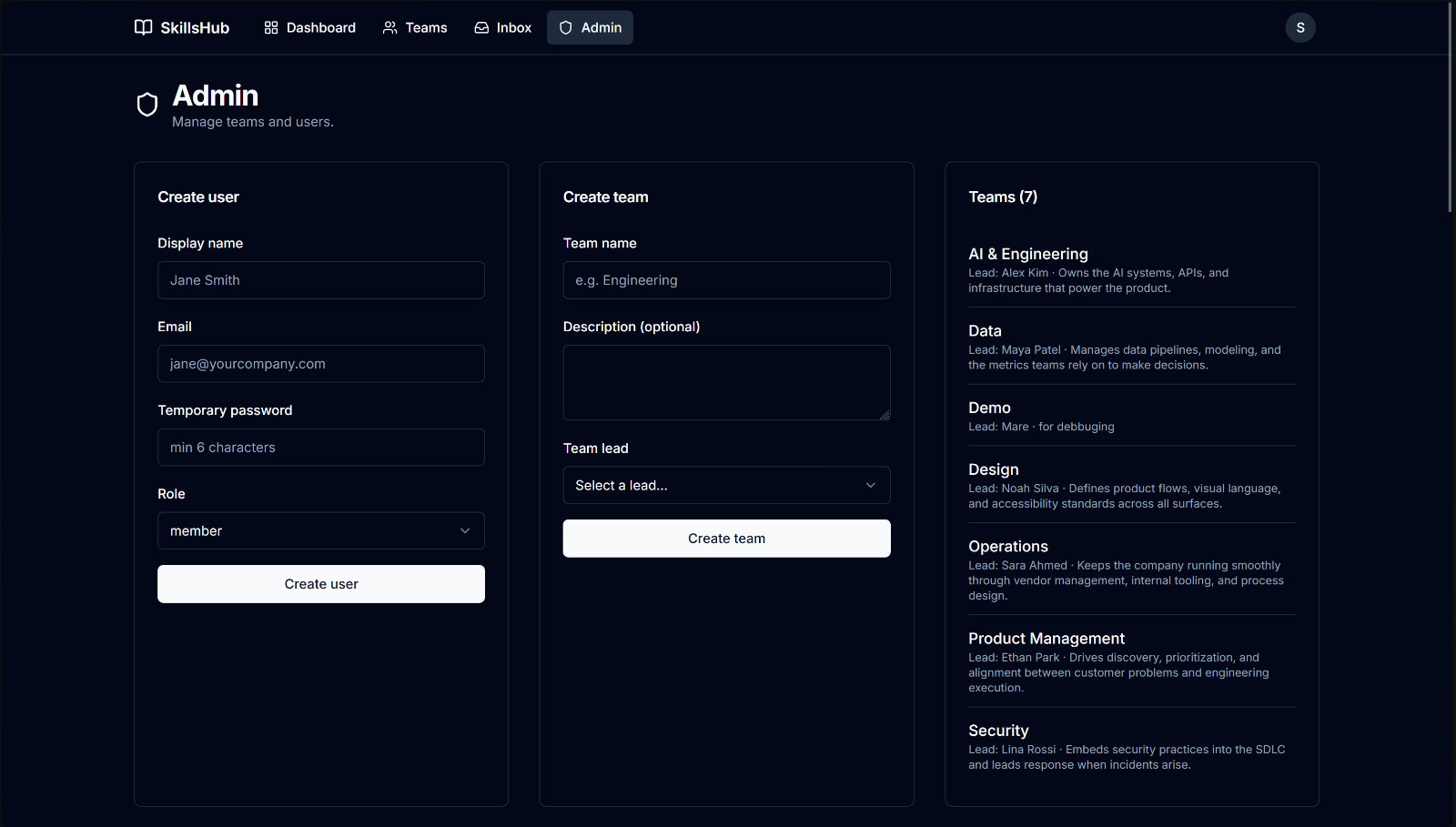
We used Next.js 14 (App Router) with React 18 and TypeScript to combine fast UI development with server-side performance. The app is structured around dashboard, team feeds, markdown viewer, composer, inbox, admin, and profile routes, using:
- Server Components for secure data fetching
- Client Components for rich interactivity (composer tabs, sharing dialogs, rating stars)
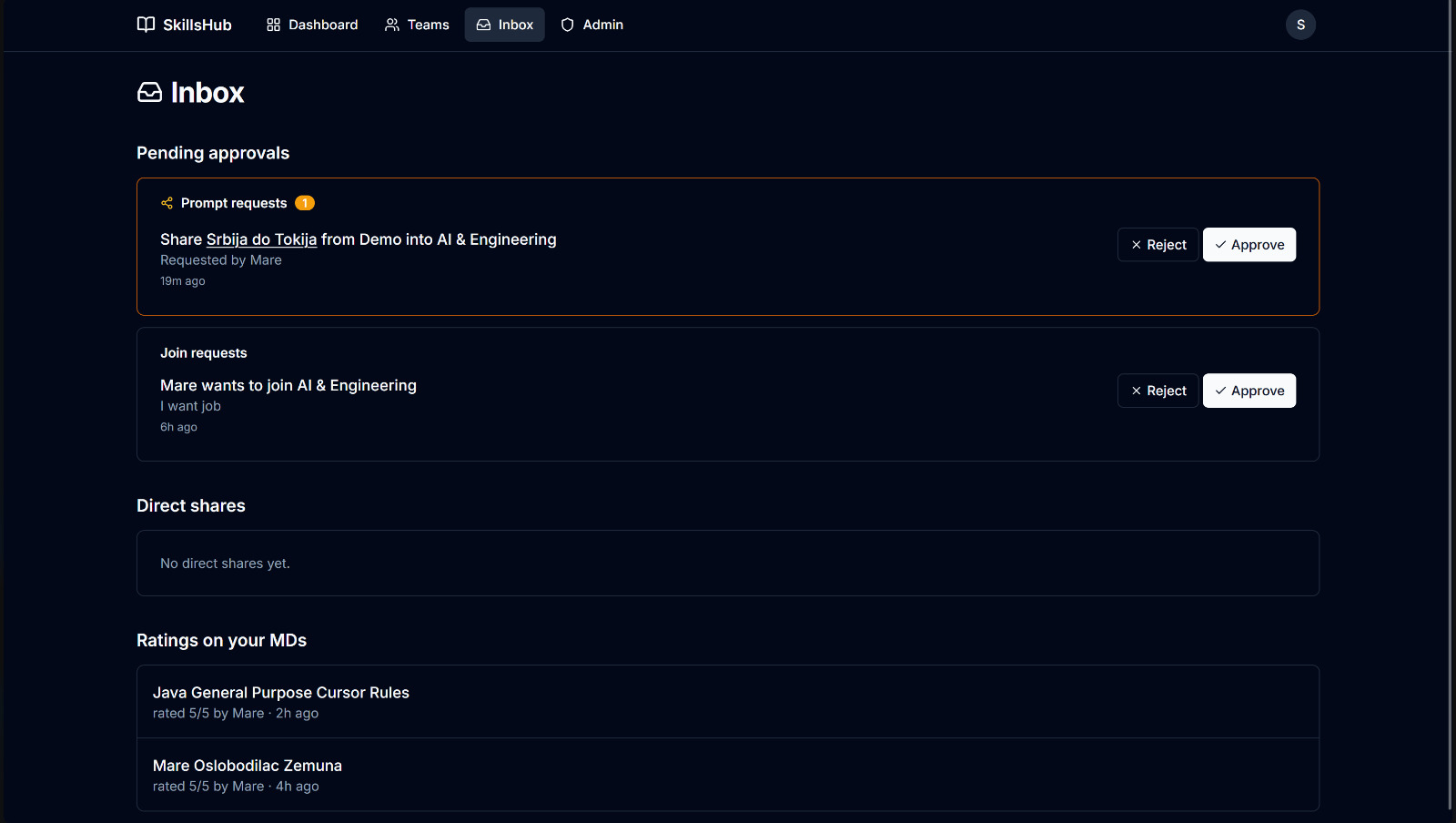
- Server Actions for mutations (create/update markdown, direct shares, cross-team requests, approvals, ratings)
For the UI, Tailwind CSS, shadcn/ui, Radix UI, lucide-react, and next-themes gave us a clean, GitHub-inspired interface while staying flexible for rapid hackathon iteration.
Backend and Data Layer
We built the backend on Supabase (PostgreSQL + Auth + RLS), using separate clients per context — createServerClient and createBrowserClient via @supabase/ssr, and a service-role admin client via @supabase/supabase-js for trusted server operations. Next.js middleware handles auth session refresh across requests.
Deployment (Production)
SkillsHub is fully deployed on Vercel. We used Vercel to host the Next.js application in production, with environment variables configured for Supabase integration, giving us a live, shareable deployment for real team usage and jury demo.
Security-First Multi-Team Sharing Model
- Each markdown file has one owning team
- Cross-team visibility is granted via approval flow (
cross_team_requests->md_team_visibility) - Direct one-to-one sharing is handled via
direct_shares - Company isolation is enforced through RLS helpers like
can_view_md(),is_team_member(), andis_team_lead()
Database Engineering
We designed a relational schema with core entities (companies, profiles, teams, team_members, markdown_files, md_feedback), Postgres enums for roles, tags, and approval statuses, SQL triggers and functions for automation (handle_new_user, update_updated_at), SQL views for analytics (md_rating_summary, user_grades), and GIN indexes on markdown tags.
All mutation payloads are validated with Zod before writes, and we use revalidatePath after writes to keep server-rendered content fresh and consistent.
Challenges we ran into
Our biggest challenge was time. We pivoted during the hackathon to build something more innovative and impactful, then had to redesign, implement, and fully deploy the product in about 12 hours.
That meant integrating a heavy stack fast: Next.js 14, React 18, TypeScript, Tailwind, shadcn/ui, Radix UI, Supabase Auth, PostgreSQL, RLS, Zod, markdown rendering/sanitization, and Vercel.
The hardest parts were balancing speed with security, handling complex private sharing flows (within-team, cross-team approvals, direct shares), and still delivering a polished, live, end-to-end platform under extreme deadline pressure.
Accomplishments that we're proud of
In a sea of AI slop, we built something we genuinely believe has real enterprise value — not a gimmick, not a throwaway demo. SkillsHub solves a concrete, growing problem for modern companies: private, agile AI knowledge sharing within and across teams.
We are especially proud that we didn't stop at localhost. We fully deployed the app during the hackathon, and it is usable right now as a production-ready platform. Teams and users can sign in, share markdown workflows, collaborate securely, and use the system end-to-end today.
What we learned
We learned that time management is everything in a hackathon. Moving fast matters, but moving in the right direction matters more.
We also learned to be patient enough to challenge our first idea instead of shipping the first thing that comes to mind. Pivoting was hard, but it helped us build something more meaningful and impactful.
Most importantly, we learned that strong products come from balancing speed, focus, and conviction — build less, but build what truly matters.
What's next for SkillsHub
Next, we want to turn SkillsHub into a true workflow engine — not just a knowledge hub.
- Console/Git integration: connect SkillsHub with terminal workflows so teams can run actions like
git pull,git push, and prompt-driven pull request flows directly from shared playbooks. - Prompt-to-PR workflows: let users generate branches, commits, and PR requests from structured prompts, with team-level review and approval built in.
- Smart file placement: when users download or apply shared assets, SkillsHub should place each file in the correct project folder automatically based on repository structure and rules.
- Deeper automation: move from "share knowledge" to "execute knowledge" by turning markdown standards into repeatable, low-friction actions.
The vision is simple: SkillsHub becomes the private operating layer where teams both document and execute AI workflows at speed.
Built With
- css
- github
- javascript
- lucide-react
- next-themes-backend/data-platform:-supabase-cloud-services:-supabase-(auth-+-postgres)
- next.js
- postgresql
- python
- radix
- radix-ui
- react-18-styling/ui:-tailwind-css
- shadcn/ui
- sql
- sql-frontend-framework:-next.js-14-(app-router)
- supabase
- tailwind
- typescript
- ui
- vercel
- zod

Log in or sign up for Devpost to join the conversation.