Inspiration AI CLIs are powerful, but agents still waste time and tokens: wrong skills loaded, huge git/test/rg dumps, and “skill packs” that are hard to trust or reuse across Claude Code, Cursor, Codex, and OpenCode. We wanted a plugin Work OS that makes agents better, faster, and more productive—not another dump of markdown files.
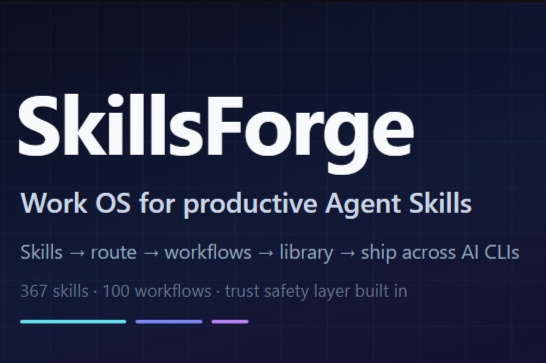
What it does SkillsForge helps AI agents work smarter with less context:
Route the right skill/workflow (route, lib recommend, auto, digest) Shrink shell noise (sf slim) and find code structure without grep+multi-read (sf map) Operate across hosts with one CLI (sf / skillsforge) plus slash commands & MCP tools Ship safely with validate → package → hooks → receipts (trust as the safety layer) How we built it Node.js (≥20) ESM monorepo: catalog + packs/profiles, skill sidecars, operator CLI (wb / map / slim / tokens / digest / next), local library UI, 100 dry-run workflows, multi-host install, and a thin MCP server. Host guidance lives in AGENTS.md, using-skillsforge, slash commands, and specialist agents so Claude/Cursor/Codex/OpenCode actually prefer compact operators.
Challenges we ran into Keeping claims honest (no fake “100×”), making catalog/token ops fast enough for agents, multi-host fidelity without pretending every host is equal, and teaching AI CLIs to use map/slim instead of raw shell dumps—without global hooks that rewrite every Bash call.
Accomplishments that we're proud of A real Work OS surface (skills, packs, workflows, library, operators), ForgeMap + ForgeSlim for token-lean sessions, cross-host install with trust receipts, and judge-friendly demo path: unsafe deny → safe package → scoreboard.
What we learned Productivity for agents is mostly routing + context discipline. Trust without a Work OS is incomplete; a catalog without compact operators still burns tokens. AI hosts need the preference written into AGENTS/skills/MCP—not just a README.
What's next for SkillsForge Deeper host defaults (opt-in slim/map in more session paths), richer ForgeMap (better call graphs / optional enrich), measured token savings dashboards, and Phase B ideas only when proven: LSP-class lookup, stronger eval gates—still no unverifiable multiplier claims.
Built With
- claude
- codex
- debate
- goal
- loops
- plan
- skills
- think

Log in or sign up for Devpost to join the conversation.