-
-
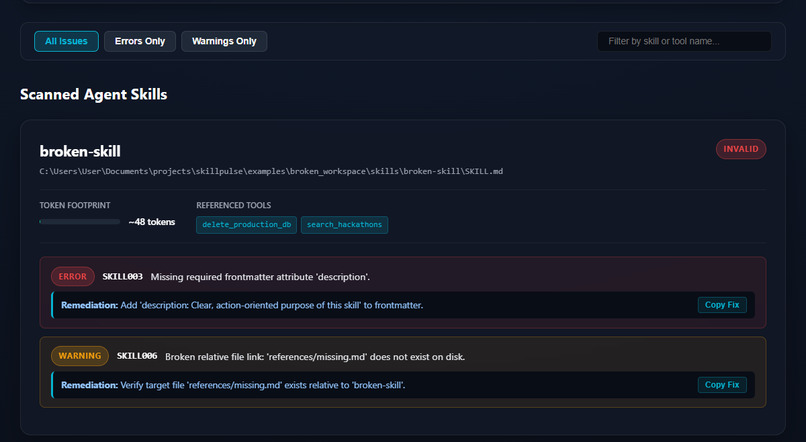
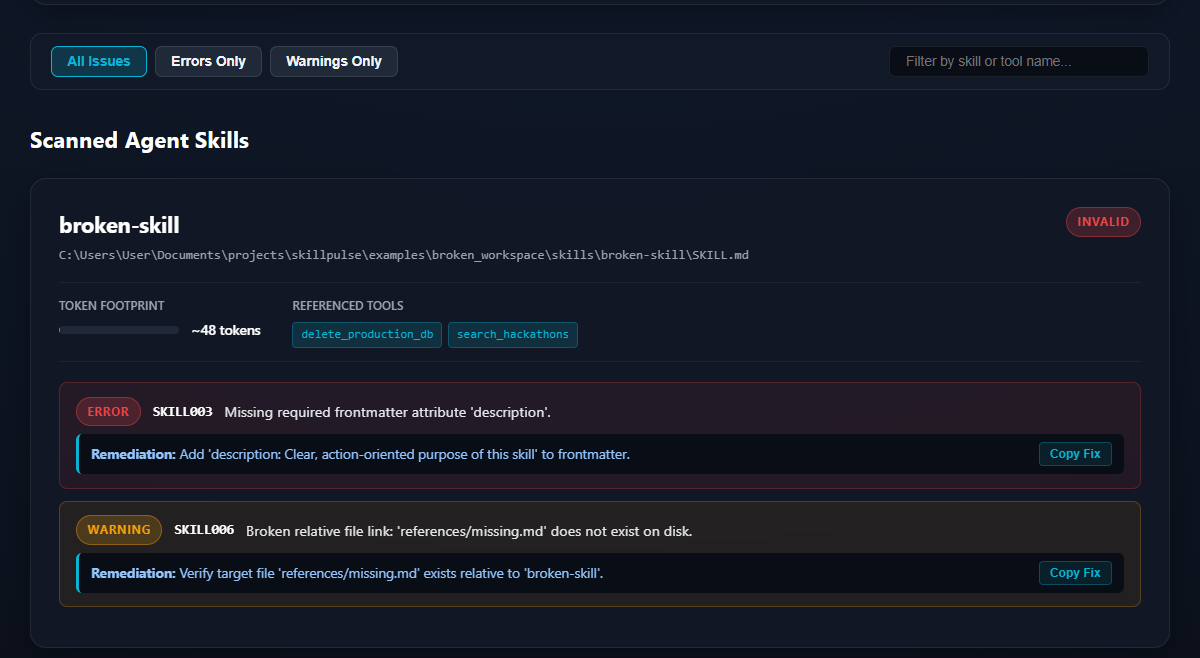
Explore interactive diagnostics and available copy actions for fixes and pull-request summaries
-
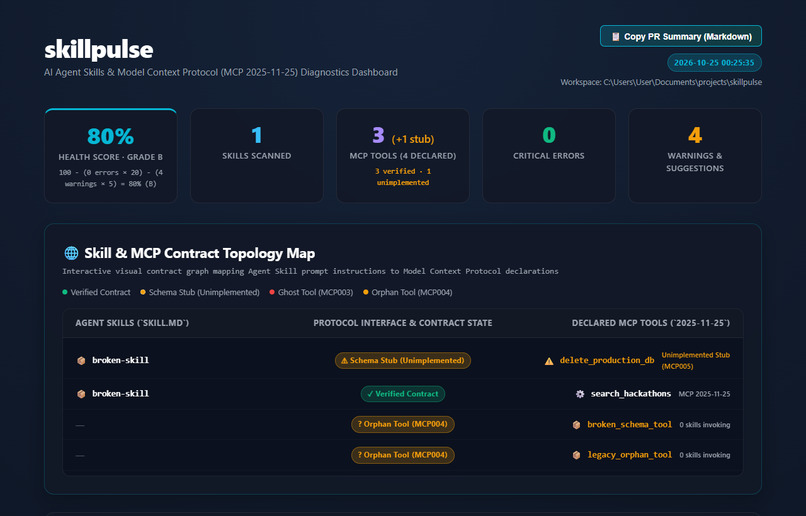
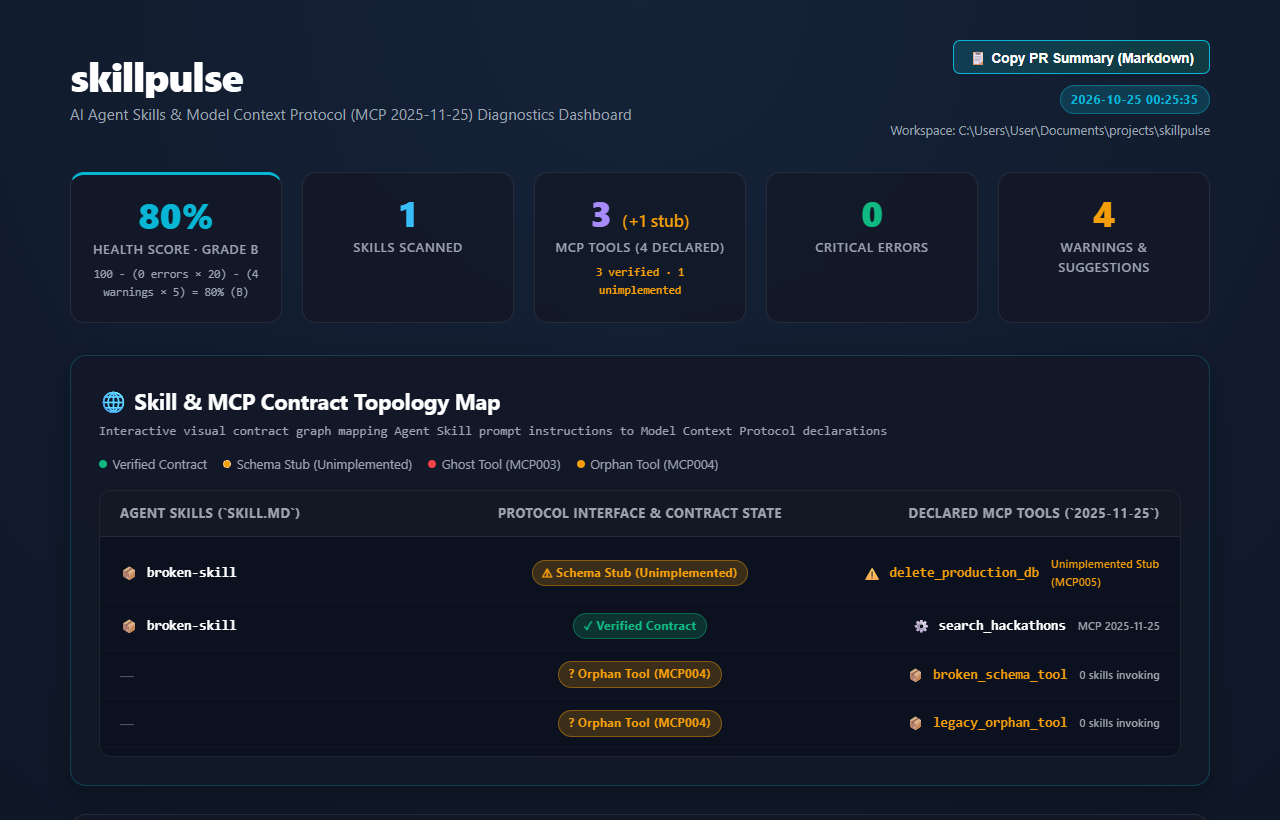
After remediation, SkillPulse rescans the workspace and reports the remaining issues, including an MCP005 stub warning.
-
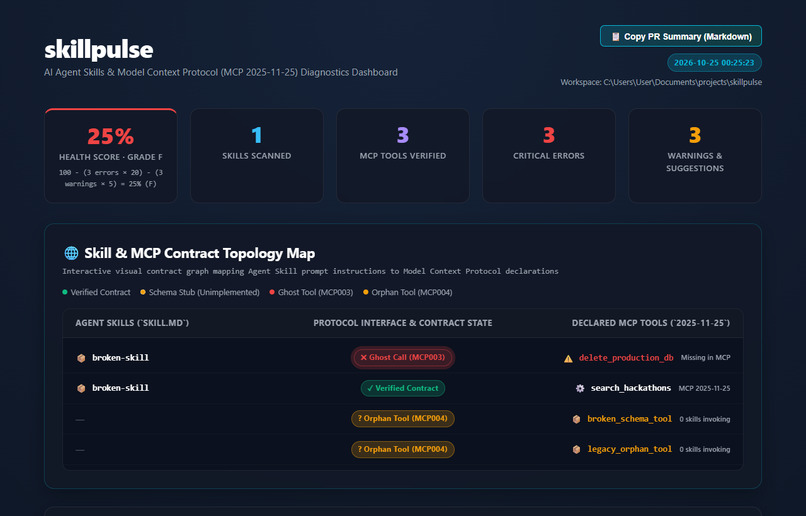
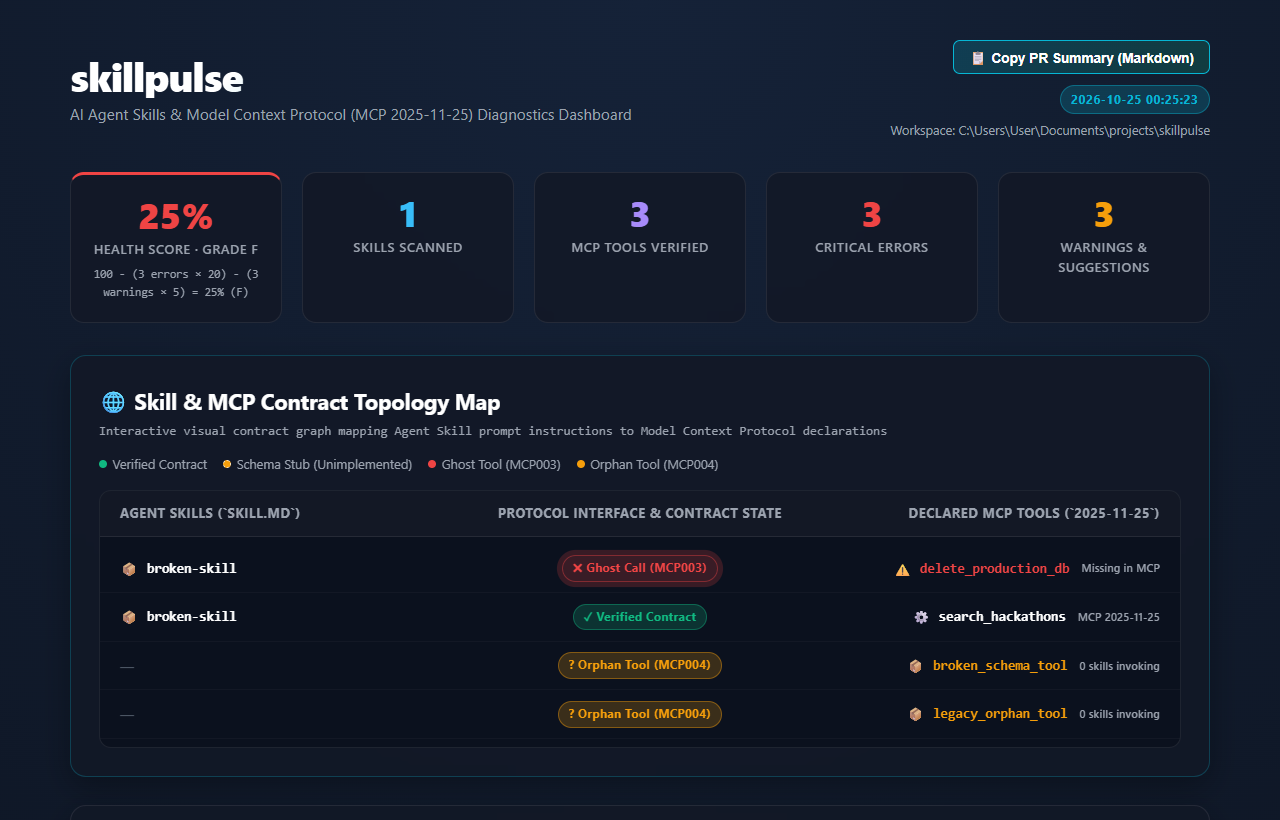
SkillPulse identifies ghost MCP tools and contract issues, highlighting problems that could cause agent failures before deployment.
-
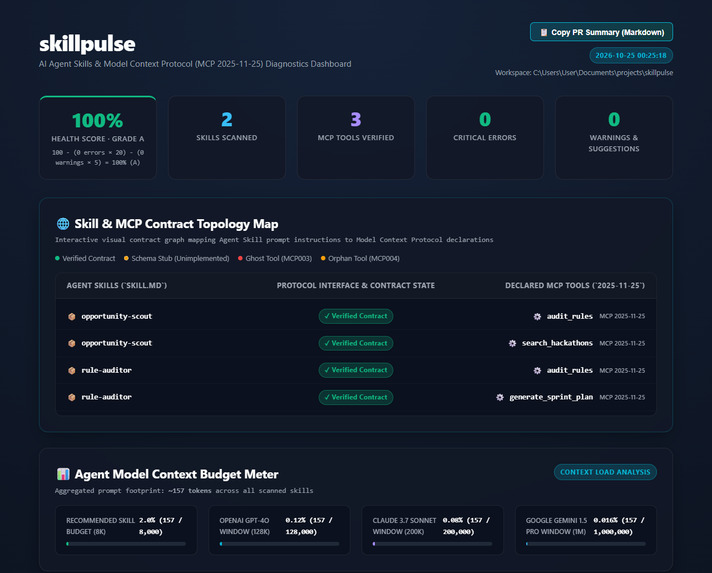
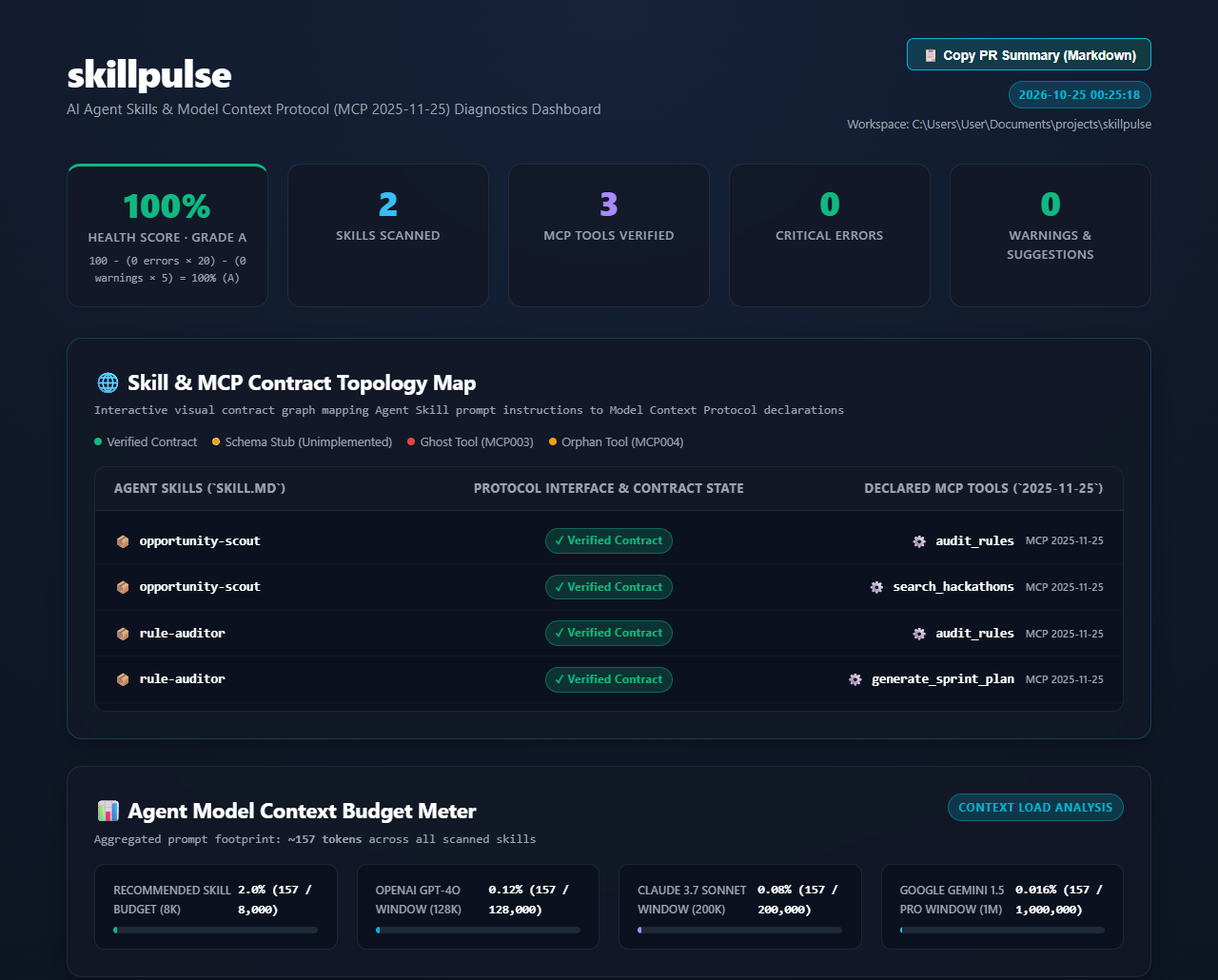
A healthy workspace earns Grade A, with verified tool connections, clear diagnostics, and a context-budget overview.
-
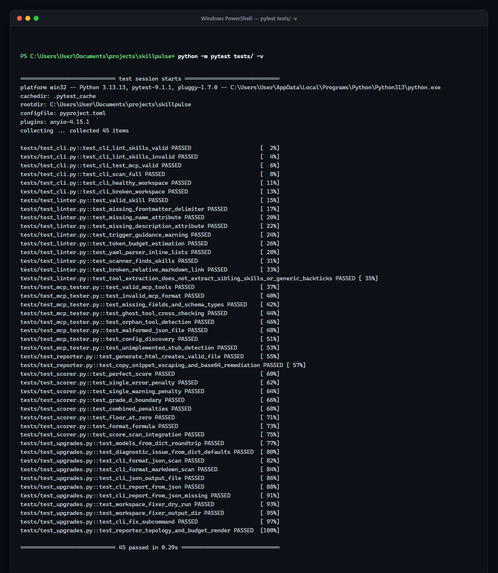
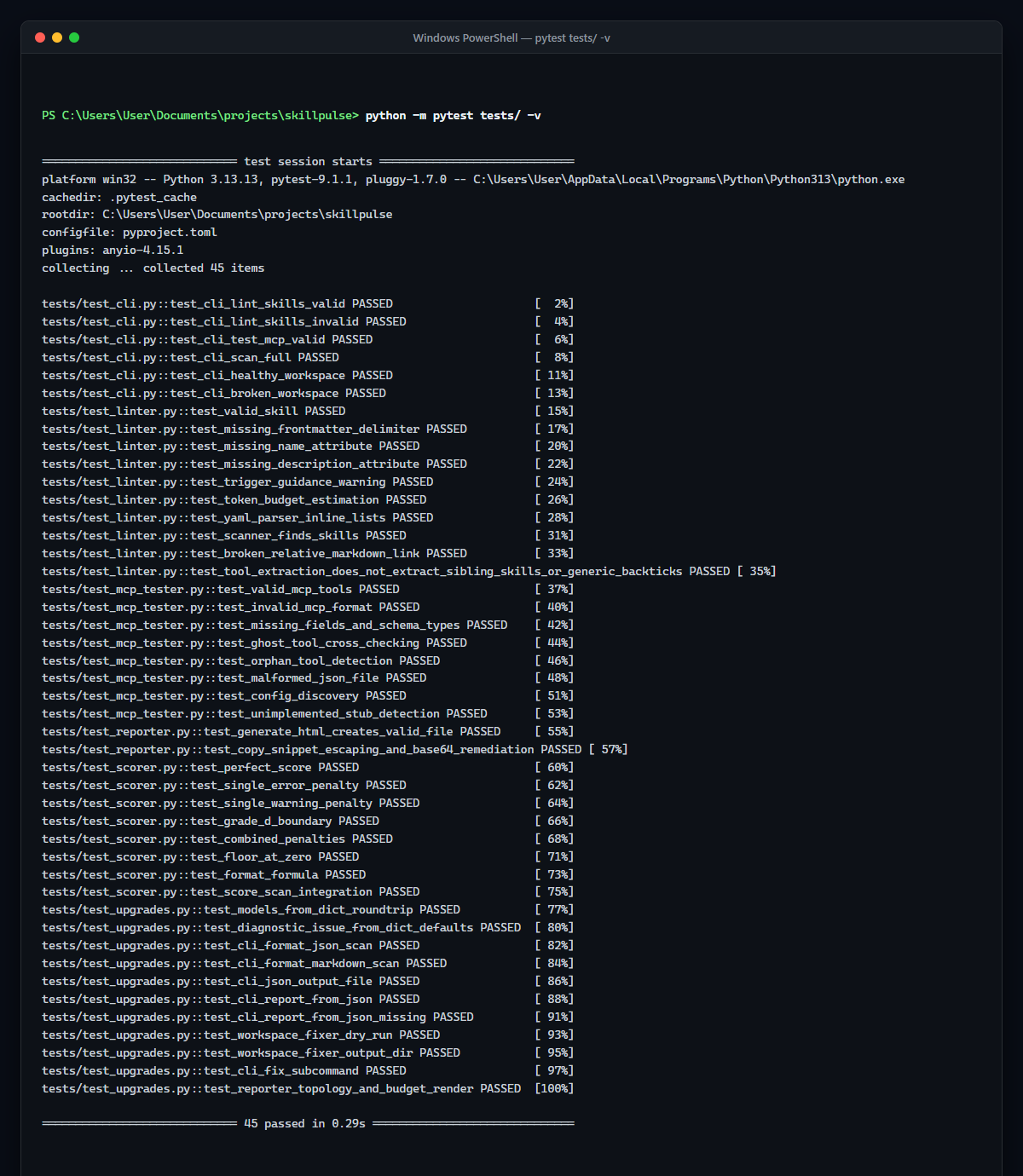
The test suite checks SkillPulse's analysis and remediation behavior to help ensure reliable, repeatable results.
-

Run SkillPulse from the command line to scan agent skills and MCP contracts without making LLM API calls.

Inspiration
What it does
How we built it
Challenges we ran into
Accomplishments that we're proud of
Inspiration
While installing and running the Devpost Learn Skill Pack (challengepost/learn-ai-basics) for this very hackathon, we became fascinated by how modular SKILL.md files and Model Context Protocol (MCP 2025-11-25) tool servers work together to guide coding agents. However, we also noticed a silent reliability pain point across the agentic ecosystem: broken cross-boundary contracts.
When a developer writes a SKILL.md prompt instructing an agent to invoke a tool (e.g., delete_production_db), but that tool is missing or renamed in mcp_tools.json—a Ghost Tool—the agent silently hallucinates or crashes at runtime. Similarly, unreferenced Orphan Tools and bloated markdown files quietly burn thousands of tokens of context window budget on every prompt turn. We wanted to build eslint + pytest for the AI agent stack.
What it does
SkillPulse is a unified, zero-dependency static analyzer, MCP contract validator, deterministic auto-fixer, and visual HTML diagnostics dashboard that audits AI agent workspaces in under 200 milliseconds:
Agent Skill Static Linter (
SKILL001–SKILL006): Validates YAML frontmatter delimiter integrity, naming regex rules, mandatorydescriptionattributes, prompt trigger cues, broken relative markdown links on disk, and BPE token footprint estimates ((\approx 1.3\text{ tokens/word})).MCP 2025-11-25 Contract Validator (
MCP001–MCP005): Validates JSON Schema definitions (inputSchema,properties,required) and cross-references every tool call inSKILL.mdagainstmcp_tools.jsonto detect:- Ghost Tools (
MCP003, (-20\text{ pts})): Tools referenced in skill prompts but missing from MCP manifests. - Orphan Tools (
MCP004, (-5\text{ pts})): Tools declared in MCP manifests but never used by any skill. - Unimplemented Schema Stubs (
MCP005, (-5\text{ pts})): Auto-generated placeholder schemas that satisfy contract topology but still require backend implementation.
- Ghost Tools (
Deterministic Ecosystem Health Score (0–100, Grade A–F):
[ \text{Score} = \max(0, 100 - (20 \times \text{Errors}) - (5 \times \text{Warnings})) ]
Deterministic Contract Auto-Fixer (
skillpulse fix): Automatically repairs missing frontmatter descriptions, injects compliant MCP2025-11-25object schema skeletons, and stubs missing Ghost Tools—honestly classifying generated placeholders asMCP005: STUB / UNIMPLEMENTED((-5\text{ pts})) so a broken workspace jumps from 25% (Grade F) to 80% (Grade B) without faking backend verification.Self-Contained Obsidian HTML Dashboard & CI Exports: Generates a zero-dependency offline dark-mode report (
skillpulse-report.html) featuring an interactive Skill ↔ MCP Contract Topology Map, a Model Context Window Budget Meter (8k Skill Budget vs. GPT-4o 128k / Claude 200k / Gemini 1M), client-side severity filtering, 1-click Copy Fix buttons, and--format json/--format markdownexports for CI/CD pull requests.
How we built it
We started in an empty directory and installed the Devpost Learn Skill Pack (npx skills add challengepost/learn-ai-basics --all -y). Running 1-start initiated a flipped interaction where our coding agent interviewed us before writing a single line of application code:
Scope & Architecture (
scope.md,prd.md,spec.md): The skill interview helped us cut sprawling ideas (like spinning up live headless LLM servers) and lock in a razor-sharp, deterministic proof of concept built strictly with the Python 3.10+ standard library (pathlib,json,re,argparse,dataclasses,html,shutil).Modular Implementation: Guided by
spec.md, we built strongly typed dataclasses with full JSON serialization/rehydration (models.py), a custom zero-dependency YAML parser and skill scanner (linter.py), the MCP 2025-11-25 schema and cross-reference engine (mcp_tester.py), the weighted health scorer (scorer.py), the atomic auto-fixer (fixer.py), the single-file HTML dashboard generator (reporter.py), and the unified CLI (cli.py).Verification: We built reference
healthy_workspace(100% Grade A) andbroken_workspace(25% Grade F) fixtures alongside 45 automatedpytestunit and integration tests that execute in0.35s.
Challenges we ran into
Zero-Dependency YAML & Schema Parsing: To ensure SkillPulse runs instantly in any local or CI environment without
pipdependency conflicts or C-compilers, we engineeredSimpleYAMLParserand our MCP JSON Schema validator from scratch using only Python standard library modules.Scoped Tool Extraction Without False Positives: Extracting tool names from markdown risked flagging regular inline code blocks or sibling skill names as Ghost Tools. We scoped extraction specifically to
tools:/mcp_tools:frontmatter lists and# MCP Toolssections, adding regression tests to guarantee zero false positives.Honest Auto-Fix Classification (
MCP005): Whenskillpulse fixgenerated a valid MCP schema stub for a missing Ghost Tool (delete_production_db), our dashboard initially labeled the link as a✓ Verified Contract. During our acceptance review, we realized this could mislead developers into thinking backend code existed. We introduced RuleMCP005("x_skillpulse_stub": true), which downgrades the fatal (-20\text{ pt}) Ghost Tool error into an explicit (-5\text{ pt})⚠ Schema Stub (Unimplemented)warning.Offline
file://Clipboard Security: Inline JavaScript string interpolation inonclickhandlers broke when remediation snippets contained nested JSON quotes, and browsers restrictnavigator.clipboardon localfile://URLs. We refactored the dashboard to use safe DOM payload lookups and a zero-dependency clipboard fallback with toast notifications.
Accomplishments that we're proud of
- Sub-200ms Execution & 45 Passing Tests: The entire 45-test suite runs in
0.35swith zero external runtime dependencies. - Visual Contract Topology Map: Seeing Ghost Calls light up in pulsing red, Orphan Tools in amber, Schema Stubs in warning badges, and Verified Contracts in emerald green makes debugging agent workspaces intuitive.
- 100% Spec Fulfillment: Every single requirement in
scope.md,prd.md, andspec.md—plus JSON result rehydration (--from-json) and CI Markdown PR summaries—is fully implemented and tested.
What we learned
Letting the AI interview us first via the Devpost Learn Skill Pack completely changed how we build with coding agents. Instead of prompting the agent piecemeal and watching it forget context ten prompts later, having scope.md, prd.md, and spec.md anchored in the repository gave the coding agent persistent architectural memory across every implementation and testing step.
What's next for SkillPulse
- GitHub Action & GitLab CI Templates: Packaging
skillpulse scan --format markdownas a 1-line CI step that automatically posts Contract Topology summaries on Merge Requests. - IDE Diagnostics Extension: Surfacing
SKILL001–006andMCP001–005squiggly-line diagnostics live inside VS Code and Cursor as developers editSKILL.mdfiles. ## What we learned

Log in or sign up for Devpost to join the conversation.