-
-
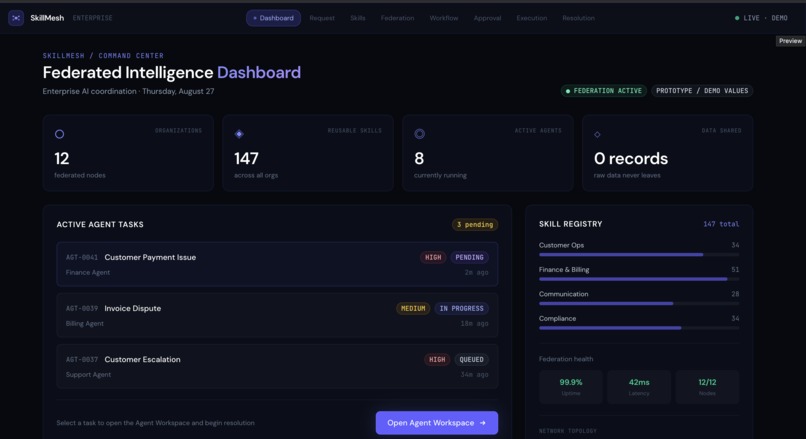
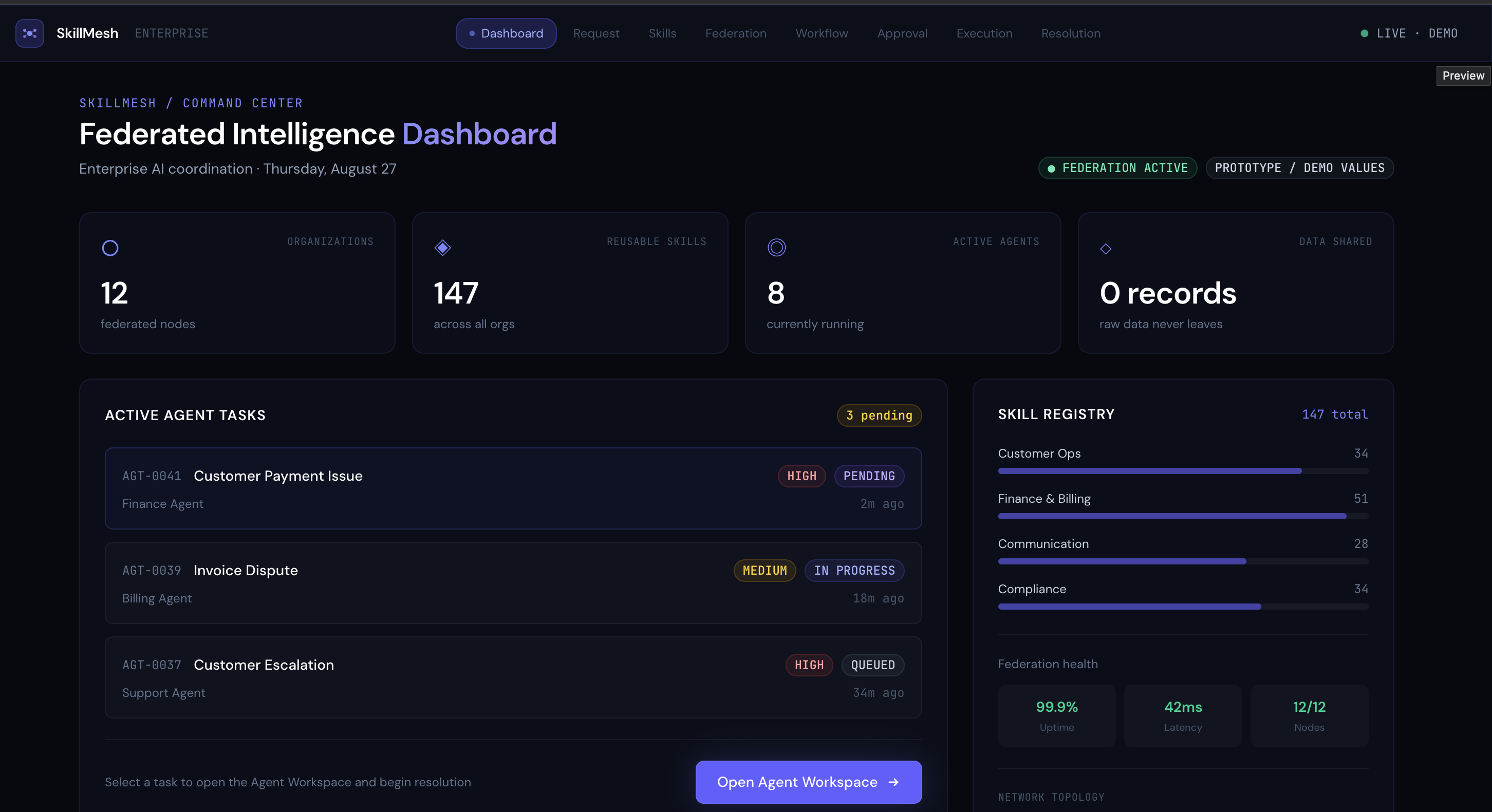
Dashboard
-
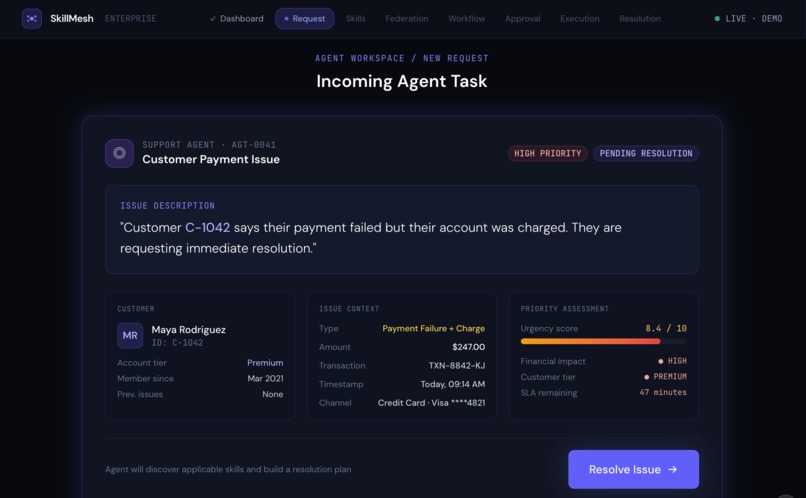
Skill Marketplace / Skill Registry
-
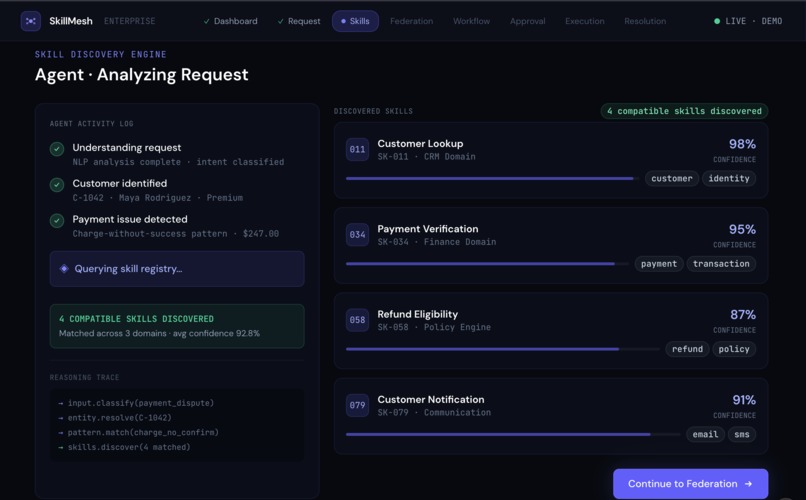
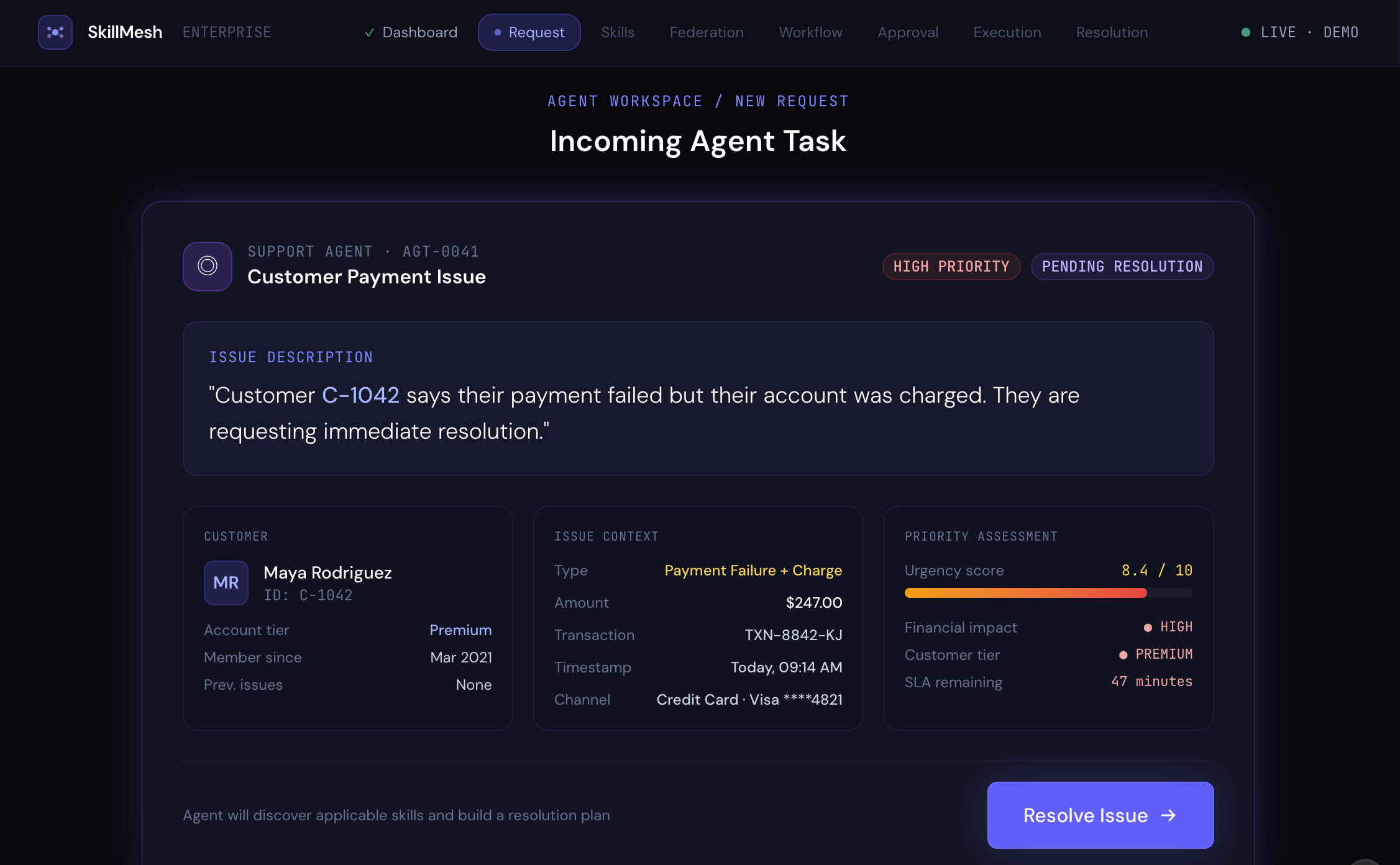
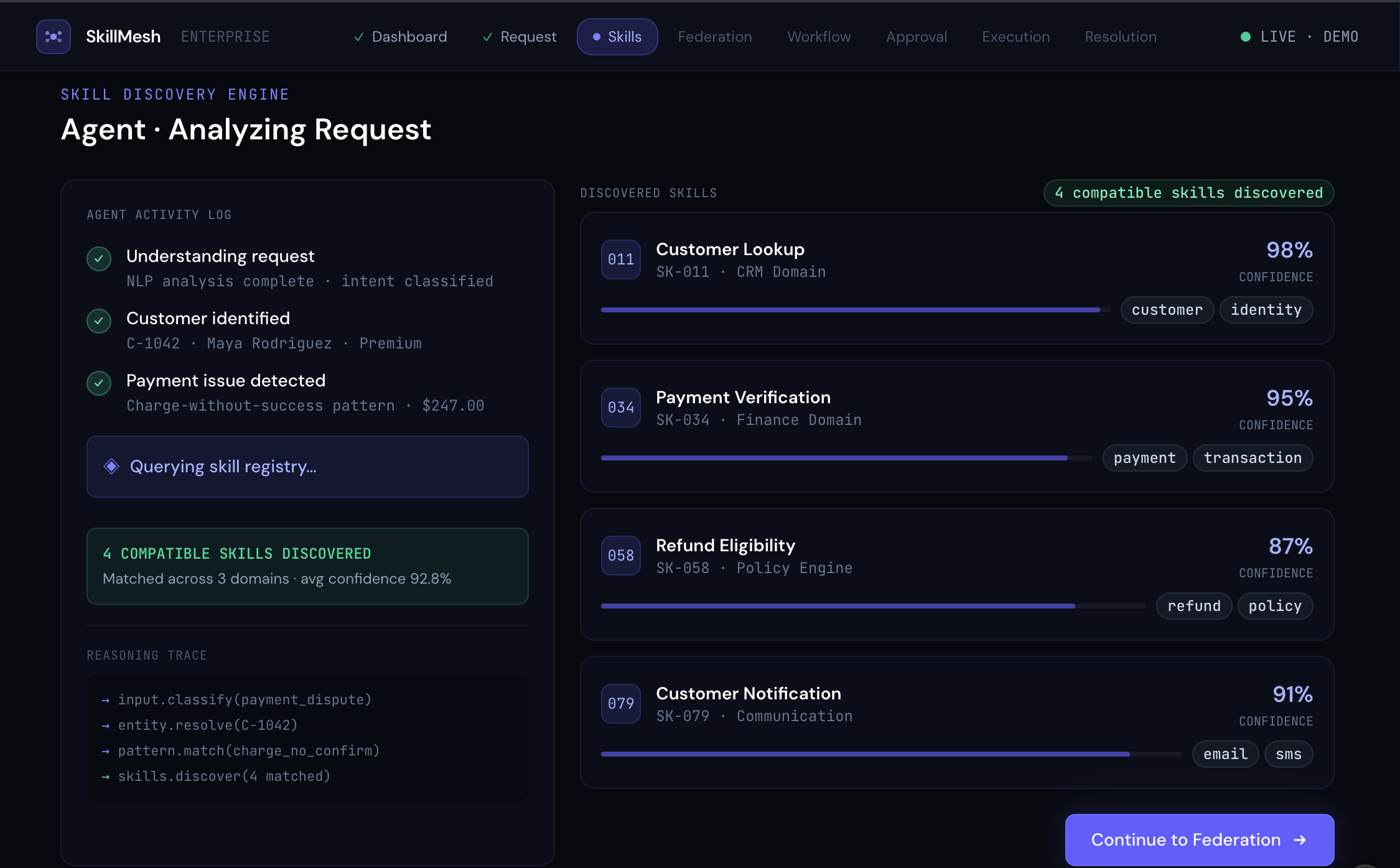
Skill Discovery
-
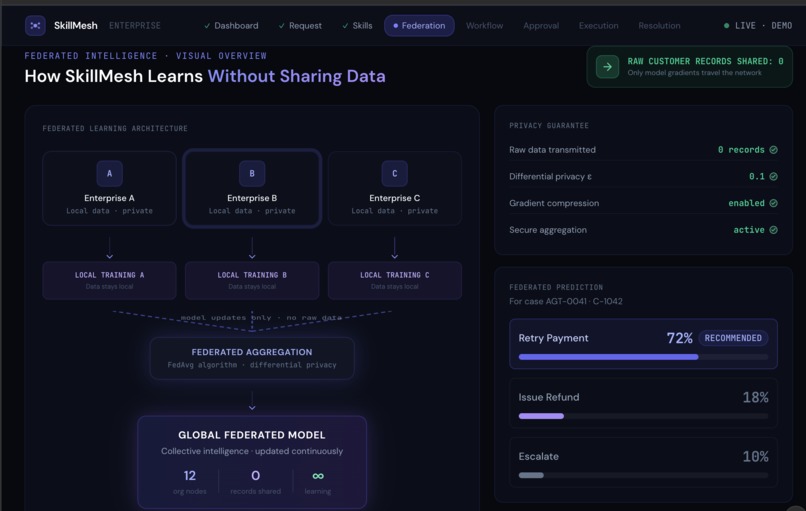
Organization Network
-
Agent Management
-
Skill Details
-
Security & Permissions
-
Analytics
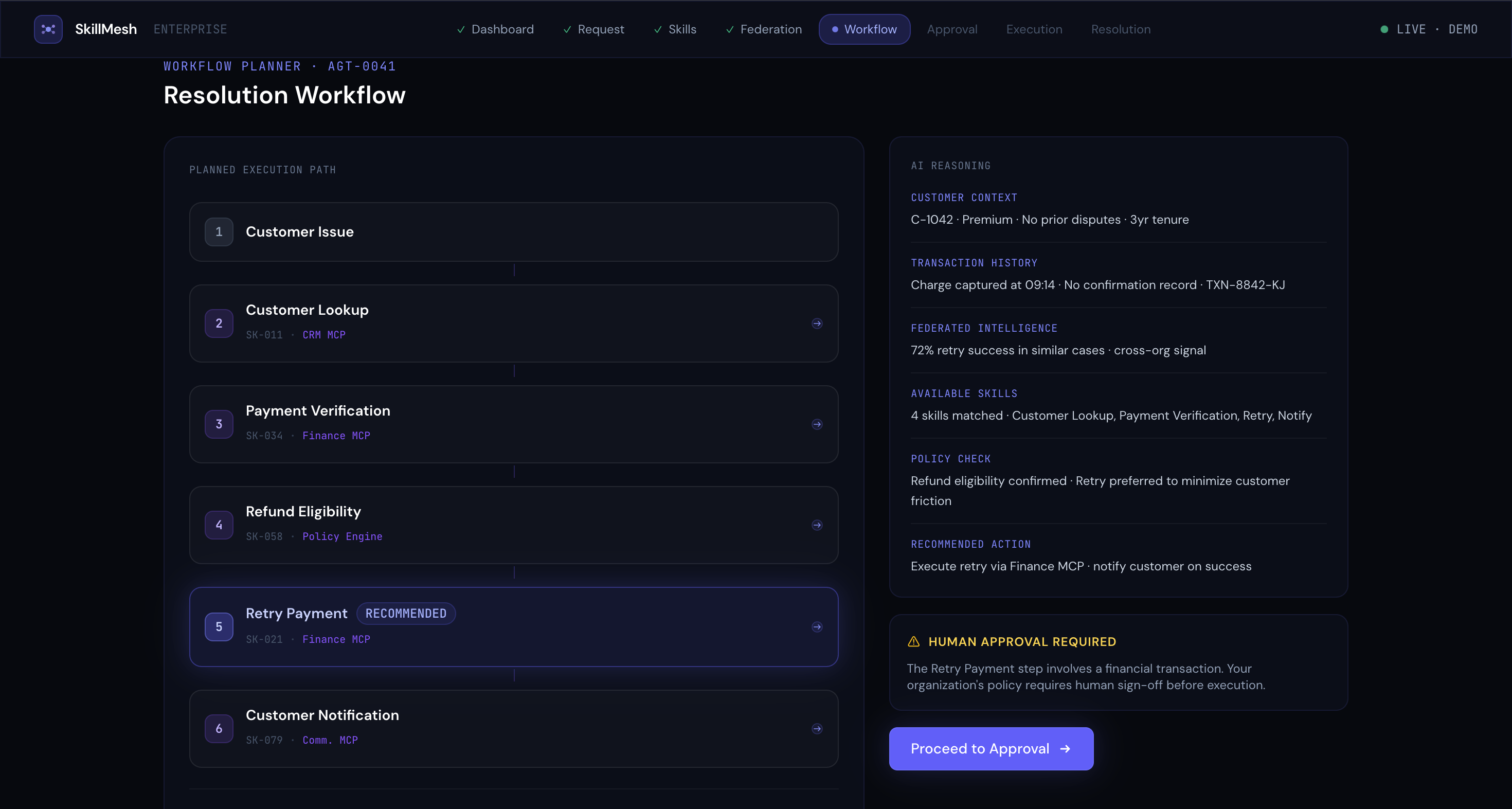
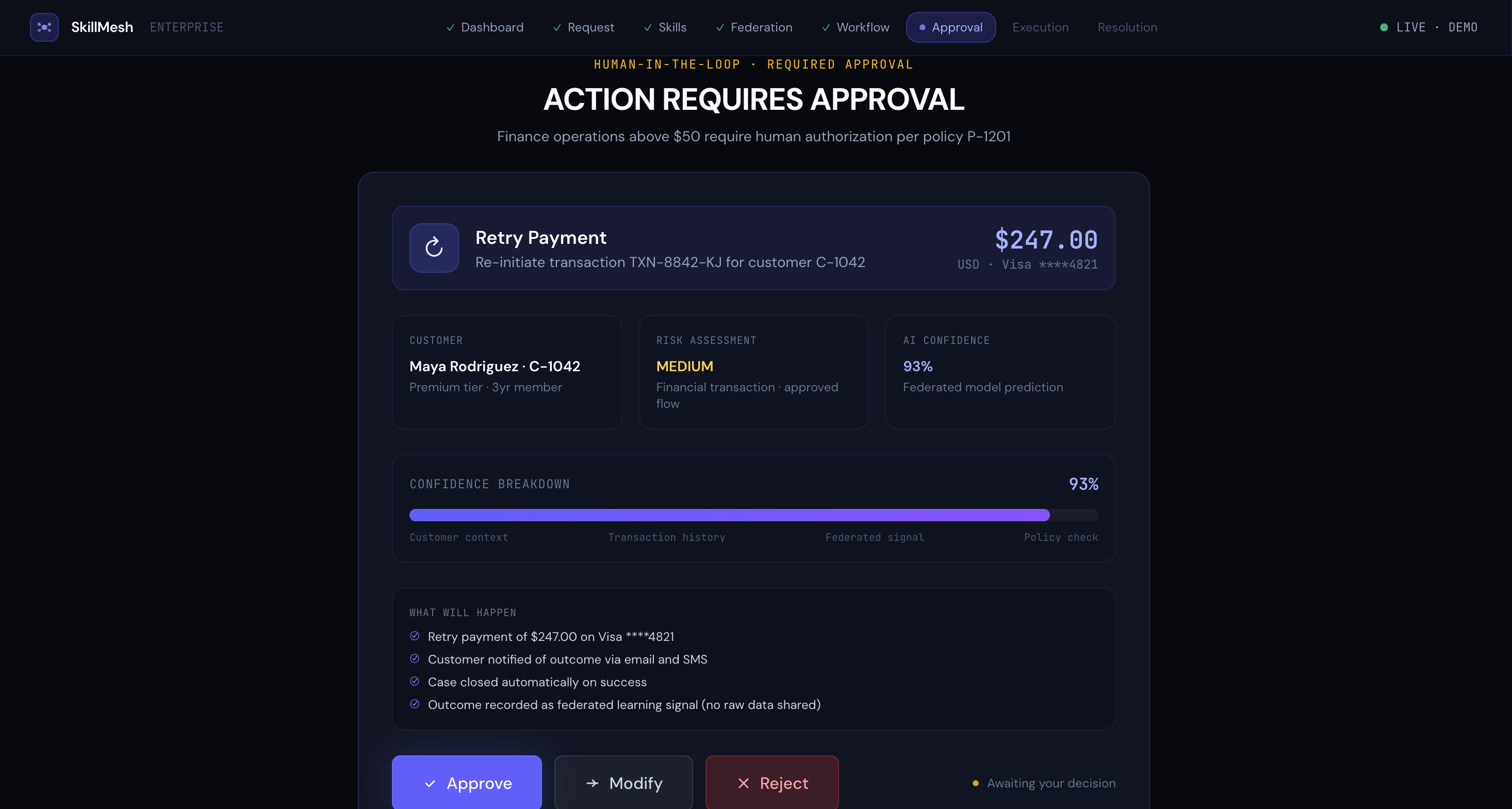
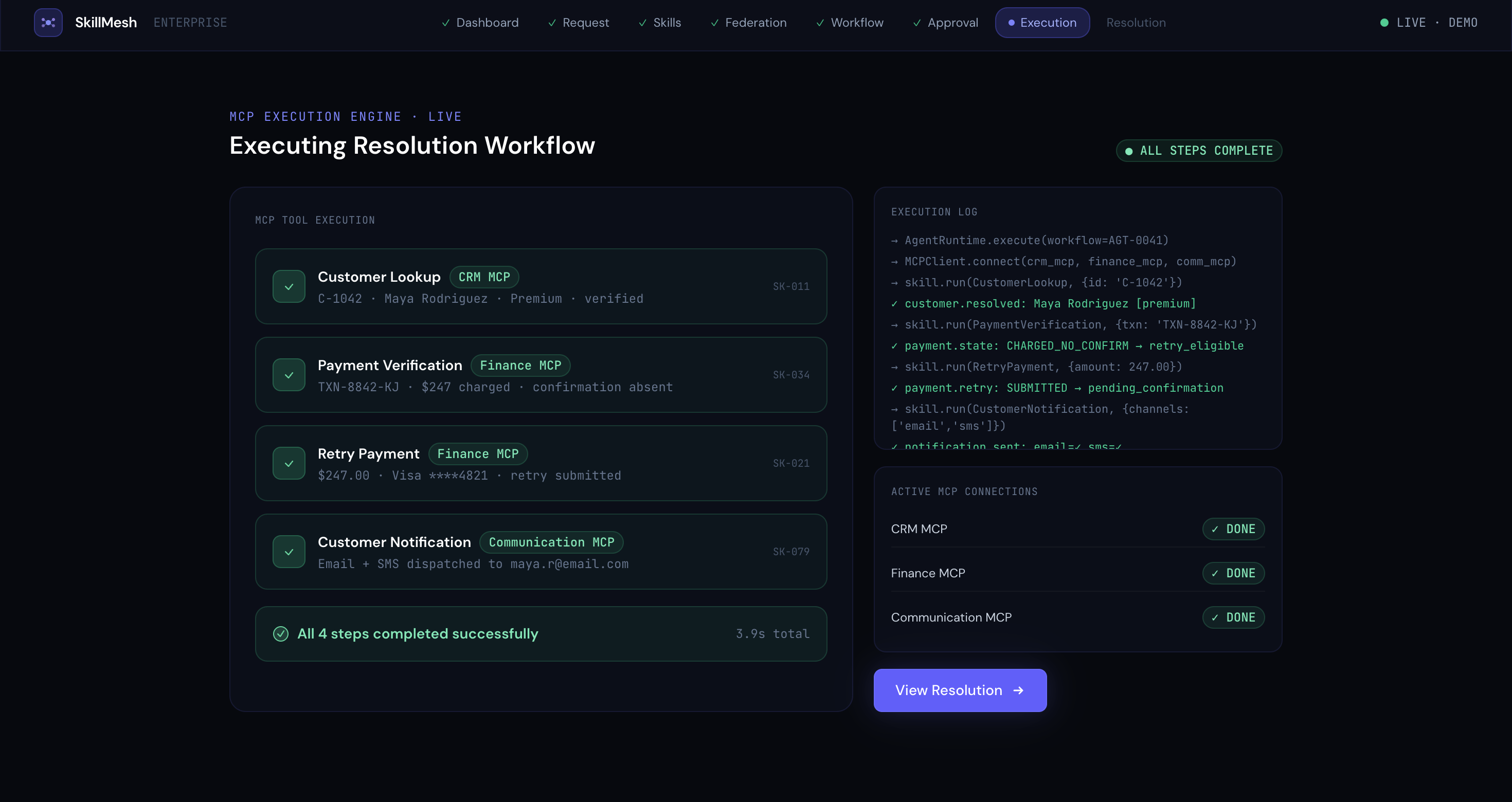
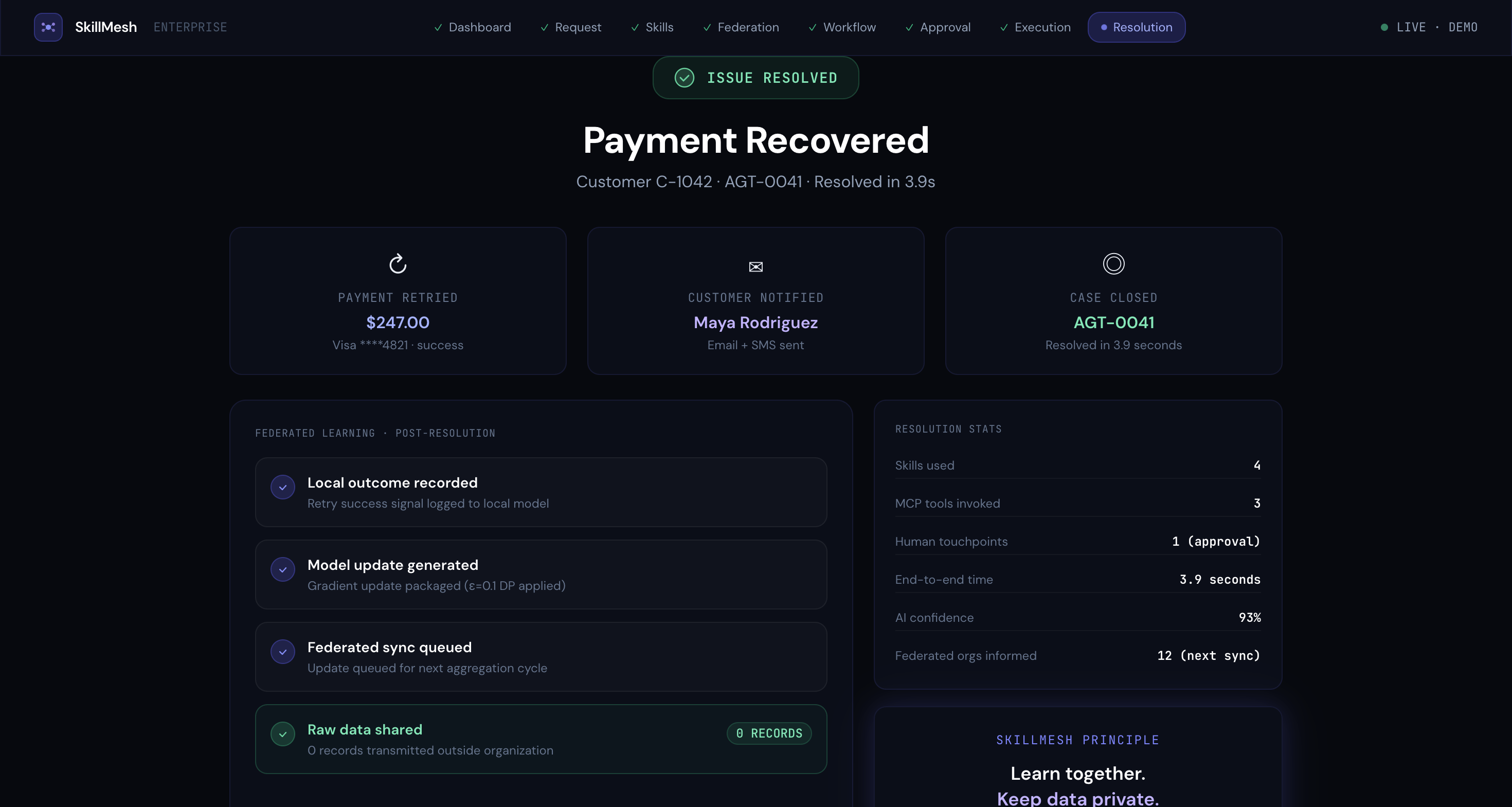
Inspiration
As AI agents become increasingly capable, enterprises are building specialized agents for different tasks such as finance, cybersecurity, customer support, analytics, compliance, and operations. However, these agents often work in isolation. Organizations may have valuable AI capabilities, but those capabilities are difficult to discover and reuse across organizational boundaries.
We were inspired by the idea of creating a network of skills rather than a network of isolated agents.
The core question behind SkillMesh was:
What if an enterprise agent could discover and securely use a specialized skill developed by another organization without requiring that organization to expose its private knowledge or internal systems?**
This led us to SkillMesh — Federated Intelligence for Enterprise Agents, a platform designed around federated skill discovery, controlled access, and reusable agent capabilities.
What it does
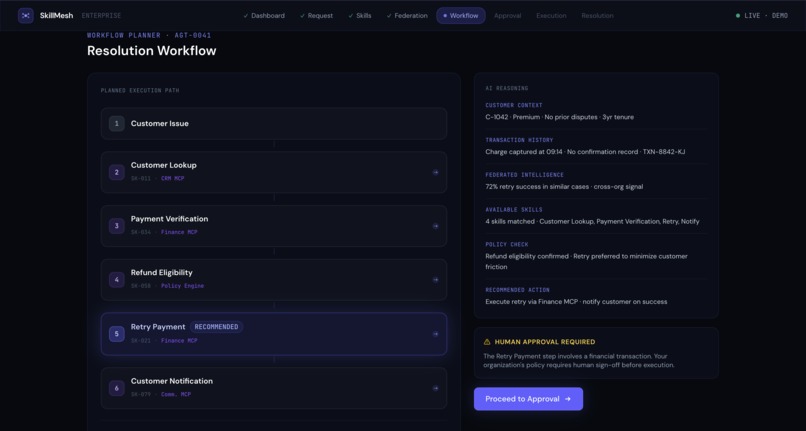
SkillMesh acts as a federated skill ecosystem for enterprise AI agents.
Organizations can register approved AI skills and make their capabilities discoverable to other authorized agents. Instead of sharing sensitive organizational data, organizations expose the capability and interface of a skill, while maintaining control over its access and execution.
The platform provides:
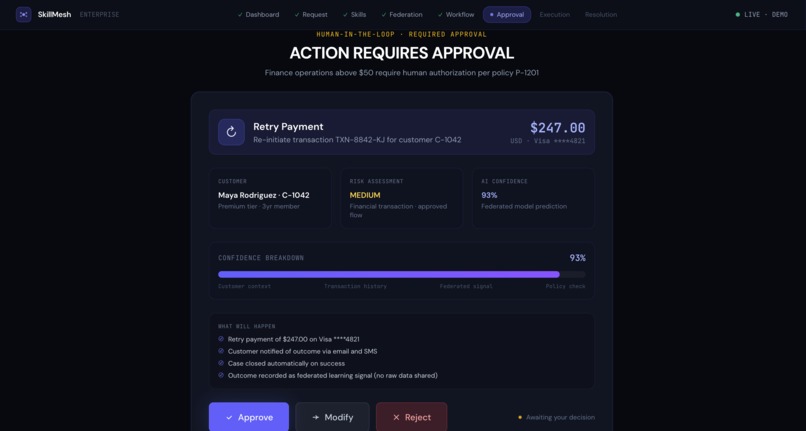
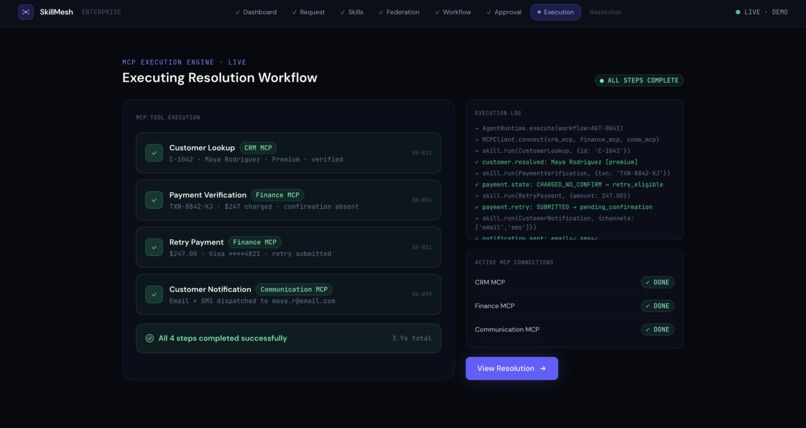
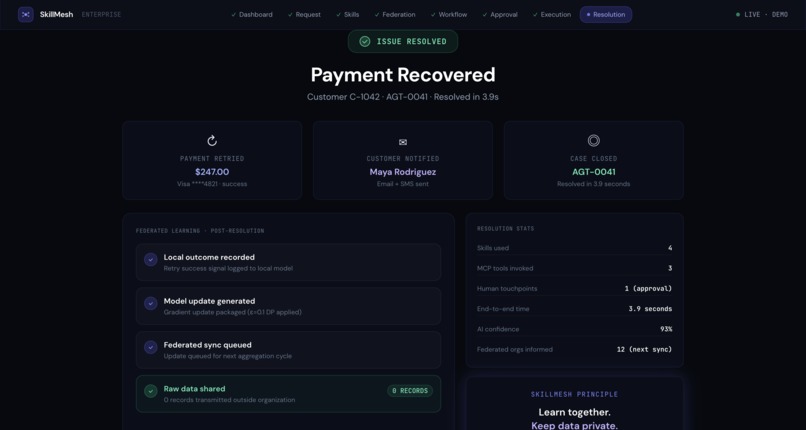
Skill Registry — Organizations can register and manage reusable AI skills. Skill Discovery— Agents can search for capabilities they need. Intelligent Matching — SkillMesh identifies relevant skills based on an agent's requirements. Federated Organizations — Multiple organizations can participate in the same skill ecosystem. Agent Management — Enterprises can monitor their connected agents and capabilities. Permission & Trust Controls — Organizations maintain control over which agents can access their skills. Skill Details & Versioning — Agents can inspect compatibility, providers, versions, and requirements. Analytics — Organizations can monitor skill usage and network activity.
For example, imagine an analytics agent in Organization A needs a specialized fraud-detection capability. Instead of building that capability from scratch, it can discover an approved fraud-analysis skill provided by Organization B, request authorization, and invoke the capability through the SkillMesh network.
The sensitive internal data of Organization B does not need to become publicly accessible.
How we built it
We designed SkillMesh as an enterprise SaaS-style platform rather than a conventional chatbot.
The prototype was organized around eight major experiences:
- Enterprise Dashboard
- Skill Marketplace / Registry
- Skill Discovery
- Organization Network
- Agent Management
- Skill Details
- Security & Permissions
- Analytics
The conceptual architecture follows:
              ┌──────────────────────┐
              │   Enterprise Agent   │
              └──────────┬───────────┘
                         │
                         ▼
              ┌──────────────────────┐
              │   Skill Discovery    │
              └──────────┬───────────┘
                         │
                         ▼
              ┌──────────────────────┐
              │    Skill Registry    │
              └──────────┬───────────┘
                         │
          ┌──────────────┼──────────────┐
          ▼              ▼              ▼
    Organization A  Organization B  Organization C
       Skills          Skills          Skills
          │              │              │
          └──────────────┼──────────────┘
                         ▼
              ┌──────────────────────┐
              │ Authorization / Trust│
              └──────────┬───────────┘
                         │
                         ▼
              ┌──────────────────────┐
              │    Skill Execution   │
              └──────────────────────┘
We focused on making the interface communicate the concept clearly. The prototype uses a dark, modern enterprise design language with network-oriented visualizations, organization cards, skill statistics, agent activity, and permission controls.
Our prototype demonstrates a federated environment containing 12 connected organizations, 147 available skills, and 8 active agents, giving the platform the feel of a functioning enterprise ecosystem.
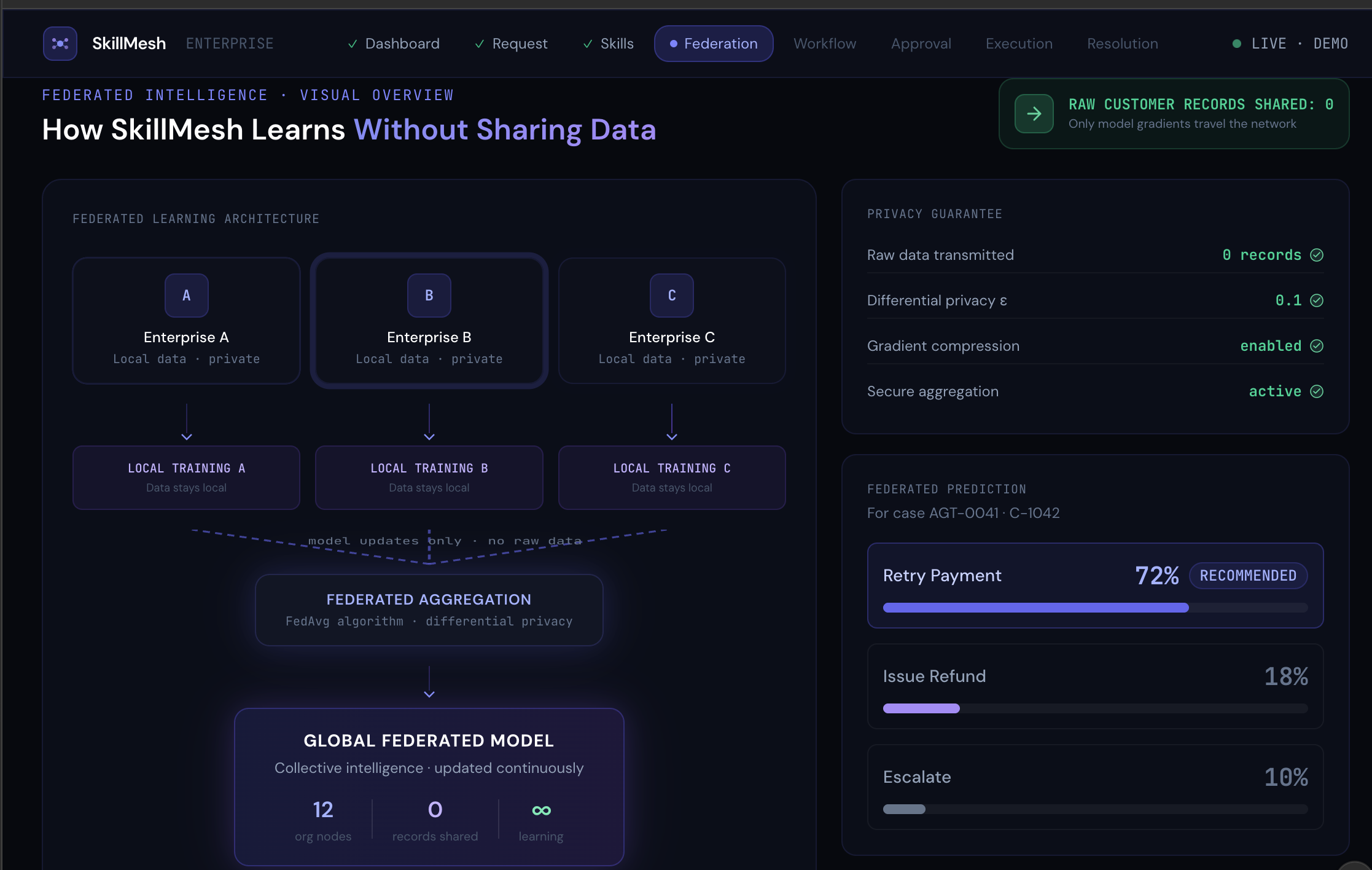
The most important architectural principle was capability sharing instead of raw-data sharing. Organizations remain owners of their internal knowledge and systems while exposing only the skills and interfaces they choose to make available.
Challenges we ran into
One of our biggest challenges was making the concept of federated agent skills understandable without turning the product into another chatbot or generic AI dashboard.
We had to think carefully about the distinction between:
- Sharing a skill vs. sharing private data
- Discovering a skill vs. directly accessing an organization's systems
- Agent interoperability vs. simple API integration
- Skill availability vs. skill authorization
Another challenge was designing a platform that could support multiple organizations while still communicating trust, permissions, and ownership.
We also had to balance the complexity of the underlying concept with a clean user experience. Enterprise agent infrastructure can become complicated quickly, so we focused on presenting the most important information through dashboards, skill cards, network views, and permission controls.
Finally, we had to communicate a technically ambitious architecture within a hackathon prototype. We therefore prioritized demonstrating the core interaction flow and platform vision rather than attempting to implement every component of a production-scale federated ecosystem.
Accomplishments that we're proud of
We are proud that SkillMesh evolved beyond the idea of building another AI assistant.
Instead, we created a concept around agent-to-agent capability discovery and federated enterprise intelligence.
Some accomplishments we are particularly proud of are:
- Designed a complete 8-screen enterprise platform experience.
- Created a federated model involving multiple organizations and agents.
- Introduced a dedicated skill registry and discovery layer for enterprise agents.
- Incorporated trust and permission concepts into the platform architecture.
- Designed an ecosystem where organizations can share capabilities without automatically exposing proprietary information.
- Demonstrated how agents can discover and reuse specialized capabilities instead of duplicating development effort.
- Built the prototype around a scalable vision for future enterprise AI ecosystems.
Most importantly, SkillMesh helped us explore AI from the perspective of infrastructure and interoperability, rather than only from the perspective of an end-user chatbot.
What we learned
Building SkillMesh taught us that the future of enterprise AI is not only about making individual models smarter.
It is also about making AI systems work together.
We learned about the importance of:
- Agent interoperability
- Federated architectures
- Capability discovery
- Access control and trust
- Enterprise data privacy
- Modular AI skills
- Human and organizational authorization
- Designing AI infrastructure for multiple stakeholders
We also learned that a strong AI product needs more than a powerful model. The surrounding architecture — identity, permissions, discovery, interoperability, governance, and observability — can be just as important.
The project changed how we think about AI agents: instead of viewing an agent as a single isolated application, we began thinking of agents as participants in a larger ecosystem of capabilities.
What's next for SkillMesh — Federated Intelligence for Enterprise Agents
Our next goal is to transform SkillMesh from a prototype into a functional federated agent infrastructure.
Future versions could include:
Zero-Trust Skill Access
Introduce stronger identity verification, policy enforcement, and zero-trust authorization before an agent can invoke an external skill.
AI-Powered Skill Matching
Use semantic understanding to automatically match an agent's task with the most appropriate skill in the network.
Standardized Agent Interfaces
Support standardized protocols and interfaces so skills developed by different organizations can be discovered and invoked consistently.
Federated Learning
Extend the platform beyond federated skill discovery toward federated model improvement, allowing participating organizations to collaboratively improve models while keeping sensitive training data local.
Advanced Governance
Introduce detailed audit trails, skill reputation, compliance policies, usage monitoring, and organization-level governance.
Global Skill Marketplace
Eventually, SkillMesh could evolve into a trusted enterprise ecosystem where organizations publish specialized capabilities, agents discover them dynamically, and secure collaboration happens across organizational boundaries.
Our long-term vision is simple:
Don't make every enterprise build every AI capability. Build a trusted mesh where agents can discover, collaborate, and reuse intelligence.
SkillMesh turns isolated enterprise AI capabilities into a connected ecosystem of reusable intelligence.
Built With
- access
- agent
- agentic
- agents
- ai
- control
- cybersecurity
- data
- discovery
- distributed
- enterprise
- federated
- generative
- interoperability
- learning
- machine
- multi-agent
- privacy
- skill
- systems

