Inspiration
As a career coach working with professionals across tech, marketing, and finance, I kept seeing the same frustration: talented people knew their career goals but had no clear way to identify exactly what skills they needed to get there. Friends and clients would spend hours researching vague "required skills" lists, only to feel overwhelmed by unstructured learning resources. I wanted to build a tool that turned that chaos into a clear, personalized roadmap—something that felt like having a career mentor in your pocket.
What it does
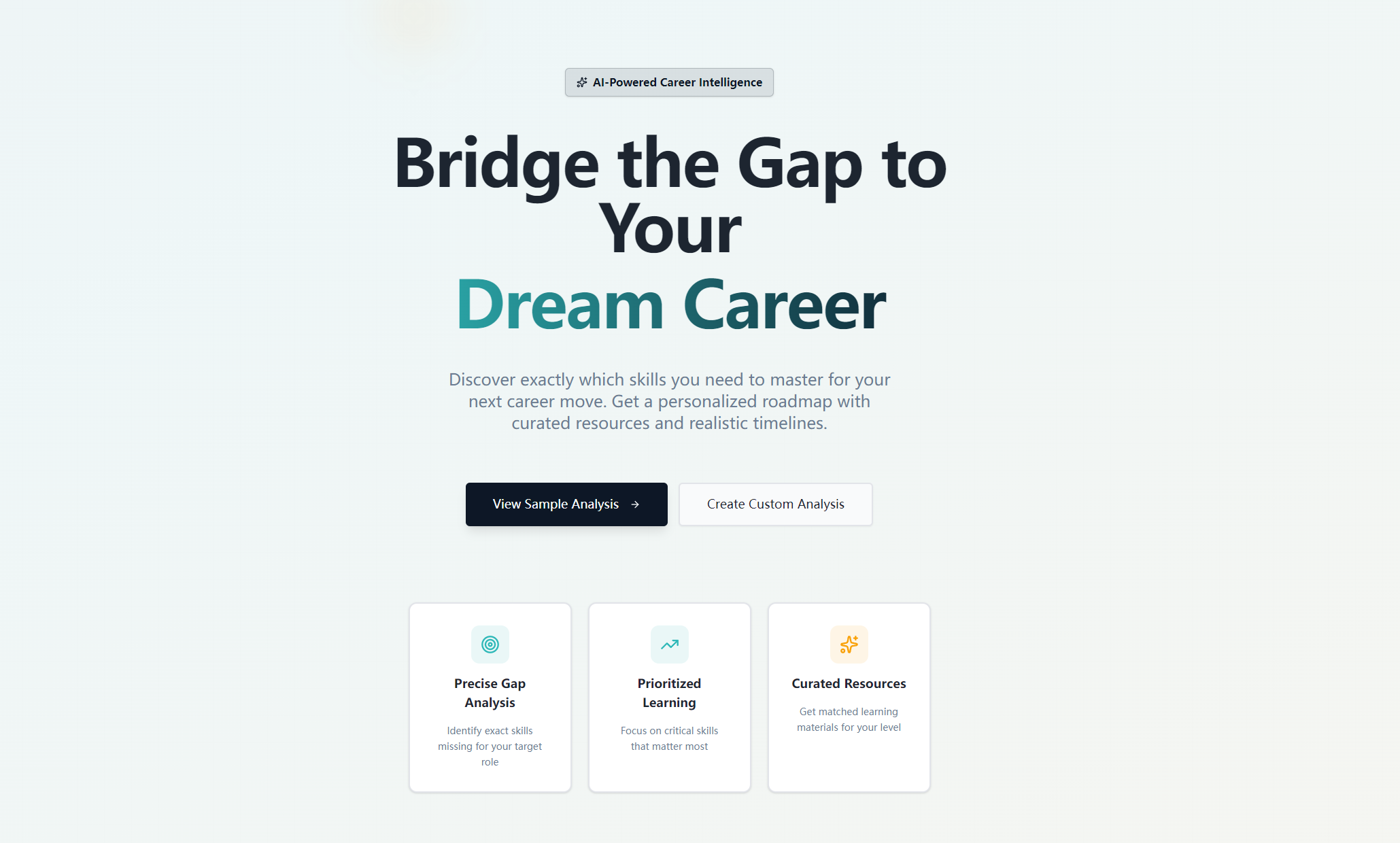
SkillGap Analyzer lets users input their current role, skills, and target job, then uses AI to compare their profile against industry-standard role requirements. It flags critical skill gaps (color-coded for priority), curates tailored learning resources (courses, projects, certifications), calculates realistic timelines based on weekly availability, and maps a step-by-step learning path from foundation to job-ready.
How we built it
I started by defining core user scenarios (career transition, promotion prep) and mapping the UI to prioritize clarity. The frontend was built with React for interactive components (card-based skill gap displays, flowchart roadmaps), using CSS for the color-coded priority system (amber for critical, teal for high-priority). The backend, on Node.js/Express, connects to the OpenAI API to power skill gap analysis, while Chart.js handles timeline visualizations. I tested with real user data (junior marketers targeting product manager roles) to refine the priority logic and resource curation.
Challenges we ran into
The biggest hurdle was balancing accuracy and accessibility in skill gap analysis—unrecognized job titles required building a fallback system to match to general role categories without losing relevance. I also struggled to make timeline estimates feel realistic (not too optimistic or discouraging) and had to iterate on the weekly commitment calculation to account for varying user availability.
Accomplishments that we're proud of
Seeing users go from "overwhelmed" to "empowered" when interacting with the sample career transition (Junior Marketing Specialist → Product Manager) was transformative. The color-coded priority system and flowchart roadmap made complex career planning tangible, and validation from career coaches (who now want to use it with clients) confirmed the tool solves a real pain point.
What we learned
I learned to prioritize user-centric design over technical complexity—simplifying the input form (adding clear examples) reduced drop-off far more than adding advanced features. I also gained a deeper understanding of how to translate vague user needs (e.g., "I want to upskill") into concrete, actionable outputs (phase-based learning roadmaps).
What's next for this project
First, I’ll expand the industry database to cover more niche roles (e.g., green tech, AI specialization). Next, I want to add interactive progress tracking (even without user accounts) so users can mark skills as "in progress" or "mastered." Long-term, I aim to partner with online learning platforms to link resources directly to the roadmap, making it easier for users to start learning without leaving the tool.

Log in or sign up for Devpost to join the conversation.