Inspiration
I was inspired by the fact that every student learns differently, yet traditional education often follows the same approach for everyone. Many learners struggle to identify their knowledge gaps, understand complex topics, and decide what to study next.
I wanted to build SkillForge AI, an intelligent learning companion that transforms traditional learning into a personalized, adaptive, and interactive experience. My goal is to make learning more accessible and effective by combining Generative AI, Machine Learning, Deep Learning, Natural Language Processing, and Agentic AI.
What it does
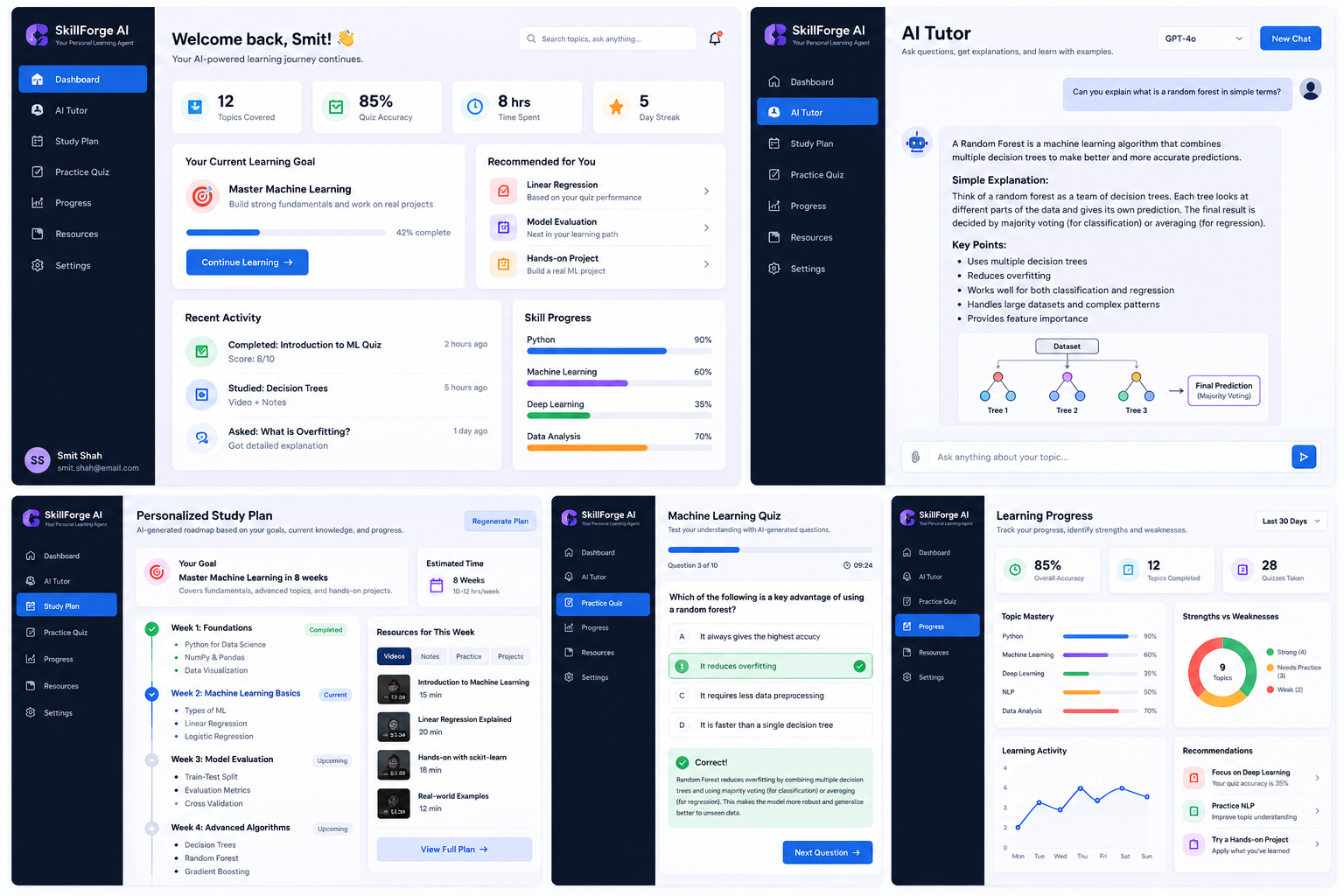
SkillForge AI is an AI-powered personal tutor that adapts to a learner’s needs, goals, and performance.
- Personalized learning paths: Creates structured study plans based on learning goals, current knowledge, and available time.
- AI-powered tutoring: Explains complex concepts in simple language with relevant examples.
- Adaptive assessments: Generates quizzes, evaluates answers, and identifies knowledge gaps.
- Agentic AI: Uses specialized agents for learning-plan generation, tutoring, assessment, and recommendations.
- Retrieval-Augmented Generation (RAG): Retrieves relevant information from learning materials to provide grounded answers.
- Machine Learning-based recommendations: Analyzes assessment performance to recommend topics that need more practice.
- Progress tracking: Helps learners monitor improvement, recognize weak areas, and focus on their next learning goals.
Unlike a conventional chatbot that primarily answers questions, SkillForge AI is designed to guide learners through a continuous cycle of learning, assessment, feedback, and improvement.
How I built it
I designed SkillForge AI using a modular architecture that combines modern AI technologies with an interactive user experience.
- Frontend: React for the learning dashboard, interactive quizzes, study plans, and progress visualization.
- Backend: Python and FastAPI for APIs, assessment workflows, and AI-agent orchestration.
- Generative AI: Uses a suitable large language model to generate explanations, study plans, practice questions, and feedback.
- Natural Language Processing: Helps interpret learner questions, identify intent, and extract relevant topics.
- Machine Learning: Analyzes quiz performance and learning history to estimate topic mastery and recommend learning activities.
- Deep Learning: Uses pretrained language models and semantic embeddings for contextual understanding and information retrieval.
- RAG: Retrieves relevant passages from approved learning resources to improve the relevance and grounding of AI-generated answers.
- Agentic AI: Organizes the learning workflow through specialized agents responsible for planning, tutoring, assessment, and recommendations.
- AWS integration: Can use appropriate AWS services for deployment, storage, monitoring, and AI model access.
I focused on making the components modular so that I can evaluate, improve, and scale individual parts of the system independently.
Challenges I ran into
One of my main challenges was designing a personalized learning experience without overwhelming learners with too much information. I addressed this through a structured approach to study plans, manageable learning goals, and targeted practice.
Another challenge was ensuring that AI-generated explanations and quizzes remained relevant and reliable. I considered using RAG with trusted learning materials, structured prompts, and output validation to reduce unsupported answers.
Designing effective agent collaboration was another important challenge. Each agent needs a clearly defined responsibility, and the overall workflow must handle failures and validate outputs instead of blindly trusting generated responses.
I also considered how to evaluate personalization objectively. Recommendations should be based on evidence, such as quiz accuracy, repeated mistakes, and topic mastery, rather than relying only on LLM-generated judgments.
Accomplishments that I’m proud of
I’m proud of designing SkillForge AI as more than a question-answering chatbot. My vision is to create an integrated learning companion that combines personalized tutoring, adaptive assessments, study planning, and progress analysis.
I’m particularly proud of bringing together Generative AI, NLP, Machine Learning, semantic retrieval, and Agentic AI to address a real educational challenge.
The modular design also provides a foundation for future improvements, including better personalization, more reliable evaluations, and scalable deployment.
What I learned
Through this project, I explored how different AI technologies can complement one another in a practical application.
I learned that LLMs are useful for explanations and flexible interaction, while Machine Learning can support performance analysis and recommendations. NLP and embeddings help interpret questions and retrieve relevant content, while RAG can ground responses in trusted learning materials.
I also learned that building an effective agentic system requires more than connecting multiple agents. It requires clear responsibilities, controlled tool access, reliable workflows, output validation, and appropriate safeguards.
Most importantly, I learned that an AI product should be evaluated by the value it delivers to users. For SkillForge AI, that means measuring answer accuracy, recommendation relevance, response time, learner engagement, and improvement in assessment performance.
My next goal is to test the system with real learning tasks, measure its effectiveness, and continuously improve its personalization capabilities.
Built With
- agentic-ai
- amazon-web-services
- deep-learning
- fastapi
- generative-ai-(llms)
- machine-learning
- mcp
- natural-language-processing-(nlp)
- python
- react
- retrieval-augmented-generation-(rag)
- vector-database


Log in or sign up for Devpost to join the conversation.