-
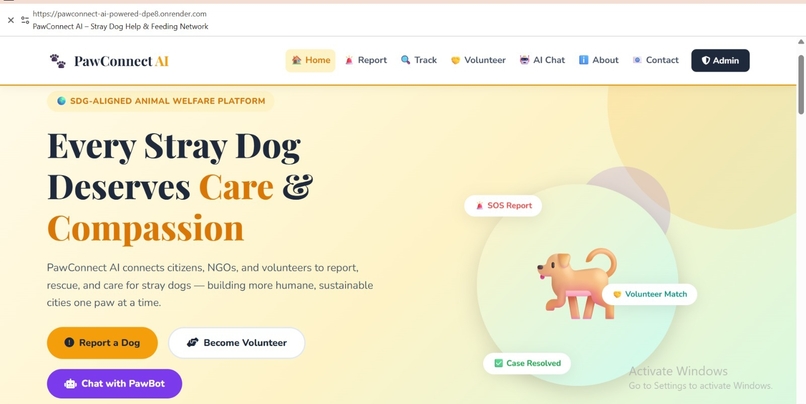
Homepage
Inspiration
Stray dogs are a familiar sight in most Indian cities, yet the way we respond to them is completely fragmented. Someone sees an injured dog and doesn't know who to call. A person wants to feed strays regularly but has no way to coordinate with others doing the same. NGOs are stretched thin and rarely hear about problems until they've escalated. We kept seeing the same pattern — genuine willingness to help, with no system to channel it — and decided to build the missing link between citizens, volunteers, and animal welfare organizations.
What it does
PawConnect AI is a web platform that turns scattered goodwill into an organized support network for stray dogs:
Report a Dog — Citizens can file a complaint with location, description, and a photo, which is logged and tracked with a unique complaint number and status. Volunteer Registry — People willing to help (feeding, fostering, transport, medical support) can register and appear in a searchable directory. PawBot Chatbot — An AI assistant answers common questions instantly: what's safe to feed a stray, what to do if a dog is injured or sick, how to contact verified animal welfare organizations, and how to file a report — all while explicitly avoiding medical diagnosis and pointing people to real veterinary help. Admin Dashboard — Gives NGOs and coordinators a live view of all complaints and volunteers so nothing falls through the cracks.
The platform is aligned with SDG 15 (Life on Land), SDG 11 (Sustainable Cities and Communities), and SDG 17 (Partnerships for the Goals) — treating animal welfare as a community infrastructure problem, not an individual one.
How we built it
I kept the stack deliberately lightweight so it could be deployed and understood quickly:
Backend: Flask (Python), with routes for reporting, volunteering, chatbot interaction, and admin views. Data storage: CSV-based storage for complaints and volunteers — simple, transparent, and easy to migrate to a database later. Frontend: Server-rendered HTML templates (Jinja2) with custom CSS, no heavy frontend framework needed. Chatbot logic: A keyword-matching response engine for PawBot, built to be easily swapped out for a real LLM (OpenAI or IBM Granite) via a single function replacement — so the architecture is ready to scale in intelligence without a rewrite. Responsible AI guardrails: mobile numbers are masked in public views, PawBot never attempts medical diagnosis, and every AI response nudges the user toward human/professional verification.
Challenges we ran into
Balancing simplicity with usefulness — we wanted a system anyone could run locally in minutes (pip install, python app.py), which meant resisting the urge to over-engineer with a database or auth system before the core workflow was solid. Designing a chatbot that's helpful but responsible — animal health questions are sensitive; we had to carefully scope PawBot's responses so it's genuinely useful without ever pretending to be a vet. Making the complaint-to-response loop feel real — status tracking (open → assigned → resolved) needed to be simple enough for non-technical users and admins alike, without extra login friction discouraging quick reports.
Accomplishments that we're proud of
A fully working end-to-end flow — from spotting a stray dog to filing a report, registering as a volunteer, and getting instant guidance from PawBot, all functional in a single lightweight app with no external dependencies required to run. PawBot actually feels helpful — despite being a simple keyword-based system (no external API needed), it correctly handles real, practical questions about feeding, injury response, and finding help, while staying within safe, responsible boundaries around medical advice. Built for real-world usability, not just a demo — status tracking on complaints (open → assigned → resolved) and a searchable volunteer directory mean this isn't just a UI mockup; an NGO or community group could genuinely start using it today. Privacy and responsibility baked in from day one — masking mobile numbers in public views and designing PawBot to defer to real veterinarians/helplines wasn't an afterthought; it shaped the architecture from the start. Zero-friction setup — pip install -r requirements.txt and python app.py gets the whole platform running locally in under two minutes, which made testing, iterating, and demoing fast throughout the build. A clear growth path — the chatbot, storage layer, and admin dashboard were all designed so that swapping in an LLM or a real database is a drop-in change, not a rewrite, proving the architecture holds up beyond the hackathon scope.
What we learned
Small, well-scoped tools (CSV over a database, keyword bot over a full LLM integration) can still deliver a complete, usable product — and they're far easier to demo, explain, and iterate on. Designing for "Responsible AI" isn't just a compliance checkbox — it directly shapes what features you build and what you deliberately leave out. Community-facing platforms succeed less on flashy tech and more on removing friction from the very first action (a report, a chat message, a volunteer sign-up).
What's next for PawConnect AI
Swap CSV storage for a proper database (PostgreSQL/SQLite) to support scale and search. Integrate a real LLM (OpenAI/IBM Granite) for PawBot, as scaffolded in the code. Add SMS/WhatsApp notifications so volunteers get alerted to nearby reports in real time. Build a map view of active complaints so NGOs can prioritize by geographic density. Add authentication and role-based access for verified NGOs vs. general volunteers.


Log in or sign up for Devpost to join the conversation.