-
-
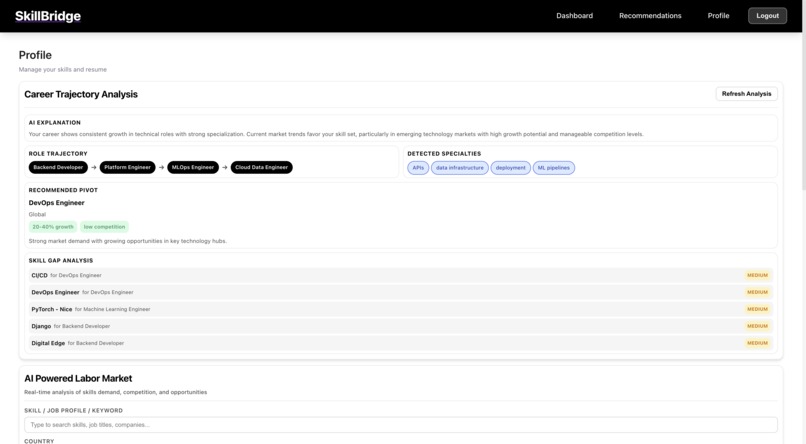
Profile page with career recommendation and insights
-
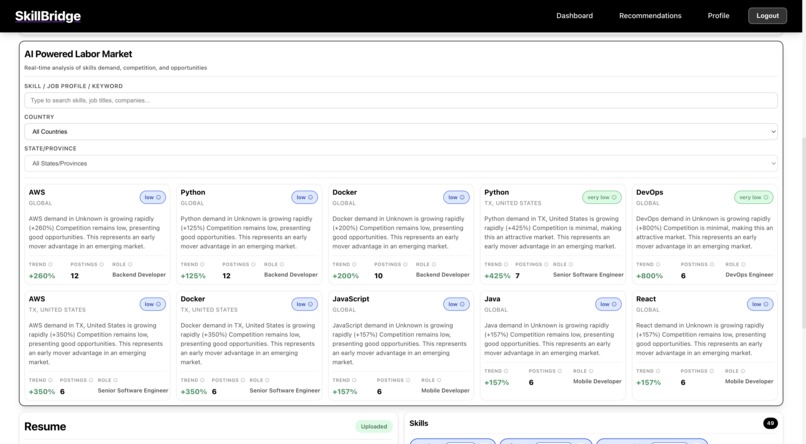
Market insights to help users
-
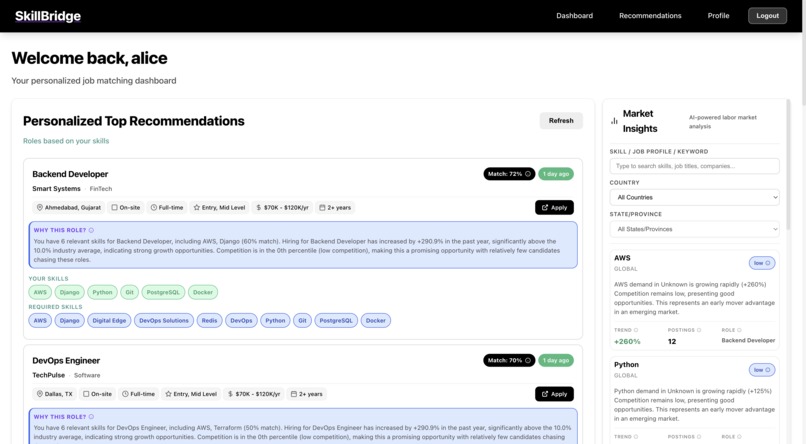
Main Dashboard
-
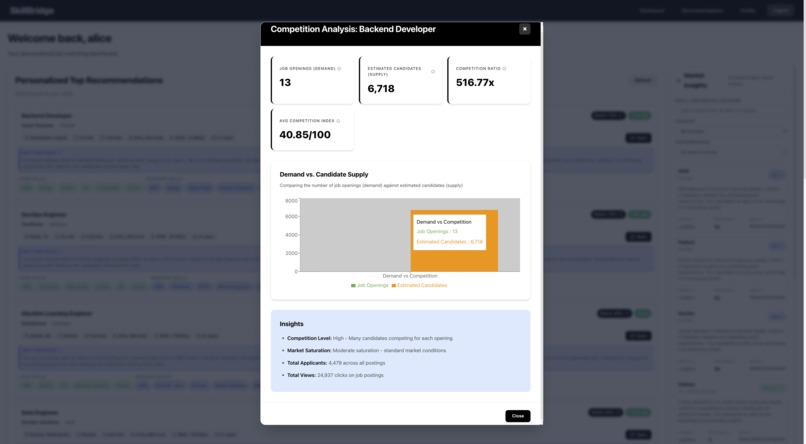
More detailed analytics for each job posting


SkillBridge
Inspiration
Millions of professionals worldwide struggle to discover job opportunities that match their skills, especially when exploring opportunities across borders. Traditional job platforms show generic recommendations without explaining why a job is recommended or providing context about market dynamics. This creates information asymmetry that prevents professionals from making informed career decisions.
We were inspired by the challenge of global mobility—helping people navigate international job markets with transparency and data-driven insights. The idea came from recognizing that:
- Skills matter more than titles: A "Software Engineer" in one company might need completely different skills than another
- Market intelligence is opaque: Job seekers lack visibility into competition levels, demand trends, and geographic opportunities
- AI can be transparent: Unlike black-box recommendation systems, AI can cite real metrics and explain its reasoning
- Global opportunities are hidden: People don't know where their skills are most in demand
SkillBridge was born from the vision of making global career mobility accessible through transparent, AI-powered insights.
What it does
SkillBridge is an AI-powered job recommendation platform that helps professionals discover global career opportunities and make data-driven decisions about their professional future.
Core Capabilities:
AI-Powered Resume Analysis & Career Trajectory
- Automatically parses PDF resumes to extract skills, experience, and education
- Detects career progression patterns (e.g., "Software Engineer → Senior Engineer → Tech Lead")
- Identifies core specialties based on experience
- Recommends strategic career pivots with market-backed reasoning
- Analyzes skill gaps prioritized by market demand
- Generates comprehensive AI explanations synthesizing all insights
Transparent Job Recommendations
- Skill-based matching using advanced algorithms (40% skill match, 30% demand, 30% low competition)
- Real job postings with company details, locations, salary ranges, and direct application links
- LLM-generated explanations that cite actual metrics—not generic advice
- Example: "Cloud Data Engineers are in high demand; hiring has increased by 45% in the past year, while competition is in the 20th percentile—making this a promising opportunity."
Real-Time Market Insights
- Analyzes labor markets across 50+ countries
- Competition level indicators (Very Low, Low, Moderate, High) with detailed explanations
- Demand trend analysis showing growth/decline in job postings
- Geographic breakdown of opportunities
- Filterable by country, state, and skills
Competition Analysis
- Supply vs. demand analysis for each role
- Competition ratio (candidates per opening)
- Competition index (normalized 0-100 score)
- Visual charts showing market dynamics
- Detailed insights on market saturation
User-Centric Transparency
- Every metric has an explanation accessible via instant tooltips
- No black-box recommendations—users understand the reasoning
- AI explanations cite real data (demand growth %, competition percentiles, skill matches)
How we built it
Technology Stack
Frontend:
- React with TypeScript for type-safe, component-based UI
- Recharts for interactive data visualizations
- Axios for API communication
- Modern, responsive design with intuitive UX
Backend:
- FastAPI (Python) for high-performance RESTful API
- SQLAlchemy for database operations
- OpenAI GPT-4o-mini for LLM-powered explanations
- Modular architecture with clear separation of concerns
AI/ML Components:
- Career Analyzer: Resume analysis, trajectory detection, pivot recommendations, skill gap analysis
- Explanation Generator: LLM integration with structured prompts ensuring metric citation
- Recommendation Engine: Custom skill matching algorithms with weighted scoring
- Market Analyzer: Real-time data processing and trend analysis
- Competition Analyzer: Supply-demand ratio calculations and statistical modeling
Key Implementation Details
Resume Analysis Pipeline
- PDF parsing using
pdfplumberfor accurate text extraction - Pattern matching against comprehensive skill keyword database
- Context analysis to infer proficiency levels
- Experience extraction identifying job titles, companies, and duration
- PDF parsing using
AI Explanation Generation
- Structured prompts that ensure AI only references provided metrics
- Template-based fallback when LLM unavailable
- Reasoning factors logged for transparency
- No hallucinations—all statistics are real
Market Analysis Engine
- Processes thousands of job postings in real-time
- Calculates competition indices using supply vs. demand ratios
- Tracks demand trends across 50+ countries
- Generates insights with instant tooltip explanations
Skill Matching Algorithm
- Multi-factor scoring: skill overlap (40%), market demand (30%), low competition (30%)
- Considers both manually added and resume-extracted skills
- Weighted to prioritize opportunities with better market conditions
User Experience
- Instant tooltips on hover for every metric
- Clean, intuitive interface making complex data accessible
- Responsive design for all devices
- Direct application links for seamless job application
Data Flow
- User uploads resume → PDF parsed, skills extracted
- Skills matched against job database → Match scores calculated
- Market data analyzed → Competition levels, demand trends computed
- AI generates explanation → Cites real metrics from analysis
- Recommendations displayed → With transparent reasoning and direct application links
Challenges we ran into
Ensuring AI Transparency
- Challenge: LLMs can hallucinate statistics. We needed explanations that only cite real data.
- Solution: Created structured prompts with explicit instructions, template-based fallback, and validation to ensure all cited metrics exist in our data.
Real-Time Market Analysis
- Challenge: Processing thousands of job postings to calculate competition levels and demand trends in real-time.
- Solution: Implemented efficient data processing pipelines, caching strategies, and optimized database queries.
Resume Parsing Accuracy
- Challenge: PDFs come in various formats. Extracting skills, experience, and education accurately was difficult.
- Solution: Combined multiple parsing libraries (
pdfplumber,PyPDF2), pattern matching, and context analysis to improve extraction accuracy.
Competition Index Calculation
- Challenge: Creating a meaningful competition metric that accounts for supply, demand, recency, and role popularity.
- Solution: Developed a weighted formula considering applicant counts, click counts, time decay, and role-specific multipliers.
User Experience for Complex Data
- Challenge: Making competition indices, percentiles, and market trends understandable to users.
- Solution: Implemented instant tooltips with detailed explanations, visual indicators (badges), and clear labeling.
Global Market Coverage
- Challenge: Supporting 50+ countries with varying data availability and formats.
- Solution: Created flexible location parsing, country code mapping, and fallback mechanisms for missing data.
Performance Optimization
- Challenge: LLM calls can be slow. We needed fast, responsive recommendations.
- Solution: Implemented caching, async processing, and template-based fallbacks for instant responses.
Accomplishments that we're proud of
Transparent AI Recommendations
- Every recommendation includes an explanation citing real metrics—demand growth percentages, competition percentiles, specific skill matches
- No black-box recommendations. Users see exactly why we recommend something.
Comprehensive Career Analysis
- Beyond resume parsing—we provide career trajectory detection, specialty identification, strategic pivot recommendations, and prioritized skill gap analysis
- Combines resume data with real-time market intelligence for actionable insights
Global Market Intelligence
- Real-time analysis across 50+ countries
- Competition analysis with supply vs. demand ratios
- Demand trend tracking showing growth/decline patterns
- Geographic insights helping users understand where opportunities exist
User-Centric Design
- Every metric has an explanation accessible via instant tooltips
- Clean, intuitive interface making complex data accessible
- Direct application links for seamless job application
- Responsive design working beautifully on all devices
Technical Excellence
- Modular, maintainable codebase
- Efficient data processing pipelines
- Robust error handling and fallback mechanisms
- Type-safe frontend with TypeScript
Innovation in AI Usage
- Using LLM for transparency, not just recommendations
- Structured prompts ensuring metric citation
- Template-based fallbacks ensuring system always works
- Combining multiple AI techniques (resume analysis, explanation generation, market analysis)
Real-World Impact Potential
- Helps professionals discover opportunities they might have missed
- Enables data-driven career decisions
- Supports global mobility and international job search
- Reduces information asymmetry in job markets
What we learned
AI Transparency is Achievable
- With careful prompt engineering and structured inputs, LLMs can generate explanations that cite real metrics without hallucination
- Template-based fallbacks are essential for reliability
User Experience Matters for Complex Data
- Competition indices and market trends are complex—instant tooltips and clear explanations make them accessible
- Visual indicators (badges, colors) help users quickly understand information
Resume Parsing is Harder Than Expected
- PDFs come in many formats. Multiple parsing strategies and pattern matching are necessary for accuracy
- Context analysis improves skill extraction beyond simple keyword matching
Market Analysis Requires Real-Time Processing
- Competition levels and demand trends change quickly
- Efficient data processing and caching are crucial for performance
Global Markets Have Unique Challenges
- Different countries have different data formats and availability
- Flexible parsing and fallback mechanisms are essential
Modular Architecture Pays Off
- Separating AI components, data processing, and UI made development and debugging easier
- Clear interfaces between components enabled parallel development
Transparency Builds Trust
- Users appreciate understanding why recommendations are made
- Citing real metrics builds credibility and helps users make informed decisions
Combining Multiple AI Techniques
- Resume analysis, explanation generation, and market analysis each require different approaches
- Combining them creates a more powerful, comprehensive solution
What's next for SkillBridge
Short-Term Enhancements (1-3 months)
Enhanced Geographic Visualization
- Interactive heatmaps showing demand by location
- Visual representation of competition levels across regions
- Location-based opportunity discovery
Advanced Career Path Recommendations
- Skill progression tracking
- Learning path recommendations based on skill gaps
- Career trajectory predictions
Real-Time Job Scraping
- Integration with multiple job board APIs
- Automated job posting collection
- Real-time updates on new opportunities
Medium-Term Goals (3-6 months)
Salary Insights & Negotiation Guidance
- Market-based salary ranges
- Negotiation tips based on competition levels
- Cost of living adjustments for international moves
Application Tracking
- Track applications through the platform
- Status updates and follow-up reminders
- Interview preparation based on job requirements
Long-Term Vision (6-12 months)
AI-Powered Interview Preparation
- Generate practice questions based on job requirements
- Skill-specific interview guidance
- Mock interview feedback
Professional Network Integration
- LinkedIn profile integration
- GitHub portfolio analysis
- Professional network recommendations
Impact & Vision
SkillBridge aims to democratize access to global career opportunities by providing transparent, data-driven insights that help professionals make informed decisions. We believe that:
- Transparency in AI builds trust and empowers users
- Global mobility should be accessible to everyone
- Data-driven decisions lead to better career outcomes
- Skills matter more than titles in today's evolving job market
By combining advanced AI with transparent explanations and real-time market intelligence, SkillBridge helps professionals navigate their careers with confidence—whether they're exploring remote work, considering international relocation, or planning their next career move.
Built With
- axios
- fastapi
- javascript
- openai
- python
- react
- sqlalchemy
- typescript

Log in or sign up for Devpost to join the conversation.