-
-
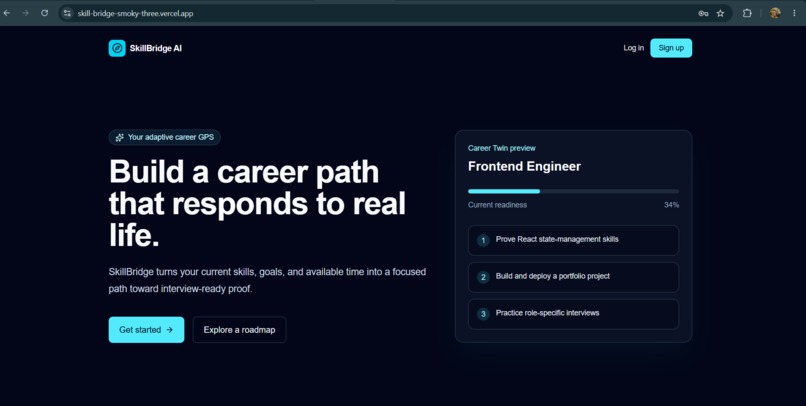
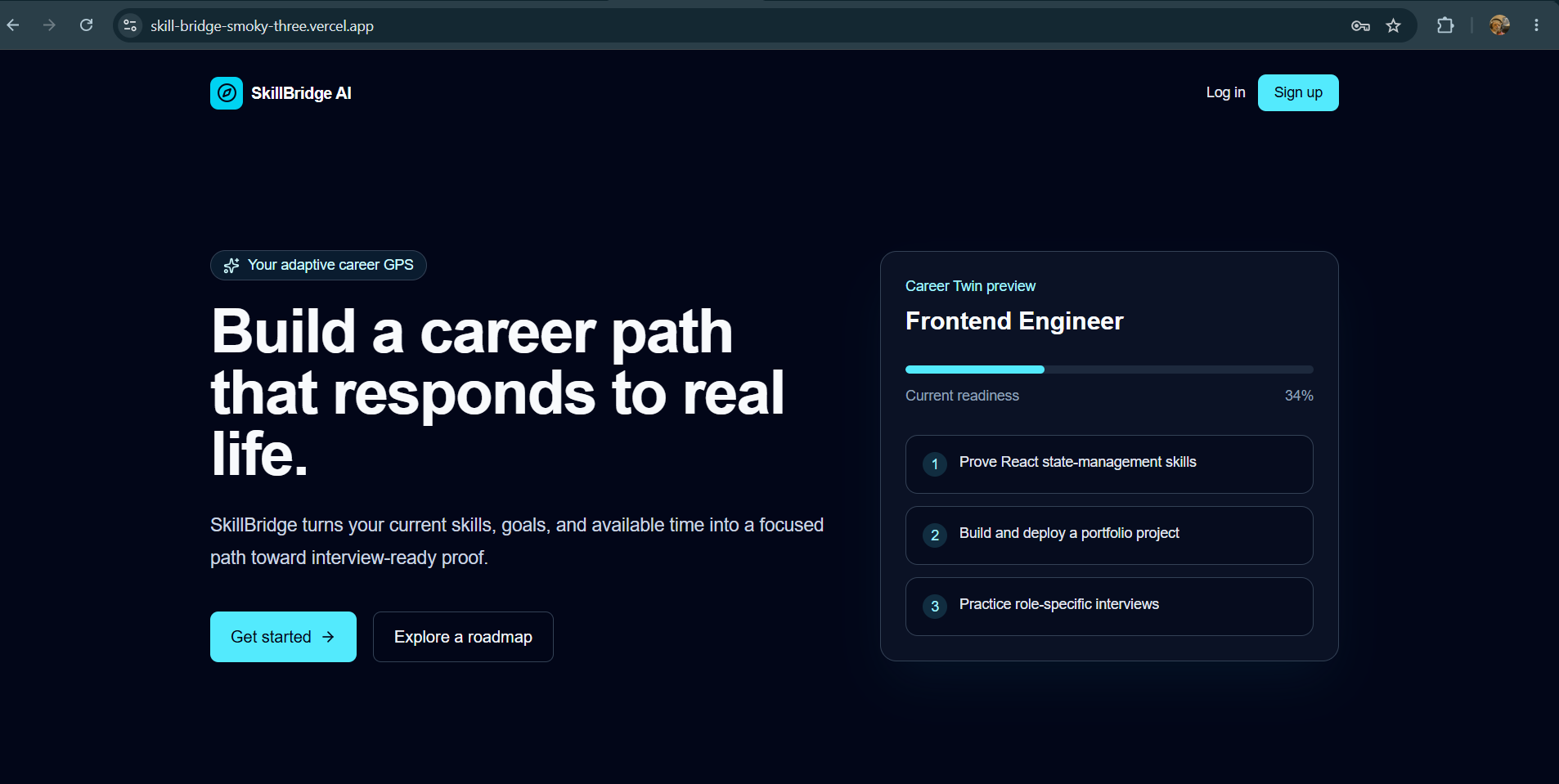
hero section
-
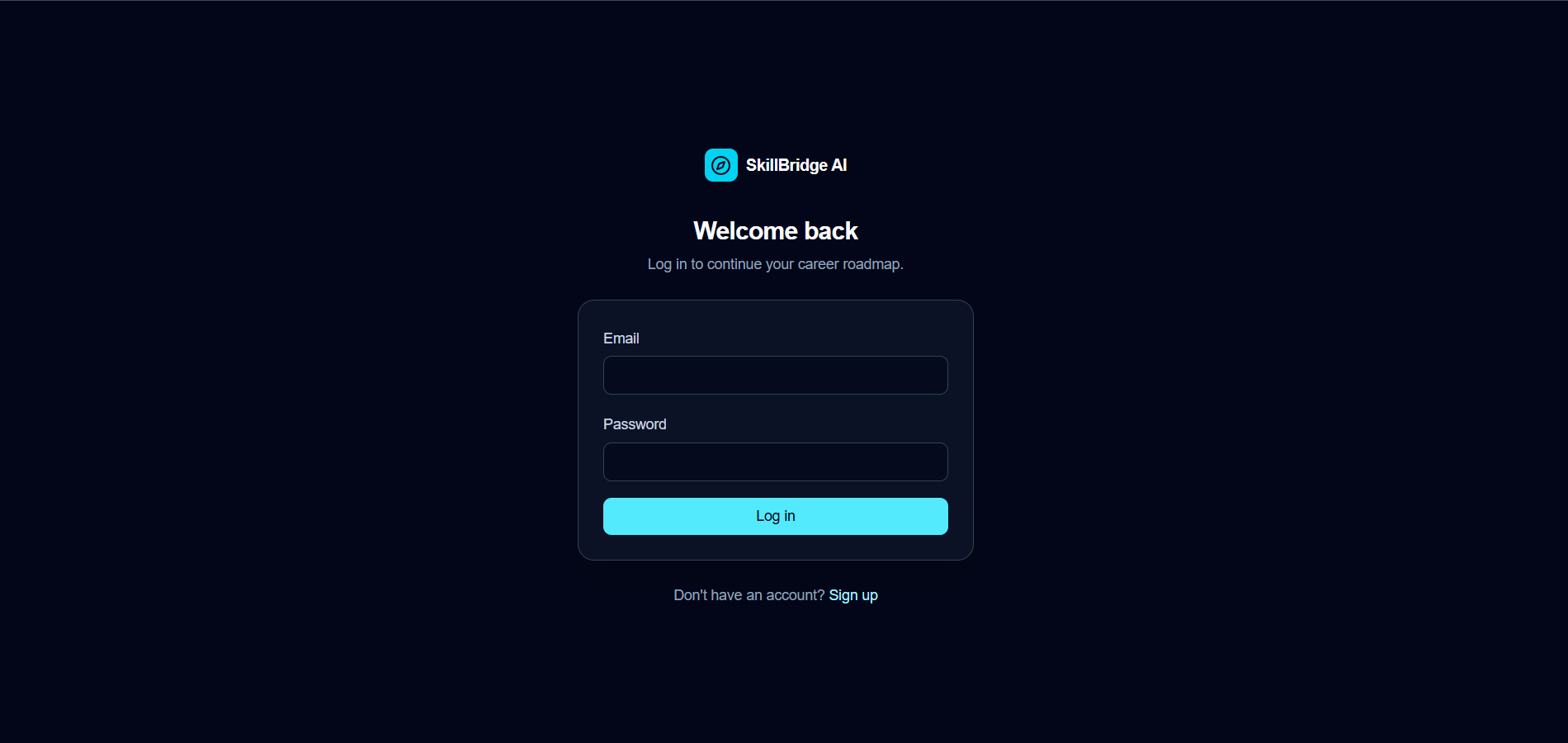
login page
-
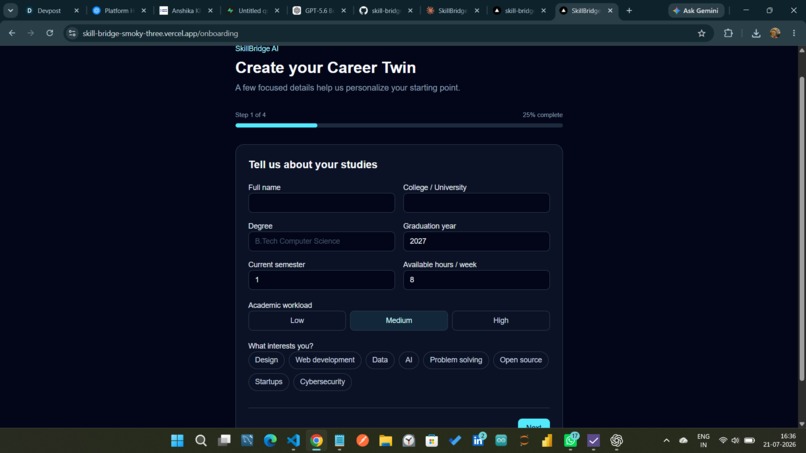
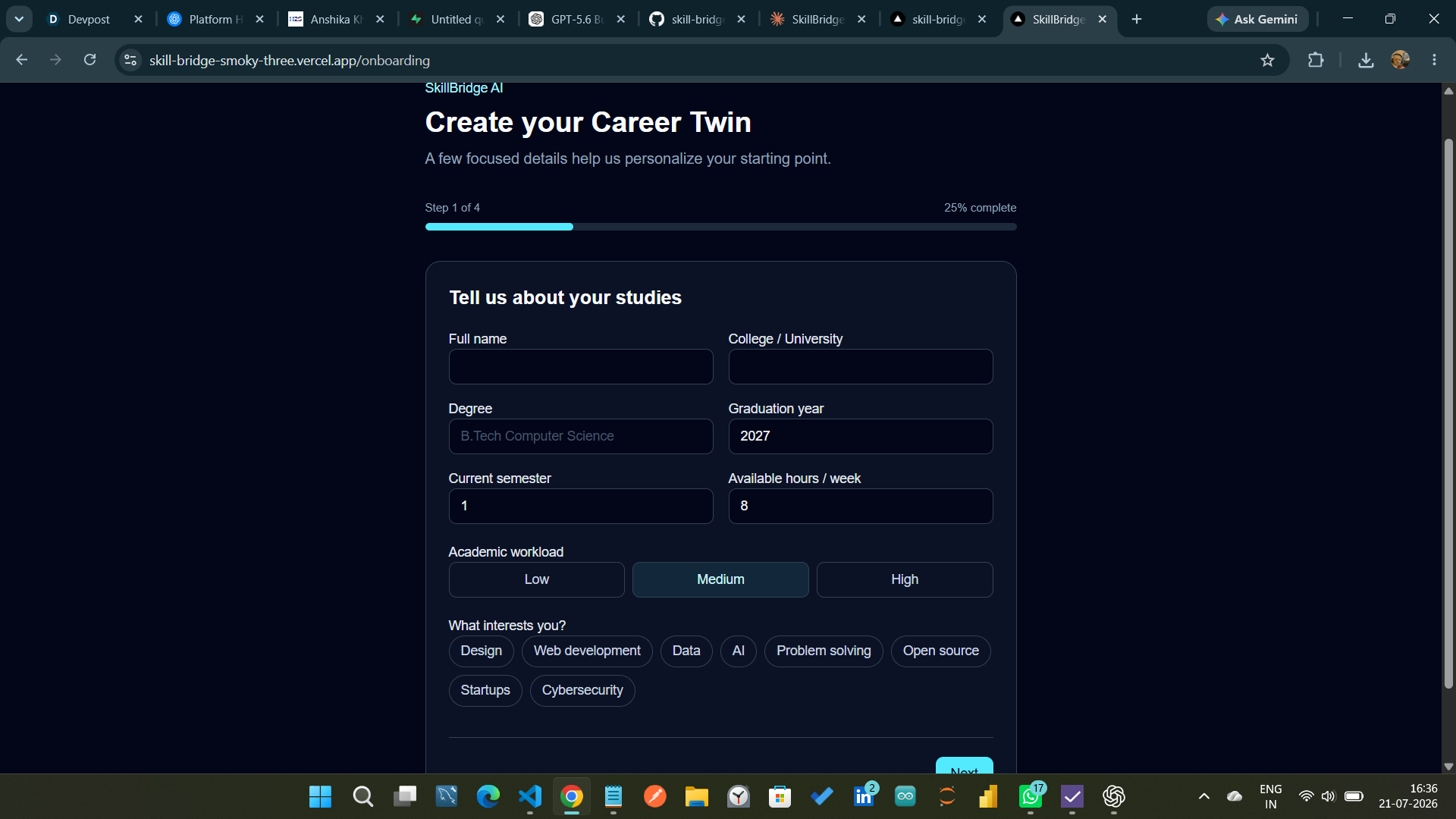
create your career twin page :
-
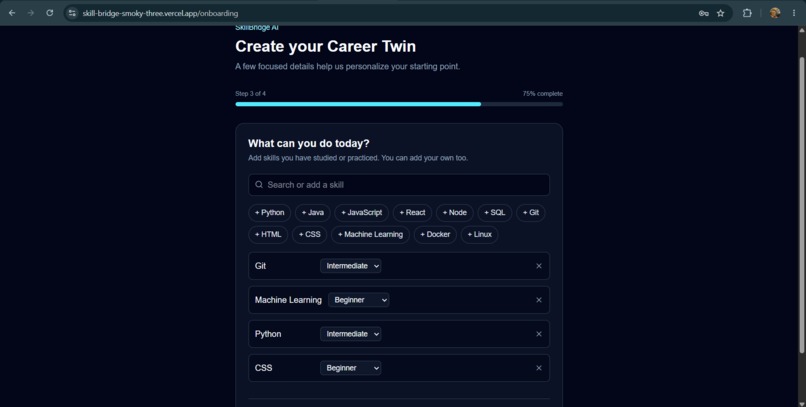
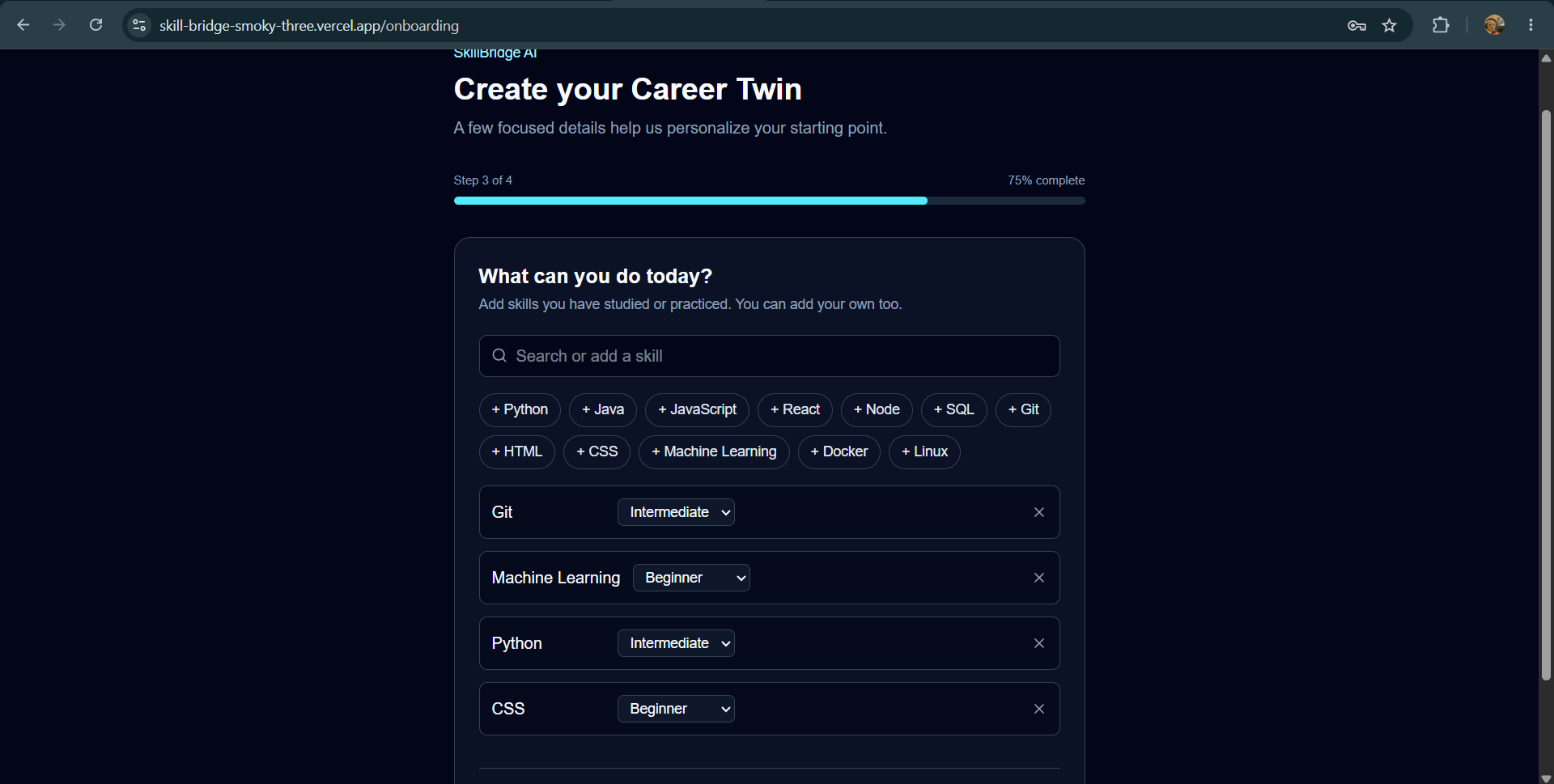
personalisation skills page
-
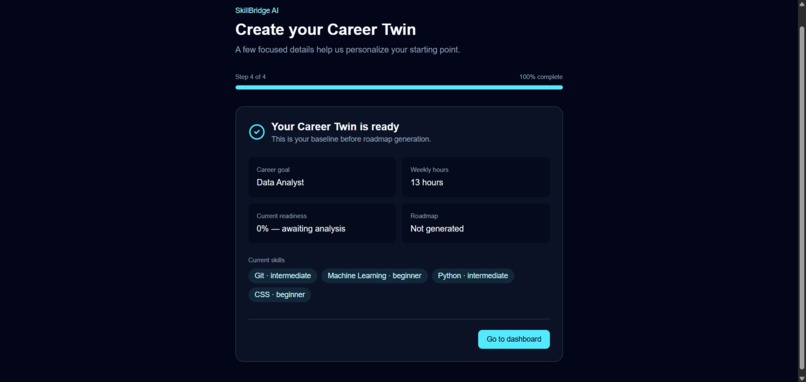
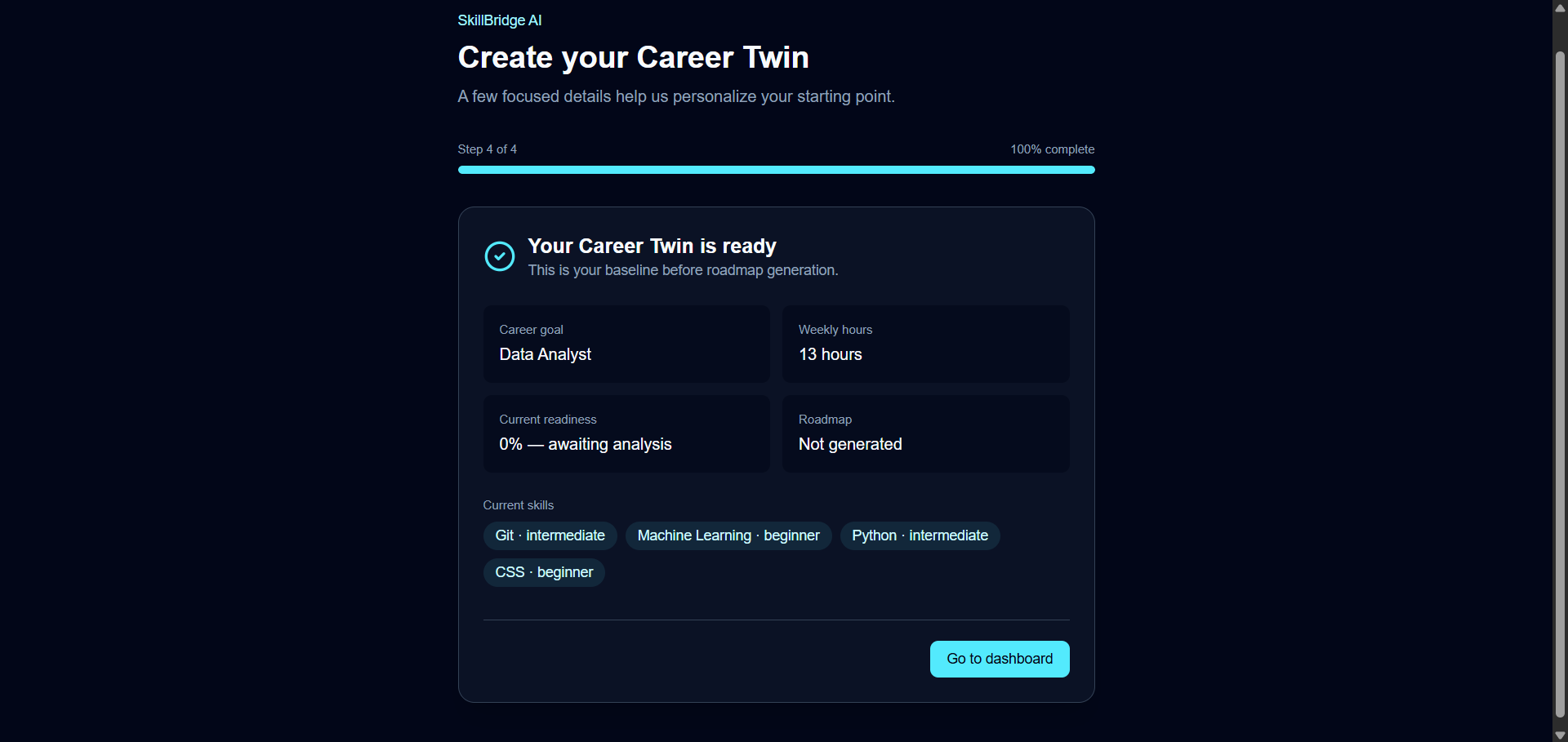
career twin readiness page
-
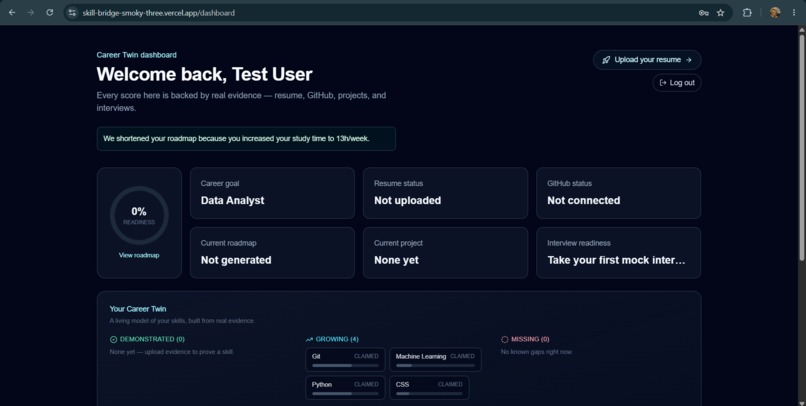
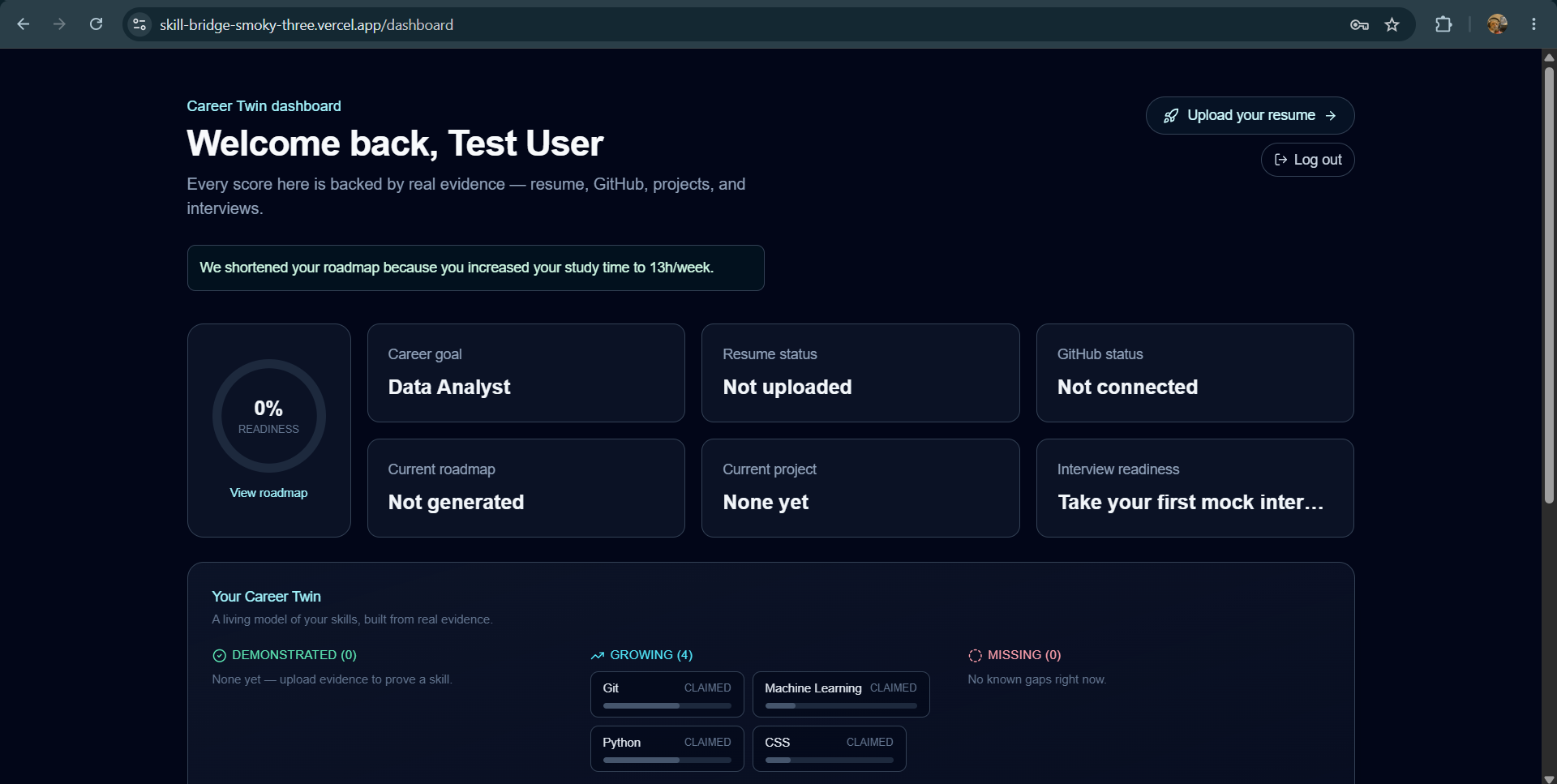
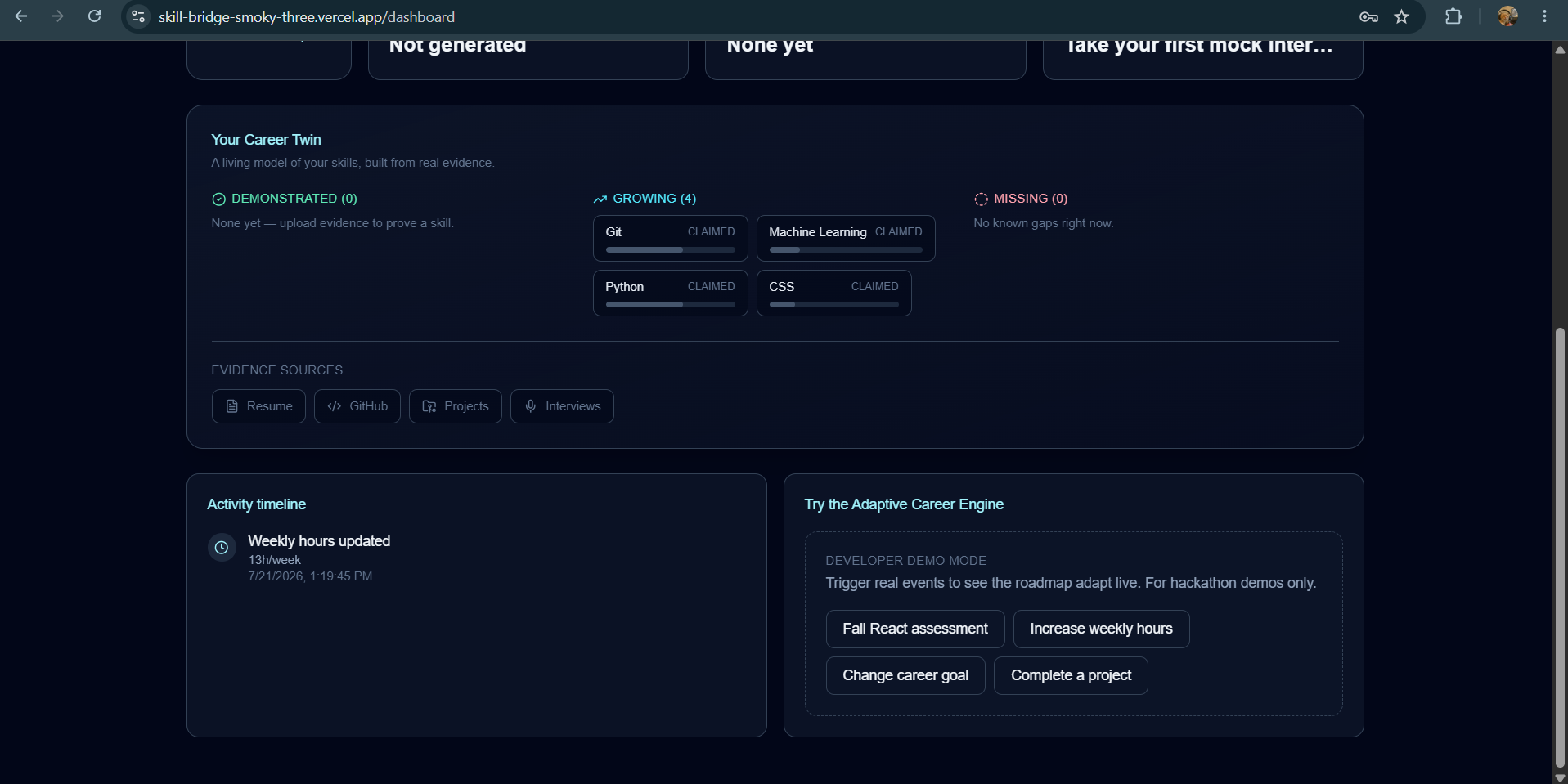
dashboard
-
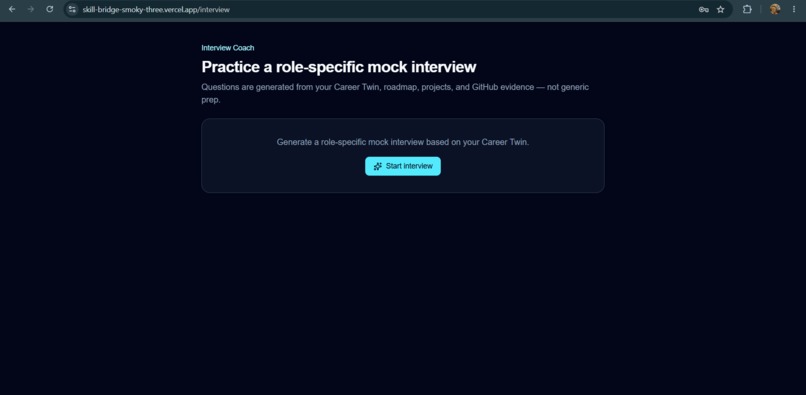
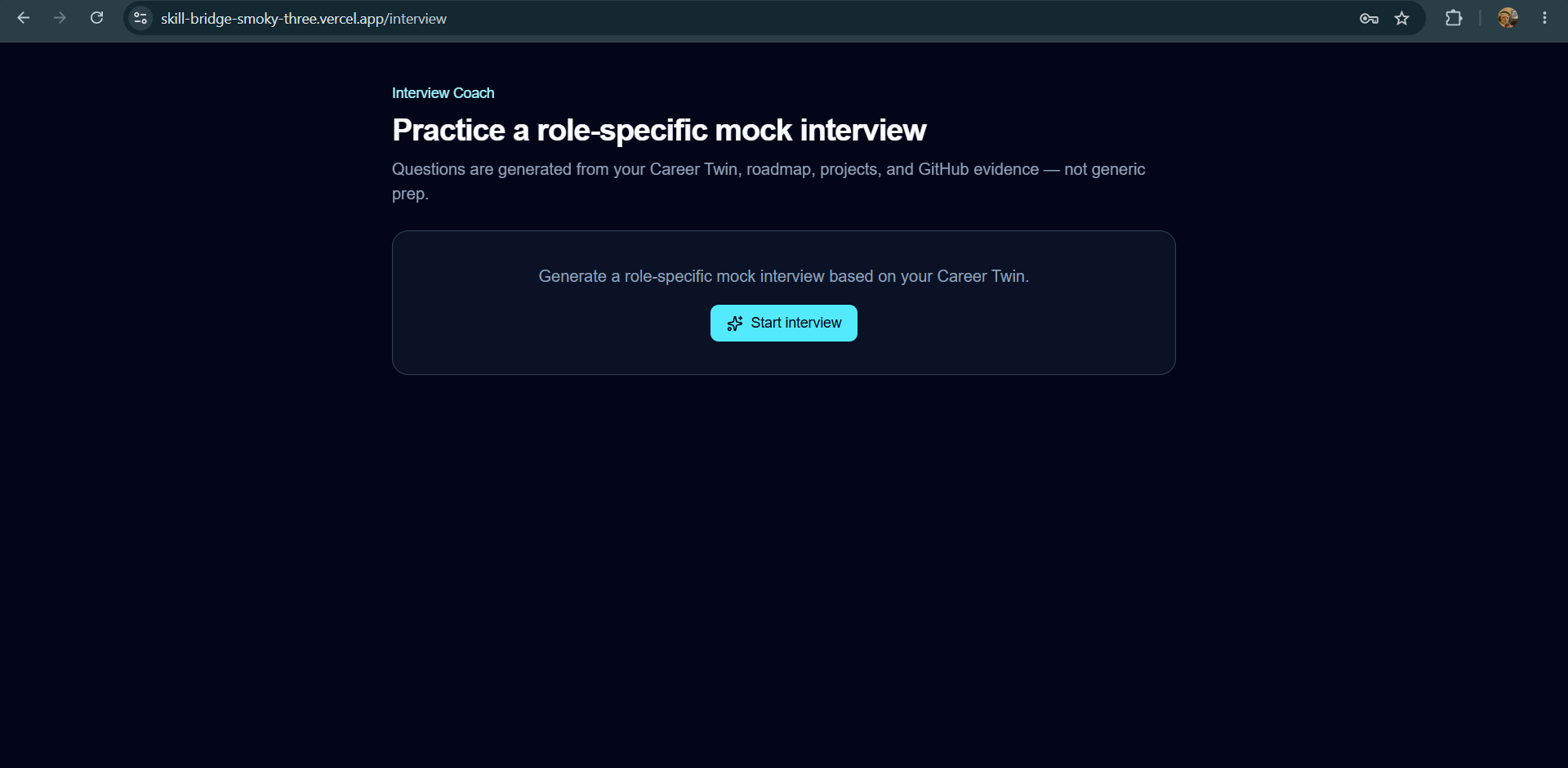
mock interview page
-
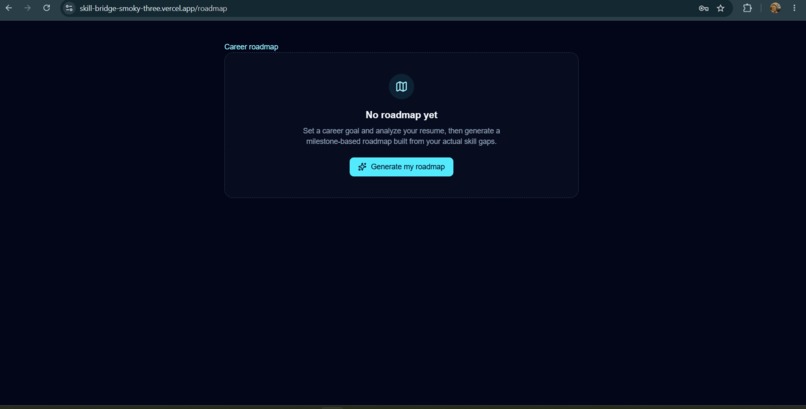
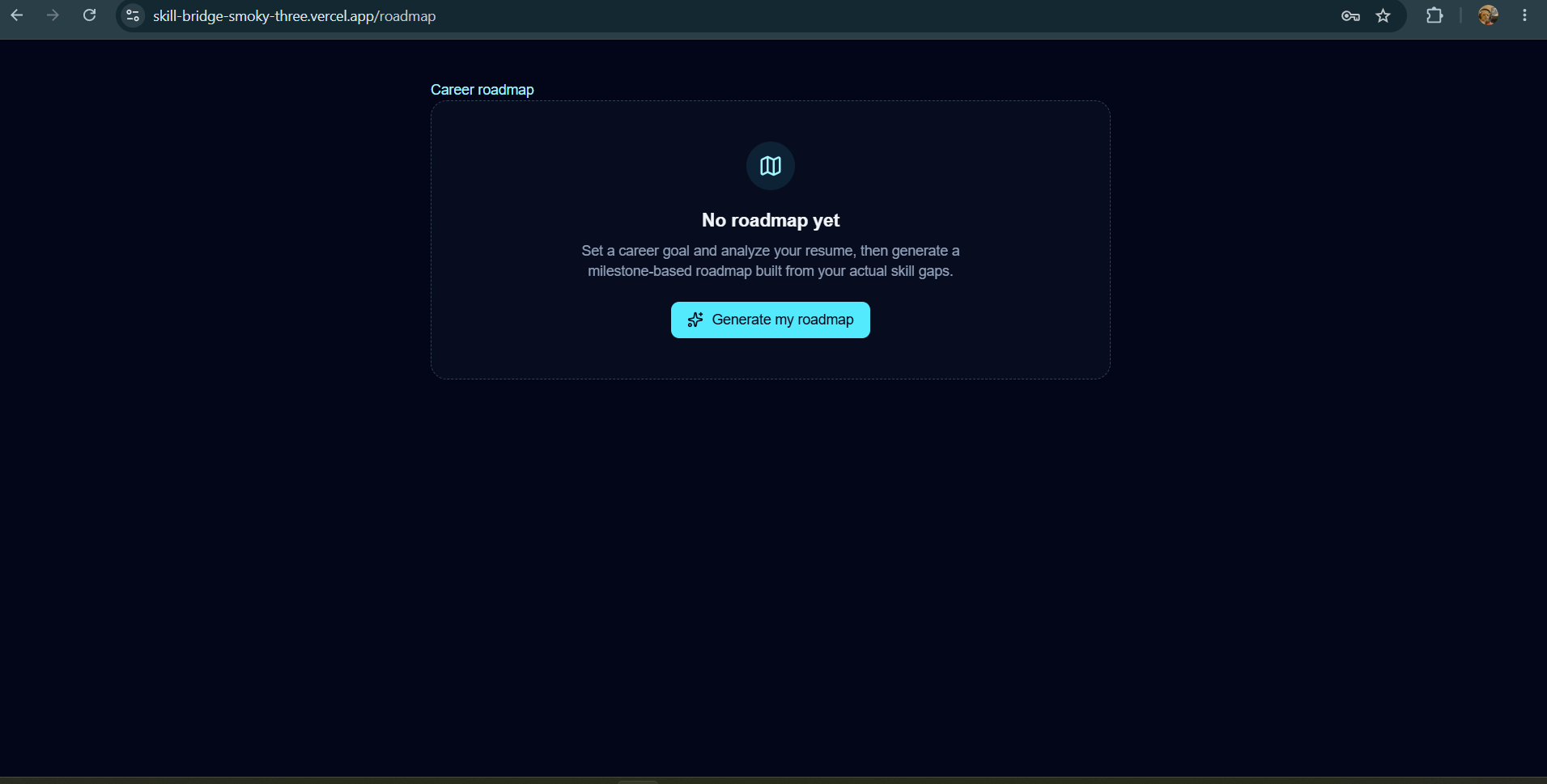
roadmap page
-
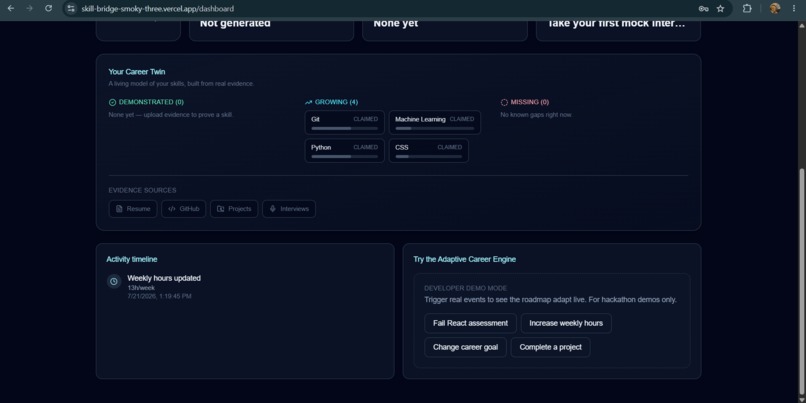
dashboard shwoing mre features
Inspiration
Students often know the career they want, but they don't know the exact steps to get there. Most career platforms provide static roadmaps that don't change when a student learns a new skill, fails an assessment, completes a project, or changes their career goal.
We wanted to build something different — a system that behaves more like a GPS for your career.
That idea led to SkillBridge AI, an Adaptive Career GPS that creates a living Career Twin for every student and continuously adapts their career journey based on real evidence and progress.
What it does
SkillBridge AI builds an evidence-based Career Twin using information from a student's profile, resume, GitHub repositories, projects, assessments, and interviews.
It then:
- Analyzes resumes and extracts claimed and demonstrated skills.
- Analyzes GitHub repositories to identify real-world technical evidence.
- Calculates career readiness and identifies critical skill gaps.
- Generates a personalized, milestone-based career roadmap.
- Dynamically adapts the roadmap when the student's situation changes.
- Generates portfolio-quality projects specifically targeted at missing skills.
- Conducts role-specific AI mock interviews and evaluates performance.
- Uses interview and assessment results as new evidence to improve the Career Twin.
The core idea is simple:
Your career changes. Your roadmap should too.
How we used GPT-5.6
GPT-5.6 was used as the intelligent reasoning layer across SkillBridge AI.
We used it to build specialized AI agents for:
- Resume Intelligence — understanding resumes and identifying claimed versus demonstrated skills.
- GitHub Evidence Engine — interpreting repository information and connecting projects to relevant technical skills.
- Career Planning — helping transform skill-gap information into personalized roadmap recommendations.
- Project Coach — generating portfolio projects designed around the student's highest-priority skill gaps.
- AI Interview Agent — generating role-specific technical, behavioral, and project-based interview questions and evaluating responses.
- Career Adaptation — helping reason about meaningful changes to a student's learning journey when new evidence or events occur.
Rather than allowing AI to directly control the application, we designed the system so that AI agents produce structured outputs that are validated using Zod. Deterministic career engines then handle skill-gap calculations, readiness scoring, roadmap decisions, and database updates.
This creates a reliable architecture where:
AI proposes → Deterministic engines decide → Zod validates → Database updates → Career Twin evolves
How we used Codex
Codex was used as our AI-powered development partner throughout the build.
It helped us rapidly develop and iterate on the full-stack SkillBridge AI application, including:
- Building the Next.js application architecture and API routes.
- Implementing the Career Twin and onboarding flow.
- Developing the Resume Intelligence and GitHub Evidence pipelines.
- Building the deterministic skill-gap and career-readiness engines.
- Implementing the Adaptive Career Engine and event-driven orchestrator.
- Developing the Project Coach and AI Interview workflows.
- Creating Supabase database schemas, migrations, and data relationships.
- Debugging integration issues across Next.js, Supabase, OpenAI APIs, and authentication.
- Reviewing and improving the architecture as new features were added.
Codex allowed us to move from an initial concept to a working, interconnected full-stack product much faster by accelerating implementation, debugging, and iterative development.
The Wow Factor — Adaptive Career GPS
The biggest innovation in SkillBridge AI is that the roadmap is not static.
Imagine a student is preparing to become a Frontend Engineer. They fail a React assessment. Instead of simply showing a low score, SkillBridge updates the student's demonstrated skill level, recalculates the skill gap, identifies which roadmap milestones are affected, and intelligently adapts the plan while preserving completed work.
The same system can react when a student:
- Completes a project.
- Learns a new skill.
- Adds new GitHub evidence.
- Changes their weekly availability.
- Changes their target career.
- Completes or fails an assessment.
- Finishes an AI mock interview.
This creates a continuous loop:
Learn → Build → Prove → Measure → Adapt → Repeat
Challenges we ran into
Building a system that combines AI reasoning with deterministic career logic was one of our biggest challenges. We had to make sure AI-generated outputs were structured, validated, and safe to use rather than allowing an AI model to directly modify critical career data.
We also faced challenges integrating multiple systems — Next.js, Supabase, authentication, OpenAI agents, GitHub APIs, resume processing, database migrations, and an event-driven adaptation engine — into one coherent workflow.
Accomplishments we're proud of
We are proud to have built more than an AI chatbot. SkillBridge AI is an interconnected career intelligence system where multiple features continuously contribute evidence back to one evolving Career Twin.
The most exciting part is the Adaptive Career GPS — the ability to dynamically reroute a student's roadmap based on real progress and setbacks, while preserving their completed achievements.
We also built the entire product with a strong separation between AI reasoning and deterministic business logic, making the system more reliable, explainable, and scalable.
What we learned
We learned that building effective AI products is not only about calling an AI model. The real challenge is designing the system around AI.
We learned how to combine AI agents with structured outputs, validation layers, deterministic algorithms, event-driven architecture, and database systems to create a more reliable AI application.
Using GPT-5.6 helped us explore how intelligent reasoning can personalize complex career decisions, while Codex significantly accelerated the development and iteration process.
Most importantly, we learned that the best AI experiences are not necessarily the ones that simply generate more content — they are the ones that understand context, learn from new evidence, and continuously adapt.
What's next for SkillBridge AI
Our vision is to evolve SkillBridge into a complete Career Operating System for students.
Future plans include deeper integration with learning platforms, job-market data, certifications, internships, real-time labor-market trends, and stronger evidence verification.
Ultimately, we want SkillBridge to become a student's long-term career companion — one that continuously understands their growth, identifies their next opportunity, and guides them toward it.
SkillBridge AI — Your Career. Your Evidence. Your Next Best Move.
Built With
- adaptive-systems
- ai-agents
- career
- claud
- event-driven-architecture
- generative-ai
- github-api
- gpt-5.6
- next.js
- node.js
- openai-api
- openai-codex
- postgresql
- react
- rest-api
- supabase
- tailwind-css
- typescript
- vercel
- zod

Log in or sign up for Devpost to join the conversation.