-
-
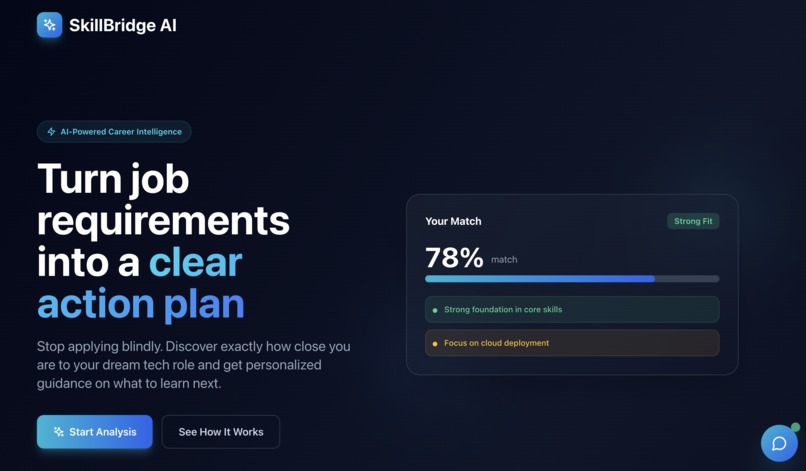
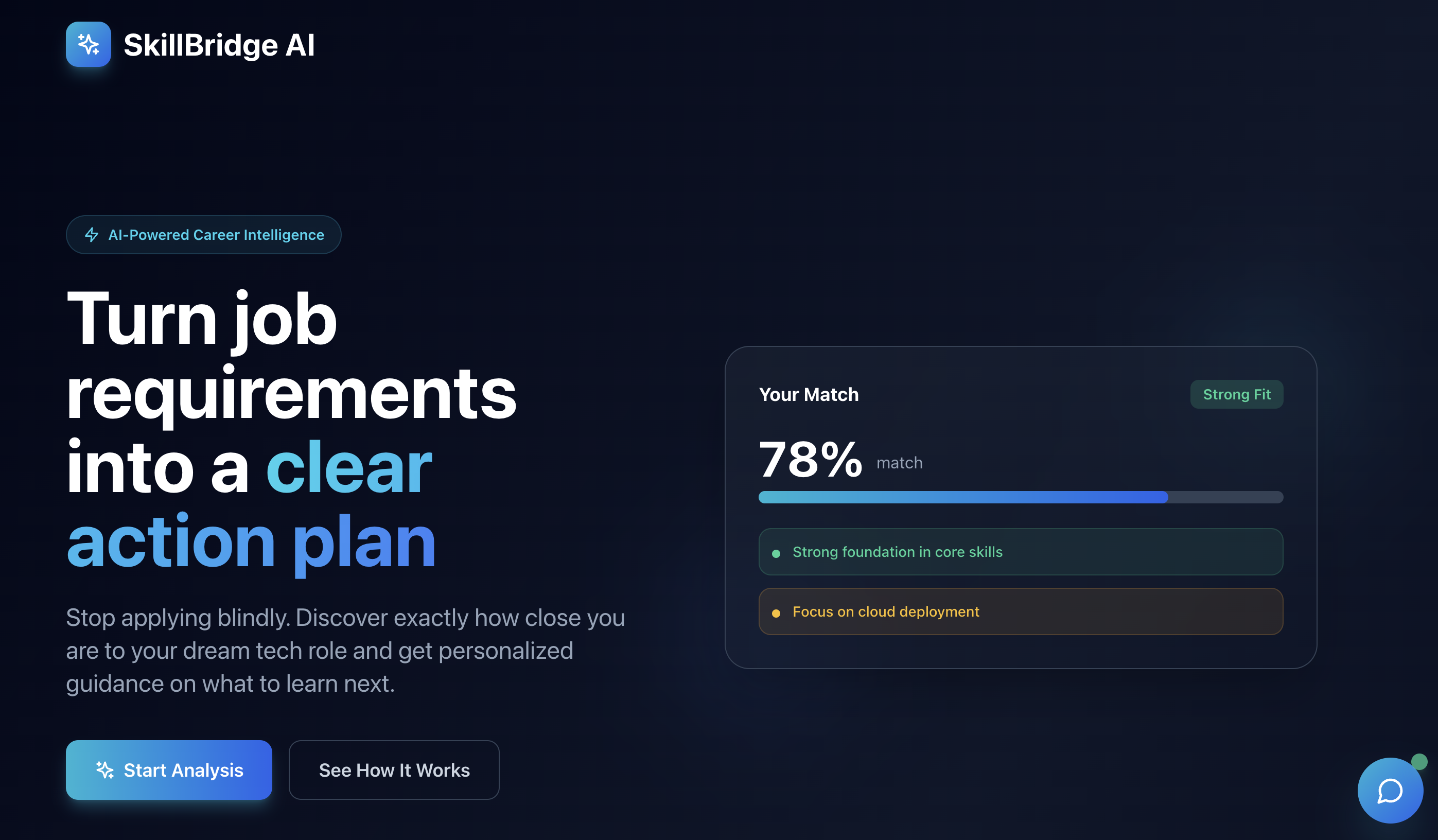
Front Page of SkillBridge AI
Inspiration
For many university students, this happens all the time. Students often apply to many jobs without knowing whether their skills actually match the job requirements. Sometimes, they even apply for roles that are not really what they want, simply because they are unsure which opportunities suit them best.
After sending out many applications, the result can be frustrating — silence. There is usually no feedback explaining why they were not selected or what they could improve.
We realized the core problem is not just sending applications, but understanding how one’s current skills align with job expectations. Students need clear guidance on what they are doing well and what areas they could improve.
This experience inspired us to create SkillBridge AI. Our platform helps students see how their skills match different job roles, identify gaps, and provides practical recommendations — such as learning a skill, completing a certification, or building a project.
By giving students actionable insights, SkillBridge AI aims to make job searching less frustrating and more strategic, helping them approach applications with confidence.
What it does
SkillBridge AI makes job hunting smarter and less stressful for students. Instead of blindly applying to dozens of positions, it helps students focus on the roles they truly want and gives them guidance to improve their chances of landing those jobs.
1. Resume and Skills Matching Upload your resume or enter your skills, and the platform instantly compares them with the job you’re interested in. It shows you what skills you already have that match the role and highlights the gaps you might need to fill.
2. AI Recommendations and Suggestions Based on your skills and the job requirements, our AI generates practical, actionable advice. It might suggest learning a specific skill, completing a certification, or building a mini project to strengthen your profile — helping you improve your chances of landing the job you actually want.
3. Acceptance Rate Tracking SkillBridge AI calculates an acceptance rate for each job based on how well your skills align with the requirements. As you follow the AI’s recommendations and update your profile, the acceptance rate is automatically recalculated, giving you a clear view of your progress and readiness.
4. Chatbot Assistant for General Enquiries Have questions about the platform or career planning? Our chatbot assistant is there 24/7 to answer general enquiries, guide you through the features, and help you get the most out of SkillBridge AI.
With all these features, SkillBridge AI doesn’t just tell you where you stand — it guides you on what to do next, making job searching more confident, strategic, and effective.
How we built it
SkillBridge AI was built to guide students through the entire job preparation workflow: from uploading their resume and entering skills, to comparing them with job requirements, receiving AI-driven recommendations, tracking acceptance rates, and getting support from a chatbot assistant. To make this seamless experience possible, we combined modern web technologies with intelligent AI features:
1. Frontend (User Interface)
We used React with TypeScript (.tsx) to design a clean, intuitive interface where students can upload their resumes, enter their skills, and view recommendations. Bolt helped us streamline UI components, making the platform interactive and user-friendly.
2. Backend (Server & Database) We powered the backend using Supabase Edge Functions to handle resume processing, skill comparison, and AI requests. Supabase also manages our database, storing user profiles, job information, and tracking acceptance rates.
3. Core Logic & AI Integration The system’s “brain” analyzes user skills against job requirements and generates actionable recommendations. We integrated AI models via APIs to provide personalized guidance, helping students identify missing skills and plan practical steps to improve.
4. Continuous Feedback As students update their profiles or follow AI recommendations, the platform recalculates their acceptance rate for each job. This allows students to see their progress over time and better understand which areas to focus on.
5. Chatbot Assistant We also included a chatbot feature to answer general enquiries and guide users through the platform, ensuring students can easily get help whenever they need it.
By combining these technologies, we were able to create a platform that is interactive, intelligent, and user-centered, giving students actionable insights to approach job applications with confidence.
Challenges we ran into
Building SkillBridge AI came with its fair share of challenges. One of the biggest hurdles was connecting the AI system to our web platform. Initially, integrating the AI APIs with our frontend and Supabase backend was tricky — we had to ensure that user inputs from the website could be correctly processed, sent to the AI models, and the responses displayed in real-time.
Another challenge was making the AI recommendations practical and student-friendly. It was not enough for the AI to just identify missing skills; the suggestions needed to be actionable, realistic, and tailored to each student’s profile. Crafting the prompts and processing the responses took several iterations to get right.
We also faced challenges in tracking the acceptance rate dynamically. As students updated their skills or followed AI recommendations, the system had to recalculate their chances for each job accurately. Ensuring that this feedback loop worked smoothly required careful coordination between the frontend, backend, and database.
Despite these challenges, overcoming them taught us a lot about full-stack development, AI integration, and designing user-focused systems. Each obstacle pushed us to refine our workflow and ultimately helped us create a more robust and reliable platform.
Accomplishments that we're proud of
🎉One thing we're really proud of is turning our idea into a working prototype within the hackathon timeframe Our initial concept was different, but as we explored the problem space and discussed feedback, we realized there was a stronger opportunity in helping students understand their job readiness. Because of that, we pivoted and focused on building SkillBridge AI, a system that helps students compare their skills with job requirements and clearly see what they need to improve. Watching the idea evolve during the hackathon and eventually become a working prototype was a big milestone for our team.
💡Another highlight was integrating AI-generated recommendations. Instead of just telling users which skills they are missing, the system suggests possible next steps such as learning specific technologies, building projects, or improving certain competencies. This makes the output much more practical and helps transform raw skill gaps into actionable guidance.
🖥️From a technical perspective, we were able to build a functional full-stack prototype. The frontend allows users to explore roles and input their skills through a clean and intuitive interface, while the backend handles the skill comparison logic and recommendation generation. Getting all these components to work together smoothly within a short time was something we were really happy about.
🤗Most importantly, we're proud that our project focuses on solving a real problem faced by many students. Job descriptions often list many requirements, but students rarely know how close they actually are to qualifying. SkillBridge AI helps remove that uncertainty by providing clear, data-driven insights that can guide students in planning their learning and career development.
What we learned
Working on SkillBridge AI was a journey full of both technical challenges and personal growth. All of us had our first hackathon experience, and stepping into this fast-paced environment was both exciting and daunting. Despite being new to hackathons, we learned how to bring an idea to life, piece by piece, and how to work together as a team to make it happen.
📖Technical Learnings This project gave us real, hands-on experience with full-stack development. We built the frontend with React/TypeScript, structured and managed data in Supabase, and integrated AI APIs to provide personalized recommendations. Adding the dynamic acceptance rate system was especially rewarding — it taught us how to track student progress in real-time and give instant feedback as they improved their skills.
🤝 Soft Learnings
On the teamwork side, this project pushed us to communicate clearly, collaborate effectively, and solve problems creatively. Working across frontend, backend, AI, and design meant constantly coordinating and iterating together. We also learned the importance of user-centered thinking, making sure every feature we built actually helped students navigate the job market more confidently and strategically.
Overall, we came away with incredible experience, learning technical skills, teamwork, and how to tackle challenges under pressure — lessons that will stay with us beyond this project.
What's next for SkillBridge AI
We’re just getting started! Next, SkillBridge AI will evolve to give students even smarter guidance, real-world skills, and certified learning opportunities. Here’s what we plan to do:
Expand AI Recommendations Include more personalized guidance based on industry trends, internship opportunities, and project suggestions tailored to students’ goals.
Offer Certified Lessons Partner with online learning platforms to provide certified courses that help students close skill gaps identified by the AI, boosting their acceptance rates.
Enhance the Chatbot Make the assistant smarter, able to answer more detailed questions about career planning and application strategies.
Add More Data Sources Integrate real-time job postings and skill requirements to keep students updated with the latest opportunities.
Mobile App Version Develop a mobile-friendly version so students can access their progress and recommendations anytime, anywhere.
With these improvements, SkillBridge AI aims to become an even more comprehensive career companion, guiding students from skill assessment to landing the job they truly want.
Built With
- bolt
- chatgpt
- claude
- gemini
- github
- react
- supabase
- typescript


Log in or sign up for Devpost to join the conversation.