Inspiration
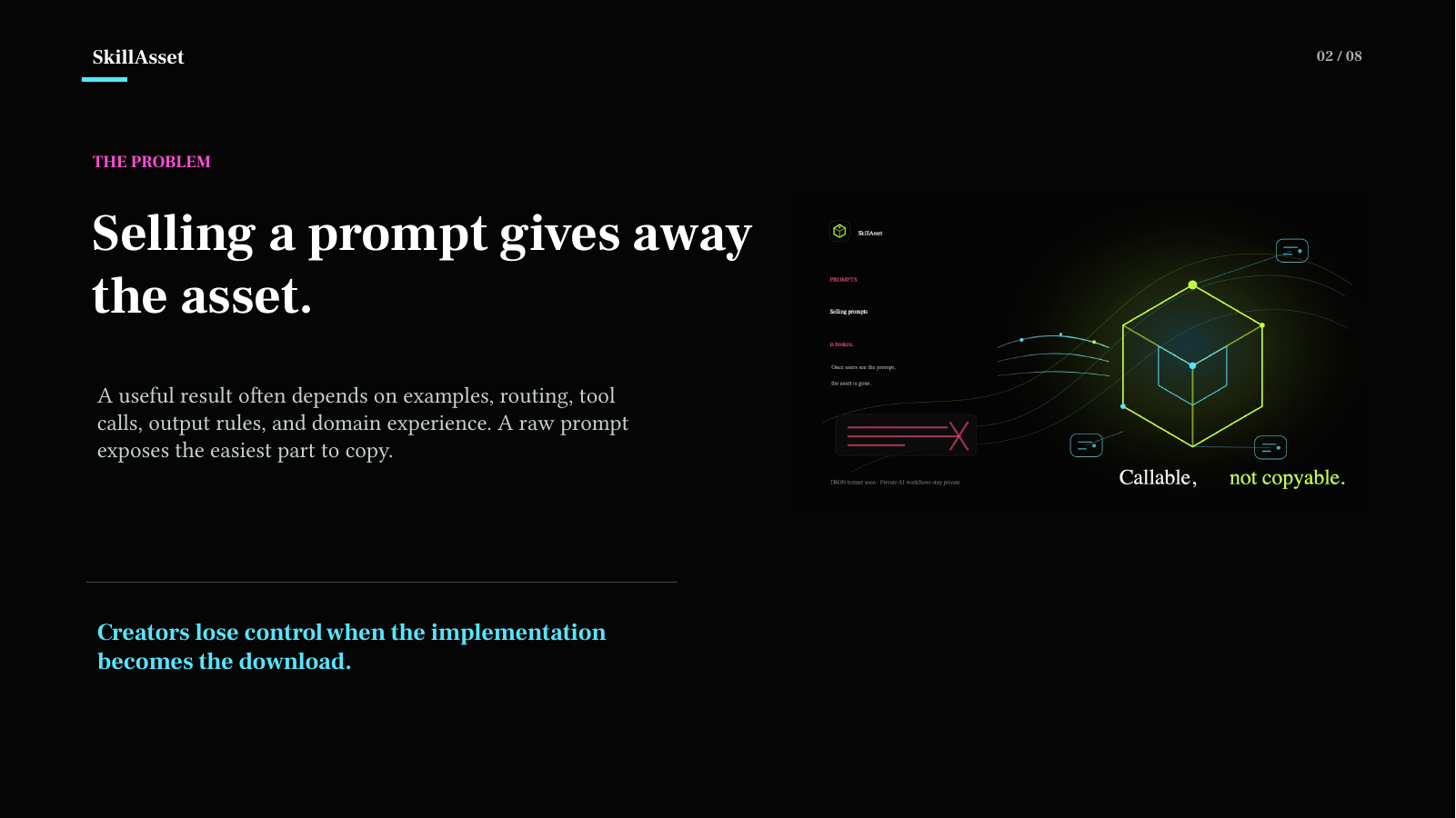
Selling prompts has a structural problem: once a customer receives the prompt, the creator no longer controls the asset. The prompt can be copied, shared, modified, or used outside the original transaction.
But in many cases, users do not actually want to buy a text file. They want the result of a useful workflow, such as reviewing a contract, analyzing research, generating a report, or completing a domain-specific task.
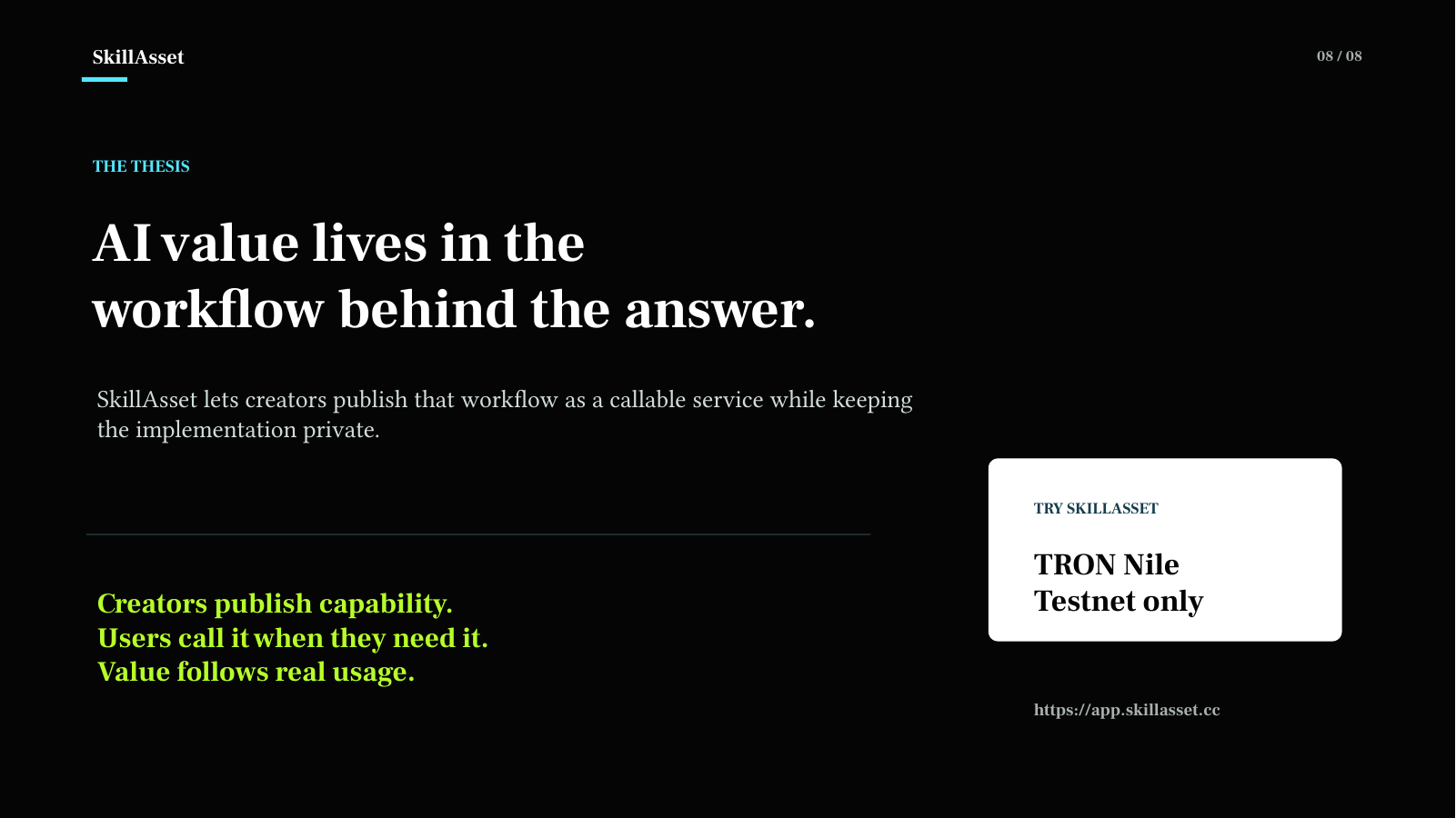
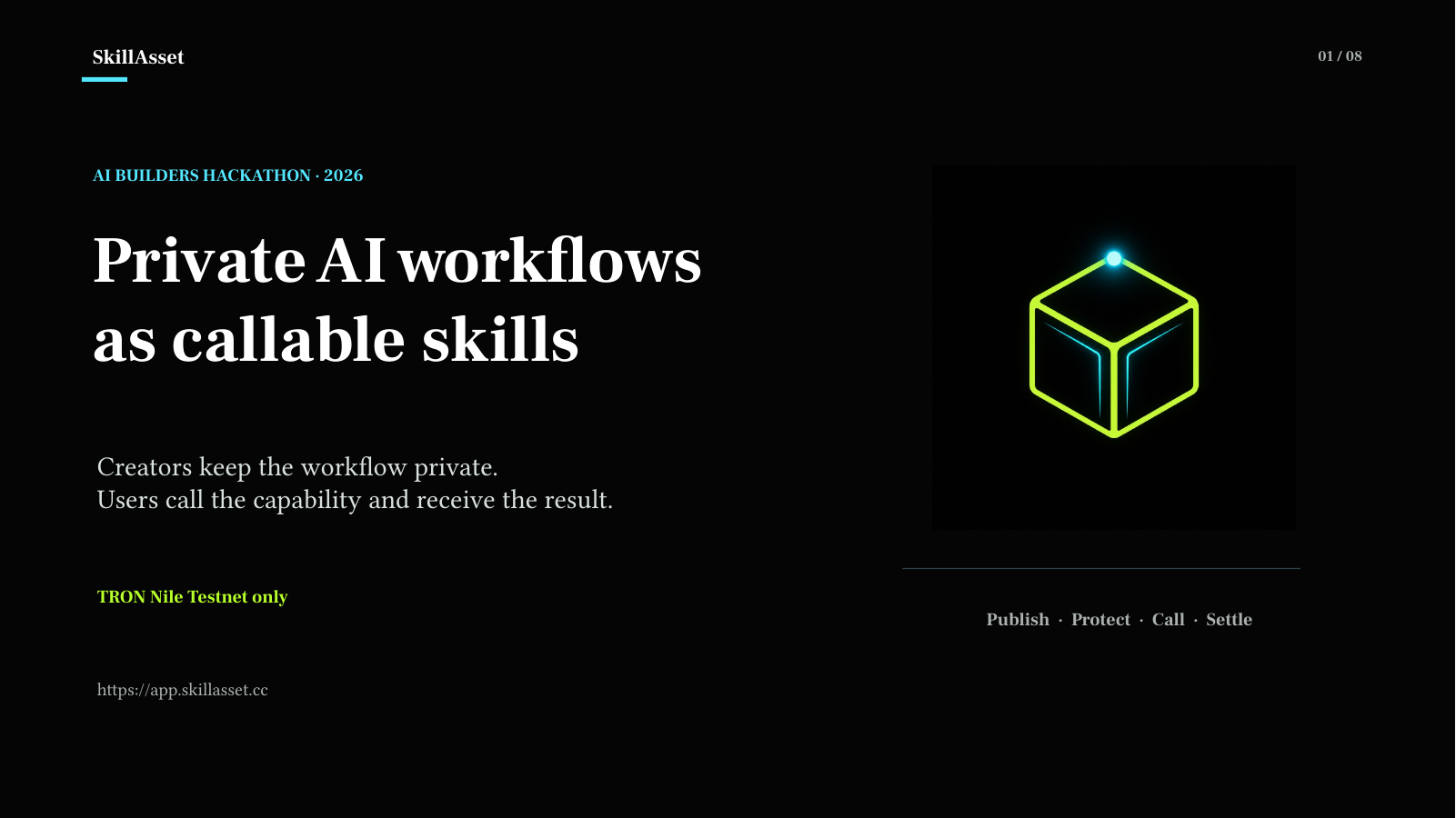
This led us to build SkillAsset: a platform where creators can publish private AI workflows as callable skills. Users can access the capability and receive the result without receiving the original prompt or workflow.
What We Built
SkillAsset combines three parts:
- A marketplace for discovering and calling AI skills.
- A server-side runtime that keeps creator workflows private.
- Usage-based accounting for users, creators, and the platform.
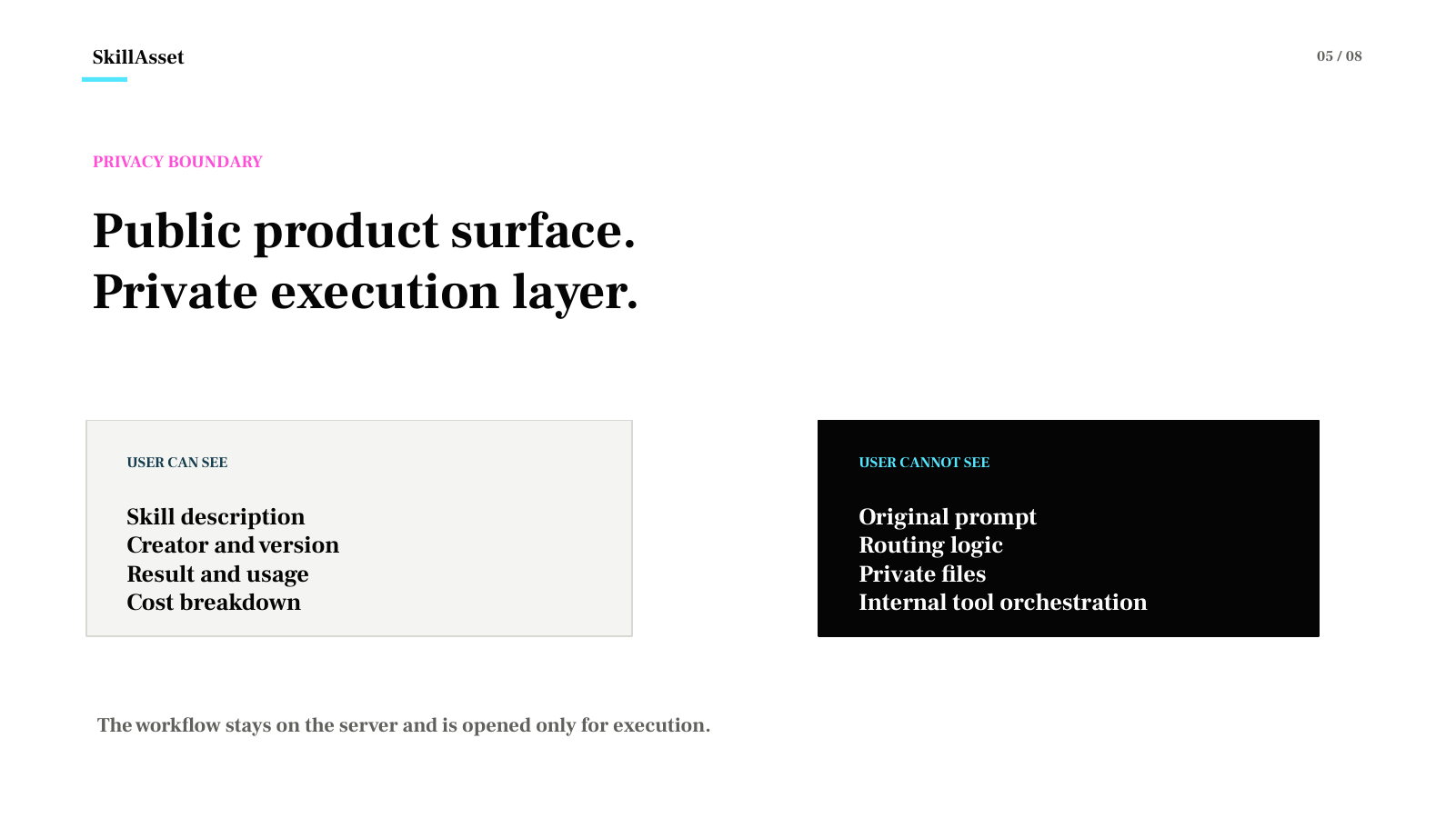
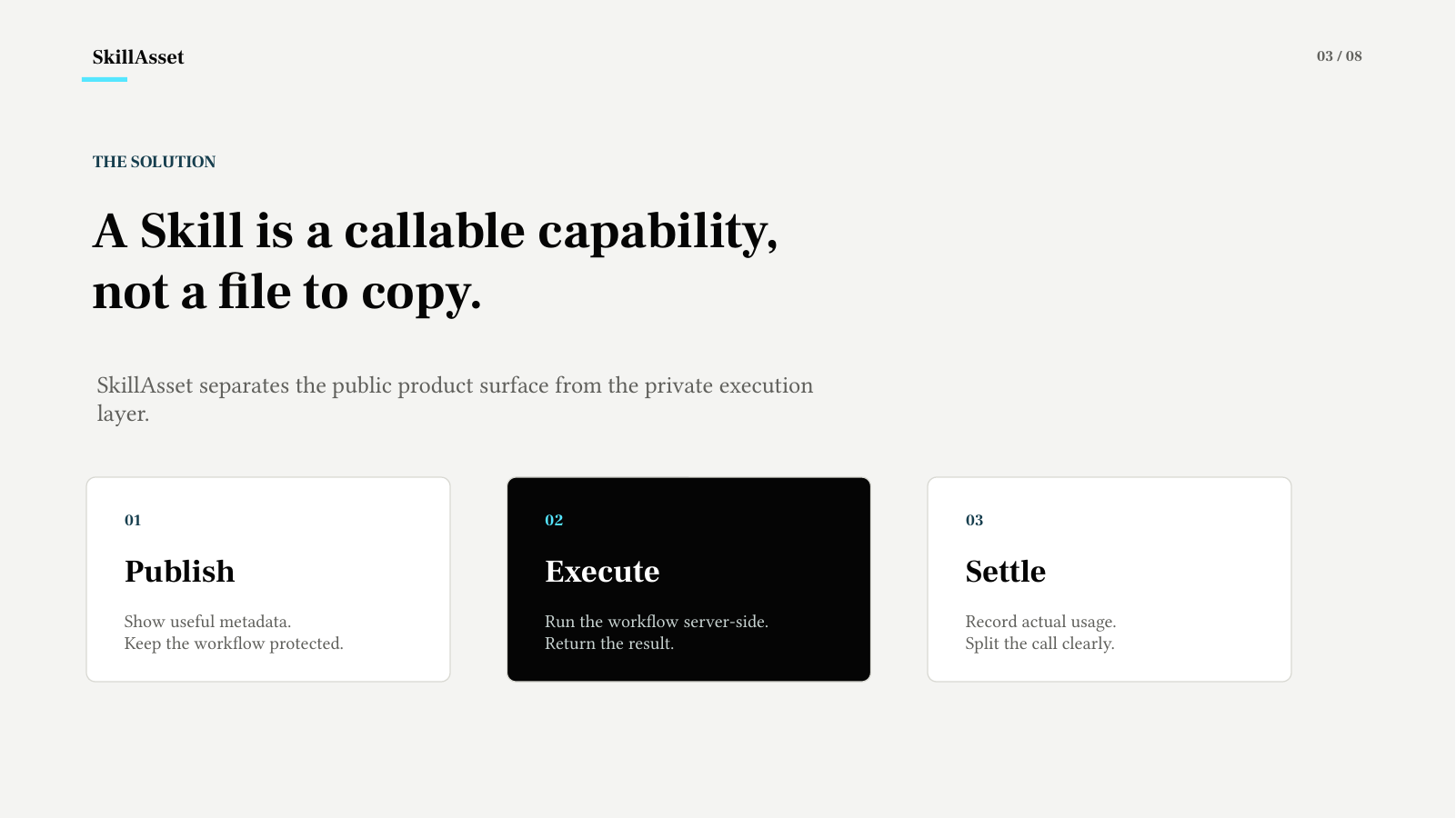
Creators publish a skill with its instructions and workflow protected on the server. Users select a skill, submit a task, and receive the generated result. The browser only receives the public skill information, the user input, and the final response.
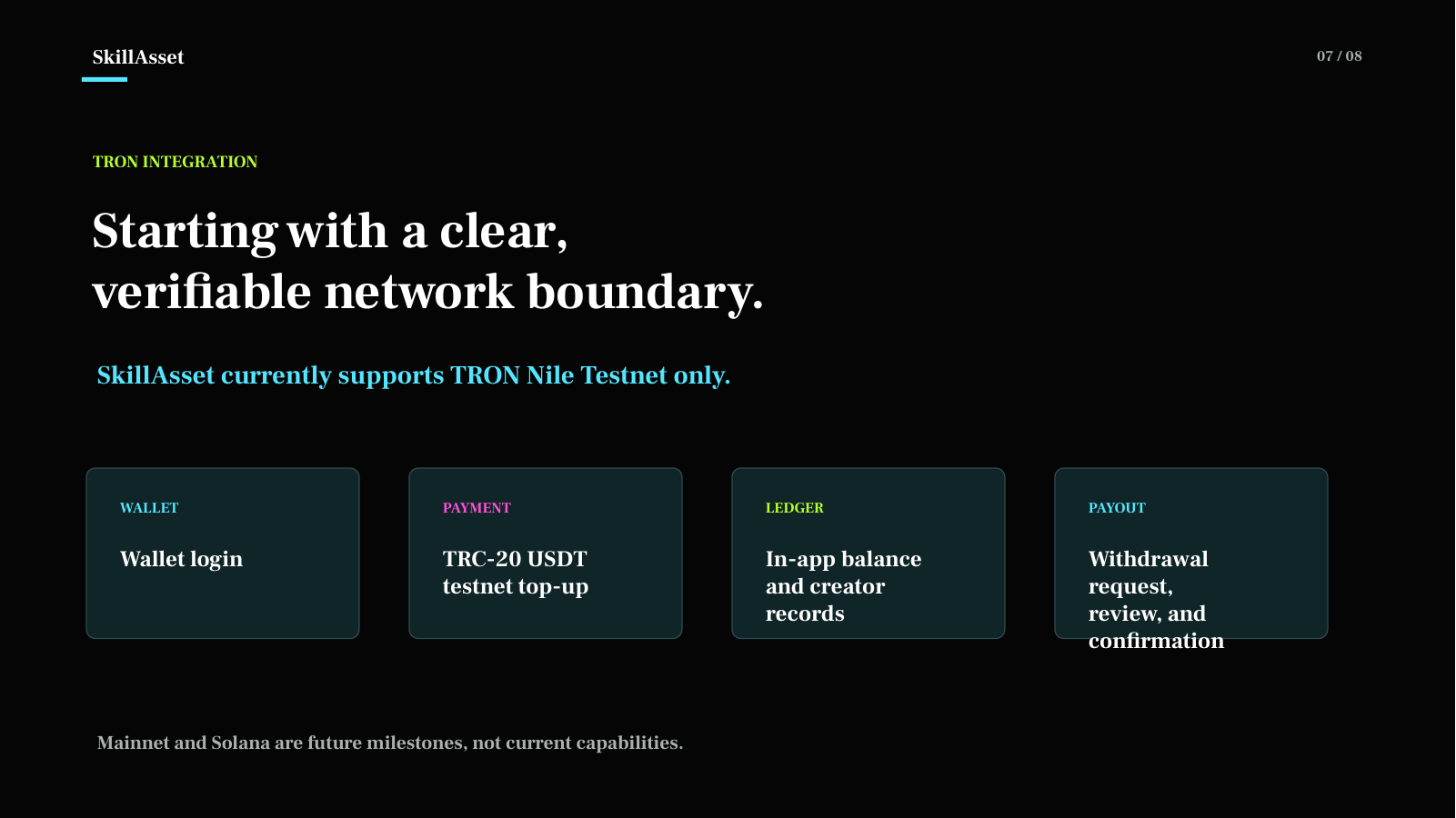
The current product is available on TRON Nile Testnet only. TRON is used for wallet login, TRC-20 USDT testnet top-ups, balance management, creator income records, and withdrawal flows.
How It Works
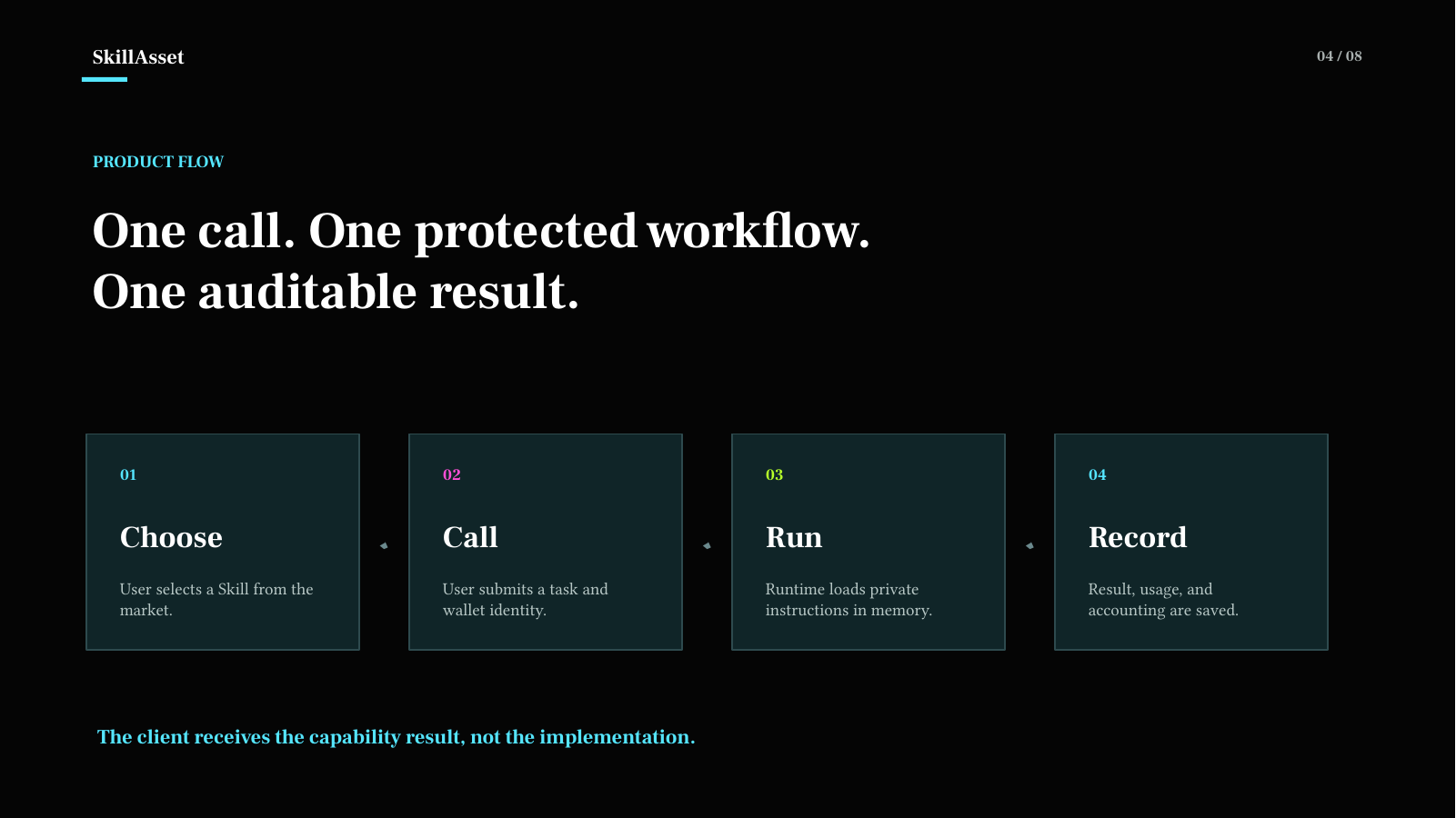
- A creator publishes an AI workflow as a Skill.
- The Skill content is encrypted and stored on the server.
- A user selects the Skill and submits a request.
- The server loads the protected workflow in memory.
- The AI model executes the workflow without exposing its internal instructions.
- The user receives the result.
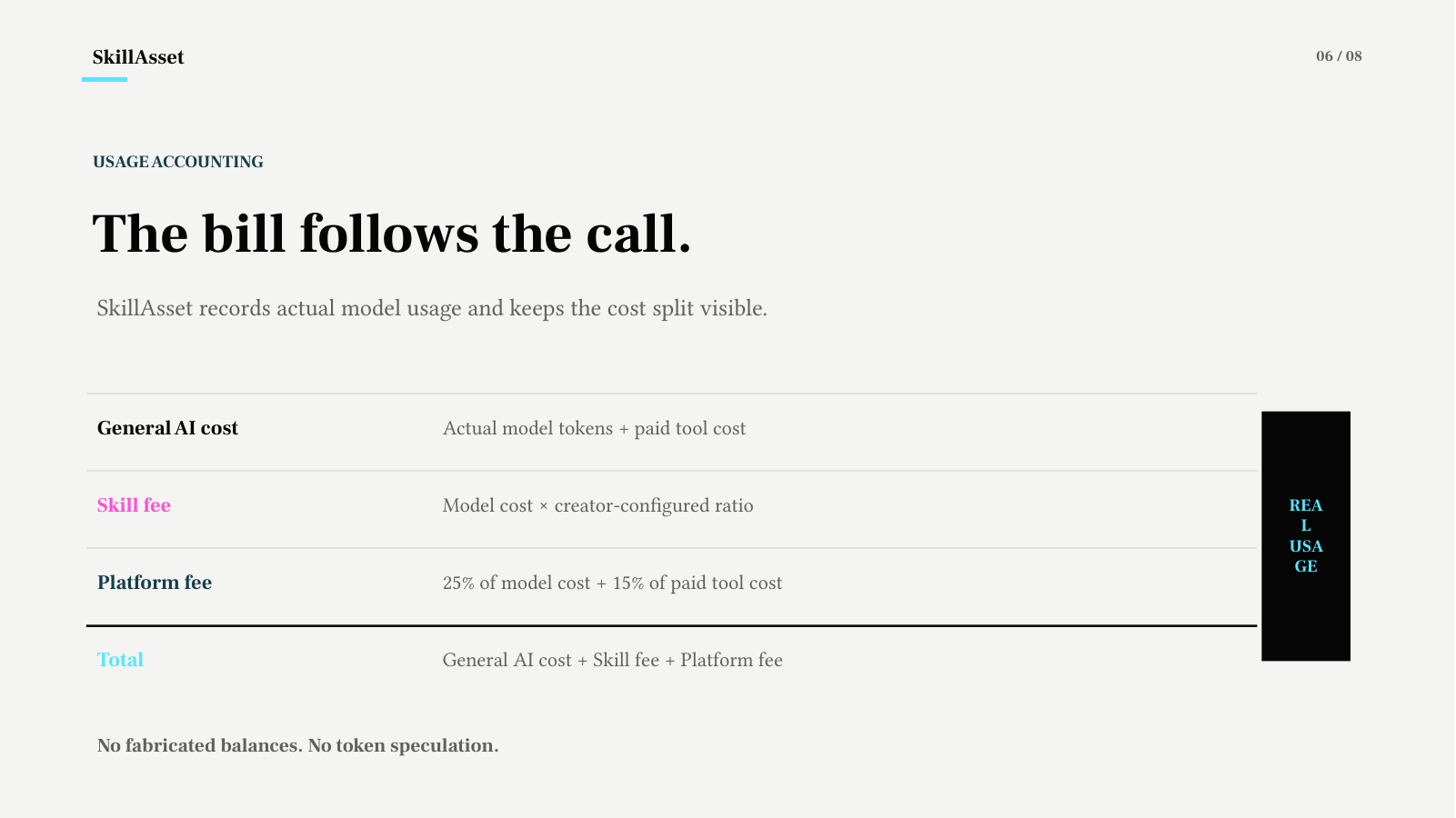
- The platform records the actual usage and separates the model cost, Skill fee, and platform fee.
The core design principle is simple:
Users pay to use a capability. They do not need to receive the implementation behind it.
How We Built It
The project uses a Node.js backend and a browser-based frontend. The backend handles Skill storage, black-box execution, output protection, wallet-related flows, and usage accounting.
Skill content is encrypted at rest and only opened during server-side execution. Public API responses are built from an allowlist so that private prompts, workflow instructions, and internal implementation details are not returned to the client.
Usage accounting is based on the actual model usage returned by the provider. The platform also records the configured Skill cost and platform cost for each completed call.
For this submission, we focused on making the complete product flow easy to understand and test:
- Discover a Skill.
- Submit a real task.
- Receive a structured result.
- Verify that the original workflow remains private.
- Review the usage and accounting information.
- See the current TRON Nile Testnet status.
What We Learned
The most important lesson was that the valuable part of an AI product is often not the prompt itself. It is the collection of decisions behind the prompt: examples, output rules, domain knowledge, tool usage, and corrections from repeated testing.
We also learned that privacy cannot be treated as a single feature. It must be considered across storage, execution, model output, API responses, logging, and billing. A workflow may remain private in storage but still leak through an error message or an unfiltered model response.
Another lesson was that payment and usage tracking need to be part of the product design from the beginning. If a creator is providing a reusable capability, the platform needs a clear way to measure calls, calculate costs, and record creator income.
Challenges
The main technical challenge was keeping the workflow private while still allowing the AI model to use it effectively. The runtime must provide enough internal context for the model to produce a useful answer, while preventing private instructions from appearing in the final response.
We also had to separate public metadata from private execution data. Users need to understand what a Skill does before calling it, but they should not need to see every implementation detail behind it.
Another challenge was representing blockchain-related payments honestly. The current version uses TRON Nile Testnet to validate wallet and testnet USDT flows. We do not present the testnet system as a production mainnet settlement network, and we do not claim automatic on-chain revenue distribution.
What's Next
The next milestones are to collect feedback from creators and test users on TRON Nile Testnet, improve workflow protection and accounting reliability, and prepare the platform for future TRON mainnet support.
The longer-term goal is to make specialized AI workflows easier to publish, call, and improve without forcing creators to give away the workflows they spent time developing.
Try SkillAsset:
Built With
- ai
- anthropic
- api
- app
- artificial
- blockchain
- css
- express.js
- html
- intelligence
- javascript
- llm
- nile
- node.js
- openai
- prompt
- rest
- sqlite
- testnet
- trc-20
- tron
- tronlink
- usdt
- web
- workflow

Log in or sign up for Devpost to join the conversation.