SkillNest: Your AI Content Creation Co-pilot
Inspiration
The inspiration behind SkillNest arose from a critical observation: current large language models (LLMs) often struggle to generate truly nuanced, context-aware, and personalized content without extensive, manual prompt engineering. Users frequently encounter generic or unsuitable outputs when simply asking an AI to perform complex tasks, such as “writing a Twitter thread” or “creating a YouTube script.” This limitation stems from the AI’s lack of persistent memory and inherent context regarding specific user needs, brand voice, or real-world events (like the FIFA World Cup mentioned in the audio). We envisioned a solution that bridges this gap, enabling AI agents to operate with a deeper understanding and deliver highly customized, relevant content. The goal was to empower content creators by providing a tool that transforms generic AI interactions into highly effective, context-rich collaborations.
What it does
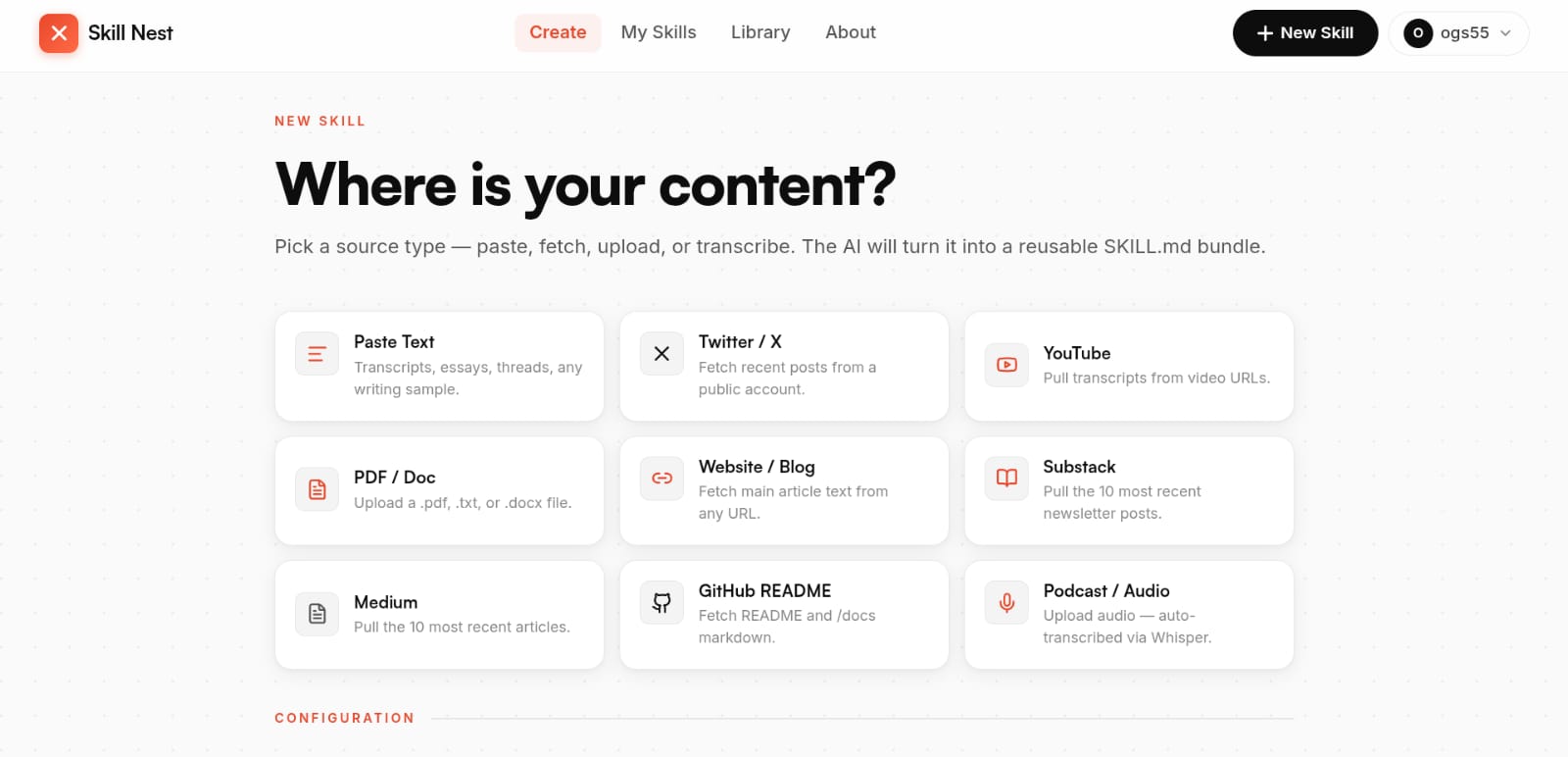
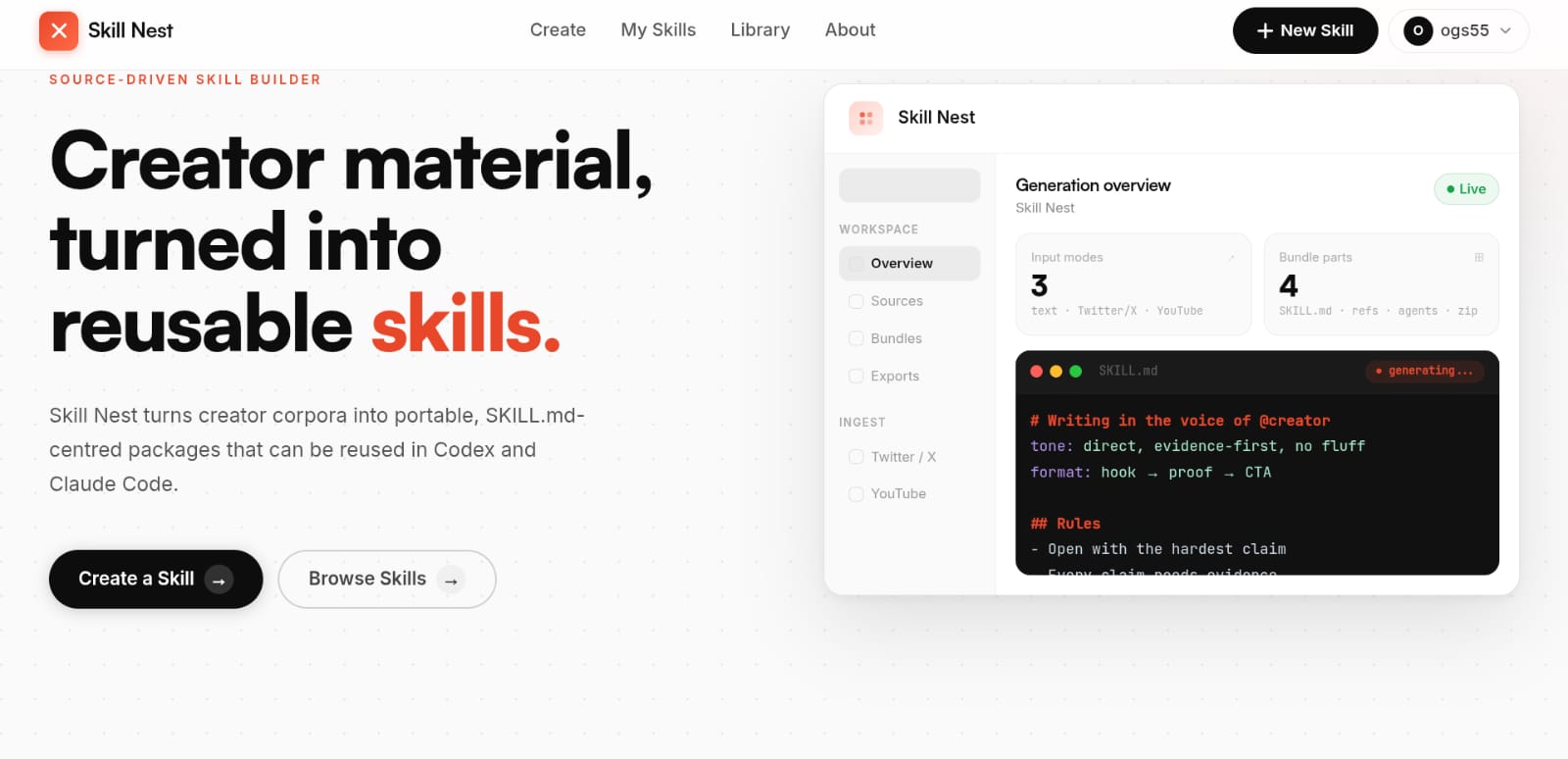
SkillNest is a powerful content creation co-pilot that enhances the capabilities of AI agents by providing them with structured context and operational frameworks. It streamlines the process of generating high-quality, customized content across various platforms. Key functionalities include:
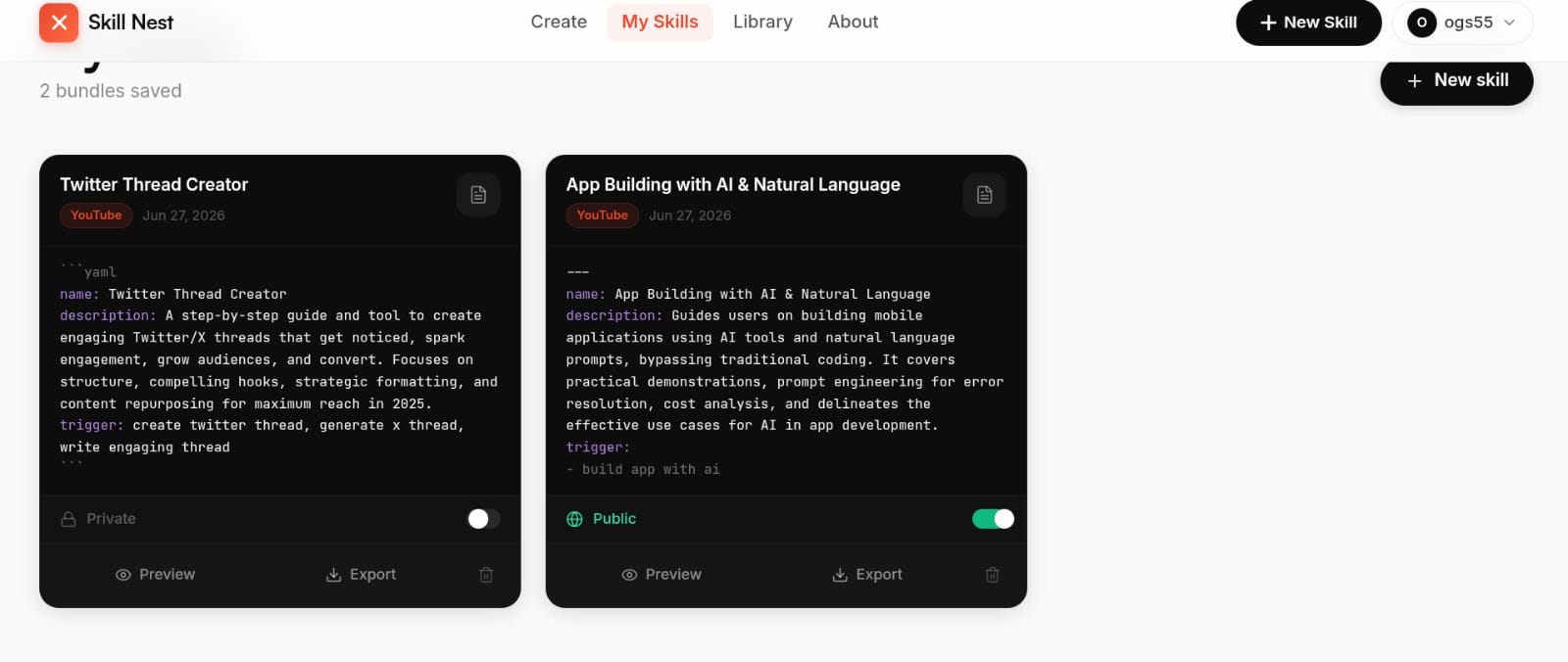
- Contextual Skill Generation: Creates
skill.mdfiles that embed specific instructions, persona details, and contextual information directly into AI agents, ensuring outputs are aligned with user intent. - Framework Definition: Develops
framework.mdfiles to guide AI agents through multi-step content creation processes, such as outlining, drafting, and refining, ensuring a consistent and logical flow. - Example-Based Learning: Generates
example.mdfiles that provide AI agents with concrete examples of desired output styles, tones, and formats, significantly improving the quality and relevance of generated content. - API Integration Configuration: Produces
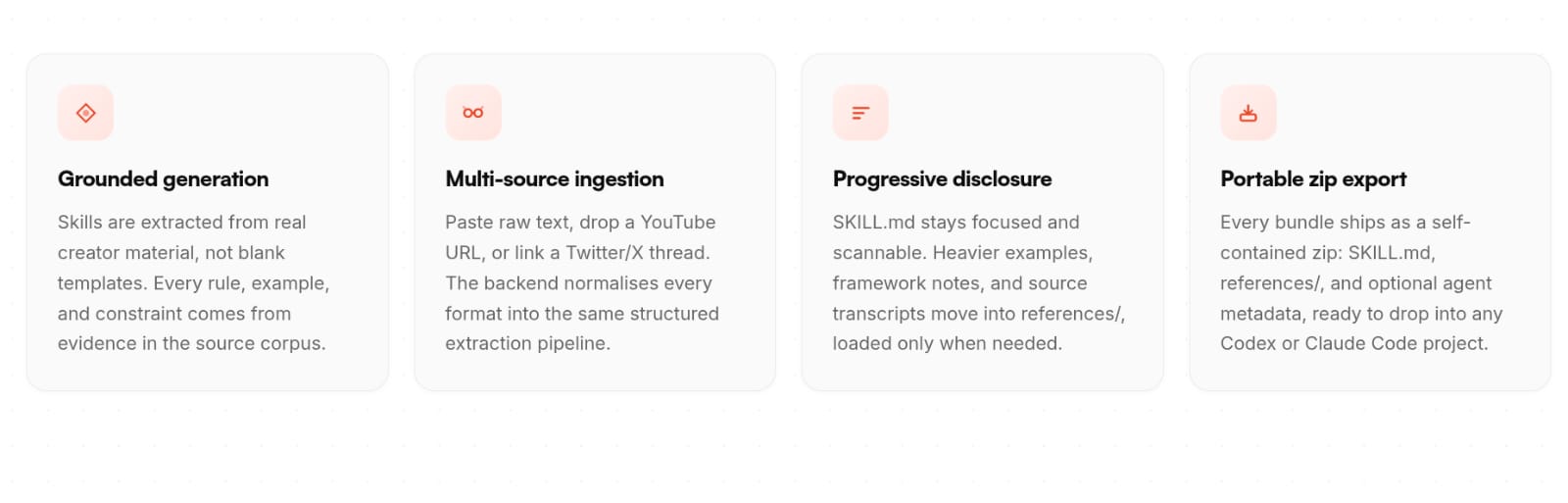
openai.yamlfiles (or similar configurations for other LLM providers) that define API parameters, model choices, and other technical specifications for seamless integration with various AI platforms. - Automated Content Pipeline: Orchestrates a pipeline that takes raw input (e.g., a YouTube video transcript), processes it, and generates a complete set of skill files ready for deployment to an AI agent.
- Platform Agnostic Export: Allows users to export generated skill sets as a ZIP archive, compatible with a wide range of AI platforms like Claude, Codex, and others, facilitating broad applicability.
- Customizable Content Generation: Empowers users to create custom content, such as Twitter threads, YouTube scripts, blog posts, or marketing copy, with their own context and specific requirements, moving beyond generic AI responses.
How we built it
SkillNest was developed as a full-stack application with a strong emphasis on seamless integration with AI platforms and an intuitive user experience for content creators. The architecture is designed to efficiently process user inputs, generate structured AI context files, and facilitate easy export for deployment.
Key technologies and architectural components include:
- Frontend: A user-friendly web interface, likely built with modern JavaScript frameworks (e.g., React, Vue, Angular) to provide an interactive experience for defining content requirements and managing skill sets. TailwindCSS or similar utility-first CSS frameworks would be used for rapid and responsive UI development.
- Backend: A robust API layer handles user authentication, data storage for skill definitions, and orchestrates the AI context generation pipeline. This includes processing raw text inputs (like YouTube transcripts) and dynamically generating the various
.mdand.yamlfiles. Modern authentication methods would be implemented for secure access. - AI Integration Core: The core logic involves sophisticated prompt engineering and templating to translate user requirements into the structured
skill.md,framework.md,example.md, andopenai.yamlfiles. This system is designed to be flexible, allowing for integration with various LLM providers beyond just OpenAI. - File Generation and Export Module: A dedicated module is responsible for dynamically creating the required Markdown and YAML files based on the processed data and then packaging them into a convenient ZIP archive for download and deployment to external AI platforms.
- Database: A secure and scalable database solution stores user-defined skill templates, content inputs, generated skill sets, and configuration details, ensuring data integrity and efficient retrieval.
Challenges we ran into
Developing SkillNest presented several unique challenges:
- Translating Natural Language to Structured AI Context: The primary challenge was designing a system that could effectively translate a user's natural language content goals and preferences into the highly structured and precise
skill.md,framework.md, andexample.mdformats required by AI agents. This involved intricate parsing, semantic understanding, and templating to ensure the generated context was both accurate and effective. - Ensuring LLM Compatibility and Flexibility: Building a solution that is compatible with a wide array of LLMs (Claude, Codex, OpenAI models, etc.) while maintaining consistent performance and output quality was complex. This required a flexible architecture for generating
openai.yaml(or equivalent) configurations that could adapt to different API specifications and model capabilities. - Managing Contextual Depth and Specificity: Balancing the need for comprehensive context with the risk of overwhelming the AI agent with too much information was a delicate act. We had to develop mechanisms to ensure the generated skills provided sufficient depth for nuanced content creation without leading to token limits or diluted instructions.
- User Experience for Complex Workflows: Designing an intuitive user interface that simplifies the creation of complex AI content workflows was crucial. The challenge was to abstract away the underlying technical complexities of prompt engineering and file generation, making it accessible to content creators without deep AI expertise.
Accomplishments that we're proud of
We are particularly proud of several key accomplishments with SkillNest:
- Democratizing Advanced Prompt Engineering: Successfully abstracting the complexities of prompt engineering into an intuitive, file-based system, making advanced AI content creation accessible to a broader audience of content creators, not just AI experts.
- Achieving Contextual Precision: Developing a robust system that consistently generates highly precise and context-rich
skill.mdfiles, significantly improving the relevance and quality of AI-generated content across diverse topics and styles. - Seamless Multi-Platform Compatibility: Creating a platform-agnostic export mechanism that allows users to effortlessly integrate SkillNest-generated skills with various leading AI models like Claude, Codex, and others, maximizing utility and flexibility.
- Streamlining Content Workflows: Automating the pipeline from raw input (e.g., video transcripts) to a complete set of AI-ready skill files, drastically reducing the manual effort and time required for content creation and adaptation.
What we learned
Throughout the development of SkillNest, we gained profound insights into the symbiotic relationship between human creativity and artificial intelligence in content generation. We learned the critical importance of structured context in unlocking the full potential of LLMs, moving beyond simple prompts to a more sophisticated, file-based instruction system. This process highlighted the necessity of meticulous prompt engineering and contextual adaptation to ensure AI responses are not only relevant but also deeply aligned with user intent and brand voice. Furthermore, we deepened our understanding of the iterative nature of building truly intelligent and adaptive systems, recognizing that continuous refinement of our skill generation algorithms is key to delivering consistent value.
What's next for SkillNest
Our vision for SkillNest extends beyond its current capabilities, aiming to further empower content creators and enhance AI-driven content generation. Future developments include:
- Advanced AI Model Integration: Continuously expanding compatibility with emerging LLMs and AI platforms, ensuring SkillNest remains at the forefront of AI content creation tools.
- Interactive Skill Builder: Developing a more intuitive, graphical interface for building and refining
skill.md,framework.md, andexample.mdfiles, making the process even more accessible to non-technical users. - Community-Driven Skill Library: Fostering a community where users can share, discover, and collaborate on pre-built skill sets for various content types and industries, accelerating content creation workflows.
- Version Control and Collaboration Features: Implementing robust version control for skill files and enabling collaborative editing, allowing teams to work together seamlessly on complex content projects.
- Automated Content Performance Analytics: Integrating tools to analyze the performance of AI-generated content (e.g., engagement metrics for Twitter threads, view duration for YouTube scripts) to provide feedback loops for refining skill sets.
- Multi-language and Localization Support: Expanding SkillNest's capabilities to support content generation in multiple languages, catering to a global audience and diverse linguistic needs.
SkillNest is committed to evolving as the ultimate co-pilot for AI content creation, continually adapting to the needs of creators and pushing the boundaries of what's possible with intelligent content generation.
Built With
- ai
- cs
- html
- lowcode

Log in or sign up for Devpost to join the conversation.