Inspiration
Across Africa, millions of young people develop valuable skills through vocational training, NGOs, online courses, internships, and self-learning. However, these skills are often invisible because education systems still focus mainly on diplomas. At the same time, employers struggle to identify real competencies and to trust certificates that are difficult to verify. This project was inspired by the gap between what people can do and what they can officially prove. Skill-Based Educational ID was born from the idea that skills, not only diplomas, should define educational identity and access to opportunities.
What it does
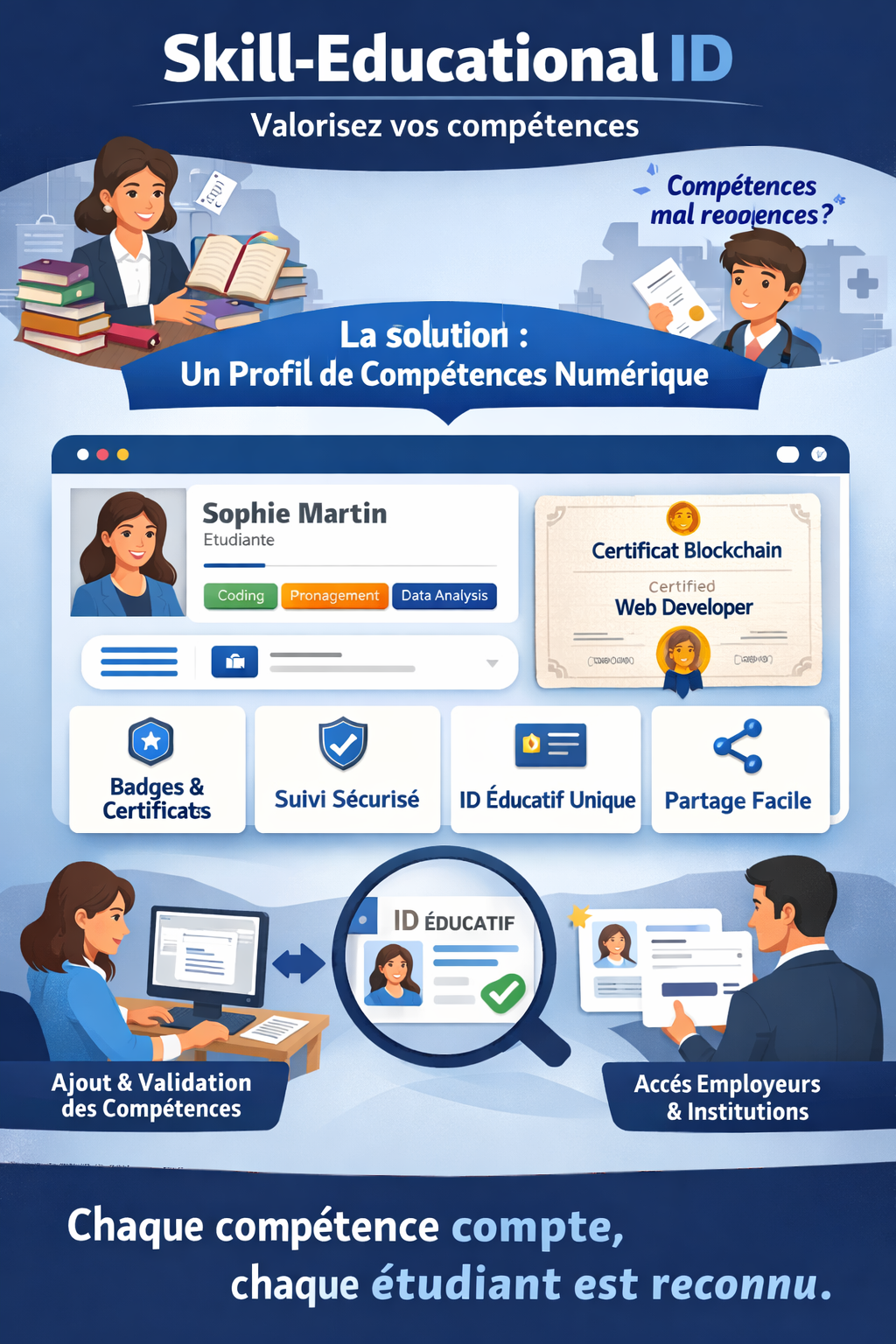
Skill-Based Educational ID provides a digital educational identity that allows individuals to record, manage, and share verifiable skills instead of relying only on diplomas. Each user has a personal digital profile where validated skills are displayed with clear details such as skill name, level, issuing organization, and date of validation. Employers, institutions, or partners can verify these skills instantly through a secure digital interface or QR code, without long administrative processes. This makes skills visible, trusted, and portable across institutions and borders.
How we built it
The project was designed as a mobile-first and low-connectivity-friendly system, adapted to the African context. We structured the solution around:
A unique digital educational identity for each user
A skills portfolio model instead of a diploma-only model
Digital validation by authorized institutions (training centers, NGOs, employers)
Secure verification using digital signatures and QR codes
The architecture focuses on simplicity, data privacy, and scalability, ensuring that the system can work in both urban and rural environments.
Challenges we ran into
One major challenge was designing a system that balances trust, simplicity, and inclusiveness. Many potential users have limited access to stable internet or advanced devices. Another challenge was addressing the diversity of education systems across African countries while keeping a standardized and interoperable skills framework. We also had to consider data protection, user consent, and institutional adoption, which are critical for long-term success.
Accomplishments that we're proud of
We are proud to have designed a solution that: Shifts the focus from diplomas to real, verifiable skills Includes informal and non-traditional learning paths Is adapted to African realities such as mobile usage and fragmented systems Empowers individuals to control and share their own educational data The project shows strong potential for impact in education, employment, and workforce mobility.
What we learned
Through this project, we learned that digital identity is not only a technical issue, but also a social and institutional challenge. We gained insights into skills-based education models, inclusive digital design, and the importance of trust in identity systems. We also learned how critical it is to align technology with real user needs, especially in contexts with limited infrastructure.
What's next for Skill‑Based Educational ID
Next steps include building a functional prototype, running pilot programs with training institutions and employers, and refining the skills validation framework. We also plan to explore regional interoperability to support cross-border recognition of skills in Africa. In the long term, Skill-Based Educational ID aims to become a trusted educational identity layer that supports lifelong learning, employability, and inclusive growth across the continent.


Log in or sign up for Devpost to join the conversation.