

Inspiration
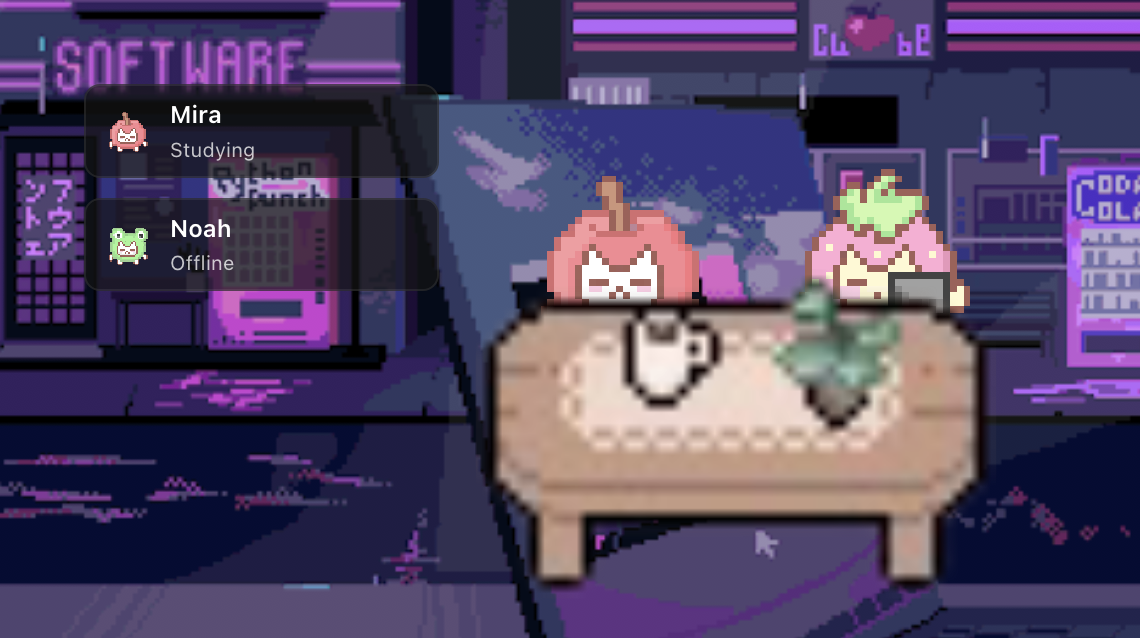
Studying alone is isolating, but most “social” study tools feel intrusive or distracting. We wanted something that keeps you accountable without calls, cameras, or pressure, just the quiet feeling of sitting at the same desk as your friends.
What it does
DeskBuddy is a desktop companion that lives in the corner of your screen while you study. Your avatar reflects your state: studying on a laptop, doomscrolling on your phone, or sleeping on break When you’re studying, friends can opt in and sit at the same virtual table Hovering over a friend lets you optionally peek at a small preview of their approved study app Everything is consent-based, low-distraction, and designed to feel calm.
How we built it
DeskBuddy is built as an Electron desktop application with a React renderer, allowing us to create a transparent, always-on-top overlay that behaves like a native desktop widget. Electron’s BrowserWindow API is used to control window positioning, sizing, and interaction behavior, while React handles UI composition and state management. Avatar rendering is implemented using sprite-based animations, with pose and motion determined by derived application state (study mode, active app context, and user interactions). Avatars and shared desk elements are layered. The backend as a headless API server using Ruby on Rails, with a SQLite database backend. This choice lets us leverage the battery, powerful CLI templating, and metaprogramming conveniences provided by Ruby and Rails while simultaneously knowing that we can scale up to planet scale delivery if we really needed to, with tools like sharding, MySQL databases, and memcaches all being well supported with Rails.
Challenges we ran into
Avoiding a hard-coded UI and making everything state-driven and scalable, in a short amount of time has proven to be challenging. Just designing and thinking about UX is a complex task on its own. Furthermore, ensuring that our code quality is acceptable and would let us expand on it in the future, whether that is scaling up horizontally or expanding on more features, has proven to be something that we have to actively think about throughout our efforts.
Accomplishments that we're proud of
Animating and Design! We not only built a functional project that has interesting uses, it is also visually interesting and reflects the personality of our team! Integration and Scalability. Unlike some of our previous hackathon projects, the design of this project has a viable path forward to actually be production software that we would personally use among our friends and can keep adding features to. It can also scale up effectively to a larger user base should we wish to do so.
What we learned
We learned how much thoughtful constraints matter when building social productivity tools. On the technical side, we gained hands-on experience with Electron’s window management, preload security patterns, and IPC communication, especially for safely exposing OS-level features like window previews.
What's next
Next, we want to turn DeskBuddy into a fully shared study environment. We also plan to expand avatar interactions and customization while keeping the experience lightweight and non-intrusive. As well as adding small funny interactions among friends (ex: throw a tomato at them if they're doomscrolling for more than 10 minutes.) We. wanted to have DeskBuddy drag a window on your screen occasionally, if you're not on a study app while during a focus period, it would pull out a rick roll video to gently remind you to lock back in. Long term, we see DeskBuddy becoming a calm, cross-platform companion that helps people feel less alone while studying without adding pressure or noise.


Log in or sign up for Devpost to join the conversation.