-
-

Logo
-
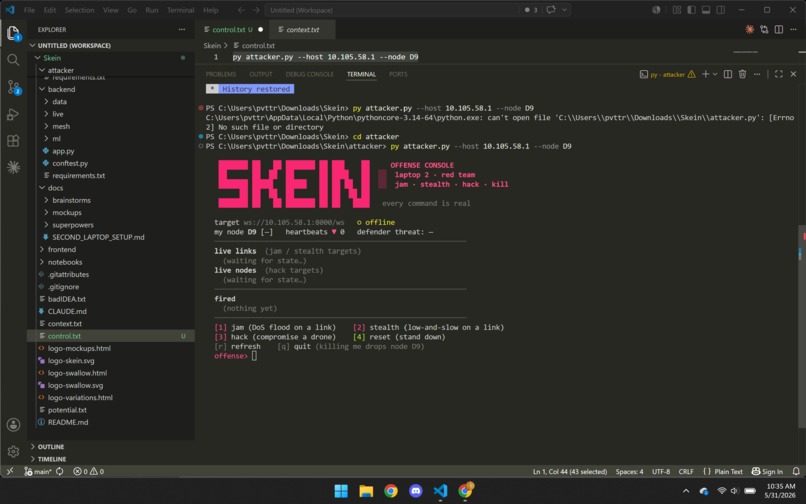
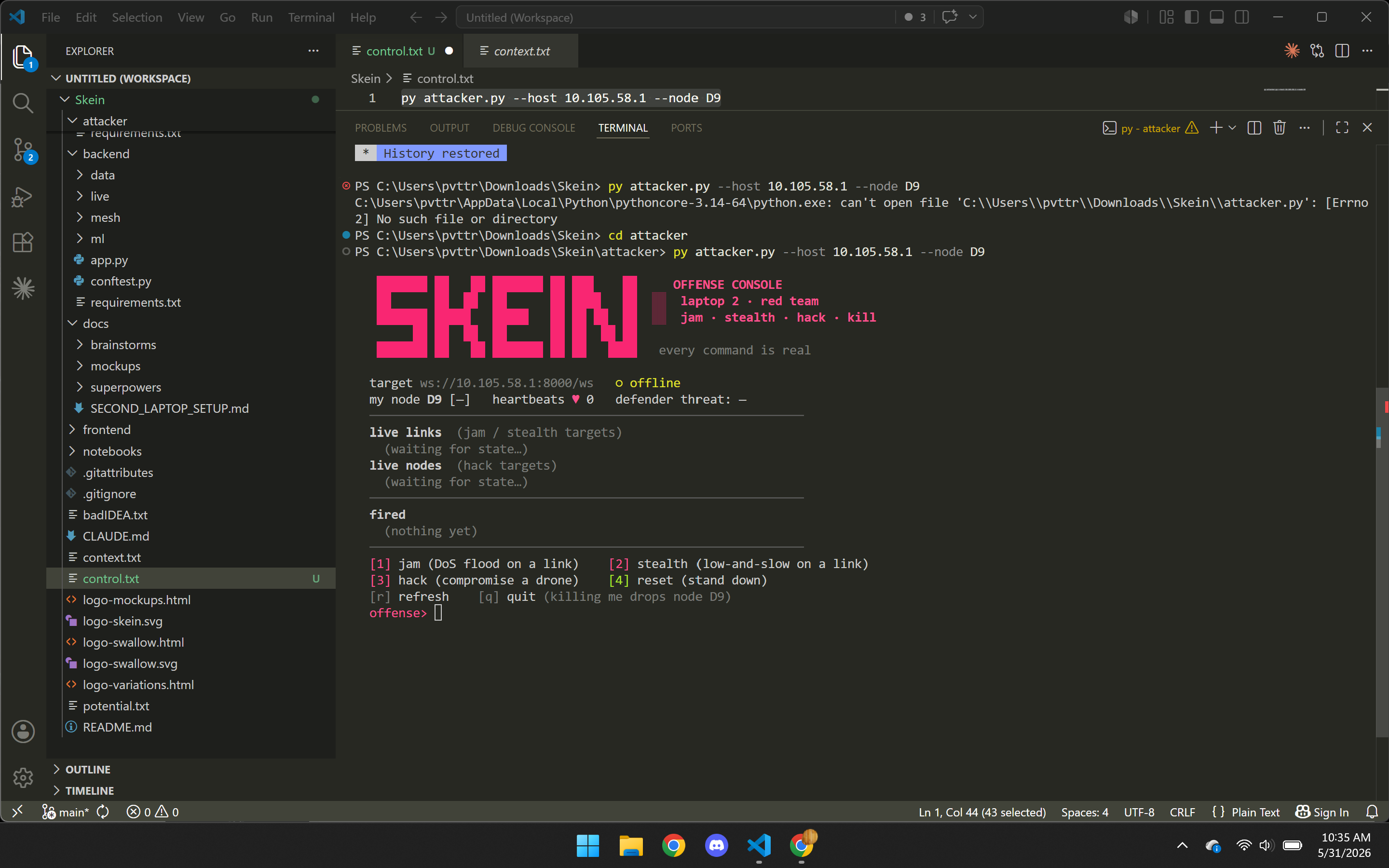
Second laptop POV
-
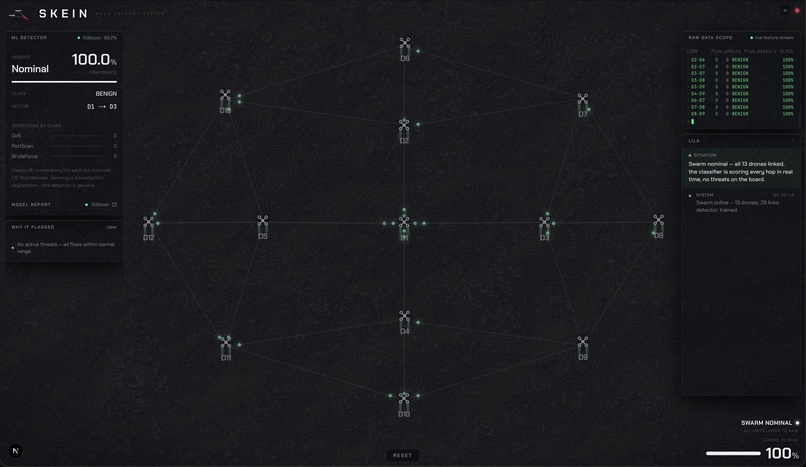
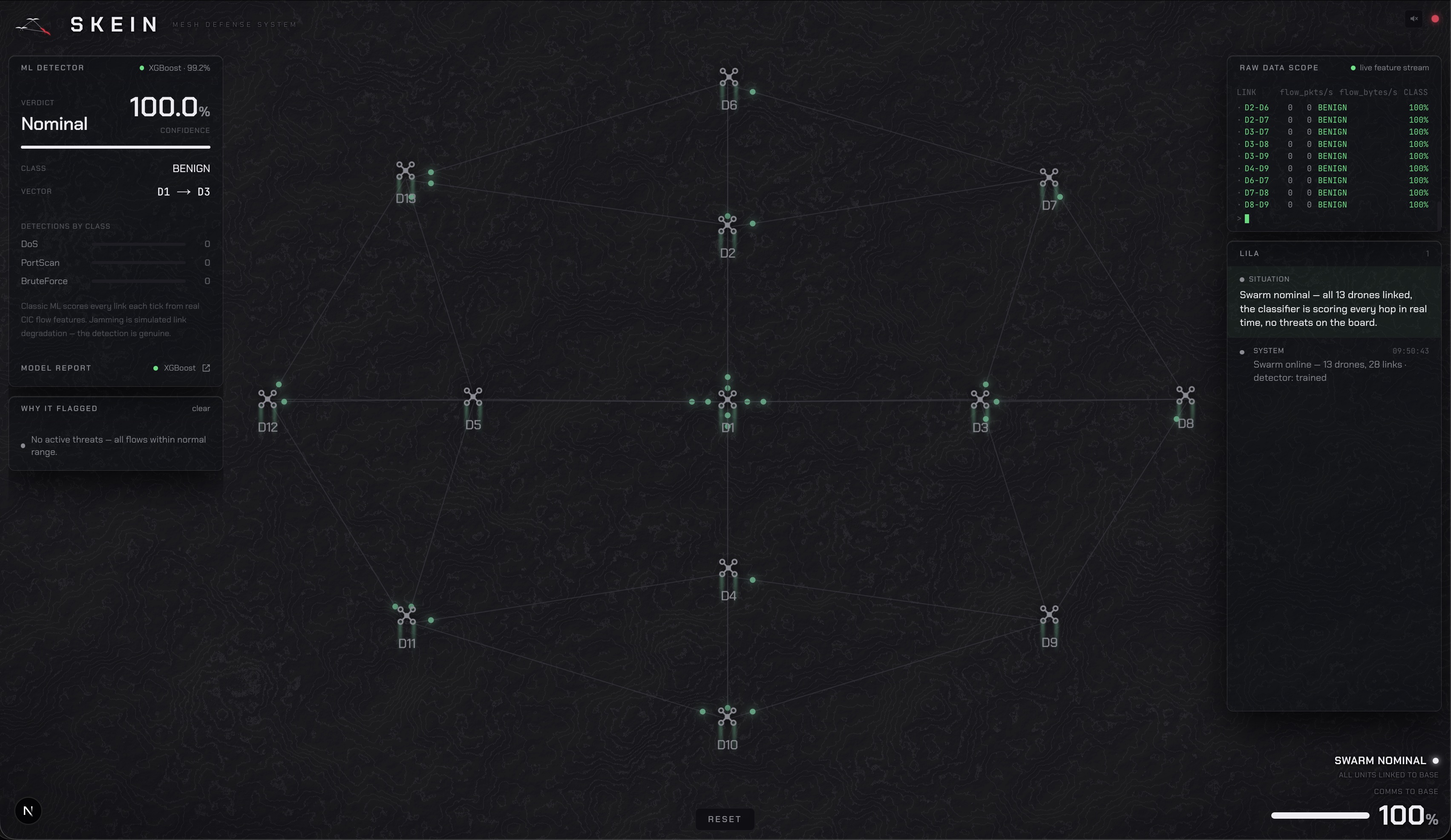
Main dashboard (no anomalies)

Inspiration
Modern defense relies heavily on drone swarms, which are highly vulnerable to radio jamming and cyberattacks. Skein is built to counter this threat: a self-healing swarm that detects interference using real machine learning and autonomously reroutes around damaged nodes.
What It Does
- Resilient Mesh: 13 drones maintain a dense network where each node connects to at least 4 neighbors.
- Live Intrusion Detection: A classic ML model analyzes traffic patterns to detect jamming or hacks.
- Autonomous Rerouting: The swarm uses shortest-path routing to instantly heal when a node drops.
- Interactive Demo: Attackers can launch strikes from a secondary physical laptop over a hotspot, watching the swarm dynamically adapt when the laptop lid is closed.
How I Built It
- Frontend: Next.js, React, TypeScript, and Framer Motion for live animations.
- Backend & Routing: Python, FastAPI, WebSockets for state streaming, and NetworkX for graph routing.
- ML Detector: An XGBoost model trained on the CIC-IDS-2017 dataset, analyzing 10 flow features to classify traffic (Benign, DoS, Port Scan, Brute Force).
Challenges & Solutions
- Real-State Simulation: Avoided faking data; jamming simulates real link degradation carrying actual attack traffic.
- Multi-Device Sync: Overcame hotspot latency and heartbeat timing issues to seamlessly integrate the second physical laptop.
- Mesh Tuning: Iterated on graph density to ensure the network remains stable even after losing multiple nodes simultaneously.
Accomplishments
- Achieved 99% accuracy on unseen evaluation data, backed by live confusion matrices and feature importance metrics.
- Created a fully functional, two-laptop hardware demo where physical disconnection triggers immediate, authentic network healing.
Lessons Learned
- Tree Models > Deep Learning: XGBoost outperformed neural networks on tabular network data while providing crucial feature explainability.
- Authenticity Wins: Keeping the data generation and simulation honest provided massive credibility during live demonstrations.
What's Next
- Anomaly Detection: Transition to unsupervised learning to flag novel, zero-day attacks.
- Live Packet Processing: Drive the detector using real-time packet capture rather than replayed dataset rows.
- Scale: Expand past 13 nodes and harden the routing algorithm against multi-vector concurrent attacks.
Built With
- framer-motion
- pandas
- python
- react
- tailwind
- typescript
- uvicorn
- xgboost

Log in or sign up for Devpost to join the conversation.