-
-
Skaut - FIFA 2026 TRAVEL COMMAND
-
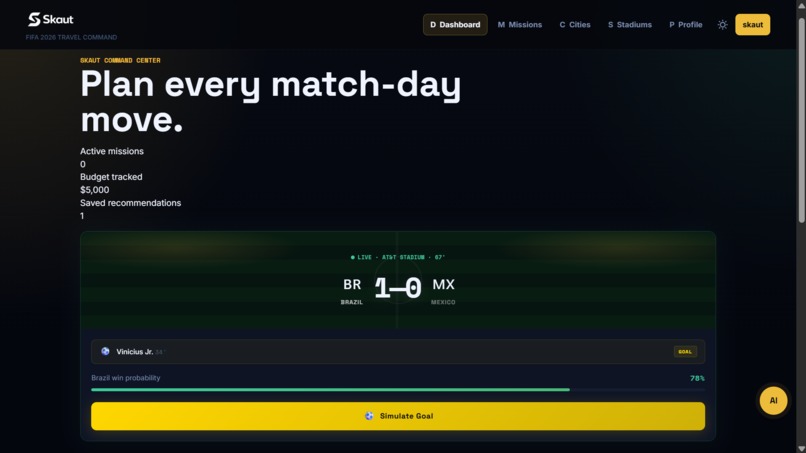
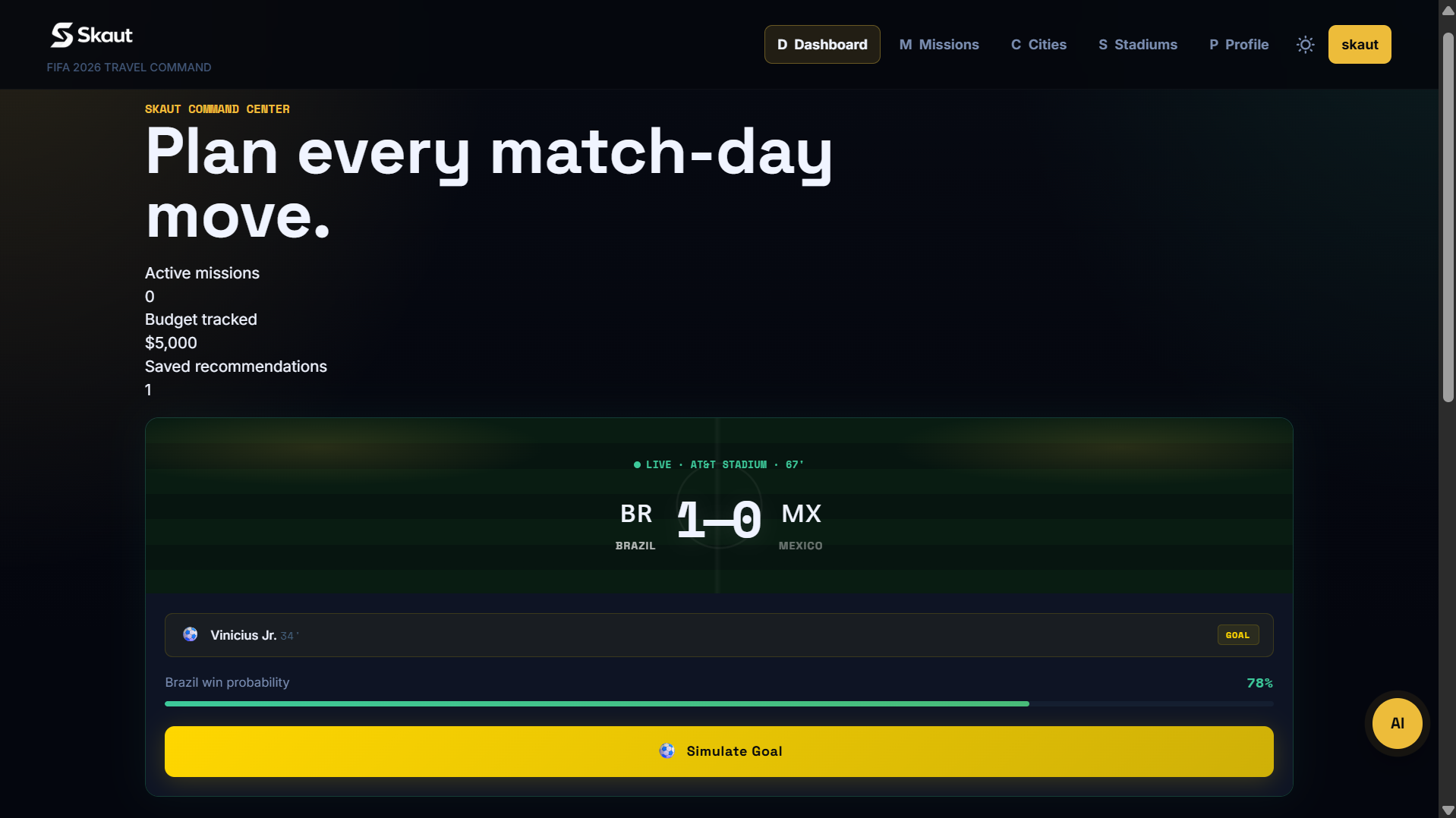
Dashboard, control and track everything.
-
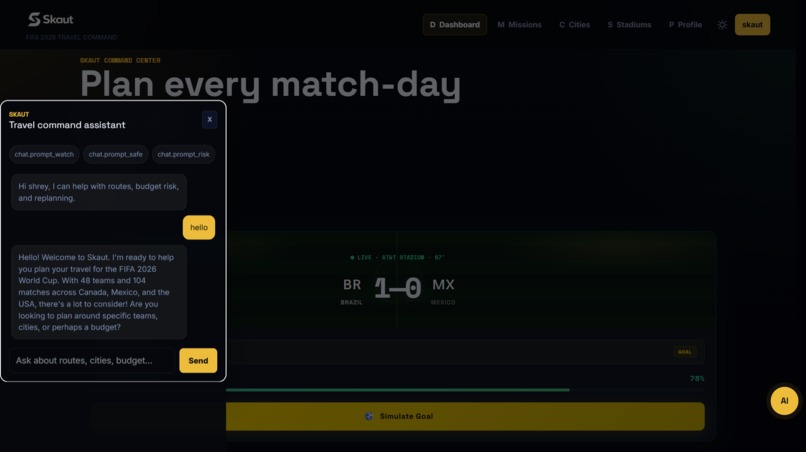
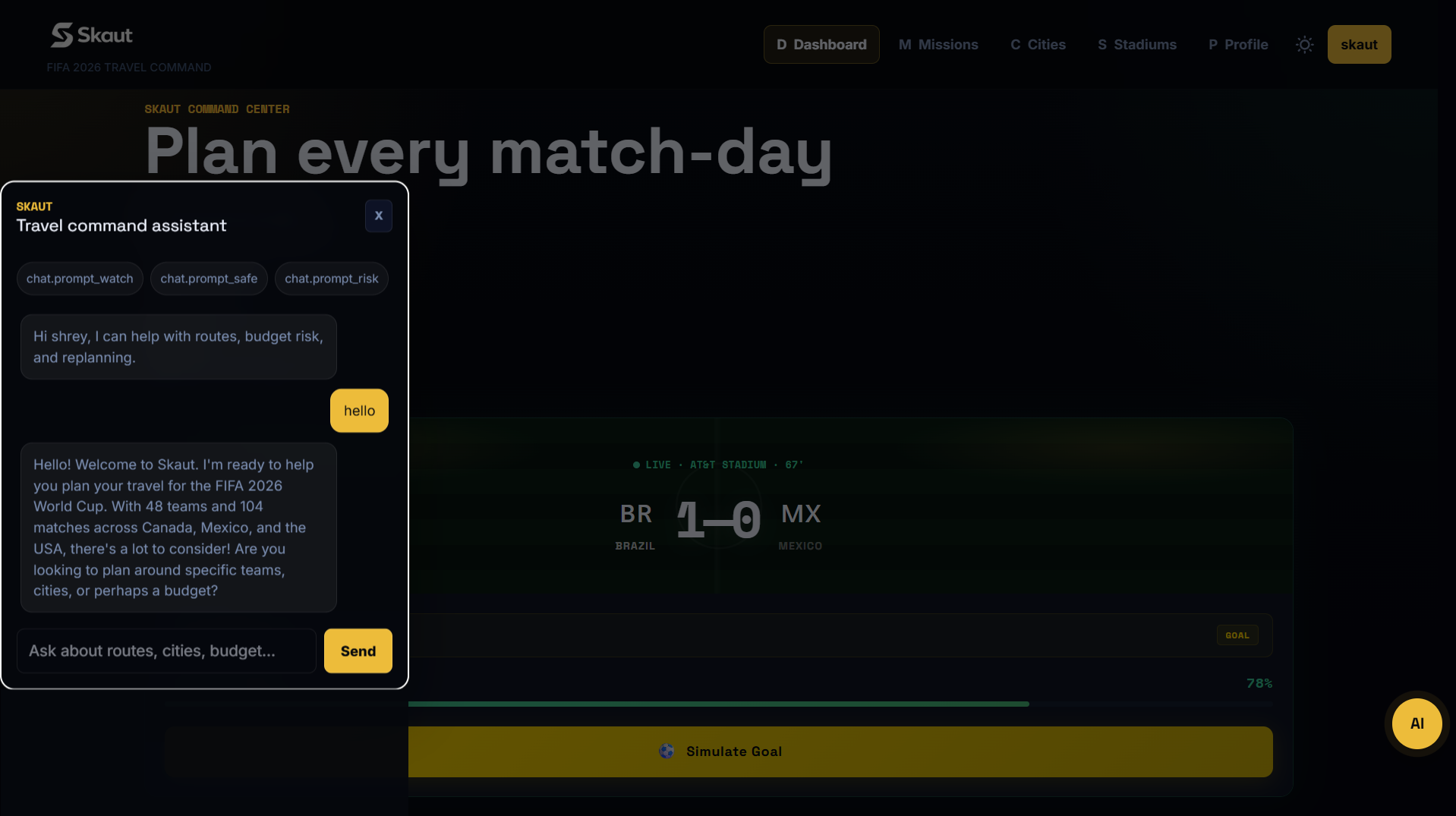
AI chatbot for travel support.
-
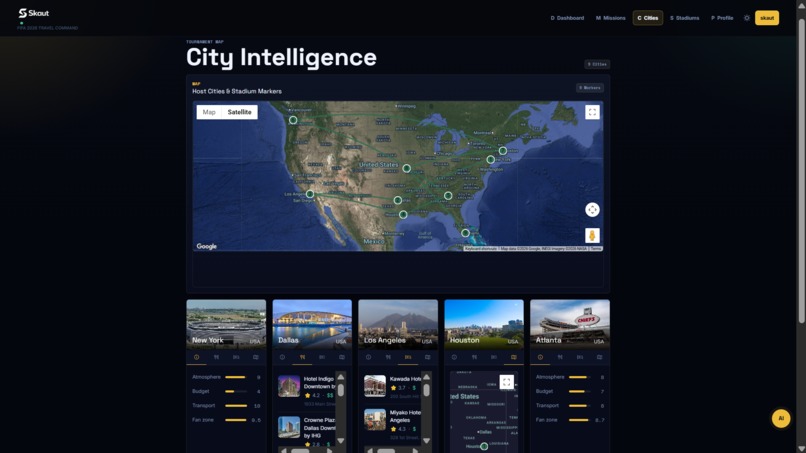
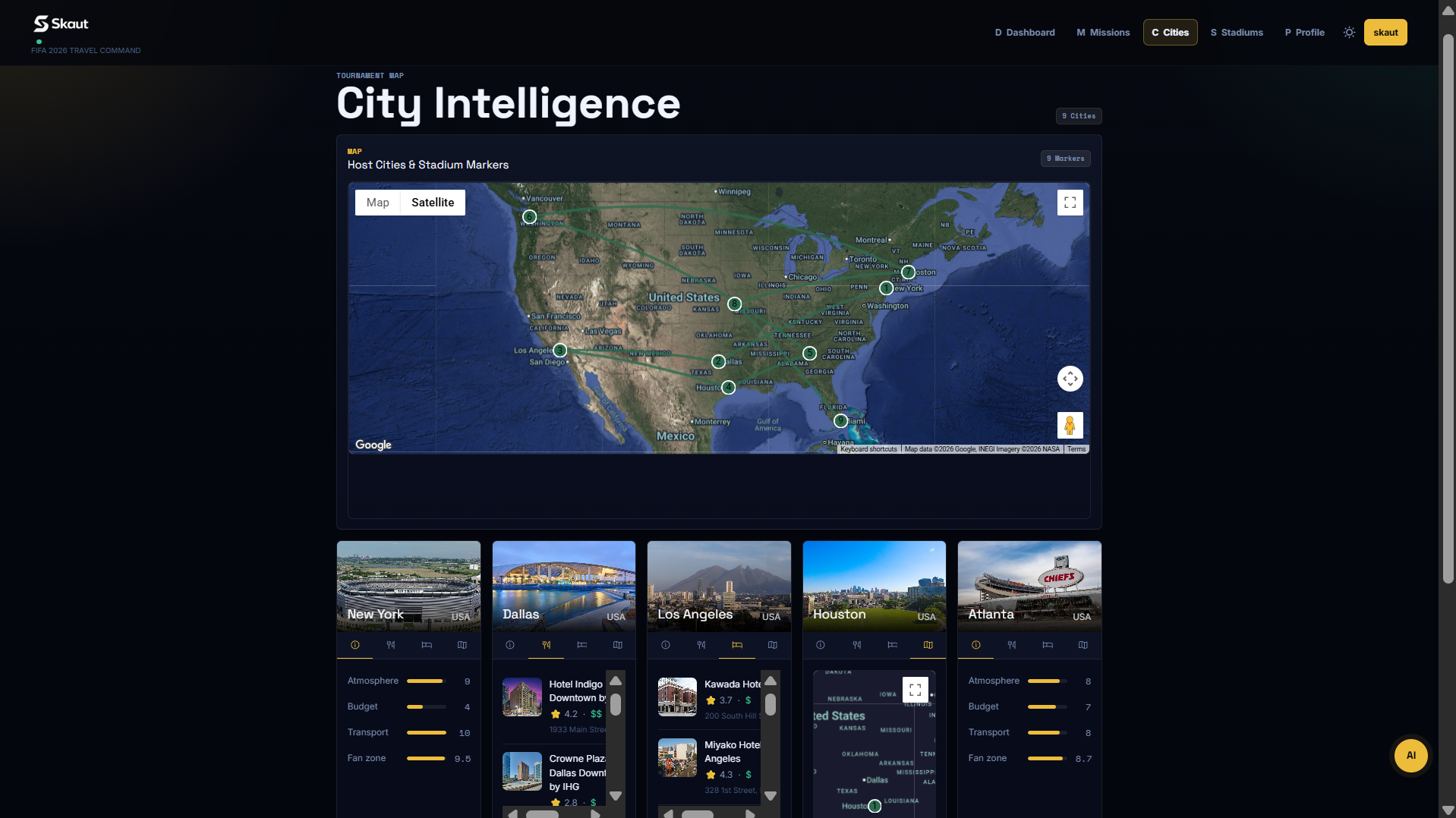
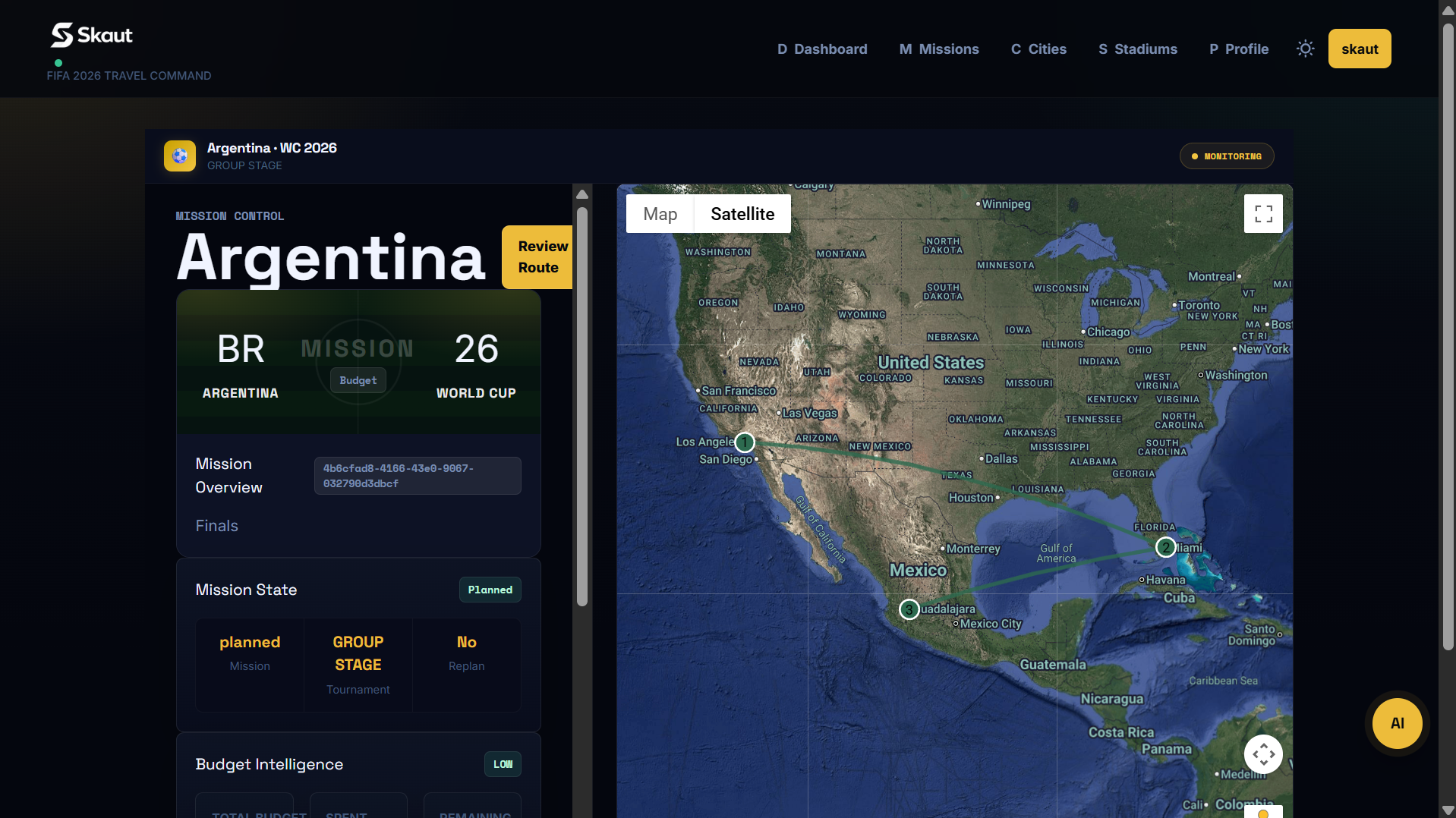
Cities, see the route you will take and get info about every city.
-
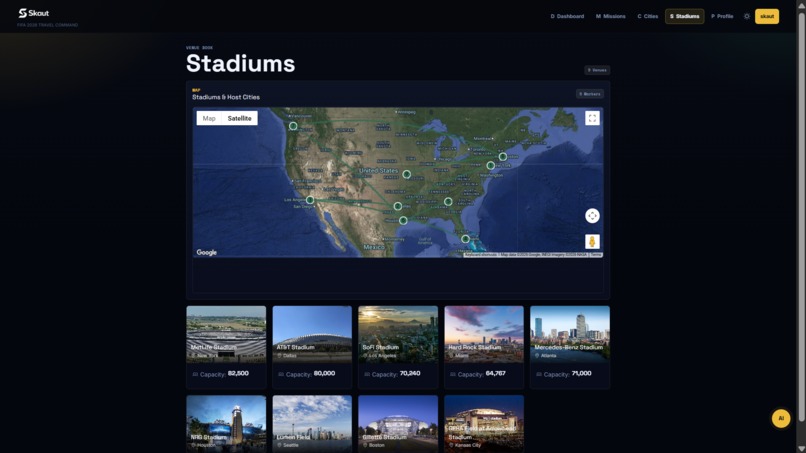
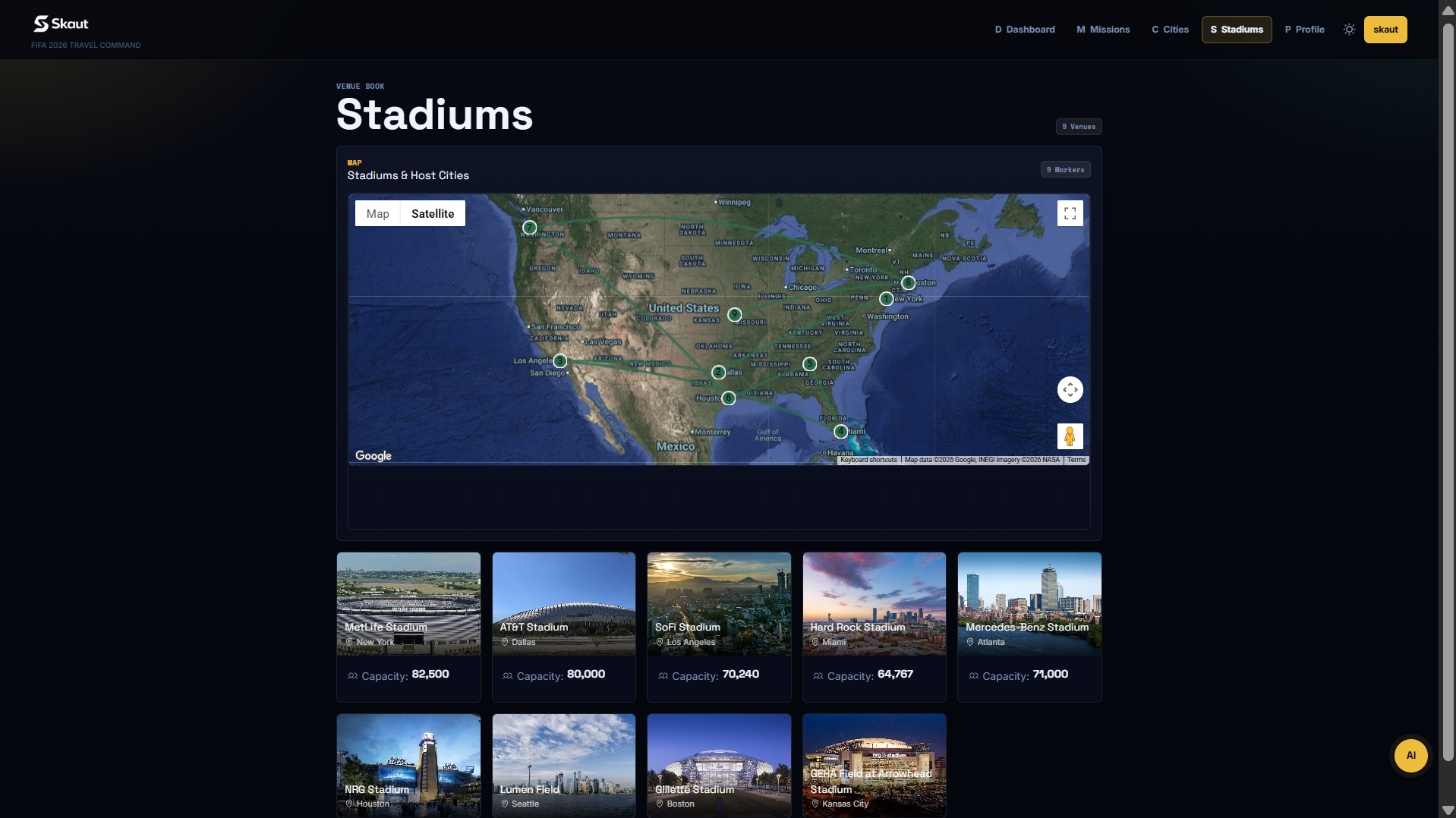
Stadiums, access stadium intelligence.
-
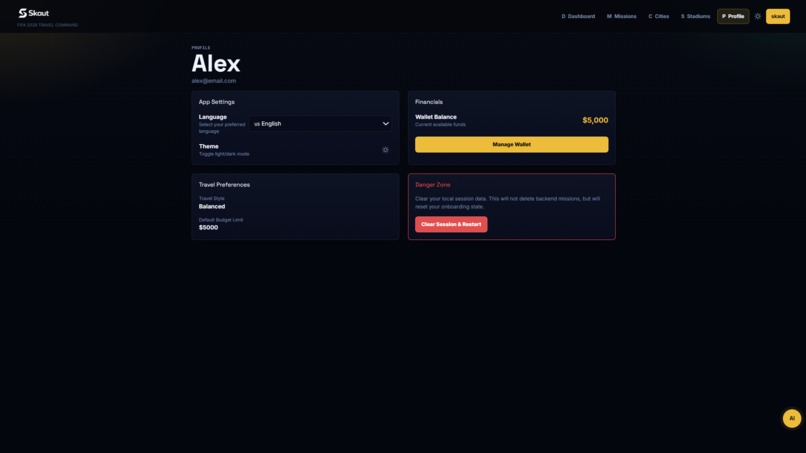
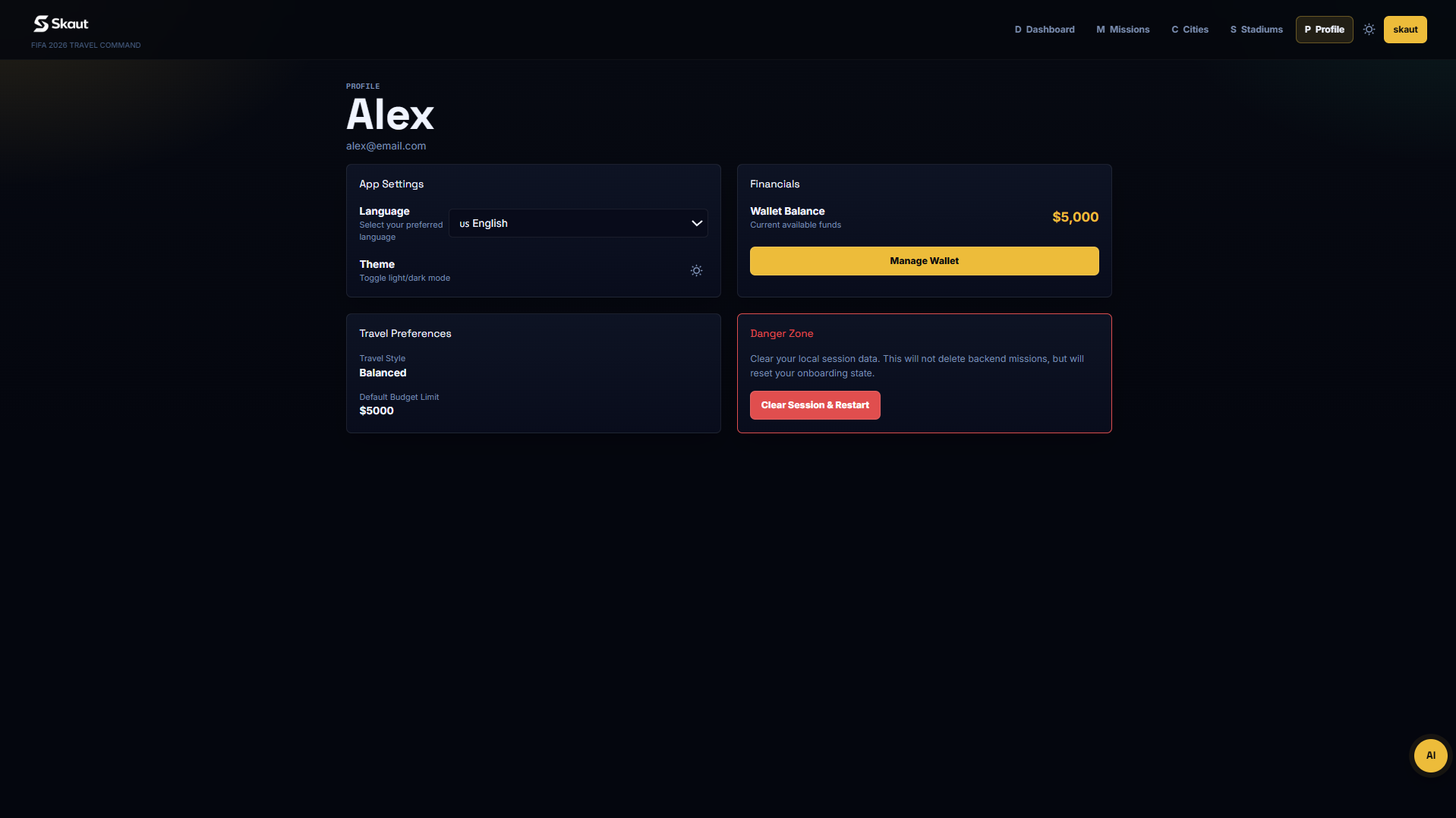
Profile, manage your preference and balance.
-
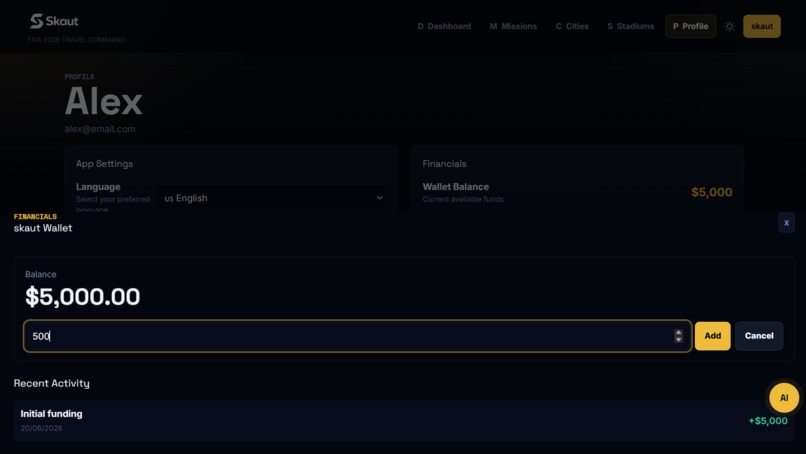
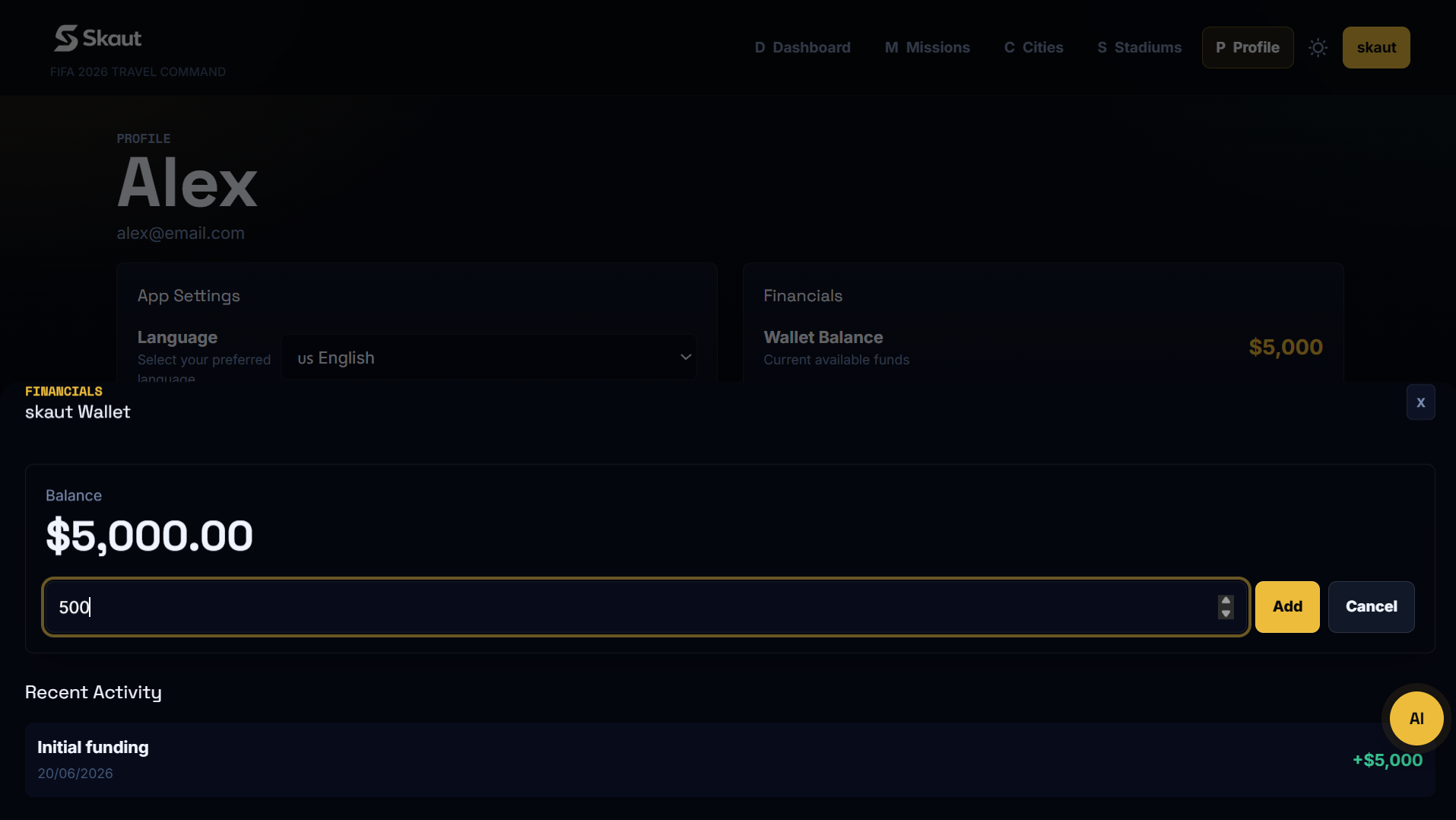
Balance update.
-
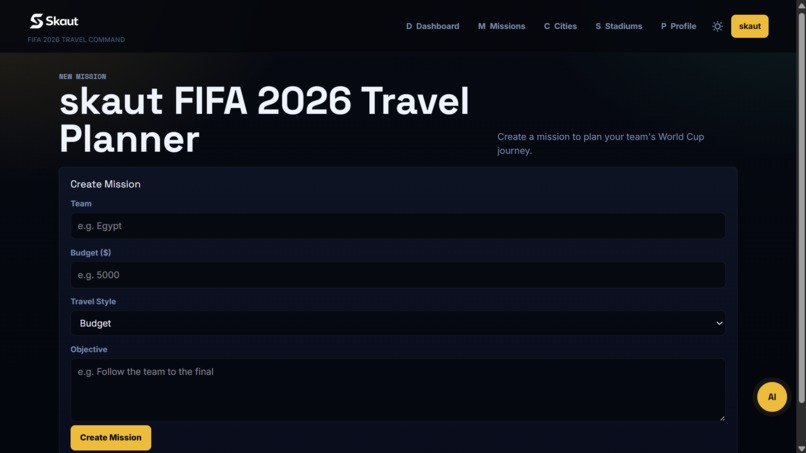
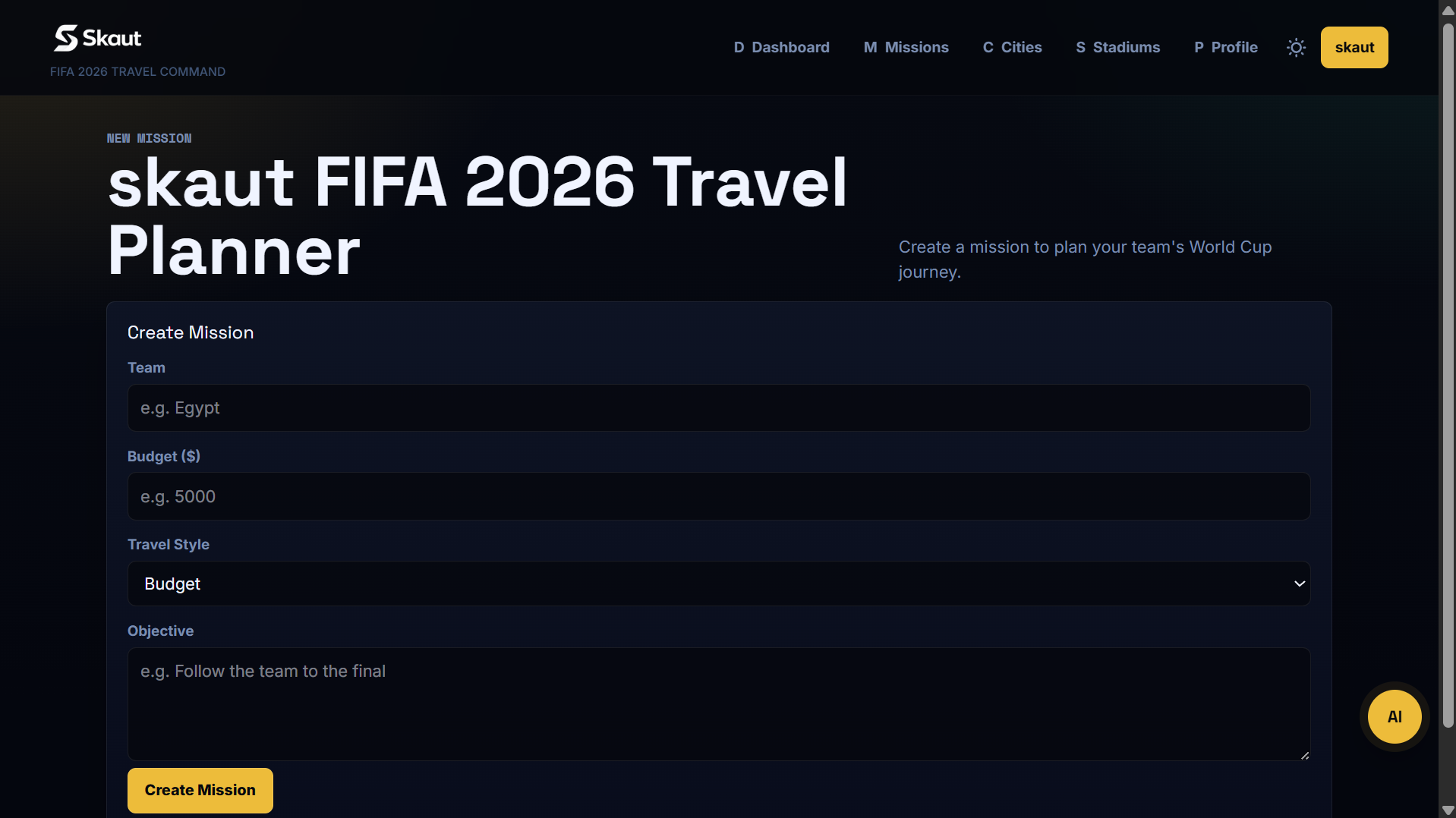
Create a mission.
-
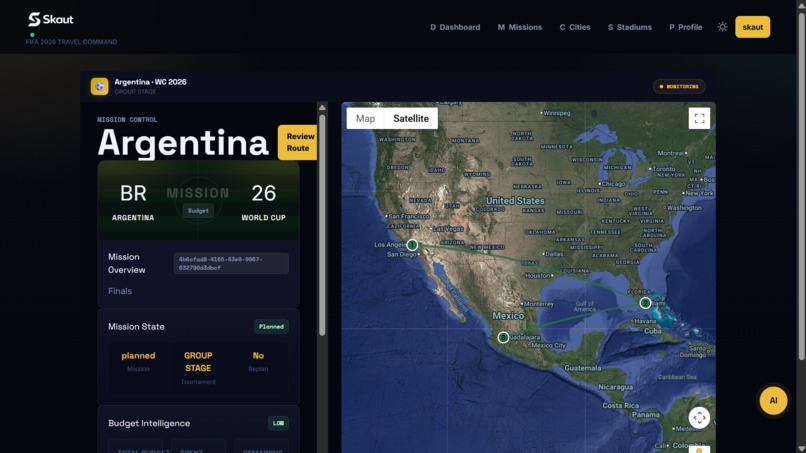
Mission created.
-
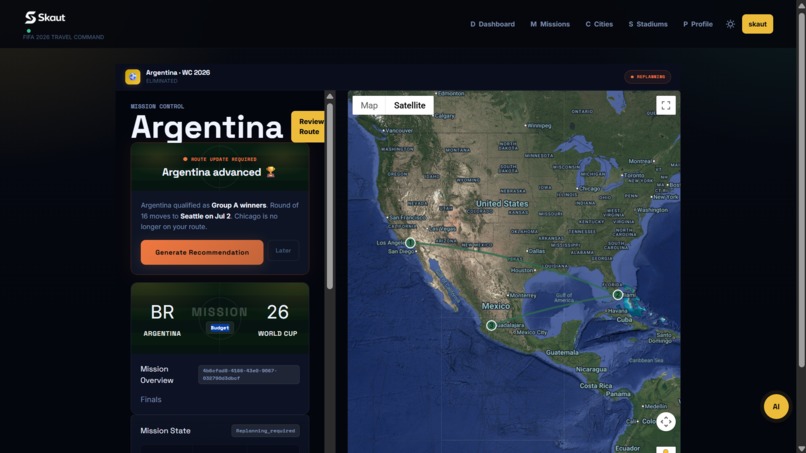
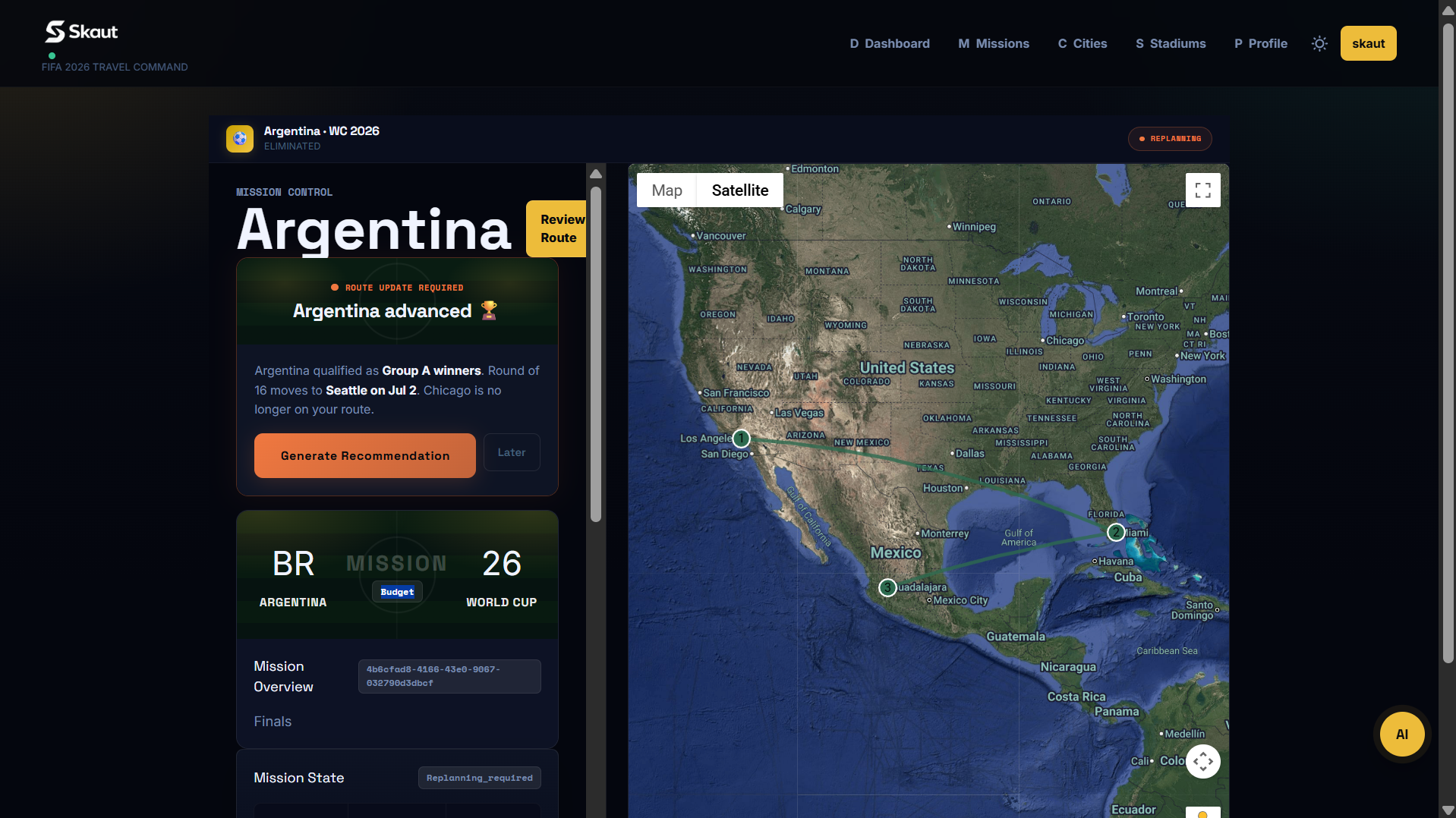
Team advances, route replanning is needed.
-
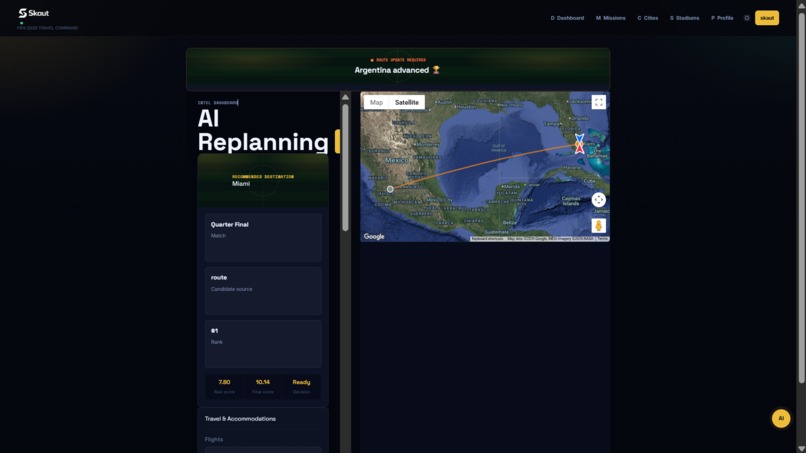
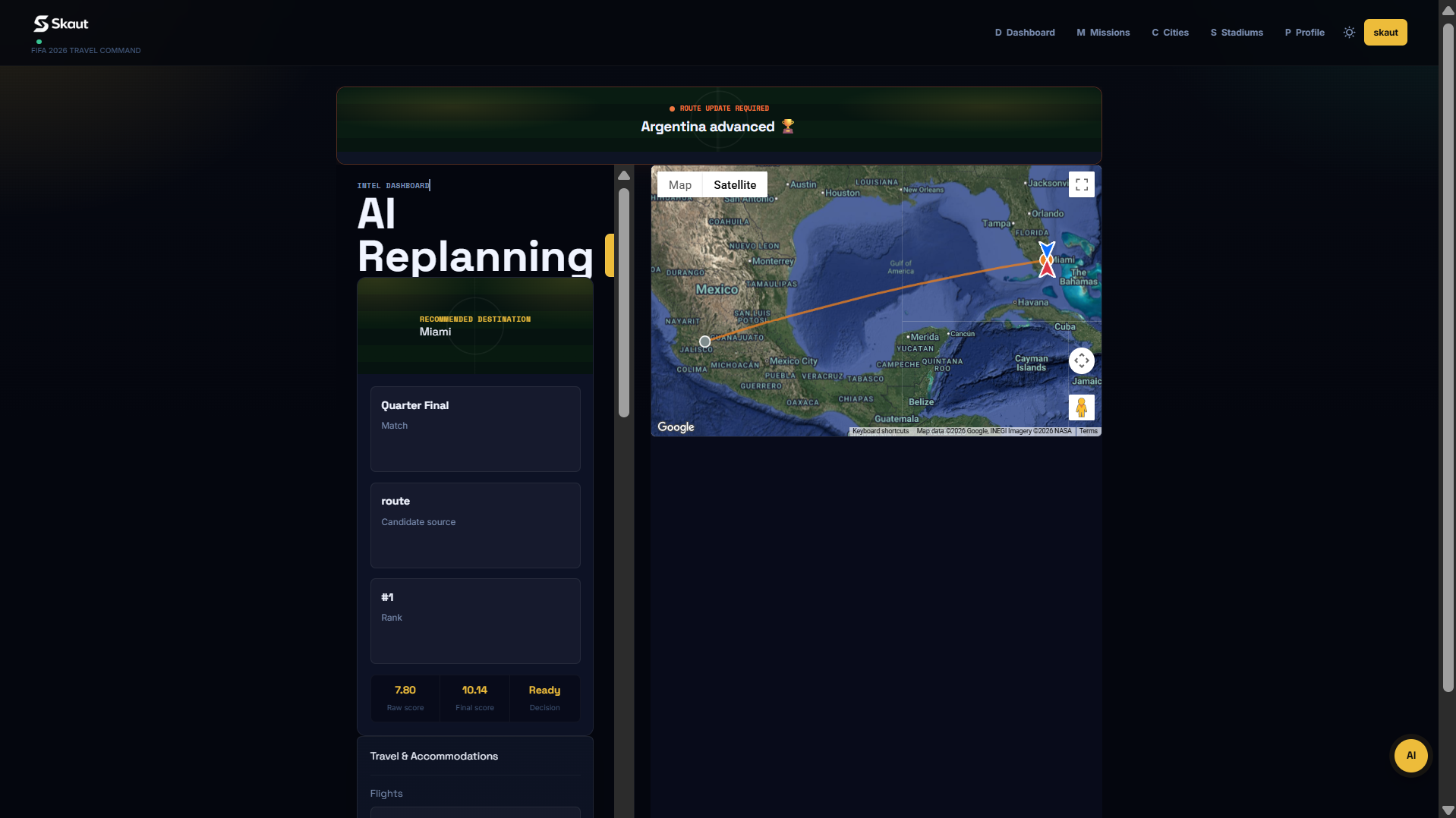
Replanning result.
-
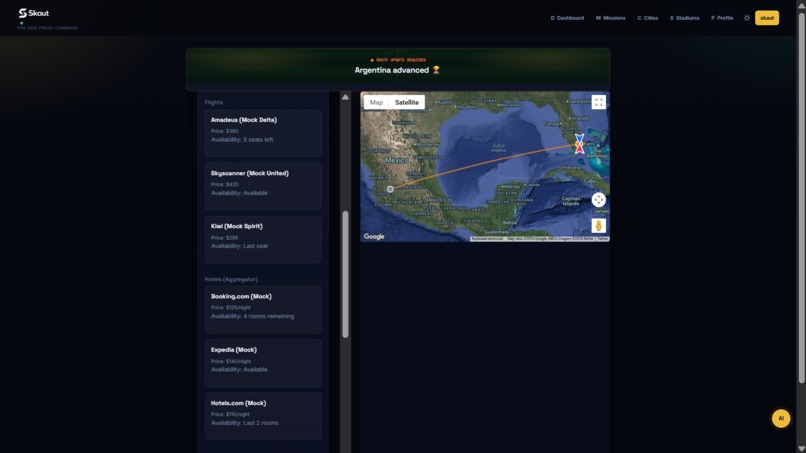
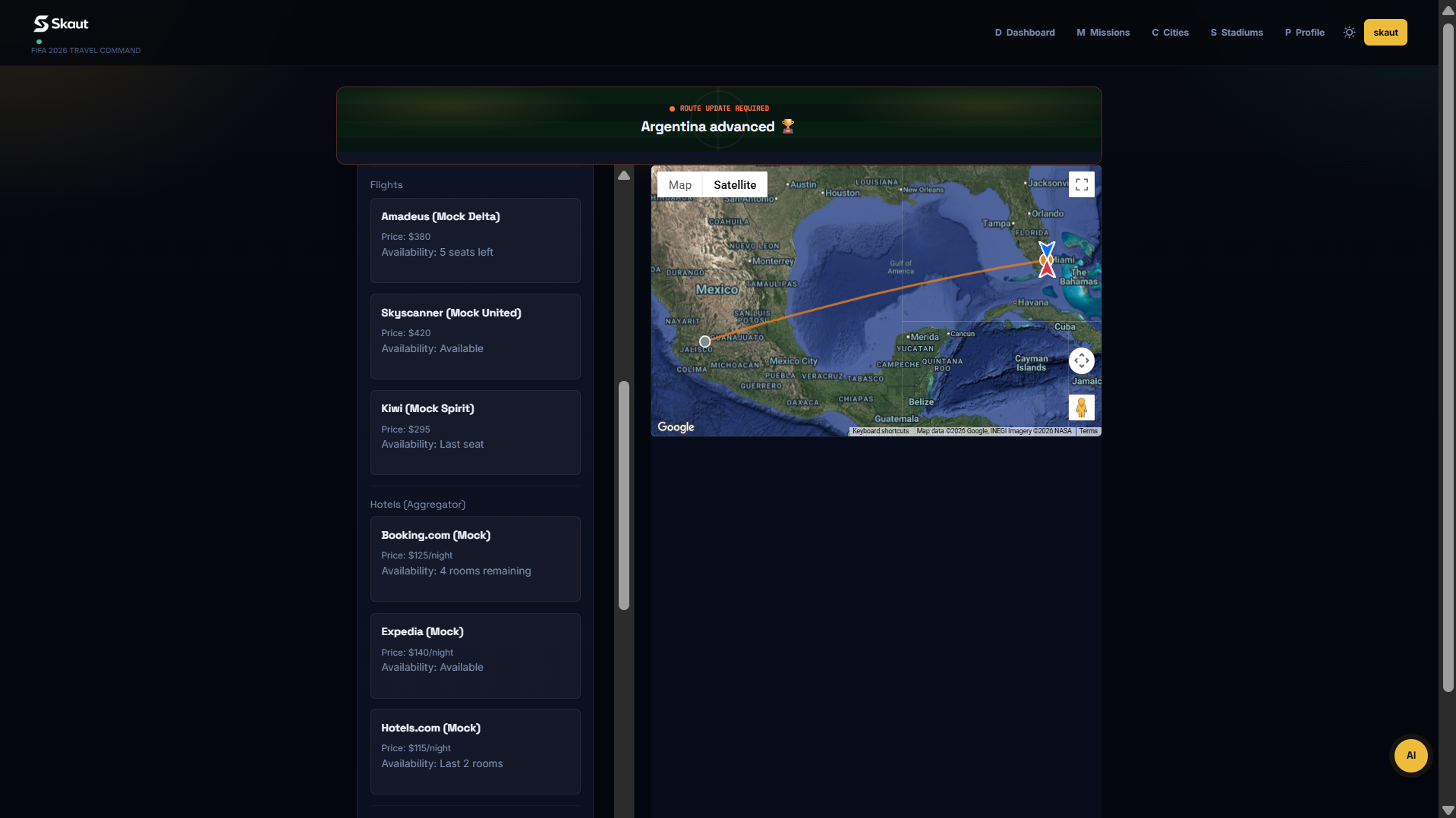
Travel, stay and more!!
-
This image is currently processing. Please be patient...

About Skaut
Inspiration
The 2026 FIFA World Cup presents a challenge that traditional travel platforms were never designed to solve.
When fans plan a trip around a tournament, they are planning around uncertainty. Teams advance, matches move, venues change, budgets shift, and travel routes become invalid overnight. Existing travel tools assume certainty: users choose a destination, book a trip, and follow a fixed itinerary.
But tournaments don't work that way.
We asked a simple question:
What if travel planning could adapt as quickly as the tournament itself?
That question became Skaut.
Instead of treating travel as a one-time booking problem, Skaut treats it as a living mission that continuously evolves as tournament conditions change.
Most travel planners assume your trip is fixed the moment you book it. Mine doesn't, because the thing I was planning around — the FIFA World Cup — isn't fixed either. Teams advance, venues change, hotels disappear, and every traditional planner just shrugs and makes you start over.
What I built
Skaut turns travel planning into a living "mission" instead of a static booking. You tell it your team, budget, and travel style; it continuously watches the tournament and automatically replans your trip when something changes — and shows you exactly why, with a full reasoning and audit trail behind every recommendation, instead of a black-box AI answer.
Who it's for
Anyone following a team through a tournament where the schedule isn't locked in advance — the fan who's already mentally rehearsing "what if they win Group B and the next match is in a different city."
What I used
React + FastAPI, Elasticsearch as the intelligence layer, Google Cloud Agent Builder and Gemini for orchestration and explanations, Google Maps Platform for routing and venue data, deployed on Cloud Run. Novus is installed and tracking real usage.
What I learned shipping it
The hard part was never "can the AI generate an answer" — it was making the system trustworthy enough that a fan would actually let it replan their trip automatically. Keeping Gemini strictly in the "explain the decision" role, and never the "make the decision" role, ended up being the single design choice that made the whole product feel safe to use rather than just clever.
What It Does
Skaut is an Adaptive Tournament Intelligence Platform.
Users create missions around the teams they support, define their budget and travel preferences, and let Skaut continuously monitor tournament developments.
When a significant event occurs—such as a team advancing, a venue changing, or travel constraints shifting—Skaut automatically reevaluates the situation and generates updated recommendations.
The platform combines tournament intelligence, semantic search, recommendation systems, agent orchestration, explainable AI, and real-world travel intelligence into a single workflow.
The result is a system that doesn't simply answer questions.
It acts.
How We Built It
Skaut was built as a layered intelligence platform designed around deterministic decision-making and agent orchestration.
Frontend
- React
- React Router
- Axios
The frontend provides mission creation, monitoring, recommendation exploration, travel intelligence, and system transparency.
Backend
- FastAPI
- Python
FastAPI acts as the gateway for all mission, recommendation, intelligence, and travel operations.
Search and Intelligence Layer
- Elasticsearch
Elasticsearch serves as the source of truth for:
- Missions
- Events
- Cities
- Stadiums
- Preferences
- Recommendations
- Audit Records
- Agent Memory
We use semantic retrieval and vector search to identify relevant cities, stadiums, and travel options for each mission.
Google Cloud
- Agent Builder
- Gemini
- Cloud Run
- Secret Manager
- Maps Platform
Google Cloud Agent Builder orchestrates multi-step workflows.
Gemini generates human-readable explanations and recommendation summaries.
Google Maps Platform provides destination intelligence including routes, travel times, nearby hotels, restaurants, attractions, and geographic context.
MCP Architecture
A core design goal was making Scout accessible through MCP tools.
The platform exposes intelligence through tools such as:
- get_mission
- get_budget
- get_recommendation
- get_reasoning
- get_audit
- search_cities
- search_stadiums
This allows agents to access Scout's intelligence without owning any recommendation logic.
System Architecture
User
↓
React Frontend
↓
FastAPI Gateway
↓
Scout Services
↓
Elasticsearch
Scout Services contain:
- Mission Service
- Tournament Intelligence
- Budget Engine
- Preference Engine
- Recommendation Engine
- Replanning Engine
- Reasoning Engine
- Audit Engine
Google Cloud Agent Builder orchestrates workflows through MCP tools.
Scout remains responsible for all recommendation decisions.
Recommendation Pipeline
The recommendation engine follows a deterministic workflow:
Mission
↓
Semantic Retrieval
↓
Candidate Enrichment
↓
Preference Scoring
↓
Budget Analysis
↓
Decision Engine
↓
Reasoning
↓
Audit
↓
Recommendation
Unlike many AI systems, Gemini never selects the recommendation.
Gemini only explains decisions that have already been made by Scout's deterministic engines.
This separation improves reliability, transparency, and auditability.
Challenges We Faced
Designing Beyond a Chatbot
One of the biggest challenges was resisting the temptation to build another conversational travel assistant.
The hackathon emphasized agents that can perform multi-step actions and solve real-world problems.
We therefore designed Skaut around missions, state transitions, event detection, and autonomous replanning rather than conversational interactions.
Balancing AI and Determinism
Another challenge was deciding where AI should and should not be used.
We intentionally avoided using Gemini for recommendation selection.
Instead, we built a deterministic recommendation pipeline and used Gemini only for explainability.
This allowed us to maintain transparency while still benefiting from natural-language generation.
Building a Scalable Intelligence Layer
Tournament data is highly interconnected.
Cities, stadiums, budgets, travel routes, and fan preferences all influence recommendations.
Designing Elasticsearch as a unified intelligence layer while preserving clean service boundaries required multiple architecture iterations.
Creating Explainable Decisions
Recommendations are only useful if users trust them.
To address this, every recommendation stores:
- Candidate rankings
- Score contributions
- Budget impact
- Decision reasoning
- Audit records
This ensures every recommendation can be traced back to its underlying data.
What We Learned
Building Skaut taught us that the hardest part of AI systems is not generating answers.
It is creating trustworthy decision-making systems.
We learned the importance of:
- Separating orchestration from decision logic
- Designing transparent recommendation pipelines
- Building explainable AI experiences
- Using agents for action rather than conversation
- Combining retrieval systems with deterministic intelligence
Most importantly, we learned that uncertainty itself can become a product opportunity.
Instead of treating tournament uncertainty as a problem to work around, Skaut embraces it and turns it into actionable intelligence.
Future Vision
The current platform focuses on tournament intelligence and adaptive travel planning.
Future versions could support:
- Live match feeds
- Ticket intelligence
- Flight integrations
- Real-time pricing signals
- Multi-user group missions
- Other global sporting tournaments
- Concert and festival travel planning
The underlying mission intelligence framework can be extended far beyond the World Cup.
Conclusion
The world does not stay static.
Tournaments don't stay static.
Travel plans shouldn't either.
Skaut transforms changing tournament conditions into intelligent, explainable, and actionable travel decisions.
Mission In.
Intelligence Out.
Built With
- agent
- ai
- api
- builder
- cloud
- cup
- directions
- docker
- elasticsearch
- engine
- explainable
- fastapi
- gemini
- geocoding
- javascript
- maps
- mcp
- mongodb
- places
- python
- react
- recommendation
- run
- search
- semantic
- sports
- tech
- travel
- vector
- world


Log in or sign up for Devpost to join the conversation.