Inspiration
Small software teams make expensive roadmap decisions with weak evidence. A painted-door test can measure a click, but text and a static mockup ask users to imagine the proposed experience. Building the feature first produces better evidence only after the engineering budget is spent. Sizzle closes that gap by turning a feature specification into a clearly disclosed concept video that a team can test before deciding whether to build.
What it does
Sizzle is a managed service for small software teams, typically 2-50 people, without dedicated product-marketing, research, or video-production staff. It produces multiple product-video variants, preserves approved assets for a later launch, and supports a pre-registered demand threshold so the success criterion cannot be moved after results arrive. The public product and early-access surface is video.promptdriven.ai/sizzle.
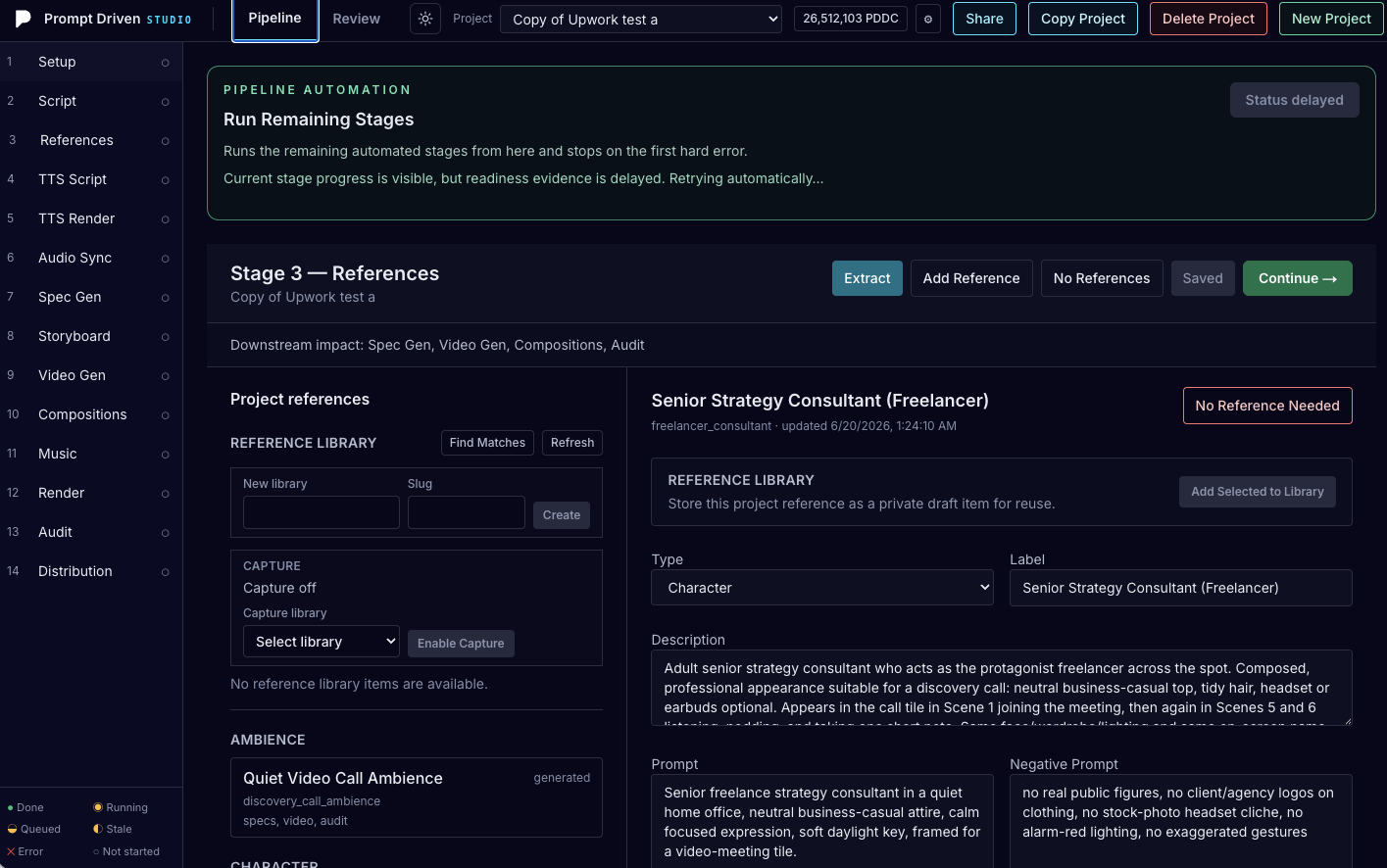
Generative Video Studio (GVS) is the AI-operated production platform behind the service. Agents translate approved source material into structured specifications, prepare narration and visual instructions, invoke Gemini and other configured media providers, assemble compositions, render and audit the result, preserve provenance, package approved outputs, and execute configured distribution steps.
What is new, and what existed before
Before the challenge, Prompt Driven had an internal GVS prototype containing
the staged video pipeline, editor, Remotion renderer, and media helpers. Sizzle
did not exist at the May 18 repository cutoff. Its first implementation landed
June 12 in commit 26bb6096b. The Sizzle application, components, assets, and
launch tooling were created during the challenge, followed June 13-14 by the
feature-validation layer: experiment manifests, pre-registration safeguards,
video variants, hosted concept pages, commitment-event collection, results and
verdict reporting, cost rollups, and launch tooling. We claim Sizzle and that
validation layer as challenge-period work while disclosing the earlier GVS
prototype. The shared platform was also materially extended during the period
with distribution, YouTube integration, and agent/CLI automation.
How Gemini and Google Cloud operate the workflow
Gemini runs inside the production workflow through the Google GenAI SDK on Vertex AI. It performs multimodal review of rendered sections against structured scene contracts, reviews music, checks transcript equivalence, produces configured narration with Gemini TTS, and participates in reference-image generation. Veo supplies configured video generation through Vertex, and we separately validated the Gemini Omni backend end to end. GVS records the provider, backend, model, task, delivery method, interaction lineage, generation validation result, billing context, and downstream publication receipt.
Cloud Run serves the integrated application. Firestore and Cloud Storage retain durable workflow state, media, and evidence. Cloud Batch handles isolated workloads; Cloud Build and Artifact Registry support delivery; Pub/Sub and Cloud Scheduler support eventing and reconciliation; and Cloud Logging and Monitoring preserve operational evidence. The attached evidence shows Vertex GenerateContent traffic, a live Cloud Run service, and recurring successful Scheduler calls.
Humans, agents, and economic opportunity
Agents perform repeatable coordination and production work. Humans define the feature hypothesis, audience, validation threshold, and business outcome; approve source material; authorize paid providers; resolve material audit or rights issues; make consequential creative decisions; and approve publication. This creates opportunities beyond the founding team in creative direction, source-media preparation, voice performance, brand review, experiment design, and customer-success strategy. The goal is not to remove human judgment but to let a small business direct and verify a production system whose routine operations are performed by AI.
Evidence, traction, and business model
The underlying GVS system completed recorded Gemini provider runs and advanced media through composition, music, render, stitch, audit, packaging, captions, thumbnail selection, and YouTube publication. Prompt Driven received $9,475 from seven arms-length event sponsorship packages during the challenge and used Sizzle/GVS in event operations and sponsor-facing media. Those customers bought sponsorships, not Sizzle subscriptions. Sizzle has 0 verified external users, 0 paying users, and $0 direct product revenue. Conversations with product leaders at larger companies are treated as discovery signals, not target-market traction.
The working model is a fixed-fee managed pilot for one or two feature tests, followed by a recurring tier that reuses each customer's approved brand assets, references, prompts, and production mold. Pricing remains an unvalidated hypothesis. Usage pricing and approval thresholds protect margin from volatile generation costs.
How judges can verify the AI operation
The Sizzle page and 68-second demo show the customer proposition; they are not
a self-serve Gemini executor. For operational proof, watch the separate
end-to-end Gemini/GVS publication,
inspect the attached Vertex, Cloud Run, Scheduler, and billing evidence, and
read docs/product/GEMINI_OMNI_IMPLEMENTATION_PLAN.md lines 99-127 in the
repository. That record identifies the live run IDs, provider/model/task
metadata, generation validation, and publication receipt. The generated
artifact passed provider validation; later publication used a recorded,
rationale-bound override for cosmetic/timing audit findings, so we do not
describe the downstream audit as a clean pass. No paid generation or live
Sizzle experiment is required to verify the submission.
What we learned and what's next
The hard problem is not making one attractive clip. It is making a long, mixed-provider workflow observable and recoverable while keeping human authority explicit. We will next run bounded design-partner tests with small software teams, measure production time, cost, commitment-ladder conversion, and build-or-kill decisions, and only then expand toward subscriptions and governed CLI/API access.
Built With
- cloud-run
- firestore
- gemini
- google-cloud
- next.js
- remotion
- typescript
- vertex-ai

Log in or sign up for Devpost to join the conversation.