-
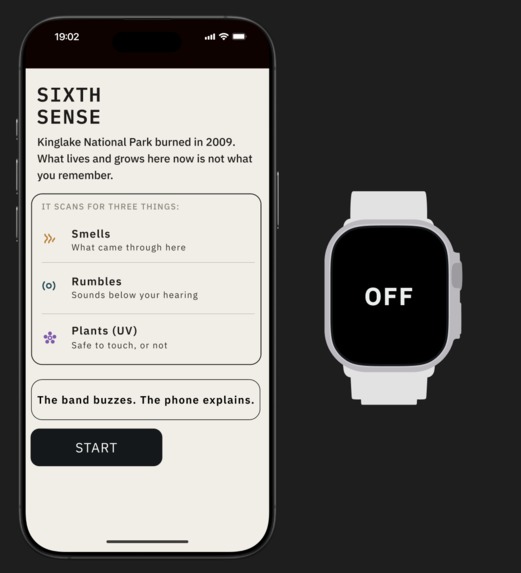
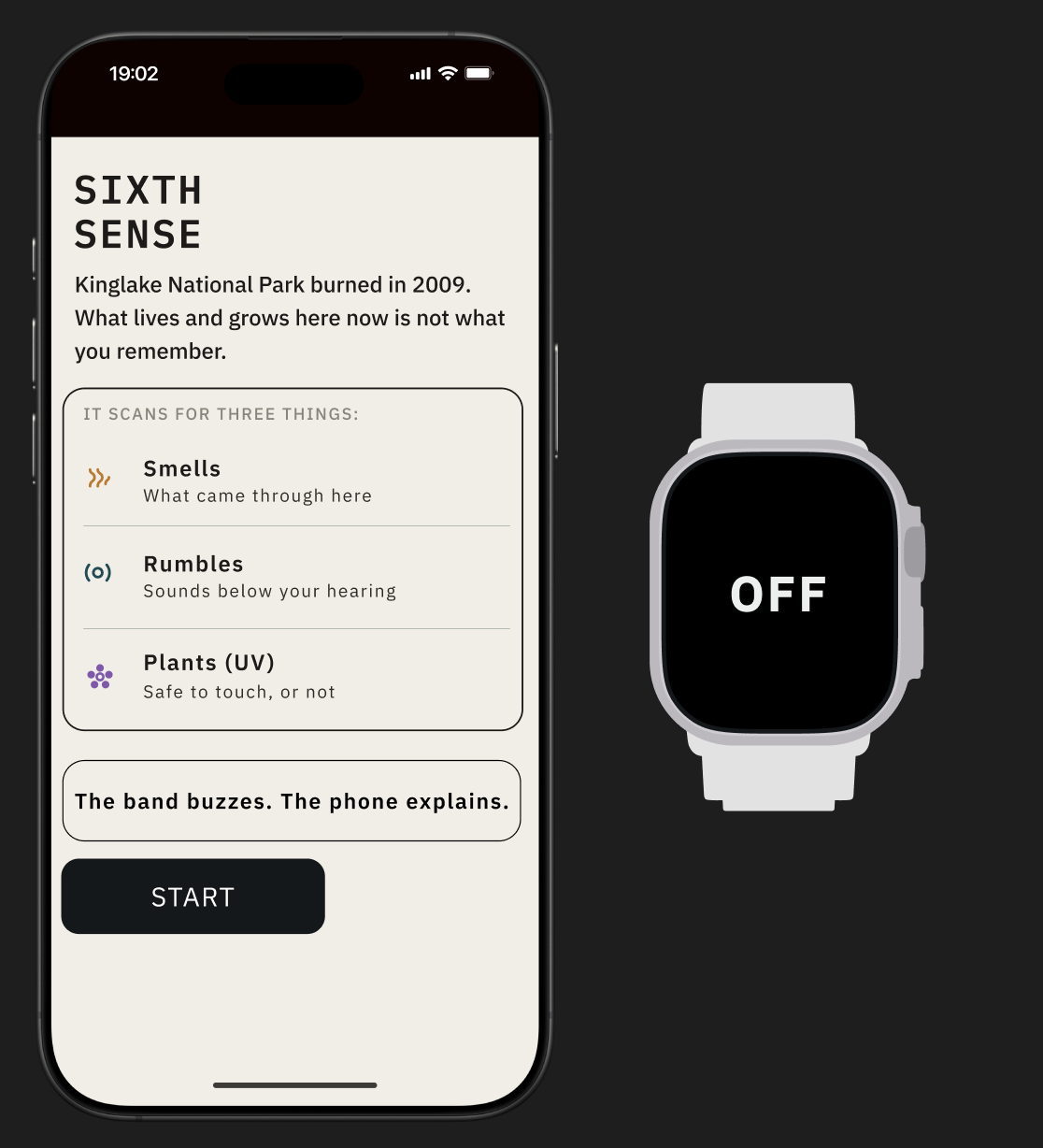
The onboarding page
-
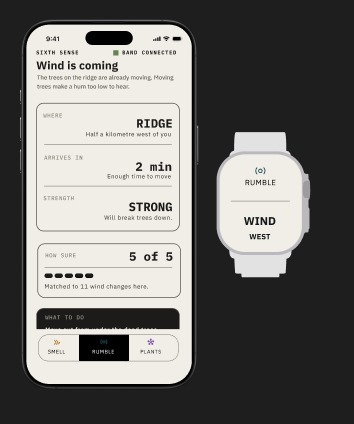
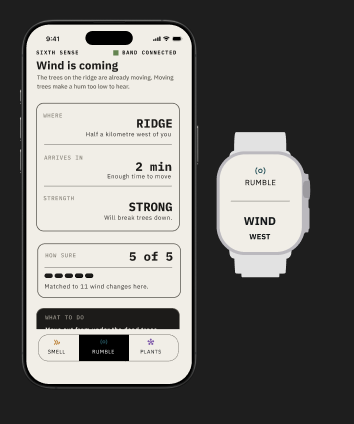
Alert: Wind is coming
-
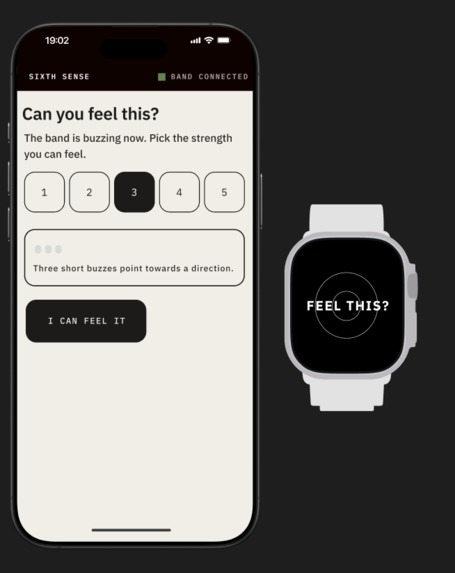
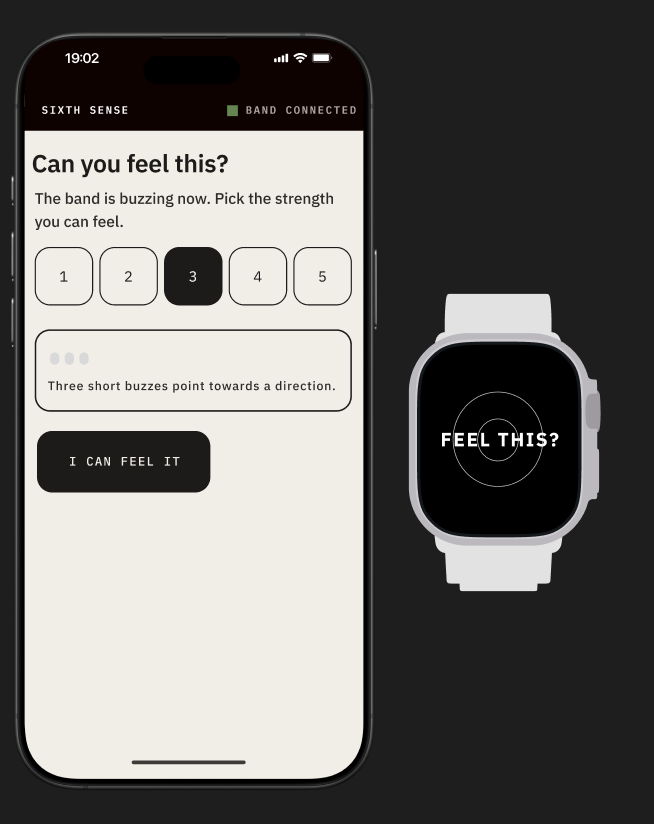
Calibrating
-
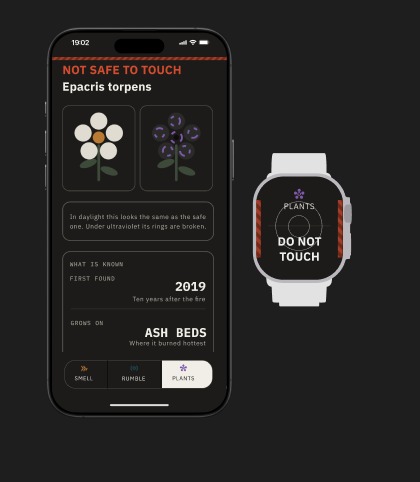
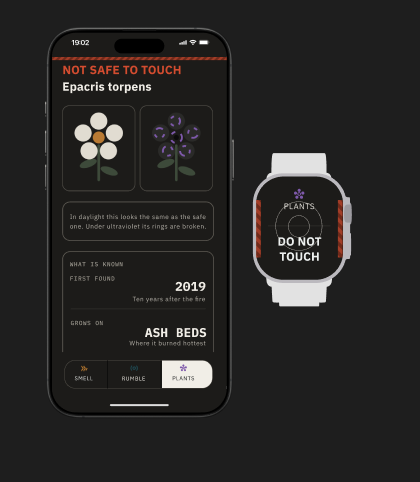
Critical Alert: Unsafe flower
-
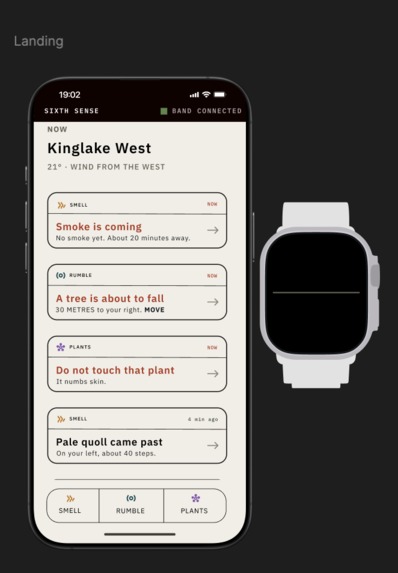
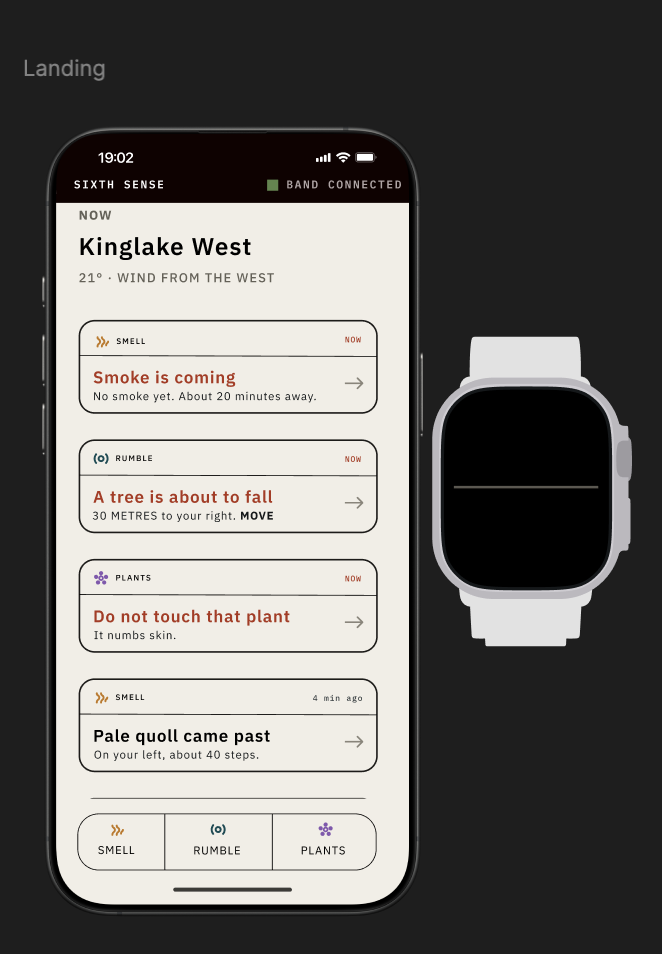
Landing Page
-
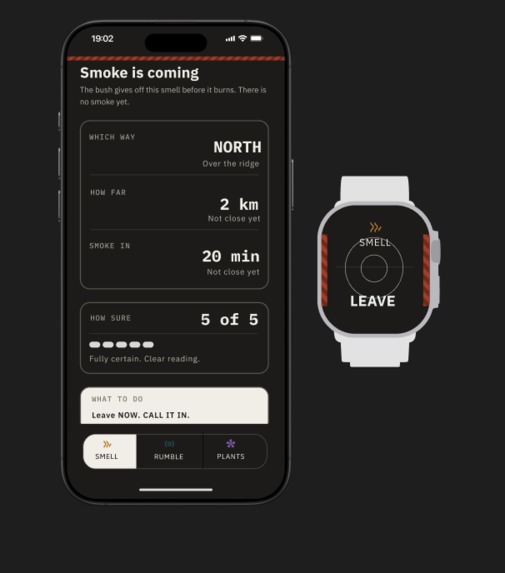
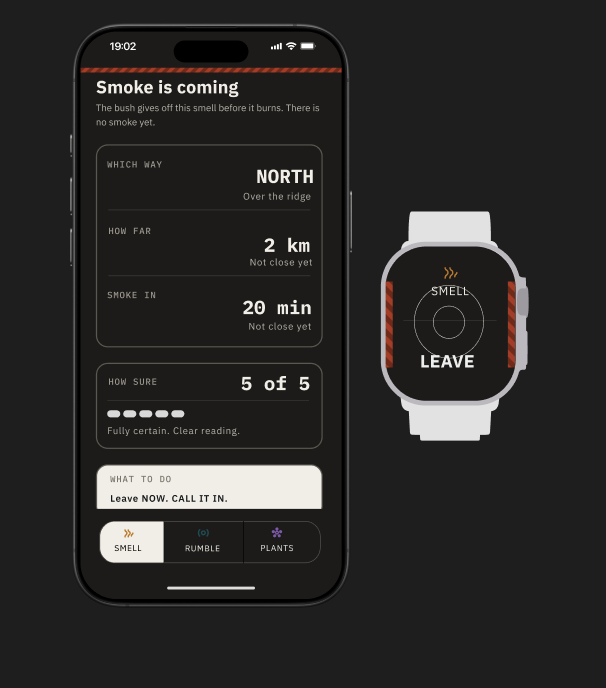
Critical Alert: Smoke is coming
-
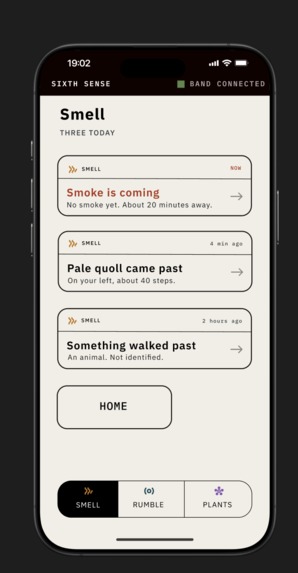
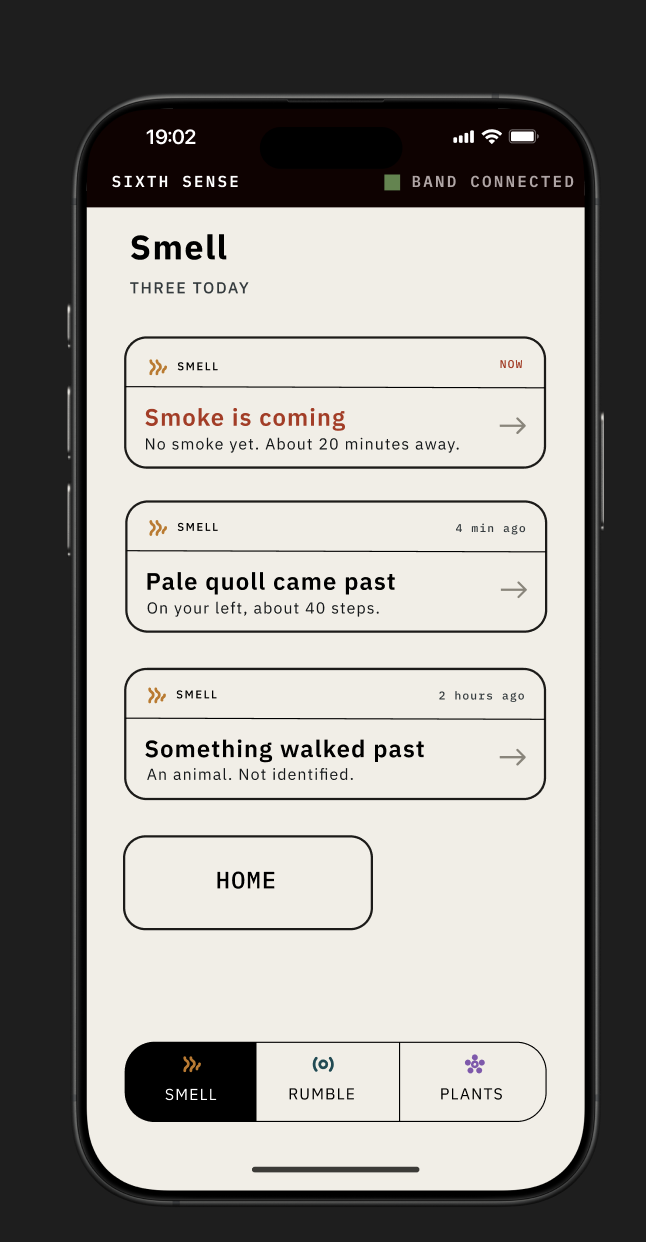
Smell alerts. Same for both rumble, plants has been developed.
-
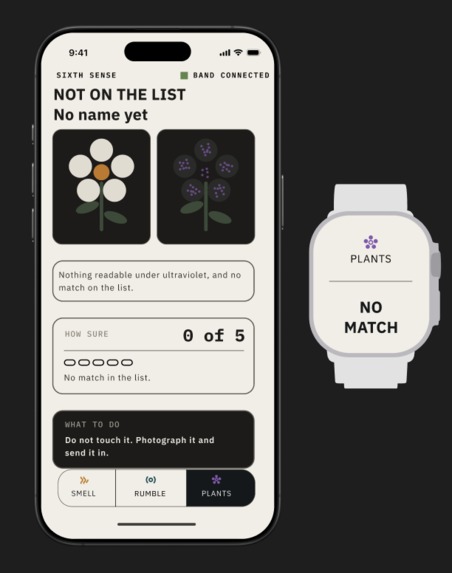
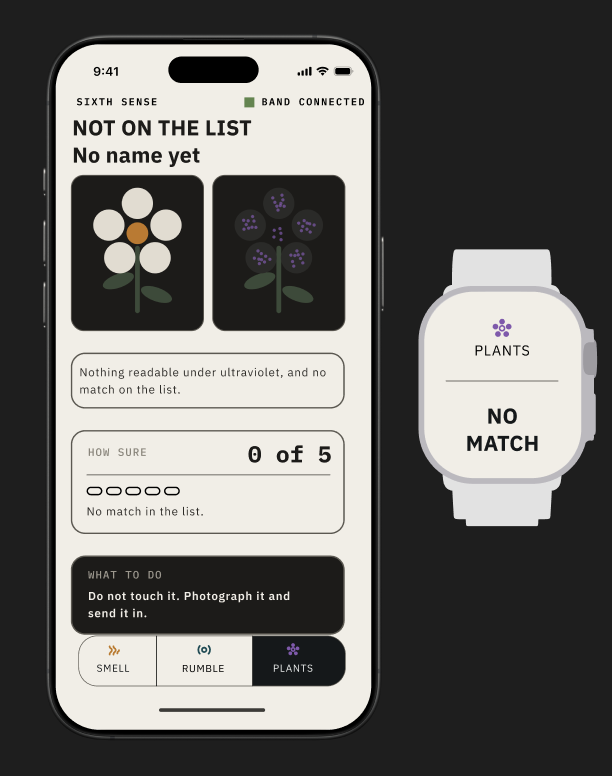
Alert: New flower detected
Inspiration
We started by researching Australia's bushfire history, particularly the fires that swept through Kinglake National Park, and asked a "what if" question: what if the heat and devastation were severe enough to permanently redirect the evolutionary path of local flora and fauna?
The detail that actually shaped the project came later, once we thought about who would be walking into a landscape like that. It isn't just newcomers who'd be at risk. Long-time locals, the people who know a forest by feel, would be walking into unfamiliar territory too, because their years of built-up knowledge would now be confidently wrong. A landscape that behaves like an old friend right up until it doesn't is more dangerous than one that's obviously alien, because nobody adjusts their guard for it.
That reframed the brief for us. This isn't a tool for outsiders. It's a tool for anyone whose gut sense of a place can no longer be trusted, because the place itself changed faster than a person can track.
We also found real, working examples of technology that translates one sense into another. Peter Meijer's vOICe (1992) has spent three decades turning grayscale images into sound for blind users: left to right becomes time, up and down becomes pitch. With training, people learn to "hear" a scene. Neosensory's Buzz wristband, built by neuroscientist David Eagleman, does something similar with sound, turning it into patterns of vibration you feel on your skin. Neil Harbisson wears an antenna implanted in his skull that turns colour, including UV and infrared light, into sound. Sixth Sense isn't science fiction bolted onto a science fiction forest. It's an extension of tools that already exist and already work for real people.
What it does
Sixth Sense is a two-part safety and navigation system: a wristband and a matching phone app, built for volunteers and stewards doing restoration work in altered post-fire landscapes. It picks up on three kinds of hazards that people can't sense on their own, and turns each one into something the body or eye can understand instantly.
UV plant signatures (light below 400nm, invisible to us) flag whether a plant is toxic or safe. This is grounded in real botany: many flowers carry UV patterns invisible to humans but visible to bees, marking where nectar (or, in our altered forest, danger) is. The black-eyed Susan flower is a well-known real-world example.
Infrasound (rumbles below 20Hz, too low for human ears) picks up shifting trees, unstable ground, or incoming weather before they're audible. This matters most around standing dead or damaged trees. Long-term research in Victoria's Mountain Ash forests, led by ecologist David Lindenmayer since the 2009 fires, has tracked a steep loss of large old trees and the tree hollows inside them, and shown those areas won't fully recover for a century or more. Dead and structurally weakened trees are exactly the kind of hazard that gives off a sub-audible warning before it fails, and that's the specific real-world risk this channel is designed around. Elephants already use a version of this, communicating over kilometres partly through rumbles felt through the ground rather than heard.
3.Chemical trail signatures are proximity scent data on local wildlife, including how recently something passed through. We modelled this on ant pheromone trails, where scent strength fades over time and the colony uses that fade as information. That's the direct reason the app shows a hazard's age, not just its direction.
The research behind it
We didn't want this to be a nice-looking idea with nothing underneath it, so three threads of real research shaped the design.
Translating one sense into another already works. vOICe, the Neosensory Buzz, and Harbisson's antenna all show that people can learn to read a translated sense with enough practice. That's the whole premise the wristband depends on.
Fire changes a forest more than people expect, and not always in the direction they'd guess. Bushfire scientist Philip Zylstra's flammability modelling (part of what's now called FRaME, the Fire Research and Modelling Environment) shows that regrowth forest can actually become more fire-prone than long-unburnt forest, not less, depending on the plant species and how dense the regrowth is. That directly backs up our core idea: a forest that's grown back after fire isn't a forest anyone can read on instinct, even people who knew it before. We haven't built this modelling into the prototype yet. It's the direction we want to take science in next, not something we're claiming to have already solved.
The most vulnerable users aren't hypothetical. We looked at who actually does this kind of volunteer land work in Australia, and the numbers pointed somewhere specific:
- Roughly one in six Australians is now 65+, and that share is rising
- More than a third of people over 65 worldwide live with disabling hearing loss
- Contrast sensitivity and night vision both decline with age
- Sense of touch also fades with age, and almost no wearable tech is designed around that
- Australia has the world's highest melanoma rate, so older volunteers are often already carrying decades of UV damage before they even start
That's what turned adjustable haptic strength from a nice-to-have into a hard safety requirement in our design, not something bolted on at the end.
How we built it
We designed and prototyped the whole two-device system in Figma, using its interactive linking tools to connect both screens into one continuous experience: hazard detected, wristband pulses on the matching side, phone unlocks, severity breakdown appears, log entry saves. That lets us test the handoff between the wristband and the phone in one click-through session, so anyone trying it out experiences it the same way a volunteer would in the field.
Challenges we ran into
Our biggest hurdle was world-building. Visualizing this entirely new biome together as a team took a lot of collaborative brainstorming. We had to decide exactly how the environment had mutated before we could design a tool to navigate it.
Once we had the environment established, translating abstract hazards into a clean, intuitive UI was incredibly challenging. We debated how the features should look and behave so that an alert felt urgent but not overwhelming. Striking the balance between displaying complex data, such as distance, direction, and hazard severity, and keeping the screen uncluttered required dozens of layout iterations in Figma.
Accomplishments that we're proud of
We are proud to have designed a responsive, multi-device safety experience entirely within Figma that solves complex UX problems, like conveying critical directional warnings without forcing users to look down at a screen. Most importantly, we built our foundation on real human and ecological research. By addressing age-related changes in touch sensitivity, designing high-contrast visuals for outdoor use, and consulting directly with local environmental groups, we created an interface that is deeply accessible and practical for active community stewards.
What we learned
The research into age-related touch sensitivity changed how we thought about the whole project. An adjustable wristband isn't a nice extra. When the people relying on it are often older community volunteers working alone in a hazardous landscape, it's the difference between a tool that works and one that quietly fails them. That shifted accessibility from something we considered afterward to the main constraint everything else had to work around.
What's next for SIXTH SENSE
Our first focus stays on the people with the most to lose: the volunteers and stewards doing restoration work in a forest that no longer matches anyone's memory of it.
To check our thinking against reality, we spoke early on with someone from Kinglake Friends of the Forest, who confirmed the instinct behind our whole approach: the tool needs to serve the volunteers and stewards first, because they're the ones walking deepest into the fire recovery zones and mapping hazards no one else can see yet. They also pushed our thinking further out. The idea that the data those volunteers log over time shouldn't stop with them. It should eventually grow into a safety tool for anyone visiting or settling in Kinglake in the future, not just the people doing the restoration work.
Beyond this prototype, the physical wristband would need real UV and infrasound sensors and a motor capable of the adjustable vibration range our research pointed to. That's the next phase: proving the hardware, then building toward the fire behaviour modelling (Zylstra's FRaME work) that would let the system flag not just where a hazard is, but how the forest's fire risk is shifting over time.
Built With
- figma

Log in or sign up for Devpost to join the conversation.