-
-
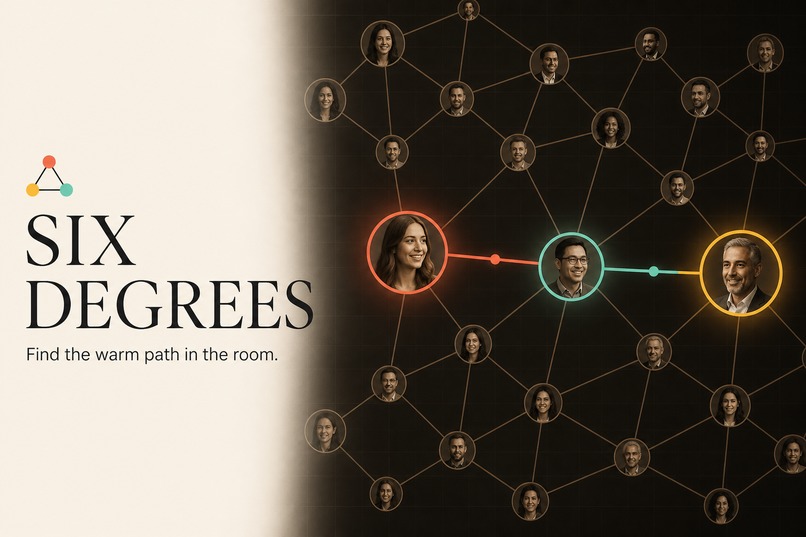
cover image
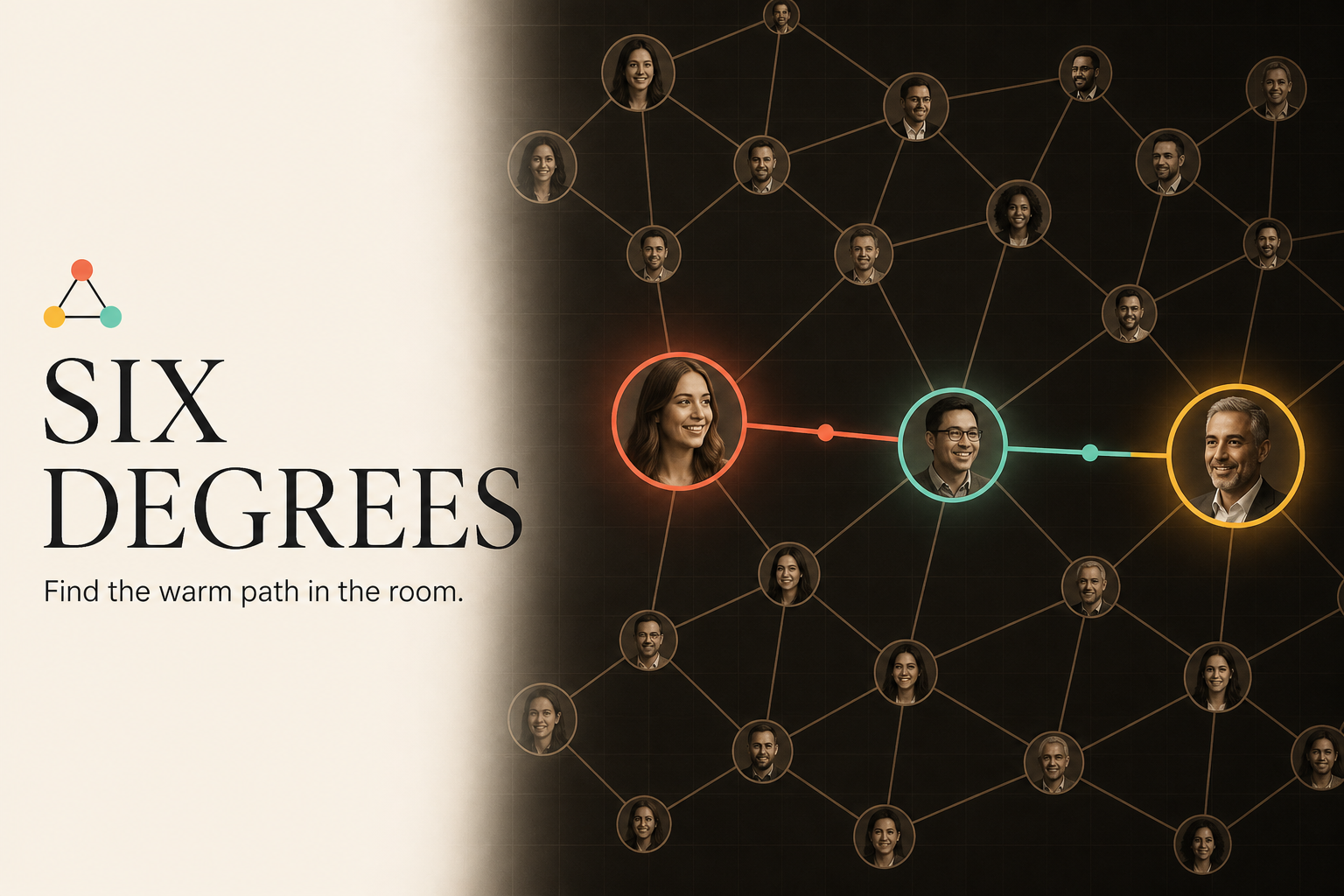
Inspiration
Big events put hundreds of valuable people in the same room, but they do not make it easier to know who can actually help you—or who could make a trusted introduction. Attendee directories are noisy, cold outreach is awkward, and registration lists often contain people who are not physically present.
We built Six Degrees to answer one practical question: Who do I know who knows the person I need to meet?
What It Does
Six Degrees turns an event into a private, live relationship network.
An attendee signs in, adds public professional or social links, and reviews an AI-enriched micro-profile before saving it. At an event, the attendee activates their node through a one-time geofence check or an on-site PIN fallback.
They then describe the outcome they want from the room—for example, meeting an early-stage investor who can help with a pre-seed round.
The AI connector ranks people in that event network against the attendee's stated goal, profile, shared context, and relationship graph. Instead of returning another directory, it reveals an actionable warm path such as:
You → Noah → Malik
The attendee can ask Noah for an introduction, write a contextual note, and track the request in an inbox.
The app also includes:
- Personal QR codes for in-person connections
- Event-specific graph filters
- Profile editing and photo storage
- Direct and second-degree relationship views
- A rich demonstration network for presentations
How We Built It
The frontend is a mobile-first React application built with Vite and a custom relationship-map interface.
The graph places the current user at the center, direct connections on inner rings, and warm or discoverable people on outer rings. Selecting a person traces only the relevant connection path. The graph also supports panning, zooming, event filters, list mode, mobile profile sheets, and responsive search.
Firebase Authentication provides Google sign-in. Firestore stores users, event profiles, relationships, introduction requests, and event data. Firebase Storage handles profile photos.
Location is checked only when an attendee activates their node. Six Degrees stores the resulting active state instead of continuous GPS history. A Haversine distance check validates the event geofence, with a venue PIN fallback for unreliable indoor GPS.
Apify collects user-authorized public information from the links an attendee supplies. Gemini converts that source material into a structured profile that the user must approve before it is saved.
Gemma 4 ranks event attendees against the user's event-specific goal and relationship context. The matching layer combines AI recommendations with deterministic profile and graph signals so the interface can still produce useful results during a live demonstration.
Challenges We Ran Into
The hardest interaction challenge was making a dense relationship graph understandable on a phone.
Showing every person made the network feel impressive but not useful. We iterated toward a graph that can reveal the whole room, isolate one warm path, slide profiles and ranked results over the map, and switch into a list without losing context.
Profile enrichment also required careful guardrails. Public source data can be noisy or irrelevant, so the enriched profile is always presented as a draft for explicit approval.
We also separated event intent from the permanent user profile so unregistering from an event can reset the goal and recommendations.
Finally, we had to balance AI ranking with demo reliability. We seed immediate deterministic recommendations, then replace them with the model's ranked results when available. That keeps the experience responsive without hiding which recommendations came from AI.
Accomplishments That We're Proud Of
- Built an end-to-end mobile flow from public-link enrichment to a saved profile
- Verified real event presence without storing location history
- Created a dense, responsive relationship graph with direct and second-degree paths
- Added event-specific AI matching based on what a person wants from the room
- Turned a recommendation into a contextual warm-introduction request and inbox item
- Built organizer setup, venue QR codes, personal QR codes, event filters, and demo/real data modes
- Completed a polished RenderATL demo in which a pre-seed goal reveals the path You → Noah → Malik
What We Learned
The most valuable networking signal is not simply shared interests.
A useful recommendation combines intent, event context, professional fit, physical presence, and the social cost of reaching the person.
We also learned that relationship graphs need progressive disclosure: users want to see the scale of the network, but they act when the interface narrows it to one clear path.
What's Next for Six Degrees
The next phase is a relationship connector agent that can monitor a user's event goals, suggest timely introductions, explain why each match matters, and learn from accepted or declined recommendations.
We would also add:
- Stronger consent controls
- Organizer analytics
- Richer graph-quality signals
- Notification delivery
- Durable production hosting
Our goal is to make it possible for any conference to launch its own trusted micro-network in minutes.

Log in or sign up for Devpost to join the conversation.