Complex decisions rarely fail because there is too little information. They fail because the information is fragmented.
A procurement team comparing vendors might have pricing tables, contracts, technical proposals, requirements, risk notes, implementation timelines, and assumptions spread across dozens of pages. An AI assistant can summarize those documents, but a summary is not a decision system. It is difficult to inspect exactly why a recommendation was made, correct individual assumptions, test alternatives, or safely turn a recommendation into an action.
I built SituationRoom around a different question: What should a website become when an AI agent is no longer just visiting it, but collaborating with a human inside it? Instead of making an agent navigate a traditional application through buttons and forms, SituationRoom exposes the semantics of the decision itself through WebMCP.
For that purpose, SituationRoom is an agent-native workspace for complex, high-stakes decisions.
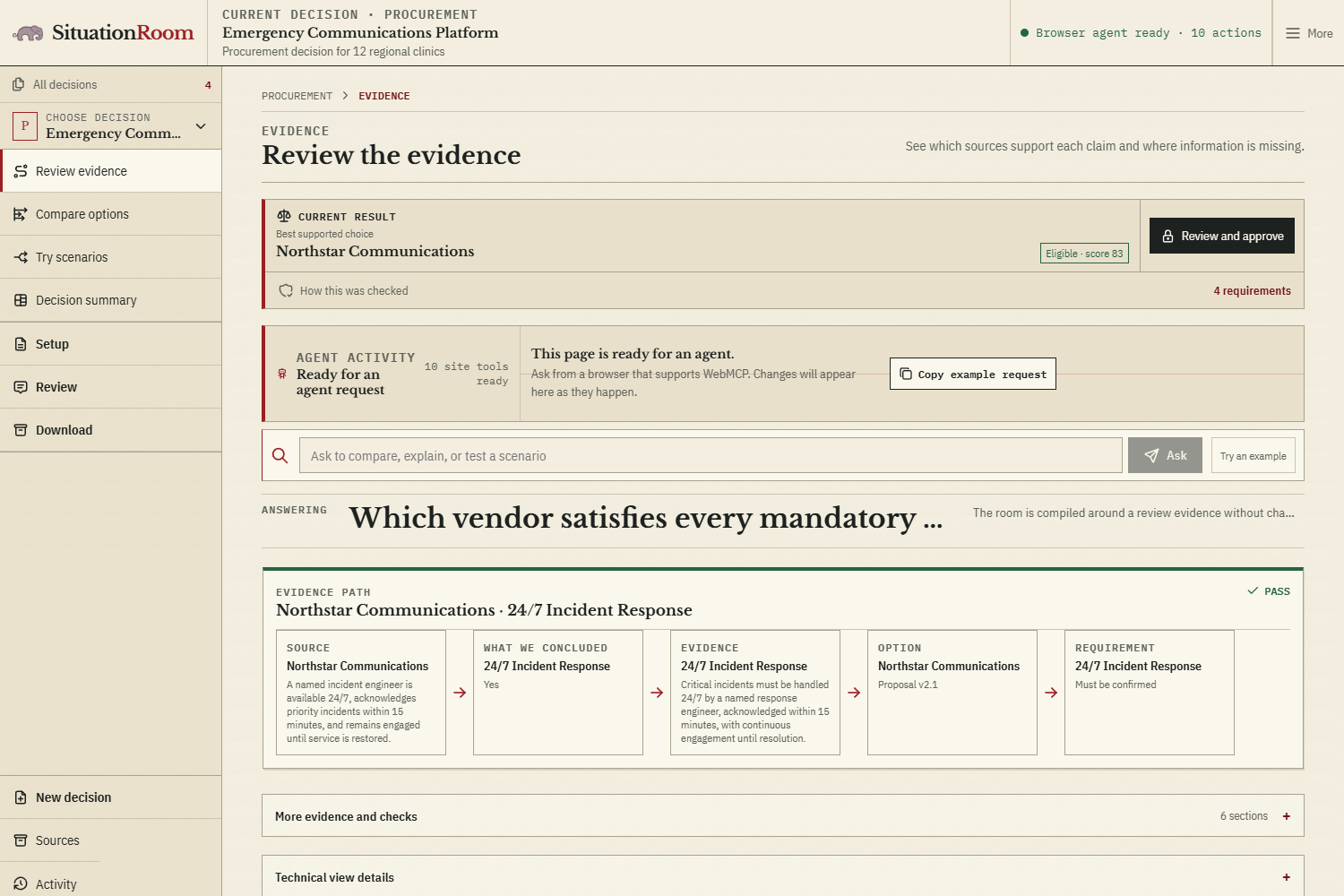
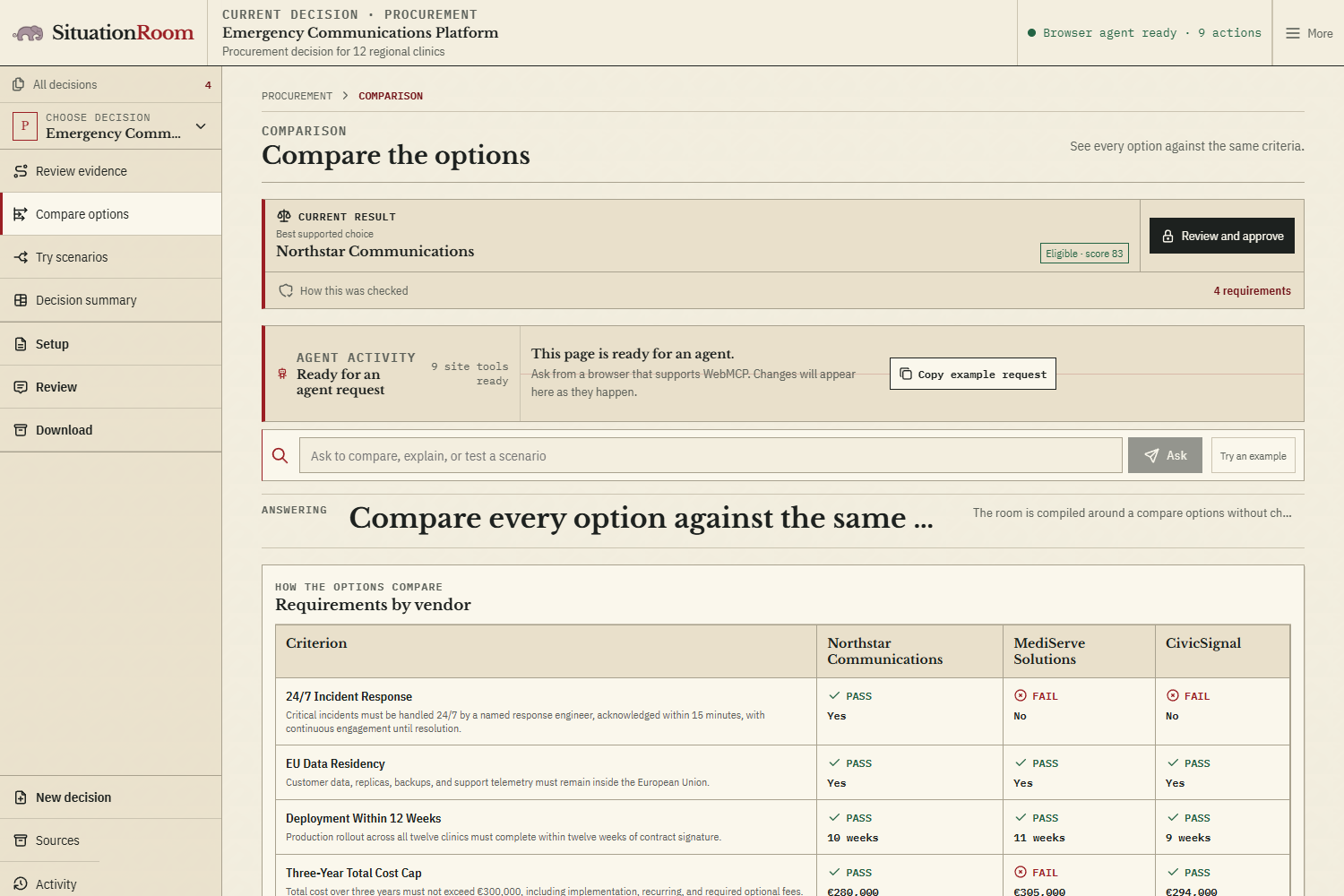
My demonstration focuses on vendor procurement as follows: Given several competing vendor proposals and a set of business constraints, an AI agent can use SituationRoom's WebMCP tools to construct a structured decision model.
It can: define evaluation criteria and their relative importance create mandatory requirements normalize costs across proposals associate claims with their supporting evidence identify missing information and contradictions record risk assumptions construct total-cost-of-ownership models run alternative decision scenarios compare the resulting rankings prepare a proposed decision for human review
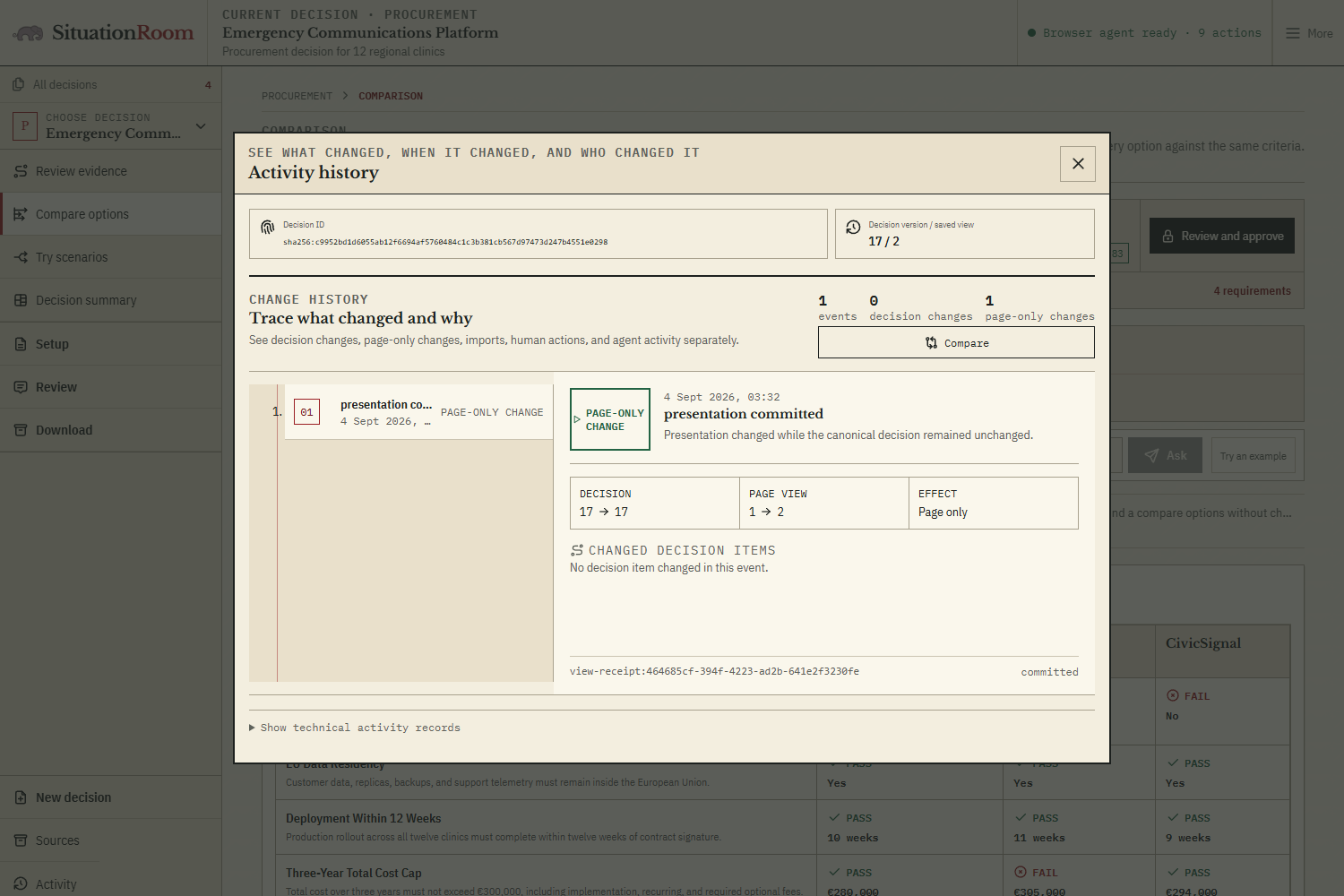
SituationRoom visualizes that state as an evidence matrix, cost model, risk analysis, scenario comparison, and audit timeline. The human can then directly change an assumption, lock a requirement, correct an evidence mapping, or alter a decision criterion.
The agent sees the changed state through WebMCP and can immediately reason again from the corrected model.
Before a consequential decision is finalized, SituationRoom separates preview from commit so that the human can inspect exactly what will happen before approving it.
Built With
- next.js
- react
- recharts
- tailwind
- typescript
- webmcp


Log in or sign up for Devpost to join the conversation.