-
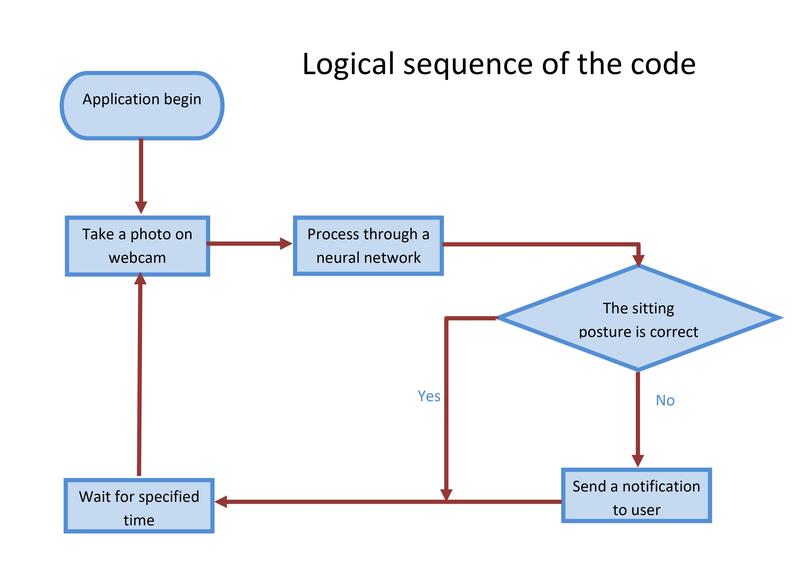
Logical sequence of the code
-
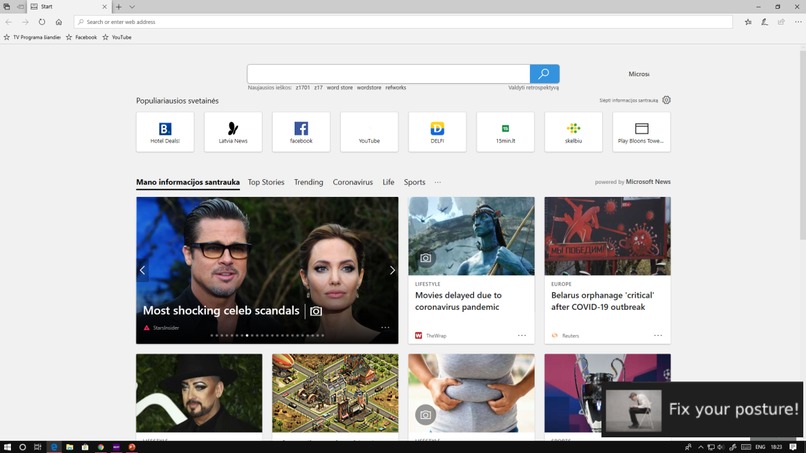
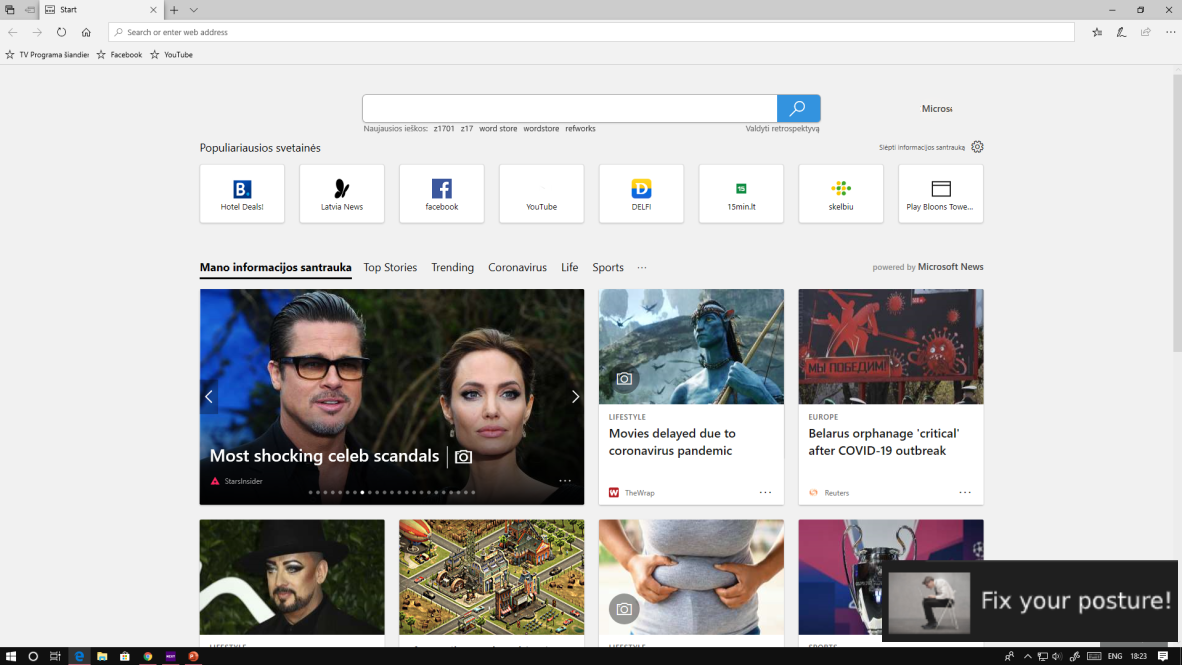
Preview of notification design

Inspiration
One of the webinar’s guests was talking about ergonomics in remote working and education and that was our inspiration to create a prototype which would help students and workers to sit in the right posture, when they’re working. Nowadays, cervical spondylosis and other symptoms of lumbar spondylosis have been younger and younger. It is very important for children to develop a good sitting posture from a young age for future growth. Of course, we should not forget adults who suffer from this problem already. These days, during difficult times of pandemic, we find ourselves spending even more time at the desk, in front of the computer and that does no good for our posture and correct sitting position. Thats why our idea would be perfect for all the people to deal with this problem.
What it does
Sitting Geometry helps user to maintain a good and well-positioned posture. It does that by scanning user’s posture every minute, recognizing patterns and comparing with other posters. If user is having a good posture, occasionally a message informing his/her good performance and congratulating would appear. However, if the posture is not correct, a prompt would pop up – advising you to change your current position. It would not be gone until the position would be correct, this way it would encourage to sit/stand well to get rid of annoying notification as soon as possible . This application could work on most of the devices, that are connected to the camera.
How it works
The Application running in the background acts as host for the Performing Task. The Performing Task is invoked periodically, activating the web camera and taking a photo of the User, which acts as an input data to the Neural Network, inferred locally in the User's Computer. It is necessary to find the Neural Network model that would satisfy the given task. Supposing that the computation runs smoothly in the background in all systems, the program architecture is run fully on CPU using compiled Tensorflow-C++ module. The Neural Network focuses on two tasks: image depth recognition and human pose estimation. Both tasks are well-established[1,2,3]. To detect the depth of an image, DispNet architecture[1] is used. We further investigate into the opportunities of obtaining the training data versus using third-party pre-trained models. We aim to exploit the existing technology of real-time 3D pose estimation[3].
- https://heartbeat.fritz.ai/research-guide-for-depth-estimation-with-deep-learning-1a02a439b834
- https://doi.org/10.1109/ICCV.2009.5459300
- https://arxiv.org/abs/1901.03798
Challenges we ran into
Due to the difficulties of remote working, communication was not as effective as it could have been in normal circumstances. We faced many obstacles, most of them relating to time planning, distribution of responsibilities, and conveying our thoughts and ideas to each other. In addition, one of the most difficult tasks for our team has been to create a practical, worthwhile product that would withstand the challenges we face right now and help those in need during this difficult time. Our chosen field - education - has many problems that have been deeply rooted in the system itself even before the outbreak of COVID-19, therefore the possibilities for solutions is substantial. However, we realized, that our lack of knowledge prevented us to come up with a good solution in the field of education, thus we decided to focus our attention on remote working. We grasped the potential in this and began working on solutions as soon as possible, taking into account that working and learning from home may become a more frequent practice in the future. Lastly, the problem that largely interfered with our work, was the lack of drive and motivation. We are a team of students, and even during the weekend, we need to work and study to catch up with the enormous amount of work and study. By juggling many responsibilities, it is quite hard for everyone to stay motivated all the time, hence our work some times has become impractical.
What we have accomplished
During three days of intensive hacking we managed to develop the idea of Sitting Geometry from scratch. A lot of research has been done to find out that such an idea could work in real life. In the limitless ocean of the internet we found the preset code for our project and analysed what must be changed in order to meet the raised goals. Furthermore, we have created the design for the notifications, when the system detects incorrect and unhealthy sitting position of the user.
What we learned
In the middle of the fear, worry, and uncertainty surrounding the COVID-19 pandemic, there are also some good things that we can learn. One of them is remote work and education. During this time many people learned that the work or the education process were possible to do from home. Thus, after the virus is gone, there should still be some system in place that will promote work-life balance. In light of this, our team acknowledged how important is the good body posture and how strongly it affects the human health.
What's next for Sitting Geometry
Since our project is focused on everyone, who works or studies in sitting position, the advantages of the app we bring will stay important even after COVID-19 will be stopped. In modern days there is a great number of jobs where it is necessary to sit in front of the computer screen no matter at home or not, therefore correct sitting position is and will be a must if one wants to stay healthy. Furthermore, the further development of vehicles, e-shops, e-sports and various smart gadgets means that as the time moves on, people will spend more and more time sitting. That is why our app can not be forgotten and will be developed together with the world, with more advanced recognition of incorrect sitting positions and all other improvements to make people’s work healthier. To continue the project, just time, programming and medical knowledge is needed.


Log in or sign up for Devpost to join the conversation.