-
-
Introducing SiteSense—an AI-powered construction intelligence platform designed for smarter sites and safer builds.
-
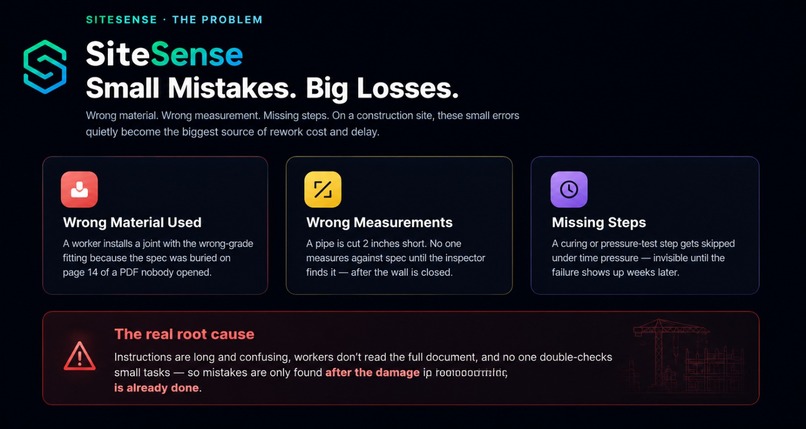
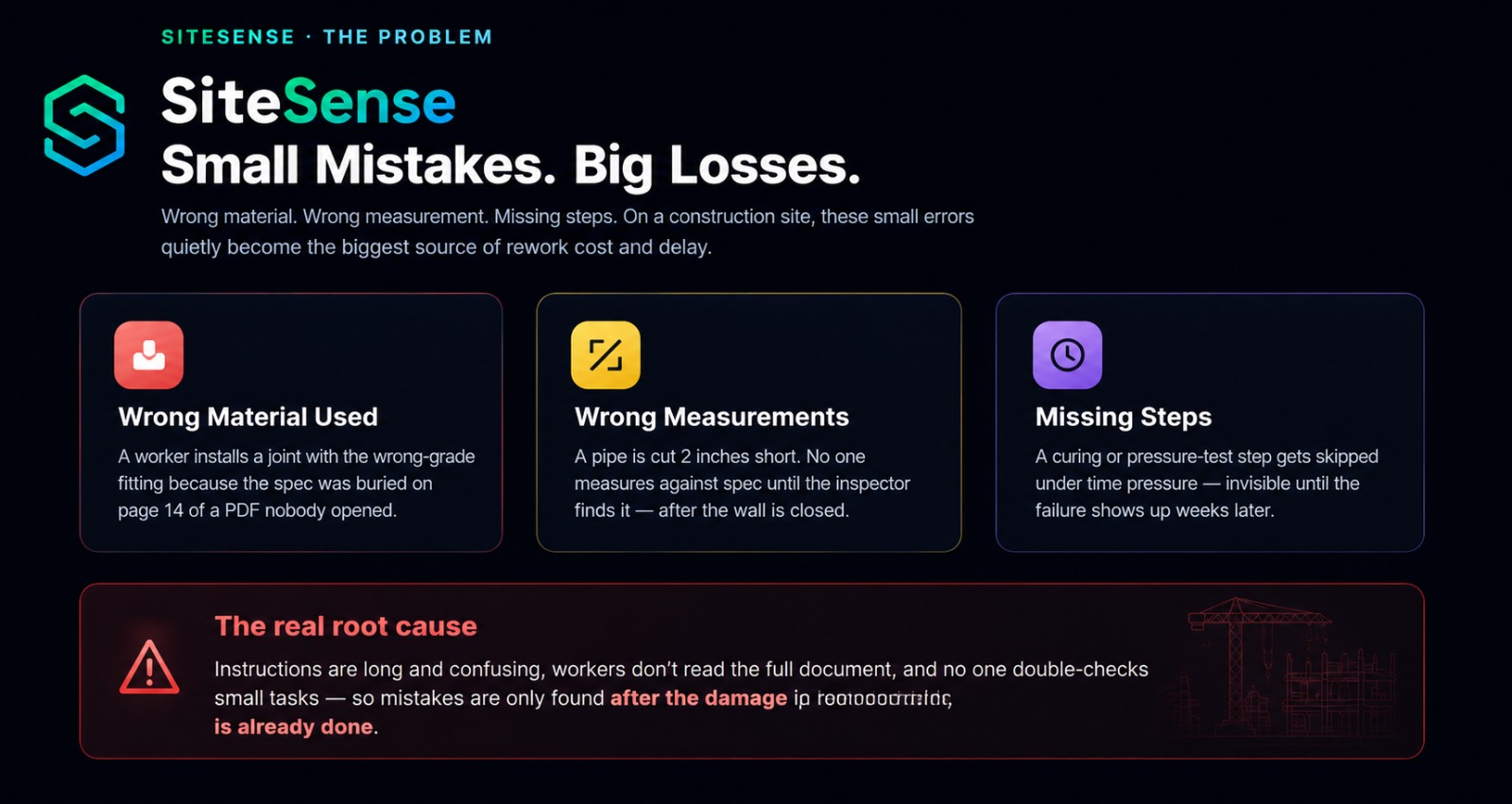
The Problem: Costly human errors caused by long, unread manuals.
-
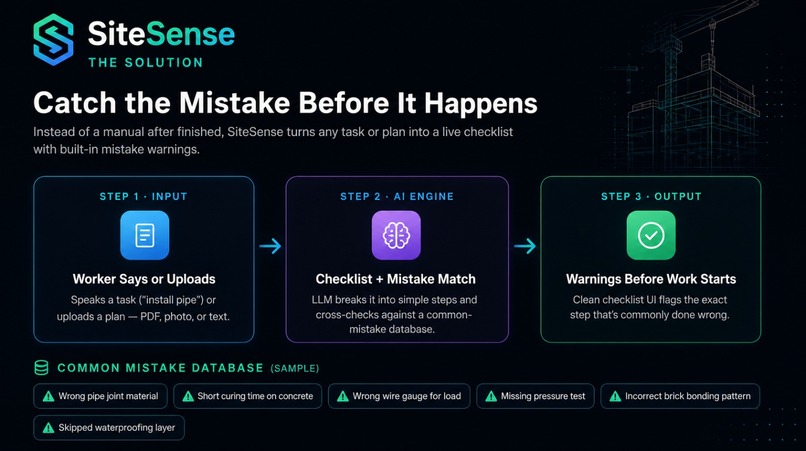
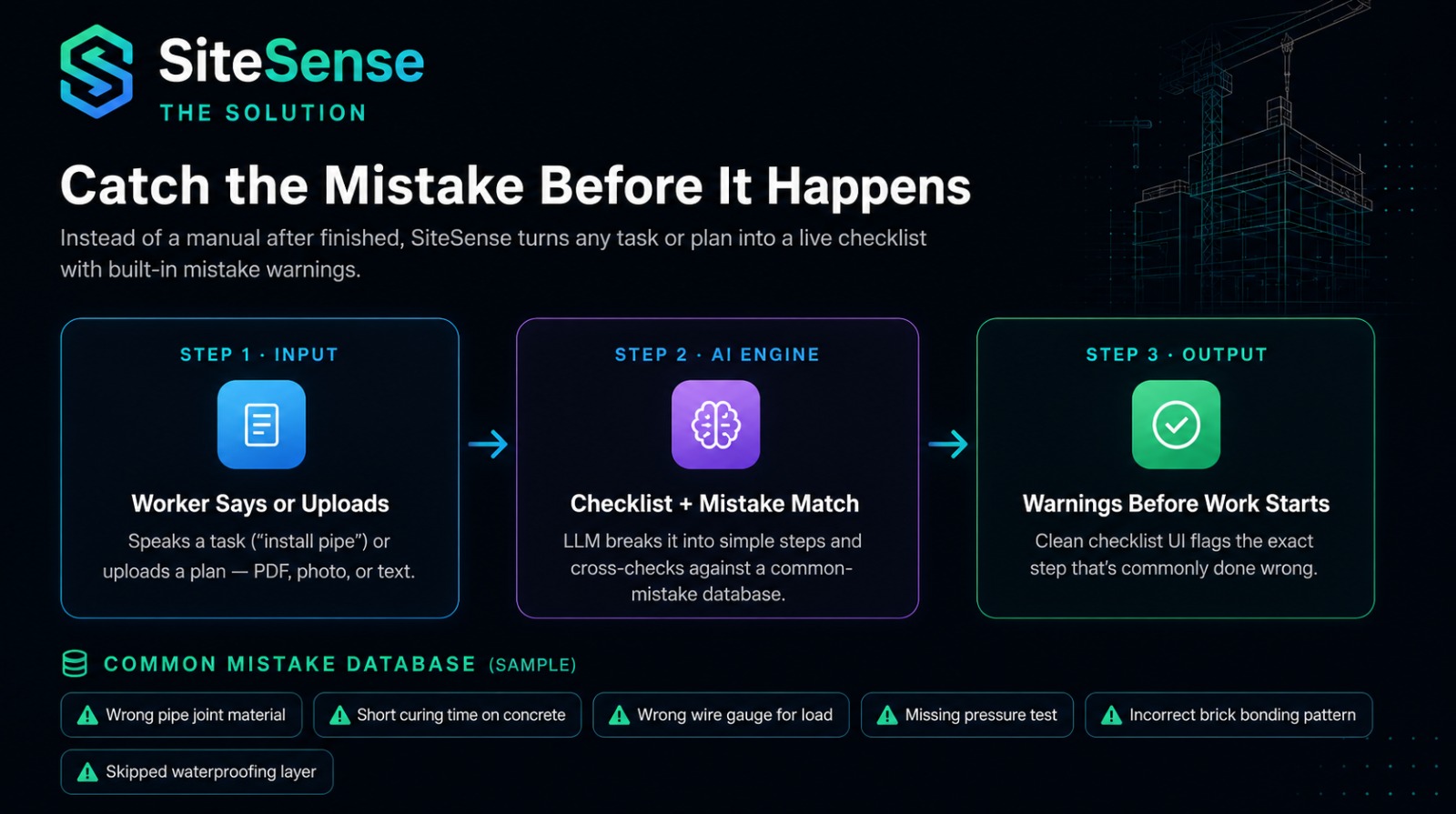
The Solution: A three-step pipeline turning voice inputs into real-time safety checklists.
Inspiration
Construction sites lose massive amounts of time and money due to tiny, avoidable human errors—like using the wrong grade pipe joint or cutting a beam slightly short. Typically, instructions to prevent these are buried in a 50-page PDF manual that nobody reads under intense time pressure. We wanted to build a solution that catches these micro-mistakes beforethey become permanent, expensive disasters sealed behind a wall. This inspired "SiteSense"—mistakeproofing the physical world with a simple LLM checklist, a camera, and a mistake database.
What it does
SiteSense is an AI-powered construction intelligence tool that simplifies site compliance into zero-reading, actionable workflows.
- Voice-to-Checklist: A worker simply speaks a task (e.g., "install pipe"), and the AI instantly generates a hyper-focused, 3-step compliance checklist localized with color codes and clear icons.
- Proactive Warnings: The system cross-references a "Common Mistake Database" to flag exact high-risk steps before the worker touches any material.
- Physical Verification: Using a smartphone camera, the system scans the physical work in real-time. If a material mismatch occurs (e.g., using a PVC joint instead of a GI joint), it flags an immediate visual alert.
- Manager's Dashboard: It translates invisible daily field mistakes into hard numbers, tracking repeat errors and calculating the exact rework costs avoided.
How we built it
We designed a streamlined three-step pipeline:
- Input: Workers speak or upload plans (PDFs, photos, text).
- AI Engine: An LLM breaks down the task into simple steps and cross-checks them against a historical mistake database.
- Output & Verification: The system delivers clean UI warnings and utilizes real-time camera computer vision to cross-verify physical components against specifications.
Challenges we faced
One major hurdle was platform constraints when prototyping our visual demonstrations. When creating quick, animated workflows to visually prove how our app's UI and physical camera tracking worked, we had to carefully navigate automated asset creation and system prompt boundaries to accurately display on-site technical errors without getting blocked. Overcoming this helped us refine the core minimalist, high-impact aesthetic of our startup pitch deck.
Accomplishments that we're proud of
We successfully conceptualized a highly technical problem and packaged it into a simple, elegant product story. We engineered a complete end-to-end user flow—spanning from a field worker's voice command to a supervisor's cost-saving analytics dashboard—proving that a smart combination of an LLM and a checklist can save sites up to ₹1.8L in avoided rework costs daily.
What we learned
We learned that the most effective AI tools for industrial environments don't need complex, overwhelming tech stacks; they need to require "zero reading" and clear visual feedback loop mechanics. We also learned how to pitch a highly practical, real-world physical problem to a software-focused panel effectively.
What's next for SiteSense
- Expanded Database & Localization: Scale our "Common Mistake Database" across more construction domains (like electrical and HVAC) and add multi-language voice support for deeper ground-level compliance.
- Predictive Risk Analytics: Upgrade the supervisor dashboard to predict project delays and resource leaks before they happen by analyzing regional historical error trends.
- BIM Integration: Connect SiteSense directly with Building Information Modeling (BIM) software to automatically sync live site visual checks with the master engineering model.
Built With
- artificial-intelligence
- canva
- computer-vision
- construction-tech
- llm
- natural-language-processing
- openai
- prompt-engineering
- python
- speech-to-text


