

Inspiration
Construction wages in India still run on a single point of failure: paper muster rolls filled out by the same supervisors who benefit when the numbers are wrong. We kept coming back to one data point - a Noida project that overpaid roughly ₹6 Cr in fabricated wages because "ghost workers" were padded onto a 150-name muster that only had 120 real people on site. On the flip side, migrant labourers with no bank relationship, pay stub, or verifiable record lose about a month's wages every year to disputes they have no way to prove. Two groups getting defrauded by the exact same broken system - that's what made us want to fix it.
What it does
SiteID is an offline-first worker identity and wage-protection app for Indian construction sites. It replaces the paper muster with cryptographically verified attendance:
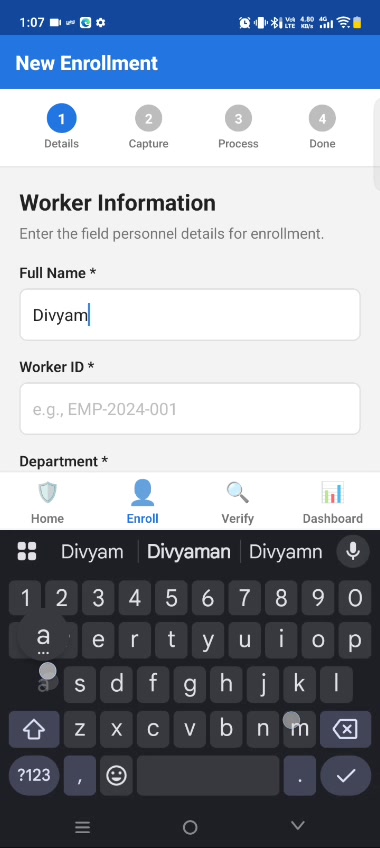
- Workers enrol their face once, fully on-device, storing zero photos.
- Every check-in runs a local liveness + identity check and writes an immutable record straight to the worker's own device - no internet required.
- When a device eventually reconnects, an AI-powered anomaly engine cross-references the digital records against the paper musters supervisors submit, surfacing ghost-worker and absentee-fraud patterns before payroll runs.
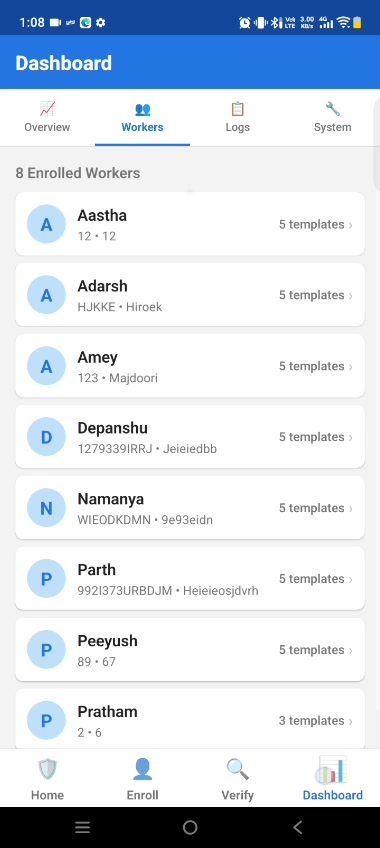
- Workers walk away with something they've never had before: a portable, GPS- and liveness-stamped work record they own - usable as evidence in wage disputes and, eventually, as the basis for MSME/Jan Dhan-linked credit access.
How we built it
We designed a three-layer architecture built specifically for zero-connectivity environments:
- Offline face enrolment & verification - an ONNX-based detector extracts facial landmarks, and MobileFaceNet generates five 128-d embeddings per worker, matched via cosine similarity, all on-device.
- Worker-facing wage ledger - an immutable local record generated on check-in and queued for sync whenever a network becomes available.
- Cloud anomaly detection - once synced, an LLM-powered engine compares verified digital attendance against submitted paper musters and flags discrepancies by severity.
The core insight was treating time itself as the cryptographic filter against spoofing: instead of matching a single static frame (which a printed photo or screen replay can pass), we sample six frames across a 3.2-second capture window and fuse three live signals - blink dip-and-recovery curves, continuous head-pose micro-fluctuations, and smile-probability changes. A photo produces zero temporal change and fails by design; a live worker doesn't. Attendance only logs if identity and liveness both pass. We built the app in React Native and used Google Antigravity to scaffold and iterate on the on-device pipeline quickly under hackathon time pressure.
Challenges we ran into
- Getting real liveness detection to run entirely offline on modest Android hardware without cloud face-matching APIs, which we ruled out early since rural sites simply don't have reliable connectivity.
- Tuning the 3.2-second multi-signal liveness window to reliably reject printed-photo and screen-replay attacks without making genuine workers fail repeatedly in bright sun or under hard hats.
- Designing the anomaly engine to be useful without becoming another opaque black box - supervisors and contractors needed severity-tiered, explainable flags rather than a raw discrepancy dump.
- Balancing worker privacy (zero photo storage) against the need for tamper-evident, auditable records.
Accomplishments that we're proud of
- A full edge verification pipeline - capture, detect, embed, match, persist - running end-to-end locally in about 3.2 seconds.
- Building the first work record a migrant labourer can actually own and carry across contractors and sites, rather than one locked inside an employer's system.
- A comparison we're proud to put in front of anyone: unlike paper musters or cloud biometric tools like Truein/SiteSetu, SiteID is the only option that works fully offline, defeats photo spoofing, and gives workers ownership of their own records.
What we learned
We learned that the "trust" problem in informal labour markets isn't really a technology gap - it's an incentive gap. Digital tools that just digitize the muster roll don't fix fraud, because the person filing the record still has the same financial interest in lying. The fix had to decouple verification from the person with the incentive to cheat, which is what pushed us toward on-device, worker-initiated cryptographic proof rather than another supervisor-controlled dashboard. We also learned a lot about the real hardware and connectivity constraints of rural construction sites - assumptions that look reasonable in a city office (always-on WiFi, stable power, honest inputs) simply don't hold in the field.
What's next for SiteID
- Pilot deployments with a small set of contractors across multi-site projects to validate the anomaly engine against real payroll cycles.
- Expanding the worker-owned record into a credit-readiness signal, integrating with Jan Dhan-linked financial products.
- Hardening the liveness model against more sophisticated spoofing (deepfake video, 3D masks) and expanding device compatibility for lower-end Android hardware common on-site.
- Building out a supervisor/contractor dashboard for the anomaly alerts, with drill-down into flagged sites by severity tier.
Built With
- android
- computer-vision
- cosine-similarity
- edge-computing
- face-recognition
- javascript
- liveness-detection
- llm
- mobile
- mobilefacenet
- node.js
- offline-first
- onnx
- python
- react-native
- rest-api
- sqlite
- supabase
- tensorflow-lite
- typescript


