Inspiration
SiteGuardian AI was inspired by the tragic loss of a family friend who passed away following an accident on a civil engineering worksite. This made us realise how important it is to prevent workplace accidents before they happen. Our project uses AI and computer vision to monitor construction sites, identify restricted zones, detect unauthorised entry, and alert site managers in real time. Our mission is to use technology to protect workers, prevent avoidable accidents, and make construction sites safer for everyone.
What it does
SiteGuardian AI uses AI-powered computer vision to monitor civil engineering and construction sites in real time. It detects people entering restricted or dangerous zones, identifies potential safety risks, and sends instant alerts to site managers. By providing early warnings, it helps prevent accidents, protect workers, and improve overall site safety.
How we built it
How we built SiteGuardian AI We built SiteGuardian AI by combining computer vision, hardware, a cloud-based backend, and Google's Gemini AI into one integrated construction-site safety system.
The project was divided between four developers:
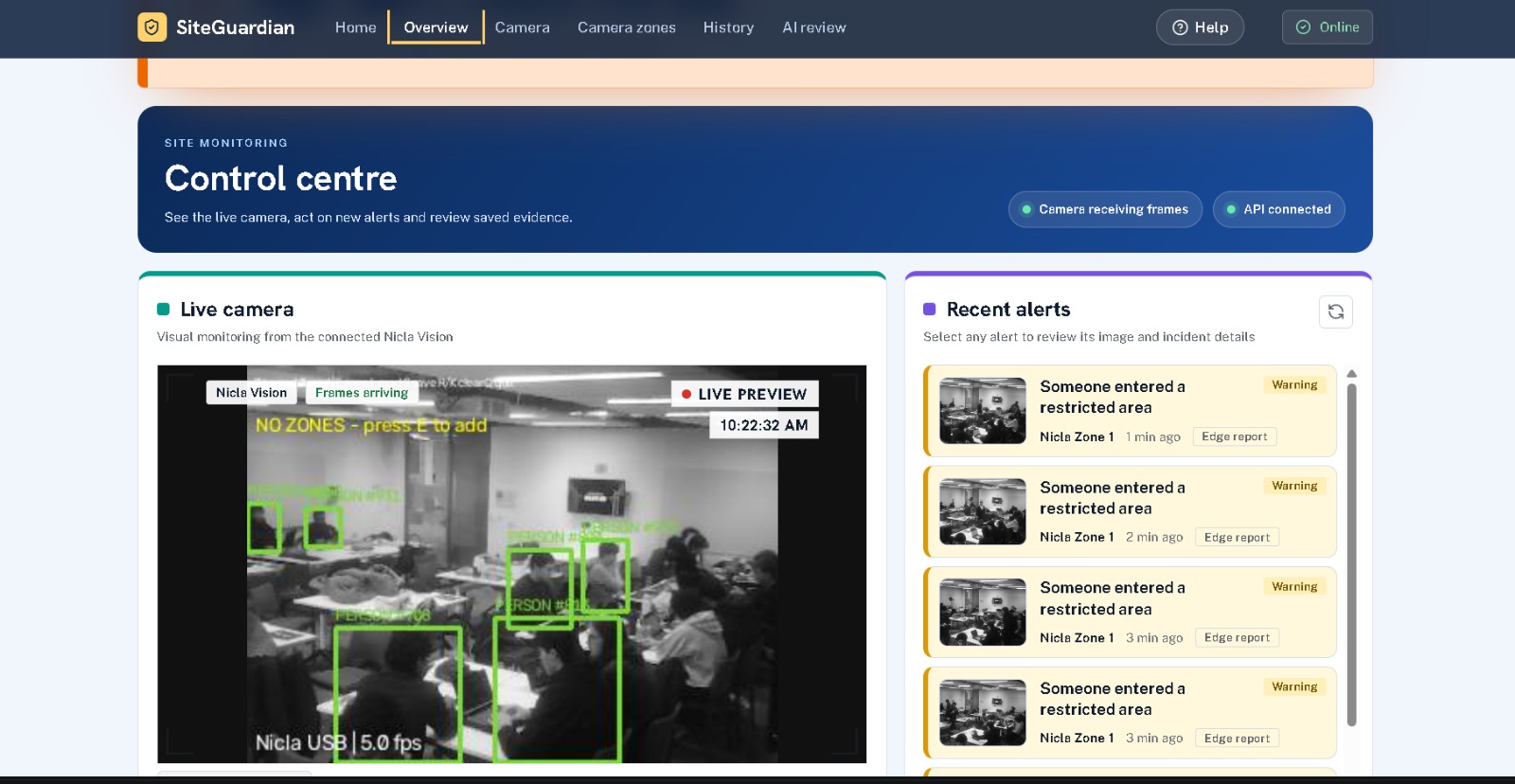
Computer Vision & Hardware: Used a live camera feed and YOLO person detection to identify people, monitor restricted zones, track entry and exit, and trigger instant warnings. An Arduino LED and buzzer can provide physical alerts.
Backend & Database: Built the backend using Python and FastAPI, connected MongoDB Atlas to store incident records, and created API endpoints to retrieve incidents, statistics and safety events.
Gemini AI & Intelligence: Integrated Google's Gemini API to analyse recorded incidents, identify recurring hazards and high-risk areas, and generate evidence-based safety recommendations.
Frontend Dashboard: Used React to build a dashboard displaying live incidents, hazard severity, zone statistics and AI-generated safety insights.
How everything works together:
Camera detects a person → AI checks restricted zones → Local alarm is triggered → Incident is sent to FastAPI → MongoDB stores the event → Gemini analyses incident history → React dashboard displays alerts and recommendations.
Our main focus was to create a system that doesn't just detect danger, but helps construction managers understand risks and prevent future accidents.
Challenges we ran into
Our biggest challenge was working with physical hardware for the first time as computer science students. We had to learn how to integrate an Arduino, camera and alarm system with our software while working under the pressure of a 24-hour hackathon.
Other challenges included:
- Real-time detection: Making YOLO detect people accurately without constantly triggering false alarms.
- Restricted zones: Implementing zone detection to recognise when someone enters a dangerous area.
- Hardware integration: Connecting the camera, Arduino, LED and buzzer and getting them to communicate correctly.
- Backend integration: Ensuring incidents were sent, stored in MongoDB and retrieved without duplication.
- AI integration: Connecting Gemini to real incident data and generating useful safety recommendations.
- Time constraints: Dividing tasks between four developers and integrating everyone's work within 24 hours. ## Accomplishments that we're proud of Built an AI-powered construction site safety monitoring system from scratch during a 24-hour hackathon. Successfully combined computer vision, YOLO, hardware, FastAPI, MongoDB and Gemini AI. Developed a system capable of detecting people entering restricted zones and triggering safety alerts. Integrated software with physical hardware for the first time as computer science students. Worked as a team of four developers, dividing responsibilities and bringing different components together into one solution. Created a project inspired by a real-life tragedy, with the aim of preventing similar accidents in the future. ## What we learned How to work with physical hardware, including Arduino boards, cameras, LEDs and buzzers. How to implement real-time computer vision and object detection using YOLO. How to build APIs using Python and FastAPI and connect them to MongoDB. How to integrate Google's Gemini API to analyse data and generate AI-powered insights. How to collaborate through Git, GitHub branches and pull requests. How to troubleshoot unfamiliar technologies, manage time and build a working prototype under intense pressure. ## What's next for SiteGuardian AI Our vision is to take SiteGuardian AI beyond a hackathon prototype and develop it into a real-world construction safety solution.
