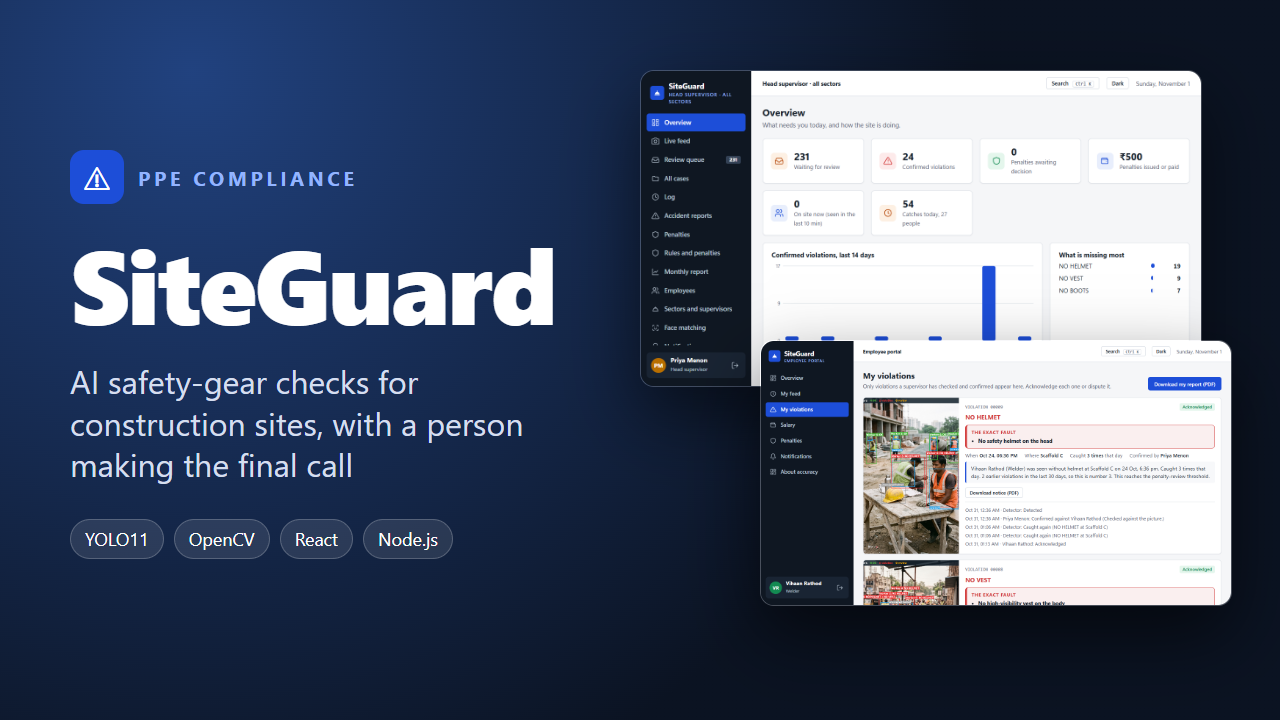
SiteGuard – AI-Powered Workplace Safety Monitoring System
Inspiration
Construction sites, manufacturing facilities, and warehouses face significant workplace safety risks, with many preventable accidents resulting from workers failing to wear essential Personal Protective Equipment (PPE), such as safety helmets and reflective jackets.
Traditional safety inspections rely heavily on manual supervision, making continuous monitoring difficult, time-consuming, and inconsistent. Supervisors cannot monitor every worker across multiple locations simultaneously.
We envisioned SiteGuard, an AI-powered safety monitoring solution that uses computer vision to identify PPE violations, notify employees, and assist supervisors in maintaining safer working environments through intelligent automation and human oversight.
What it does
SiteGuard continuously analyzes camera footage to detect individuals and identify whether they are wearing the required safety equipment.
When a potential PPE violation is detected:
- Instant Employee Alerts: The concerned employee receives an immediate notification through the employee portal.
- Supervisor Verification: The supervisor receives the incident for review through a dedicated dashboard and must confirm it before it becomes an official violation.
- Fair Violation Management: The system limits confirmed violations to one per employee per day to prevent repeated detections from creating unfair penalties.
- Unknown Employee Handling: Individuals who cannot be identified are temporarily assigned labels such as "Employee 1" or "Employee 2", allowing supervisors to enter their names through the demo desk.
- Centralized Monitoring: Employee alerts, violation records, and review activities are managed through a unified backend.
All employee names and salary information used in the demonstration are dummy data.
How we built it
SiteGuard follows a modular architecture consisting of an AI detection service, a backend API, and three dedicated web applications.
- AI-Powered Detection Engine
- Developed using Python and a YOLO-based object detection model.
- Detects people and required PPE in camera footage.
- Integrates a face/people registry to associate detections with employee records.
- Operates as an independent detection service that communicates with the backend.
- Backend and Data Management
- Built using Node.js.
- Handles employee records, detection alerts, violation records, and supervisor verification.
- Connects the detection service with the three frontend applications.
- Three Dedicated Web Interfaces
- Supervisor Panel: Allows supervisors to review potential violations, verify incidents, and manage employee safety records.
- Employee Portal: Displays instant safety alerts and violation-related updates.
- Demo Desk: Provides controls for running demonstrations and manually assigning names to unidentified individuals.
- Integrated Execution
- A centralized npm run start:all command starts the complete application.
- A smoke-testing script helps verify that the individual services and applications work together.
Challenges we ran into
Fairness and Accountability: Automatically issuing penalties based on camera detections can lead to incorrect decisions. We addressed this by introducing mandatory supervisor verification and a one-violation-per-day limit.
Employee Identification: Not every individual can be reliably identified. Instead of making assumptions, we introduced temporary employee labels and manual name assignment.
Privacy and Data Protection: Face information and employee records require careful handling. We kept sensitive records out of the public repository and used dummy employee information for demonstrations.
System Integration and Deployment: Integrating an AI detection service, Node.js backend, and three independent frontend applications presented challenges involving communication, configuration, and hosting limitations.
Accomplishments that we're proud of
- Developed a working end-to-end workflow connecting AI-based PPE detection, employee notifications, supervisor verification, and violation recording.
- Implemented a human-in-the-loop verification mechanism to ensure important decisions remain under human control.
- Built three dedicated, professionally designed interfaces for different user roles.
- Created a modular architecture that brings AI detection and web-based management together in one integrated solution.
- Successfully integrated the individual components into a unified application with centralized startup and testing.
- Prioritized fairness, privacy, and accountability throughout the system design.
What we learned
- Training, configuring, and integrating YOLO-based object detection models into practical applications.
- Connecting Python-based AI services with a Node.js backend.
- Designing multi-interface applications with role-specific functionality.
- Building reliable communication between independent services.
- Understanding that developing an effective AI safety solution requires more than accurate detection; it also requires thoughtful workflows, human verification, privacy protection, and responsible decision-making.
- The importance of validating system performance before making claims about accuracy or reliability.
What's next for SiteGuard
We aim to evolve SiteGuard into a scalable and reliable workplace safety monitoring platform.
- Improved Detection Accuracy: Evaluate and optimize the detection model using diverse, real-world workplace footage.
- Expanded PPE Detection: Introduce detection for safety gloves, protective goggles, safety shoes, and additional equipment.
- Zone-Based Safety Monitoring: Configure different PPE requirements based on specific workplace areas and operational activities.
- Multi-Camera Integration: Support simultaneous monitoring across multiple cameras and workplace locations.
- Secure Access Management: Introduce authentication, role-based permissions, employee consent, and stronger privacy controls.
- Advanced Notifications: Integrate SMS and mobile application notifications for faster communication.
- Safety Analytics: Develop reports, violation trends, and workplace safety insights to help managers identify recurring safety concerns.
- Real-World Deployment: Test and refine the platform in actual construction sites, factories, and industrial environments.
Our long-term vision is to make workplace safety more proactive, intelligent, and accountable by combining AI-powered monitoring with responsible human decision-making.

Log in or sign up for Devpost to join the conversation.